- 350 pages
- English
- ePUB (mobile friendly)
- Available on iOS & Android
eBook - ePub
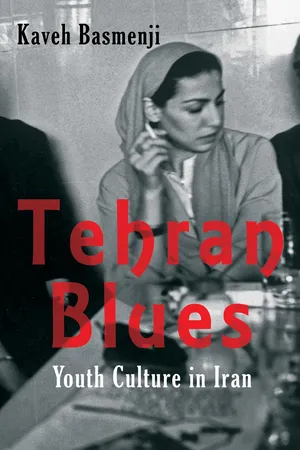
About this book
More than two decades after their parents rose up against the Shah's excesses, increasing numbers of young Iranians are risking jail at the hands of religious paramilitaries roughly their own age, for things their counterparts in the West take for granted: wearing makeup, slow dancing at parties, holding hands with members of the opposite sex. Every day anxious parents queue at courthouses to bail out sons and daughters who have been detained for 'moral crimes'.
Kaveh Basmenji, who spent his own youth amidst the turbulence of the Islamic Revolution, argues that Iran's youth are in near-open revolt for want of greater freedoms, in furious defiance of the mullahs and their brand of sombre religiosity.
Through candid interviews with young people, and in a careful assessment of Iran today (including a special chapter on the implications of the recent election to the presidency of hardliner Mahmoud Ahmadinejad), Basmenji gets to the heart of the matter: What do Iran's youth want, and how far are their elders prepared to go to accommodate them?
Information
ONE
Dormant Volcano
Every generation imagines itself to be more intelligent than the one that went before it, and wiser than the one that comes after it.
George Orwell
Youth is a strange force that even ridicules folly and deceit.
Bahram Sadeqi, Malakut
Why should I care about posterity? What’s posterity ever done for me?
Groucho Marx
They slice through traffic on their motorbikes, racing each other at breakneck speed while holding their mobile phones.
They listen to heavy metal, read Günter Grass and admire Tom Cruise. They don’t go to the mosque the way their parents did, and they have given up on politics.1
In upscale north Tehran last summer, young men and their girlfriends walked along the streets holding hands – a display of affection that could have cost them a beating and time in jail a few years ago. A very few women dared walk the five yards from their front door to their cars without a headscarf. And while headscarves, or the more conservative head-to-toe black chador, are still required by law outside the home, increasingly women let some of their hair escape, wear colourful scarves and don short manteau coats, allowing their bare feet in dainty slippers to be seen – often with bright nail polish.2
Increasingly, even young Iranians who care little about politics are rebelling against a society whose architect, the Ayatollah Ruhollah Ayatollah Khomeini, once proclaimed, ‘There is no fun in Islam’.
Instead, many Iranian youths are intent these days on having fun, and their increasing defiance may represent the most potent challenge to one of the world’s strictest Islamic societies. Typically, they do not feel they have to turn from Islam to live their lives as they wish; many profess to pray and fast.
But two decades after their parents revolted against the excesses of the then-ruling shah’s pageants and palaces, more young people in Iran are risking jail, fines and official beatings for things American youths take for granted: wearing make-up, slow dancing at a party and holding hands on a date.3
In the ski resorts, life is more free than the socially restricted cities, drawing criticism from conservative parts of the establishment. Shemshak, the main resort town a ninety-minute drive from Tehran, is known for illegal parties, where young men and women mix without supervision, drink alcohol and use drugs.4
‘What are you going to do this year?’ I asked Dariush, an eighteen-year-old boy from a middle-class family in Tehran.
‘Just like last year, only more powerful,’ he said. ‘I have bought four kilos of explosives. You remember the one we did in the stadium? Twice as powerful! We’re going to have real fun!’
He was referring to the handmade ‘grenades’ that explode with a loud bang, giving out a huge mushroom of orange-grey smoke. During a football match between Iran and North Korea in 2003 in Tehran’s Azadi (Freedom) Stadium, spectators threw one such grenade into the pitch, which injured a Korean player, put an end to the match, and resulted in a penalty against Iran’s national squad.
‘Aren’t you afraid it may explode in your hands?’ I asked him.
‘Give me a break,’ Dariush said, pulling back his heavily gelled forelocks from his face. ‘This is the one night we can enjoy ourselves.’
‘But aren’t you afraid of the Basijis?’
‘Oh, to hell with them! They can’t do a damn thing! In the worst case, they’ll keep us for the night and release us the day after. I’ve been arrested a couple of times. All I got was a few slaps on the back of the neck, a lot of bad words and spending one night with no food with fifty other guys in a tiny room.’ Having said this, Dariush vanished into the shadows of the concrete buildings of Ekbatan Apartments, a neighbourhood in West Tehran that is usually the scene of some of the wildest Chaharshanbeh Suri, or ‘fire festival’, celebrations in town. He was carrying a worrying payload of homemade grenades in a rucksack. He was heading towards a huge bonfire around which a hundred or so young girls and boys were cheering and dancing.
Every year, on a Tuesday evening that often falls in the third week of March, the streets of Tehran, a sprawling metropolis of ten million people, as well as other major cities across Iran, seem to turn into battlefields in a civil war. For weeks before, the youngsters prepare themselves for the Chaharshanbeh Suri. Traditionally, on the evening of the last Tuesday of the Iranian year (which ends 20 March), Iranians hold these celebrations, at the centre of which lies the veneration of fire, a central tenet of Zoroastrianism, which was the predominant religion in Iran before the invasion of the Arab Muslims and the conversion of Iranians to Islam some fourteen centuries ago.
The twelve Persian months, named after Zoroastrian angels, match the seasons and the signs of the zodiac. The first six months all have thirty-one days, the next five have thirty, and the last has twenty-nine days plus an extra one in leap years. These lengths actually correspond to the seasons, as spring and summer are about a week longer than autumn and winter, and so the equinoxes and solstices are accurately reflected in the Persian calendar. Omar Khayyam is said to have been one of the scholars who worked on perfecting this system in the eleventh century.
In the years following the Islamic Revolution, the youngsters have in practice transformed Chaharshanbeh Suri into a festival of explosions and a show of defiance. Most of them hardly pay any attention to their parents’ advice, or to televised footage that shows people of their own age lying with severe burns in hospital, let alone to warnings issued by the authorities, unhappy to see celebrations of a pre-Islamic tradition in an Islamic country.
The warnings are issued from different viewpoints. Conservative clerics such as Ayatollah Safi Golpaigani, an elderly high-ranking clergyman in the holy city of Qom, fundamentally reject the occasion. ‘Superstitious customs such as Chaharshanbeh Suri do not befit the dignity of the Muslim people of Iran’, said the Ayatollah in a statement made in March 2004. ‘Those who take part in such ceremonies are mostly ignorant people – although some of them seek to undermine the Islamic identity of the society’, he added, exemplifying the traditionalist attitude towards customs and rituals that are pre-Islamic relics.
But those who have a closer contact with the everyday realities of life, and are therefore well aware that it would be futile to keep youngsters at home on Chaharshanbeh Suri, have taken a different position in recent years. Avoiding banning the festivities, as was done during the early years after the 1979 Revolution, security officials have chosen to announce that they recognise the occasion and the festivities, but issue strong warnings against any incidents of ‘unrest’.
On the other hand, during the days preceding the festival, anti-regime opposition radio and television stations abroad incessantly call on the Iranian youth to turn Chaharshanbeh Suri into a struggle against the state.
Despite sporadic clashes with security forces, however, the youngsters do not seem to be interested in outright politics. Once the sun is down, loud sounds of explosions fill the city. Huge bonfires are lit, into which all sorts of hand-made firecrackers and other explosive devices are thrown, amid the cheerful screams of young girls and boys. When, and if, the Basijis or the police intervene to disperse the crowd, youngsters flee in several directions, booing them, some taking ambush and throwing ‘grenades’ at them. Some get caught and are subsequently taken into minibuses bound for Basij or police stations. But as Dariush said, most of them are freed the following day.
Dariush’s parents told me that they were worried about what he and his friends did, but added that there was nothing parents could do to stop their kids.
‘These horrifying sounds scare the daylights out of us, let alone the sick and elderly people,’ Dariush’s father, an architect in his late forties said. ‘But what can we do? There are no other real opportunities for the youth to be happy together. Almost all kinds of fun are banned for them in this country.’
Dr Davar Sheikhavandi, a sociologist in Tehran, agrees, saying that the reason behind the transformation of Chaharshanbeh Suri celebrations into the current form is that the government has failed to provide legal facilities to celebrate the event:
‘When you don’t provide facilities for a tradition that has been celebrated throughout centuries, when you try to hamper it, when – like in the early years after the (1979) Revolution – you try to cancel it altogether, you’re provoking the youth to resist. Obviously when a large number of excited angry youngsters is involved, there will be grounds for violence and vandalism.’5
Meanwhile, many youngsters brazenly sing and dance to illicit Iranian or Western music on the streets, some of them openly drinking contraband liquor or smoking marijuana.
In a corner of the big square where the outdoor party was going on, I saw a member of the Basij paramilitary force lurking in the shadows, clad in khaki uniform and brandishing an automatic rifle. He looked about twenty years old, although it was difficult to tell his exact age because of his unshaven face that was covered by a layer of soft curly hair. Shaving the face is considered a sin for strict Shi‘ites according to the teachings of traditionalist ayatollahs – which explains why all the officials of the Islamic Republic have beards or stubble.
‘This is blasphemy,’ Ahmad, the young Basiji, told me, ‘singing, dancing and worshipping fire, particularly in Moharram.’ He was referring to the most sacred month for Shi‘ites in the lunar calendar. The mourning period of Moharram commemorates the massacre of Karbala, when on 10 October 680, Hossein, the prophet’s grandson and Third Imam of the Shi‘ites, was butchered with his seventy-two followers on the orders of the Caliph Yazid. The ten days leading up to Ashura, the actual anniversary, are marked by anguished, almost hysterical, wailing, and on the last two days, men parade through the streets flagellating themselves with chains and metal scourges as women look on.
The lunar months are shorter than those in the solar calendar, and therefore they rotate and coincide with a different solar period each year.
‘What are you going to do about it?’ I asked Ahmad.
‘Nothing serious. They’re sissies, mother’s babies. We just scare them, and they run away.’
That seems to be the most that the police, the armed forces and the authorities can do about the Last Tuesday extravaganza.
By tradition, the festivities of Chaharshanbeh Suri include several different rituals, the historical or mythological origins of which are not quite clear today. The key ritual is lighting up bonfires (traditionally with thorn bushes) outdoors, over which family members, neighbours and passers-by jump, chanting, ‘Let your rosy glow be mine/Let my wan pallor be yours,’ thus asking the fire for bliss in the coming new year.
I remember as a teenager how excited I was on the occasion. Before the evening fell, most people rushed to buy ‘Ajil-e Moshkel Gosha’, a special blend of nuts, which, legend has it, can solve one’s problems. Many of my relatives came to our house, and my grandmother would prepare ‘Reshteh Polo’, a special dish of noodles and rice, for the dinner. After jumping over the fire and asking it for bliss, young boys would go for ‘Qashoq Zani’ or ‘spoon-rattling’. This involved going to the neighbours’ clad in the chador (a single-piece women’s dress that covers them from top to toe), knocking on the doors and rattling spoons in a bowl. The owner would then open the door and place nuts, sweets, or other edible things in the bowl.
Another old custom was Falgoosh: to listen furtively to the conversations of people on the street at random and take it as a good or bad omen.
All such rituals have virtually disappeared.
On a bench in one corner of the square, which was filled with dense smoke, the smell of gunpowder and screams of joy, I came across three girls relaxing momentarily before rejoining the crowd. They were wearing loose headscarves that let lush locks of blonde-dyed hair freely protrude, tight blue jeans, and short, bright-coloured tight-fitting robes. This latter item was to cause a lot of controversy and even some street clashes later in summer, when the ‘moral police’, aided by hard-line vigilantes from the political organisation known as Hezbollah (‘party of God’) and Basij forces, raided boutiques and beat up girls wearing such outfits, considered un-Islamic by conservatives and hardliners.
‘Do you know anything about Chaharshanbeh Suri customs such as Qashoq Zani or Falgoosh?’ I asked them.
‘Are you a stranger?’ they giggled, looking bewildered. ‘Chaharshanbeh Suri is all about having fun, singing and dancing and being free,’ one of them said.
The transformation of Chaharshanbeh Suri into its current form is one example of how Iranian youth, the so-called ‘third force’, has found outlets to vent its compressed energies and find temporary relief from the individual and social restrictions imposed on them by an ideological state. It is also an example of the rift between older and younger generations, as no matter how many people may be disturbed by the sound of the explosions, the youth do almost whatever they want to do.
I asked the girls what they thought about their lives.
‘Oh, it’s such a bore most of the time,’ Anahita, apparently the more outgoing one, replied. ‘We can see on satellite TV how free and happy the youth are in other countries. But look at us: we can’t dress the way we like, can’t listen to the music we like, can’t talk to a boy without fear of being harassed or arrested. We’re all the time told what’s good and what’s bad. And we do the opposite!’ They laughed.
These girls, however, did not have any idea how much more boring, depressing and worrying life had been a couple of decades ago.
‘Do you have any idea how things were before the Revolution?’ I asked.
‘Since they say it was so bad, it must have been so good!’ Anahita said.
Our conversation was interrupted by a sudden stampede of people. A dozen young men were running away from Basijis who chased them, s...
Table of contents
- Cover
- Title
- Contents
- Prologue: Elephant in the Dark
- 1. Dormant Volcano
- 2. Theocracy and Techno
- 3. Bullets, Carnations and Turbans
- 4. Awakenings
- 5. The Last Dynasty
- 6. Liberals and Angry Young Men
- 7. A Utopia of Ideas
- 8. Looking to China
- 9. Playing Chess with an Ape
- 10. The Rorschach Test
- 11. Childhood’s End
- Notes
- Select Bibliography
- Copyright
Trusted by 375,005 students
Access to over 1.5 million titles for a fair monthly price.
Study more efficiently using our study tools.
Frequently asked questions
Yes, you can cancel anytime from the Subscription tab in your account settings on the Perlego website. Your subscription will stay active until the end of your current billing period. Learn how to cancel your subscription
No, books cannot be downloaded as external files, such as PDFs, for use outside of Perlego. However, you can download books within the Perlego app for offline reading on mobile or tablet. Learn how to download books offline
Perlego offers two plans: Essential and Complete
- Essential is ideal for learners and professionals who enjoy exploring a wide range of subjects. Access the Essential Library with 800,000+ trusted titles and best-sellers across business, personal growth, and the humanities. Includes unlimited reading time and Standard Read Aloud voice.
- Complete: Perfect for advanced learners and researchers needing full, unrestricted access. Unlock 1.5M+ books across hundreds of subjects, including academic and specialized titles. The Complete Plan also includes advanced features like Premium Read Aloud and Research Assistant.
We are an online textbook subscription service, where you can get access to an entire online library for less than the price of a single book per month. With over 1.5 million books across 990+ topics, we’ve got you covered! Learn about our mission
Look out for the read-aloud symbol on your next book to see if you can listen to it. The read-aloud tool reads text aloud for you, highlighting the text as it is being read. You can pause it, speed it up and slow it down. Learn more about Read Aloud
Yes! You can use the Perlego app on both iOS and Android devices to read anytime, anywhere — even offline. Perfect for commutes or when you’re on the go.
Please note we cannot support devices running on iOS 13 and Android 7 or earlier. Learn more about using the app
Please note we cannot support devices running on iOS 13 and Android 7 or earlier. Learn more about using the app
Yes, you can access Tehran Blues by Kaveh Basmenji in PDF and/or ePUB format, as well as other popular books in Social Sciences & Cultural & Social Anthropology. We have over 1.5 million books available in our catalogue for you to explore.