- 176 pages
- English
- ePUB (mobile friendly)
- Available on iOS & Android
eBook - ePub
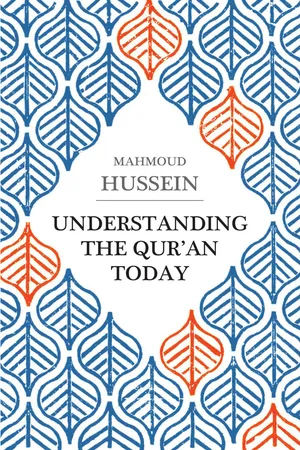
Understanding the Qur'an Today
About this book
The prevailing belief among Muslims is that, because the Qur'an is the Word of God and God is eternal, it follows that His Word is also eternal. The belief is based on the postulate that the Word of God must be of the same nature as God Himself. Mahmoud Hussein refutes this by showing that it contradicts the very teachings of the Qur'an. Whereas God transcends time, His Word is inscribed within time. It is not a monologue, but a living exchange, through which God reveals to His Prophet different orders of truth, weaving together the absolute and the relative, the general and the particular, the eternal and the contingent. An international bestseller, Understanding the Qur'an today offers a new perspective on one of the world's most influential texts and adds an invaluable contribution to the debate on Islam and modernity.
Information
Topic
Theology & ReligionSubtopic
Islamic TheologyOne
What the Qur’an says and what people make it say
We were emerging from a period of several years spent writing a book which retraced the life of the Prophet Muhammad, according to the earliest Muslim chronicles.1 Absorbed in the events of the seventh century of Arab history, we were in a sense absent from today’s world, until the publication of the two volumes of the book brought us back to contemporary reality. Publication was followed by lecture tours in Europe and in some Arab countries, intended for what is usually termed “the general public”. We expected that we would be questioned on the two essential themes of the Muslim chronicles: firstly, the human dimension which they restore to the figure of the Prophet, and secondly, the Qur’anic Revelation situated in its historical context. More often we spoke of other subjects. Wherever we went, people wanted first of all to know “what the Qur’an says” about elementary questions which were a source of general preoccupation.
Non-Muslims came in order to learn what they did not know. Muslims generally sought confirmation of what they thought they knew. Both groups expected simple, clear and conclusive answers – the kind of answers that we could not give them.
Can one find a Qur’anic reference to the actions of those kamikazes who blow themselves up in a public space or on the underground, indiscriminately killing combatants and civilians, young and old?
The Qur’an2 (5:32) condemns the person who takes the life of an innocent person. The Prophet forbade Muslims to kill themselves, and permitted them to kill only armed and adult enemy combatants, excluding women, old people and children.
How can certain Muslims nevertheless commit such crimes? They quote a verse which calls for combat against the idolaters (9:3–5) and then describe as such all those whom they consider to be their enemies. They make the Qur’an say what suits them.
We find the same kind of manipulation of the text in connection with apostasy. Does the Qur’an say that apostasy incurs the death penalty? We witnessed someone defend this point of view so robustly that we began, for a moment, to doubt our own knowledge of the text. There is no such condemnation of apostasy in the Qur’an. Our interlocutor based his opinion on a verse (2:27) in which God addresses those who have violated a pact concluded with Him, warning them that they are the losers.
The stoning of adulterous women is a particularly troubling case. Numerous Muslim intellectuals continue, albeit with regret, to accept this practice on the grounds that God would have commanded it. The Qur’an, in reality, says nothing about this. This conviction lives on, supported by dubious arguments, dictated, people say, by a Qur’anic verse variously described as lost or abrogated.
What about legalised inequality between men and women, or the institution of slavery? A highly qualified woman in one of our audiences was convinced that such practices were foreign to the Qur’an. She informed us that she would accept no quotations from the Hadith (sayings of the Prophet) or the Sira (eyewitness accounts of the Prophet’s companions); the Qur’an itself was the only reliable guide, in her opinion.
We began by quoting verses which permit inequality between men and women (4:34 and 2:178) and then reminded our perplexed interlocutor that we consider that the question should be seen in its historical context. The Qur’an approached the position of women in a humanitarian way, giving them rights which hitherto they had not enjoyed and accorded them, as believers, equal dignity with men, in the eyes of God. The practice of slavery was also circumscribed by moral limitations, with slave owners being advised to free as many slaves as they could, in particular in order for their sins to be pardoned. The Qur’an did not create inequalities in an existing context of equality; it brought improvements to flagrant inequalities.
A man of advanced years maintained that polygamy was a practice contrary to Islam and had been introduced long after the time of the Prophet. We were obliged to read to him, translating from Arabic, one of the Qur’anic verses which authorises a man to marry up to four wives, on the condition that he treat them equitably (4:3).
We did not expect to encounter this patchy and selective knowledge of the Qur’an, particularly among practising Muslims. We were surprised above all by the prevailing feeling among them that the Qur’an should bring clear, unequivocal and definitive answers to the questions they were asking, as it had done (or so they believed) in the case of all the questions Muslims had asked since the time of the Prophet.
Listening to one of our lectures was a young woman, her hair discreetly covered by a shawl. We were explaining the circumstances in which (according to a companion of the Prophet) the wearing of a shawl was commanded by God.
At Medina, at nightfall, women needed to leave the city in order to answer the call of nature. They were often molested by outlaws. They complained to their husbands who in turn referred the matter to the Prophet. Following these incidents the Qur’anic verse was revealed to the Prophet. By wearing a shawl, free Muslim women (not slaves) could be easily recognised and thus respected, even at night (33:59).
The young woman was visibly irritated and finally asked us how we dared believe that God, whose Book contained only eternal commandments, could have commanded the wearing of the shawl for such trivial reasons.
We replied that this episode was quoted by the most orthodox exegetes, and in any case, she was free to consider either that this verse obliged all women everywhere to wear the shawl, or that the Qur’anic text addresses a particular context which no longer exists.
Beyond the question of the tenor of particular verses, we endeavoured to underline a point that seemed obvious to us: the text of the Qur’an is closely linked to the context in which it was revealed. The series of lectures we undertook enabled us to measure the difficulty that numerous believers have in accepting this approach. Privately, they do not feel that they are allowed to accept it.
They are prevented from doing so by a doctrine which progressively took shape after the death of the Prophet and which, since then, has gravely misled many Muslims. This doctrine is based on a process of reasoning which is ostensibly unassailable. It maintains that the Qur’an, as the Word of God, transcends time, and that its verses are not linked to the context in which they were revealed. Rather, they are formulated, once and for all, to take in all possible contexts. Today, as in the past, these verses are to be accepted as they are in the text. This is a literal understanding of the text.
The believer is, therefore, faced with the following syllogism: a Muslim is a person who believes that the Qur’an is the Word of God. The person who doubts that all the verses of the Qur’an are irrevocable casts doubt on the belief that the Qur’an is the Word of God. Such a person is no longer a Muslim.
This rigid reasoning explains the difficulty in which numerous believers find themselves when they encounter Qur’anic prescriptions which they would prefer to avoid. They deceive themselves by striving to “forget” particular verses or “giving preference” to one verse over another, although they believe they have to accept that all the verses, without exception, are irrevocable.
A believer’s conscience is thus troubled by a series of underlying conflicts: between fidelity to the text of the Qur’an and the pressures of reality; between timeless truth and the experience of change and relativity; and between the acceptance of arguments dictated by authority, and the exercise of personal reflection.
Certain individuals try to flee these dilemmas by embracing fundamentalism. This entails surrendering their freedom of conscience in exchange for simple certainties arbitrarily selected from the text of the Qur’an. They acknowledge reality only insofar as it seems to confirm their dogmas.
The following pages will show that these conflicts are not produced by the Qur’an, but result from a piece of misleading sophistry, according to which the Word of God must be of the same nature as God himself. As God is eternal, so too His Word must be eternal. But the Qur’an does not say this. It says the contrary. In order to become aware of this, one has to engage directly with the text of the Qur’an, abandon pre-conceived ideas and endeavour to understand the text in its context.
Such a reading of the Qur’an leads us to the three following propositions: firstly, God is not synonymous with His Word. God transcends Time, but His Word is inscribed in Time, maintaining a living link with the historical context in which God revealed it.
Secondly, the Word of God does not take on the form of a monologue but of an exchange between Heaven and Earth. God speaks, through the Prophet, with the community of the first Muslims.
Thirdly, God did not give the same weight of meaning to his Word at each moment of its Revelation. The Qur’an therefore enunciates different orders of truth, in which figure the absolute and the relative, the general and the particular, the everlasting and the transitory.
Two
The created and the uncreated
The literalist preconception was not always considered the norm. It was imposed on the Muslim community after a struggle which began following the death of the Prophet and lasted for several centuries.
In the first schools of Qur’anic interpretation there were already two opposing approaches: one which relied on the tradition received from the first generations of believers, with a commentary on the text of the Qur’an which adhered to the letter of the text, and another approach which favoured personal reflection and relied on reason.
When the first religious doctrines were outlined, a conflict developed between the Qadarites, who saw the Qur’an as underlining human free will, and the Jabrites, for whom the Qur’an gives primacy to the absolute power of God. The translation into Arabic of the Greek philosophers, and particularly the logic of Aristotle, gave added authority and coherence to the current of thought which emphasised the autonomy of reason. The great theological debate began, provoking intellectual disputations whose variety and richness are today largely forgotten. A simplified presentation of the debate identifies two main viewpoints.
The Mu‘tazalites’ reading of the Qur’an is characterised by confidence in the power of reason. God himself is Reason, and gave humans the ability to act freely. He will reward them at the end of time, according to their acts.
This school is opposed by the representatives of Tradition, of whom a leading member was Ibn Hanbal, founder of one of the four schools of jurisprudence. He forcefully rejected the notion of human free will, as an obstacle to the absolute power of God, which lies beyond the bounds of human reasoning.
The decisive debate took place in Baghdad in the ninth century, on the nature of the Word of God: is this Word consubstantial with God or is it only one of His attributes? Is it timeless and eternal like God, or is it distinct from Him and situated within human history?
This gave rise to the famous question concerning the status of the Qur’an: “created” or “uncreated”?
According to the Mu‘tazalites, the Qur’an is “created”, meaning that it is distinct from God and, unlike Him, is situated within history. Reason renders the Qur’an comprehensible to believers, who are free and responsible for their acts. They must undertake personal research to interpret the Qur’an as best they can in situations different from those in which God revealed it.
According to Ibn Hanbal the Qur’an is “uncreated”. This means that it is part of the substance of God, and inseparable from Him. On the one hand the Qur’an is timeless, like God, and on the other hand, it is above reason. For believers, therefore, the intelligibility of the Qur’an’s verses is less significant than the divine presence which they convey. It matters less to understand the verses than it does to absorb them more and more deeply.
The confrontation between Mu‘tazalites and Hanbalites ended in the decisive victory of the latter in Baghdad towards the end of the ninth century. The debate between rationalism and traditionalism continued, employing subtle or trenchant formulations throughout the Muslim world, particularly in Andalusia.
The teachings of Ibn Taymiyya1 in the fourteenth century, propagated by Muhammad ibn ‘Abd al-Wahhab2 in the eighteenth century, assured the victory of traditional opinion, in its narrowest and most literalist version, for centuries to come.
Throughout this period, literalism has profoundly influenced the mentality of Muslims in every area of religious science, to the extent that it seems self-evident, not even requiring comment, as though literalism were synonymous with Islam itself.
Numerous believers engage with the Qur’an as a text that should sustain their faith but not their intelligence. Reason’s role is limited to grasping the primary meaning of words.
As children, they learn fragments by heart without understanding them. As adults they are familiar with the text, although they do not dare to reflect on it. They pass from one word to another, reciting or chanting the verses, and listen to extracts commented on in mosques, on television, or, perhaps, in evening classes.
The majority will not, however, embark on a personal journey in which they will discover the text. They will not search for meaning, even less for interpretation.
Depriving themselves in this way of an unhindered personal understanding of the world of the Qur’an, these believers undermine the heart of their identity and self-confidence. They tend to retreat into themselves and isolate themselves from the rest of...
Table of contents
- Cover
- Title
- Contents
- 1. What the Qur’an says and what people make it say
- 2. The created and the uncreated
- 3. Understanding the Qur’an
- 4. The historical setting for Revelation
- 5. The beginnings of Revelation
- 6. The Qur’an in its historical context
- 7. The Qur’an in the time of Creation
- 8. Text and context
- 9. God replies to the arguments of the polytheists
- 10. God orders combat against the polytheists
- 11. God replies to the arguments of the Jews
- 12. God replies to the arguments of the Christians
- 13. God cares for the Muslim community
- 14. God guides His Messenger
- 15. Verses concerning the person of the Prophet
- 16. Verses concerning the contemporaries of the Prophet
- 17. Verses concerning historical events
- 18. The abrogated verses
- 19. Circumstances and causes
- 20. Yesterday and today
- Notes
- Works cited
- Copyright
Trusted by 375,005 students
Access to over 1.5 million titles for a fair monthly price.
Study more efficiently using our study tools.
Frequently asked questions
Yes, you can cancel anytime from the Subscription tab in your account settings on the Perlego website. Your subscription will stay active until the end of your current billing period. Learn how to cancel your subscription
No, books cannot be downloaded as external files, such as PDFs, for use outside of Perlego. However, you can download books within the Perlego app for offline reading on mobile or tablet. Learn how to download books offline
Perlego offers two plans: Essential and Complete
- Essential is ideal for learners and professionals who enjoy exploring a wide range of subjects. Access the Essential Library with 800,000+ trusted titles and best-sellers across business, personal growth, and the humanities. Includes unlimited reading time and Standard Read Aloud voice.
- Complete: Perfect for advanced learners and researchers needing full, unrestricted access. Unlock 1.5M+ books across hundreds of subjects, including academic and specialized titles. The Complete Plan also includes advanced features like Premium Read Aloud and Research Assistant.
We are an online textbook subscription service, where you can get access to an entire online library for less than the price of a single book per month. With over 1.5 million books across 990+ topics, we’ve got you covered! Learn about our mission
Look out for the read-aloud symbol on your next book to see if you can listen to it. The read-aloud tool reads text aloud for you, highlighting the text as it is being read. You can pause it, speed it up and slow it down. Learn more about Read Aloud
Yes! You can use the Perlego app on both iOS and Android devices to read anytime, anywhere — even offline. Perfect for commutes or when you’re on the go.
Please note we cannot support devices running on iOS 13 and Android 7 or earlier. Learn more about using the app
Please note we cannot support devices running on iOS 13 and Android 7 or earlier. Learn more about using the app
Yes, you can access Understanding the Qur'an Today by Mahmoud Hussein in PDF and/or ePUB format, as well as other popular books in Theology & Religion & Islamic Theology. We have over 1.5 million books available in our catalogue for you to explore.