- 256 pages
- English
- ePUB (mobile friendly)
- Available on iOS & Android
eBook - ePub
About this book
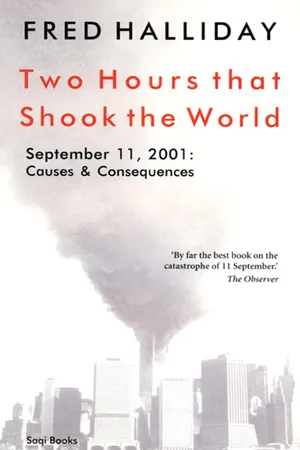
Examines the causes of the September 11, 2001 attacks, and also provides a reasoned approach as to what the future may hold. As the dust settled around the devastation of the World Trade Centre and the Pentagon on 11 September 2001, a host of questions emerged surrounding the attacks, the motives behind them and their future implications. In Two Hours that Shook the World Fred Halliday expands on the many socio-cultural, religious and political problems that have plagued the Middle East and Central Asia in the last half-century. Much has been written about 'global terrorism' and the need to eliminate it but also about the divide between East and West, the 'clash of civilisations'. Halliday dispels the idea that the Muslim and non-Muslim worlds are poised for conflict. He explains the causes and rise of Islamic fundamentalism, how terror became an instrument of political and military conflict, and why seemingly well-educated and sane individuals are taking drastic actions to voice their desperation. The burden of history is also invoked, as with the Palestinian-Israeli situation, the festering malaise at the heart of Middle Eastern consciousness and identity. While Halliday's book examines the causes of what has happened, it also provides a reasoned approach as to what the future may hold.
Information
Topic
Ciencias socialesSubtopic
Historia de Norteamérica1
September 11, 2001 and the Greater West Asian Crisis
The crisis unleashed by the events of 11 September is one that is global and all-encompassing. It is global in the sense that it binds many different countries into conflict, most obviously the USA and parts of the Muslim world. It is all-encompassing in that, more than any other international crisis yet seen, it affects a multiplicity of life’s levels, political, economic, cultural and psychological. In an attempt to get an initial intellectual hold on this momentous process, a first reaction is to reach for grand historical analogy. In terms of world history there is mention of Sarajevo 1914, where a single terrorist act, in this case the assassination of Archduke Ferdinand of Austria and his wife, precipitated World War I and with it the end of the imperial order in Europe; of Operation Barbarossa and Pearl Harbour in 1941, the attacks of, respectively Germany on the USSR and Japan on the USA; of Cuba 1962, when, in the aftermath of the 1959 Cuban revolution and attempts by the USA to overthrow the new regime, Soviet intermediate-range missiles were placed on the island of Cuba and, in the confrontation between Washington and Moscow, the world came nearer to a nuclear exchange than ever before.
Each of these events was global in cause and consequence. In each case, the explosion had roots deeper than strategic rivalry. The ensuing clash of states was preceded by social and ideological conflict. Yet none of these historical analogies matches the peculiar timbre of 11 September 2001, at once the most spectacular case ever of the policy espoused by anarchists from the 1880s onwards of ‘propaganda of the deed’, an iconic destruction against the clear blue sky, and an event that, at one stroke, launches a roller-coaster of grief, fear and uncertainty. It is easy and portentous to say, as many have, that ‘everything has changed’ since 11 September. This is, however, a proposition that is as hard to disprove as it is hard to prove. Even the most cataclysmic of events can lead to exaggeration: the world did not change, the sun did not darken, the novel, hope or happiness did not die after Auschwitz, the Gulag, Sabra and Chatila, Sarajevo, Rwanda. The world learnt something, or at least some of it did: as a result, some things, not least the political systems, the histories, the cultures, the hopes and fears of mankind continued. The same will be true of 11 September 2001. Yet enough has changed, and will continue to change, for this to be recognized, already, as one of the landmarks of modern world history.
If the causes of this event can be traced back into the history of the Arab and Muslim worlds and of Western interaction with them and with the non-European world as a whole, the consequences of 11 September will stretch far into the future. It is a measure of the very pervasive and far-reaching impact of these events that they are not just concentrated in one geographical area or on one aspect of life, the military or the economic. These consequences can be identified on at least five levels: the military engagement of the USA and its allies in Afghanistan and possibly other countries; changes in relations between states, in terms of diplomacy, resolution or exacerbation of local and regional conflicts; a distinct, reformist if not revolutionary, shift within developed countries in arrangements for security, intelligence, surveillance and compliance; the long-run, global, social and economic consequences of the crisis that has followed 11 September; and the cultural, philosophical and psychological aftermath of violence and insecurity felt in all societies. One of the effects of 11 September is, however, greatly to increase insecurity not only in those countries suspected of being associated with terrorism, but also in all other states, an insecurity of the economy and market being compounded by a personal one. It is rightly said that risk has become a pervasive feature of modern life in regard to food, sex, travel. In many countries political security did not exist before 11 September. But in many it did, and was a good, personal and public, to which all people could reasonably aspire. Moreover, for those already in war or insecurity on 10 September, 11 September may well have made things worse. For the rest of us, living in or visiting any city or country that had hitherto avoided such violence, the sound of an overflying aircraft causes anxiety. A sense of assumed security in much of modern life has, for some long time at least, been significantly eroded.
To this pervasive insecurity is added the unique, opaque, character of the conflict. The terrorists have not exhausted their options: as in planning for nuclear war, so too in this kind of offensive, a plan for a successful, surprise, ‘first’ strike may be accompanied by an equally well-hidden second-strike capability. Some of the things that have followed 11 September are processes that were, in some degree, already in train: they include the worldwide recession, growing hostility to immigrants and refugees in developed countries and an assertion by the USA of military hegemony. But 11 September has also reversed some trends hitherto prevailing: the most obvious is the shift from the certainties of neo-liberal market policies to the intervention of Organisation of Economic Cooperation and Development states (OECD), above all the USA, in their economies. Subsidies, infusions of money into markets, tax incentives have all followed, as has a more invasive attitude to tax havens and money laundering. It will take years to assess the consequences.
The governments of the world talk, as they must, and as, under Article 51 of the UN Charter, they may, of a war against an enemy: but this is an enemy that is not a strategic threat and against which there can be no easy or predictable end. Therefore, this is not a war, in the sense of a great mobilization with a clear strategic or calculable end. One of the casualties of 11 September has been those doctrines painstakingly laid out to justify war to a sceptical population of the developed world: Caspar Weinberger in 1985, Tony Blair in Kosovo in 1999. Weinberger, then US Secretary of Defense, laid down six conditions for military action by the USA. Some of these conditions are met in this case (a challenge to the US national interest, Congressional support) but one, namely, ‘clearly defined political and military objectives’, most certainly is not. Blair, in his April 1999 speech justifying the intervention in Kosovo, listed five criteria: some, national interest and the exhaustion of diplomatic options, coincided with Weinberger’s criteria. But again, military operations that could in his words be undertaken ‘sensibly and prudently’, seem elusive in this case.
There is no clear strategic goal and most certainly no clear exit. Indeed, as US strategists quickly recognized, there is not only no ‘silver bullet’ but also no criteria, other than universal peace and tranquillity, that would signal an end to this conflict. Here too it is important to avoid exaggeration. This is not the first war of the twenty-first century: the inhabitants of Grozny, Juba, Prestovo, Colombo, Kabul, not to mention Srinagar, Nablus and Medellin, would have reason to question that. Those who seek to use this event not to condone the carnage in the USA but to question anterior political and moral neglect of other conflicts are right to do so: yet among the greatest casualties of these events may precisely be those caught up in such conflicts. The response to such moral inconsistency should and can be to bring indignation and diplomatic concern with these other questions up to the level expressed after 11 September with regard to the events in New York and Washington. It is illogical and immoral to allow real or alleged Western neglect of other conflicts, in the Balkans, Central Africa or Palestine, to lessen indignation at the brutality and folly of 11 September. No balance sheet of such neglect, especially with regard to the Muslim world, can ignore what was done in the 1990s, not least in Bosnia and Kosovo.
Explanations
11 September 2001 was, therefore, an event, possibly unique in its form and impact, that raises many broader issues, which will confront all of us in the years to come. The first question is cause: why this group of young men, most from the Arabian Peninsula, planned this action. Here a distinction may be made between the longer-term and more immediate, or conjunctural, causes. Much is made of the long-term antecedents. Some involve the Crusades, the attacks by Western Christians on the Muslim world that began in the eleventh century, others the Islamic concept of struggle, jihad: bin Laden says the conflict has been going on since the 1920s. In his statement delivered in October 2001 (Appendix 5), bin Laden invoked the ‘80 years’ time frame: he did not say exactly what he meant – the collapse of the Ottoman Empire or the British takeover of Palestine. Some of his associates have invoked the expulsion of the Arabs from Spain in 1492. But the image of the Crusades means little to those outside the Mediterranean Arab world, and the term Crusader War (al-harb al-salibiyya) has only recently entered the generic Islamic vocabulary. In 1991 Saddam denounced George Bush Sr as Hulagu, the Mongol emperor who destroyed Baghdad in 1258, not as a Crusader. Jihad is quite an inappropriate term, for the proper, Quranic reason that the armies of Islam sought to convert those they conquered to Islam, whereas, whatever else is involved, this desire to conquer is irrelevant in the contemporary context. Khomeini, for example, distinguished between jihad-i asghar, the smaller or military struggle, and jihad-i akbar, the greater struggle, or jihad ba nafs, the struggle with the self. Jihad, literally ‘effort’, can mean any form of exertion by Muslims, from fighting to economic mobilization to prayer and mystical introspection.
There are two more immediate historical contexts for 11 September, one colonialism, the other the cold war. The legacies of both, followed by the inequalities associated with globalization, have produced, in the Middle East as elsewhere, a generalized resentment against the West. Colonialism created the state system in the Middle East after 1918, but it also left behind a set of unresolved issues that have bred conflict and a kind of rancour, towards the USA and others, ever since. These issues include the Palestine question, the Kurdish issue and the status of Kuwait, and indeed the very sense of thwarted relations with the outside world. As no claim was made for responsibility in the US attacks no one can be sure what the exact significance, if any, of 11 September was, but in a broader framework it is a date that resonates in three ways: as an echo of ‘Black September’, in Arabic Aylul al-aswad, the 17 September 1970 attack by King Hussein of Jordan on the Palestinian forces in his country; as a throwback to the day in 1683 when, it is said by some, the Ottoman armies were defeated at the gates of Vienna; and as the date on which, in 1973, in one of the most signal crimes of the cold war, one abetted by the USA in aftermath if not in origin, General Pinochet launched his bloody coup against the elected Popular Unity government in Chile. One may doubt if the last of these, far from the Islamic world, or the second, an obscure date in Ottoman history, meant anything to the hijackers of the US east coast. But these resonances do suggest that the event has to be seen in a broader contest of conflict between the developed and non-European worlds. If nothing else, for the first time in five hundred years of European and ‘Northern’ interaction with the South, the latter had struck in significant degree against the territory, cities and hegemonic symbols of the dominant state. That this took place in a way that was itself criminal and destructive boded no good for the majority of the world’s population. That in the statements of al-Qa‘ida it confined its appeals to one portion only of the non-European world and was indeed racist towards non-Muslims in general, and Jews in particular, was itself part of the crime. Colonialism, the long arc of centuries of Western interaction with the rest of the world, is of limited relevance.
The age of colonialism (roughly 1870–1945) was succeeded by that of the cold war (1945–90). Some commentators suggested that 11 September marked the real end of the cold war in that it marked the start of a new global conflict replacing that of the post-1945 era. For others, the conflict between the West and the Islamic world was itself a new cold war, a new global rivalry replacing the old. It is tempting to recall here that the first, original and probably forgotten usage of the term ‘cold war’ was indeed in regard to the conflict between Christianity and Islam in Spain, in the writings of the Castillian author Don Juan Mañuel (1282–1348): ‘War that is very strong and very hot ends either with death or peace, whereas cold war neither brings peace nor brings honour to the one who makes it.’1 But these invocations of total war are flawed. The latter – ‘Islam’– Western relations as cold war – is mistaken: the contemporary conflict with some Muslim states and with most Muslim opinion is not a global conflict at all, as was the cold war, not least because ‘Islam’ does not in any way appeal to the populations of the developed Western states and lacks strategic military or economic potential. The former – ‘Islam–West’ as substitute for the cold war – is misleading in that the rise of the fundamentalist groups is not subsequent to, but an integral result of the cold war itself.
The cold war indeed contributed to this crisis and in particular to the destruction of Afghanistan from 1978 onwards, but in a way that should give comfort to few. One can here suggest a ‘two dustbins theory’ of cold war legacy: if the Soviet system has left a mass of uncontrolled nuclear, chemical and biological weapons and unresolved ethnic problems, the West has bequeathed a bevy of murderous gangs, from the National Union for the Total Independence of Angola (UNITA) and Cuban exiles in the Caribbean and Miami to the mujahidin in Afghanistan, who are now on the rampage. There is an intimate relation between the rise of the armed Islamists and the crushing of the Left in the cold war. In two countries in particular, the transnational Islamist militias associated with bin Laden were used first not against the West, but against the local forces of the left, the PDPA in Afghanistan and the YSP in Yemen, both ruling pro-Soviet forces brought down in the early 1950s by their enemies. The People’s Democratic Party of Afghanistan (PDPA) took power in 1978 and fell, after the withdrawal of Soviet aid, in 1992; the Yemeni Socialist Party (YSP) ruled in the South Yemen from 1967 to 1990 and was defeated in the 1994 civil war.
Here of course there has been another striking example of the denial of responsibility that is so pervasive in the wake of 11 September. This denial is found in East and West: the leaders and intellectuals of the Arab world and, more broadly, of the Islamic world have been criticized, rightly, for a failure to counter the half-arguments and demagogy of the Islamists. Their failure is one that stretches back before 11 September and was indeed a contributory factor to it, as it has been to the confused arguments thereafter. But there is a striking Western responsibility here too, for stoking up Islamist movements in the cold war period and in helping to promote the kinds of autonomous terrorism that culminated in the Taliban and in al-Qa‘ida. Much is made, after 11 September, of the West’s culpability in abandoning Afghanistan. It is said that after the cold war, the West ‘abandoned’ Afghanistan. Here there is much validity, but with two corrections. First, it was not the West or the East that sparked the explosion of Afghan society in the late 1970s: it was Afghans themselves. The conflict began, and will end, as an Afghan civil war. In so far as this is the case, part of the responsibility must lie with the Afghan communists, particularly the dominant Khalqi faction of the PDPA who ruled after April 1978 and who did so much to provoke Afghan society. Afghanistan was an example even more extreme than anything seen in Iran, Algeria, Egypt or Turkey of a revolt against the modernizing secular state.
Secondly, it was not abandonment by the West in 1989 but three other things that played a decisive role in the subsequent violence. One was the decision, taken soon after the PDPA came to power in 1978 and reinforced after the Soviet forces went in in 1979, to arm and finance the mujahidin. It would have been much wiser to allow the reformist–communist regime to stay in power. This was followed by a catastrophic decision, taken by the USA in 1988, to sabotage the international agreement associated with the Soviet withdrawal of forces. For eight years the UN Secretary-General had worked, along with diplomats from other countries, to get a negotiated withdrawal by the USSR. In the end, in Geneva 1988, the USSR agreed, but on condition that the West and Pakistan stop arming the mujahidin: Article II of the agreement signed in Geneva stipulated just that. But from the very day of the signing, the Reagan administration broke the agreement and continued its policy of promoting the mujahidin. This illegal decision, taken as part of the USA’s global cold war strategy, was the root of the subsequent chaos and fighting, which led to the triumph of the Islamist guerrillas in 1992. The third fateful decision taken by Pakistan and Saudi Arabia and, at least to some degree, condoned by the West, was to create the Taliban and support their drive to power in 1994–96. The first two of these three policies were direct products of the cold war.
The West Asian crisis
So much for the long-term causes – colonialism and the cold war – of 11 September 2001. The conjunctural causes are to be found in the formation of what may be termed a new integrated West Asian crisis. The necessarily imperfect term ‘West Asia’ is used to denote an area that, in addition to the countries of the Arab world and Iran, also covers Afghanistan and Pakistan. There has, in several countries, been a weakening, if not collapse, of the state, in the 1970s and 1980s in Lebanon, more recently in Afghanistan and Yemen. It is in these countries, where significant areas are free of government control or where the government seeks to conciliate autonomous armed groups such as al-Qa‘ida, that a culture of violence and religious demagogy has thrived.
This crisis has three general features: the first is the new pattern of linkages between hitherto separate conflicts, the second is the crisis of the state in this region and the third is the emergence of a new, transnational and fundamentalist Islamism. A central confusion concerns the interrelationship between the different centres of conflicts. It is common in Western parlance to talk of ‘the Middle East’ problem, or crisis, meaning by this the Arab–Israeli question. This is mirrored in some Middle Eastern rhetoric. In parallel vein, nearly all Arab opinion attributes a pervasive, if not determining, role in the modern history of the region to the establishment of the state of Israel. Israel, for its part, looks at the policies of other states, in the current context most obviously Iran, solely in terms of the Arab–Israeli conflict. No one who studies the history of the region can doubt that, since the end of World War I, there has been some connection between the different conflicts and movements in the region: you cannot write the history of Arab nationalism without including the role of Palestine. You cannot assess US strategy in the region as a whole without taking its relationship with Israel into account, as was, indeed, the case with France, until the 1960s Israel’s closest ally. We see now, in rising Arab anger with the USA over Palestine, combined with growing sympathy for Iraq, another such interconnection. In this sense, Saddam Hussein was and is right when he talks of ‘linkage’...
Table of contents
- Cover
- Title
- Contents
- List of Appendices
- Keywords: A Lexicon of Crisis
- Introduction: Political Violence and the Claims of Reason
- 1. September 11, 2001 and the Greater West Asian Crisis
- 2. Fundamentalism and Political Power
- 3. Violence and Communal Conflict: Terrorism ‘from Above’ and ‘from Below’
- 4. Anti-Muslimism: A Short History
- 5. Confusing the Issue: ‘Islamophobia’ Reconsidered
- 6. Oslo 1993: A Possible Peace
- 7. A Decade after Invasion: The Unease of Kuwait
- 8. Iran: The Islamic Republic at the Crossroads
- 9. Saudi Arabia: A Family Business in Trouble
- 10. The Other Stereotype: America and its Critics
- 11. Global Inequality and Global Rancour
- 12. ‘Islam’ and the ‘West’: Cultural Conflict and International Relations
- Conclusion: Causes and Consequences
- Appendices
- Notes
- Index
- Copyright
Trusted by 375,005 students
Access to over 1.5 million titles for a fair monthly price.
Study more efficiently using our study tools.
Frequently asked questions
Yes, you can cancel anytime from the Subscription tab in your account settings on the Perlego website. Your subscription will stay active until the end of your current billing period. Learn how to cancel your subscription
No, books cannot be downloaded as external files, such as PDFs, for use outside of Perlego. However, you can download books within the Perlego app for offline reading on mobile or tablet. Learn how to download books offline
Perlego offers two plans: Essential and Complete
- Essential is ideal for learners and professionals who enjoy exploring a wide range of subjects. Access the Essential Library with 800,000+ trusted titles and best-sellers across business, personal growth, and the humanities. Includes unlimited reading time and Standard Read Aloud voice.
- Complete: Perfect for advanced learners and researchers needing full, unrestricted access. Unlock 1.5M+ books across hundreds of subjects, including academic and specialized titles. The Complete Plan also includes advanced features like Premium Read Aloud and Research Assistant.
We are an online textbook subscription service, where you can get access to an entire online library for less than the price of a single book per month. With over 1.5 million books across 990+ topics, we’ve got you covered! Learn about our mission
Look out for the read-aloud symbol on your next book to see if you can listen to it. The read-aloud tool reads text aloud for you, highlighting the text as it is being read. You can pause it, speed it up and slow it down. Learn more about Read Aloud
Yes! You can use the Perlego app on both iOS and Android devices to read anytime, anywhere — even offline. Perfect for commutes or when you’re on the go.
Please note we cannot support devices running on iOS 13 and Android 7 or earlier. Learn more about using the app
Please note we cannot support devices running on iOS 13 and Android 7 or earlier. Learn more about using the app
Yes, you can access Two Hours That Shook the World by Fred Halliday in PDF and/or ePUB format, as well as other popular books in Ciencias sociales & Historia de Norteamérica. We have over 1.5 million books available in our catalogue for you to explore.