- 268 pages
- English
- ePUB (mobile friendly)
- Available on iOS & Android
eBook - ePub
About this book
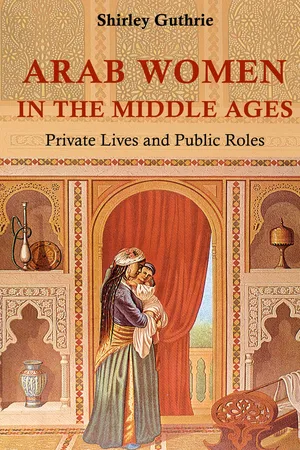
Regardless of social rank and religion, whether Christian, Jew, or Muslim, Arab women in the middle ages played an important role in the functioning of society. This book is a journey into their daily lives, their private spaces and public roles. First the reader is introduced into the women's sanctuaries, their homes and what occurs within its realm - marriage and contraception, childbirth and childcare, culinary traditions, body and beauty rituals - providing an insight into the rights and rituals prevalent among the different communities of the time. But women were also very present in the public arena and made important contributions in the fields of scholarship and the affairs of state. A number of them were benefactresses, poets, calligraphers, teachers and sales women. Others were singing girls, professional mourners, bath-attendants and prostitutes. How these women managed their daily affairs, both personal and professional, defined their roles in the wider spheres of society. Drawing from the Islamic traditions, as well as legal documents, historical sources and popular chronicles of the time, this book offers an informative study.
Information
CHAPTER 1
Marriage and the Home
Marriage
Al-Ghazali, acknowledging the benefits to men of marriage, which relieves the mind and heart of the man from the burden of looking after the home, and of being occupied with cooking, sweeping, cleaning utensils and arranging for the necessities of life posited one eleventh-century male viewpoint reflecting the urban bias of traditional Islamic culture.1 Thus a husband would not find ‘most of his time wasted, and would not be able to devote himself to work and to knowledge’. He also conceded that ‘A good woman, capable of setting things to rights in the home’, was ‘an invaluable aid to religious holiness.’ This conservatism reflected his role as the arbiter of Sunni orthodoxy, would have appealed in periods of social dislocation, and was perhaps a response to it. Nevertheless, despite the noblest of all her tasks being to produce and raise children, a woman’s everyday domestic role was seldom acknowledged in Arabic literature, where women were frequently portrayed as the playthings of men.
The patriarchal nature of Muslim society and the value attached to lineage ensured that men formulated the rules for marriage. Family and political alliances and economic interests for the collective good came into play at the expense of individual feelings, and first cousin marriage was preferred, since it kept wealth – in whatever form – in the family. It also ensured, as in the biblical levirate marriage, that women and children were not left destitute on the death of the breadwinner; this was an ever-present possibility. However, some women were married off outside the tribe for economic or political expediency as weaker tribes forged alliances for protection with more powerful neighbours. In these circumstances, there was little element of choice for the marriage partners and the girl was frequently married between the ages of ten to twelve years, before puberty, to circumvent her exercising her prerogative on the age of consent. Her’s was a small still voice, if heard at all. To be fair, a young man equally had little say.
Despite the prestige and trappings of the court, arranged marriage for political reasons was equally unappealing for Maysun bint Bahdal, the Christian wife of the Caliph Mu‘awiya and mother of his successor, Yazid. Maysun longed for her own kin:
I’d rather be in the company of my proud and fine-figured cousin than with the bloated foreign mass. My simple country life appeals to me more than this soft living. All I want is to be in my country home, indeed it is a noble home.2
Honour was all and the young woman bore the burden as its repository. It is arguable that honour, that is, the regulation of female sexuality as it impinges on the male, was easier to establish and maintain when marriage was kept within the family. Male relatives could guarantee in unequivocal terms a girl’s virginity and family honour. These related to her ‘worth’ and relegated her in a sense to a commodity, at the same time severely restricting her freedom of movement in society at large. The least hint of sexual impropriety, real or imagined, besmirched the males of the family, and the behaviour and fertility of the married woman was carefully monitored. Men were quick to apportion total blame in sexual matters to women. However, the penalty for wrongfully slandering a woman, thus impugning the family, was rigorously meted out in line with Qur’anic condemnation.3 Patrilocal marriage ensured that a mother-in-law was also assigned a particularly powerful role, as monitor and guarantor of family honour and a major influence on her son.
Life for many a young new bride, moving to her husband’s family home was a daunting situation, exacerbated by her ever-present mother-in-law, an oft-maligned figure in most societies, but nonetheless an extremely powerful matriarch. Where girls had been contracted to marry their first cousins, their mothers-in-law were their aunts, whom they had known since childhood. This could produce its own tensions. Further, because of the close kinship ties, there was ever the possibility of interference from their own parents. On the other hand, many girls would find comfort in easy familiarity and intimate knowledge of a bridegroom and family known from their earliest days.
Marriage for women was monogamous. Their spouses, however, were allowed serial marriage or concubines, and for many women the spectre of another wife must have loomed large. It would indeed be unusual if the appearance of another wife in her home did not place great psychological pressure on the repudiated wife; this would be intensified when children followed, and many would have found the strains unbearable. Sons and daughters, the extended family on both sides, even servants, would find their own loyalties confused. Financial factors and the future custody of her children would necessarily come under scrutiny. A new wife and her children and the children of concubines were all entitled to material support, as well as a share in the man’s estate, and the children of his first family would see their birthright literally diminishing before their eyes. Divorce was probably not an option for many, woman or man, as there was too much at stake financially, and there was little a woman in those circumstances could do.4
Despite the very harsh penalties and dangers in transgressing sexual codes, there are many references to adultery in Arabic literature. It was therefore patently possible for women to enter into extramarital sexual liaisons, wherever and however they conducted them, in spite of family vigilance. In these circumstances, the veil would offer the perfect guarantee of anonymity. How did these women make the acquaintance of their paramours, if they were not in some way related to them? When did they have the opportunity to be seen unveiled in the first place? The simplest explanation might be that the men were friends of their husbands who had visited their own homes as guests, and somehow they must have glimpsed each other. Perhaps servants were brought in as go-betweens, although it is most unlikely that other women in the same household could have risked being implicated. Is it possible that women became romantically involved with their brothers-in-law? These were men with very close acquaintance and opportunity. The Umayyad ruler Walid evidently took to heart the proverb, ‘Be good to your own wife and you can have your neighbour’s’, for he inadvertently caught a glimpse of his sister in law and promptly fell in love. Walid, unlike most men, could act with impunity.
Marriage contracts
Affluent women were frequently wealthy in their own right and some were well able to lay down ground rules in their marriages; their hand was strengthened when the match was advantageous for the groom’s family, for whatever reason. However, unlike women in the lower strata of society, they did not appear personally in court to defend their cases, and left this to (male) agents. Their husbands, who often had the diversions of concubines or other wives, possibly considered it a matter of ‘peace at any price’.
It appears from the ample evidence in Ibn al-Attar’s Book of Contract and Seals (Kitab al-watha’iq wa’l-sijillat), a textbook laying out sample agreements, that some Muslim women, particularly in tenth-century al-Andalus and north Africa (Ifriqiya), in theory enjoyed considerable licence to dictate their own terms in marriage contracts, through binding conditional clauses. For example, one bride stipulated monogamy, for ‘should he commit aught of the above, (taking another wife or concubine) then matters are in her own hands, and she may repulse the intruding woman by contract’.5 In some cases women even enjoyed the right to demand a divorce. Others found it necessary to include visits to their families, which suggests that many husbands even withheld their permission for something so fundamental to a girl’s emotional wellbeing, and to preclude relocation elsewhere of the marital home. The prevailing Maliki legal rite was extremely conservative, but it was tempered in these instances by the fact that society was an amalgam of Arabs, Christians and Jews. Berbers, European mercenaries and local custom also came into play.
Given the enormous distances involved and the great inconvenience, if not hardship, one can only marvel that travel for many men featured so prominently in the medieval period. This obviously had great implications for women, and another contract insisted that:
The girl’s spouse might not absent himself nigh or far for more than six months – save to discharge the pilgrimage incumbent upon his soul, for which he may then absent himself three years . . . the meanwhile thereof to see to her upkeep, and to her clothing, and to her dwelling.6
There was often a downside to the acquisition of a comfortable lifestyle, for example for the wives of merchants engaged in long-haul trade. The high price of the imported commodities reflected the time, the arduous journey, and the constant possibility of shipwreck, attack by marauding bands or the succumbing to the rigours of climate and travel, and if the husband came back safely, the wife’s lifestyle was enhanced. For many women, anxiety that their husbands might take a foreign wife, however temporarily, and the possibility of abandonment, was ever-present. The burden of day-to-day responsibility for the children fell squarely on the wife’s shoulders. In the father’s absence there might well have been disputes with their grandparents regarding their upbringing. What happened in the case of a young wife? Was she supported emotionally and financially by her in-laws? The ultimate price she probably paid during her husband’s prolonged absence was severe restrictions on her movement outside his father’s home and contact with men other than the family. Even wives of pilgrims were not immune to the taking of wives on the journey; Ibn Battuta did so on two occasions en route to Mecca from Tunis.
Thirteenth-century marriage contracts in north Africa reflected local custom, also precluding another wife or concubine. Women could initiate divorce proceedings on the grounds of a husband’s mental incompetence, impotence or his withholding of marital rights, but only through a court of law or by mutual agreement. On the other hand, a man needed only to utter his intent before witnesses, without offering any reason. In practice, families generally counselled reconciliation in the first instance.
Marriage contracts also included detailed trousseaux inventories and gifts to the bride from her own family, as well as the dowry (mahr), which was for her sole use and benefit. Expensive textiles, possibly heirlooms but certainly an investment, were carefully recorded, and several writers noted that women at court possessed extremely costly carpets. Members of the Jewish community were no less prudent. The betrothal document of the daughter of a Jewish trader dated 11 November, 1146, mentioned a textile gift to her of a ‘real Tabari from Tabaristan’, and this pre-empted later substitution with an inferior product, if not an outright imitation.7 Embroidered furnishing fabrics from Susanjird, in Persia, were also noted.
Such attention to detail was highly relevant in the event of divorce, as families sought to recover costly items gifted on marriage. All of these formed part of the inventory of a well-to-do household and entailed legal obligations in the event of marriage breakdown. They also served as the guarantee of a financial hedge for a woman facing an uncertain future. The girl’s male guardian could also stipulate a ‘postponed’ (mu’ajjal) portion of the dowry, to be paid by the husband should he initiate divorce.8 However, it should not be imagined that all women were so empowered, that marriage contracts redressing the balance in favour of women were acceptable throughout the Muslim world in all eras, or that husbands necessarily adhered to the conditions. One presumes that contracts were drawn up by families with some means, therefore with something worthwhile to lose, and these factors suggest that the possibility of divorce in this class and the incidence of inter-family disputes was great. This might have been one factor in the bias towards marriage within the family. One must conclude that many young women entered into marriage not in the slightest starry-eyed and already anticipating these problems.
Berber women evidently commanded great respect from men and exacted some authority over them. Around the year 1352 among Berber tribes, no caravan could pass through their territory ‘without a guarantee of their protection, and for this purpose a woman’s guarantee is of more value than a man’s’. It is telling that their husbands wore a face veil.9 Ibn Battuta had been similarly impressed by the degree of respect which Turkish men accorded their women, noting that ‘among the Turks and the Tatars their wives hold a high position’. Indeed he considered that women even held ‘a more dignified position’. One ruler’s wife received him courteously, while another consort personally poured his drink, but they were hardly representative of society as a whole.10 The preoccupation with male honour and strict, even oppresive seclusion, persisted into the eighteenth century, for the marriage contract of the daughter of one Ottoman official described her as ‘the pride of the guarded women (mukhadarat), the ornament of the venerable, the exalted veil, the inviolable temple’.11 This is a testament to male pride, but seems also to demonstrate their respect for the virtuous wife. However, this exaggerated respect in no way precluded the introduction of another wife or concubine, and one modern account of personal childhood experiences in such a household remains valid for women throughout the ages:
The nature and consequences of the suffering of a wife who lawfully shares a husband with a second and equal partner in the same house differs both in degree and in kind from that of the woman who shares him with a temporary mistress.12
Seclusion and honour
In theory, the most effective way of preserving family honour was to ensure that the woman had no contact with other men; for those who did leave their homes, suitable clothing was prescribed, and this is extensively discussed in Chapter 5. One ingenious if impractical solution of the jurists was, ‘Leave the women unclothed, and they will remain at home’.13 Many men in tenth-century Baghdad who adhered to the extremely conservative Hanbali law school also strongly disapproved of women going into the public domain, but it would be erroneous to imagine that all Arab women were secluded in their homes. At the turn of the eleventh century al-Hakim, himself apparently no paragon, forbade shoemakers to make women’s shoes, ...
Table of contents
- Cover
- Title
- Contents
- Note and Acknowledgements
- Introduction
- 1. Marriage and the Home
- 2. Fertility, Health and Childcare
- 3. Contraception and Abortion
- 4. Food, Etiquette and Hospitality
- 5. Costume
- 6. Cosmetics, Jewellery and Fashion Accessories
- 7. Women’s Public Roles
- 8. Marginals in Society
- Conclusion
- Notes
- Bibliography
- Index of Names
- General Index
- Copyright
Trusted by 375,005 students
Access to over 1.5 million titles for a fair monthly price.
Study more efficiently using our study tools.
Frequently asked questions
Yes, you can cancel anytime from the Subscription tab in your account settings on the Perlego website. Your subscription will stay active until the end of your current billing period. Learn how to cancel your subscription
No, books cannot be downloaded as external files, such as PDFs, for use outside of Perlego. However, you can download books within the Perlego app for offline reading on mobile or tablet. Learn how to download books offline
Perlego offers two plans: Essential and Complete
- Essential is ideal for learners and professionals who enjoy exploring a wide range of subjects. Access the Essential Library with 800,000+ trusted titles and best-sellers across business, personal growth, and the humanities. Includes unlimited reading time and Standard Read Aloud voice.
- Complete: Perfect for advanced learners and researchers needing full, unrestricted access. Unlock 1.5M+ books across hundreds of subjects, including academic and specialized titles. The Complete Plan also includes advanced features like Premium Read Aloud and Research Assistant.
We are an online textbook subscription service, where you can get access to an entire online library for less than the price of a single book per month. With over 1.5 million books across 990+ topics, we’ve got you covered! Learn about our mission
Look out for the read-aloud symbol on your next book to see if you can listen to it. The read-aloud tool reads text aloud for you, highlighting the text as it is being read. You can pause it, speed it up and slow it down. Learn more about Read Aloud
Yes! You can use the Perlego app on both iOS and Android devices to read anytime, anywhere — even offline. Perfect for commutes or when you’re on the go.
Please note we cannot support devices running on iOS 13 and Android 7 or earlier. Learn more about using the app
Please note we cannot support devices running on iOS 13 and Android 7 or earlier. Learn more about using the app
Yes, you can access Arab Women in the Middle Ages by Shirley Guthrie in PDF and/or ePUB format, as well as other popular books in History & Women in History. We have over 1.5 million books available in our catalogue for you to explore.