- 522 pages
- English
- ePUB (mobile friendly)
- Available on iOS & Android
eBook - ePub
About this book
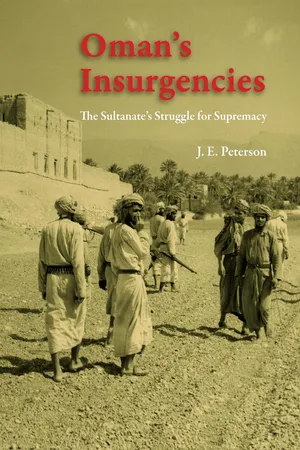
Oman today is a rapidly modernizing and peaceful country on the fringes of a region in turmoil. It does, however, have a long history of internal strife. In the twentieth century, this strife took the form of two internal conflicts. The Northern Oman or al-Jabal al-Akhdar War of the 1950s was a struggle between the forces of the old tribally based Imamate and the newer Sultanate in the northern part of the country. In the Dhufar War of the 1960s-70s an anti-Sultanate - and later Marxist - front sought secession in the south. J. E. Peterson takes a detailed look at these two wars in the context of insurgency and counter-insurgency warfare. He surveys Oman's transition from a strictly traditional regime controlling only parts of the country to a modern, inclusive state, particularly in terms of security concerns. Peterson analyses the development of the Sultanate's successful responses to security challenges, especially in the creation and evolution of modern armed forces.
Information
CHAPTER ONE
The Sultanate and its Challenges
Throughout much of Oman’s history, central government consisted of little more than a respected and accepted authority figure, generally an Ibadi Imam, and a small coterie of religious cum secular officials. While there were armed retainers or shurat at the disposal of the Imam and his walis (representatives in various towns and regions), effective power resided within the tribes. It was the duty of the tribal shaykhs (leaders) to provide armed forces at the command of the Imam when necessary, particularly when Oman was threatened from the outside. But, in practice, the shaykhs were independent and they were most concerned with protecting and advancing their own interests. This often involved inter-tribal conflict. In such cases, the Imam’s role was reduced to that of an arbitrator. When the Imamate degenerated into hereditary dynasties, the focus of such dynasties was generally on maritime enterprise and foreign conquest.
The emergence of the Sultanate, as outlined below, brought little difference. The first of the Al Bu Sa‘id rulers was proclaimed Imam despite having little religious qualification. His successors, even after they moved their capital to the coastal town of Muscat, changed little in the way they governed. Even the most renowned of the Al Bu Sa‘id, Sa‘id bin Sultan, spent most of his energy in building his fleet and extending his control over Zanzibar and the East African littoral. His descendants in Oman, bereft of the African possessions and resources, held on to power only shakily, thanks in large part to British quasi-protection.
As Oman entered the twentieth century, its Sultans, along with their British allies, were constantly aware of the difficulty of maintaining power in the absence of modern armed forces. This was brought into sharp focus by the Battle of Bayt al-Falaj in 1915, in which Indian Army troops stationed in Muscat successfully defended Muscat from invasion. Even though a local levy corps finally replaced these troops in 1921, the small size and lack of capabilities of the new force gave the government very little military potential. Expansion beyond the small garrison force was left to the early 1950s, when the intrusion of external factors was directly responsible for the addition of another two small units. These were enough to allow the Sultanate to regain control of the interior but not sufficient to maintain its control.
Throughout the last century or two, undoubtedly Oman’s closest international friend has been Britain. In addition to direct military assistance, Britain has also provided financial help and political support. Until 1947, Anglo-Omani relations were conducted through India, as British representation in the Gulf was the responsibility of the then-British Government of India. The senior representative was styled the political resident in the Persian Gulf (PRPG), and he made his headquarters in Bushire (Bushehr) on the Persian coast. Under him were a series of political agents stationed along the Arab littoral, including one in Muscat. Because Oman was always independent, the political agent in Muscat also carried the title of consul and thus reported to the Foreign Office in London on some matters. With Indian independence, the PRPG shifted to Bahrain and the chain of command went direct to the Foreign Office in London. Soon after the change of government in Oman in 1970, the British representative in Muscat was upgraded from consul-general to ambassador.
In the 1950s, a mix of factors meshed to produce a volatile situation in Oman. During the second half of the nineteenth century, various attempts had been made to resuscitate the Ibadi Imamate. But efforts to capture Muscat and replace the Al Bu Sa‘id dynasty had foundered because of British opposition. The Imamate was finally restored in 1913, but its writ ran only in the interior while the Sultanate retained control of Muscat and the coast. This bifurcated situation lasted until the death of the respected Imam in 1954. The alliance of his weak successor with external Arab support failed to protect his independence from Sultanate encroachment. While the Imamate never existed again in a real sense after 1955, its supporters continued to solicit pan-Arab support and wage rebellion against Sultanate forces. The Sultan was heavily dependent on British backing, which was reluctantly given amid Britain’s controversial standing in the Arab world after its participation in the 1956 Suez invasion of Egypt. The only way out of the dilemma of protecting an isolationist Sultan against an Arab-backed proto-Imamate movement was to create proper armed forces in Oman. This process was begun in 1958.
These armed forces had hardly brought peace to interior Oman when another dissident movement took shape in the southern province of Dhufar. Annexed to the Al Bu Sa‘id dominions only in the nineteenth century, Dhufar had never been properly integrated into the Sultanate and successive Sultans seemed to regard it as their personal property. An incipient rebellion against petty treatment by the reigning Sultan in the early 1960s morphed into a broader Dhufari nationalist movement a few years later. By the late 1960s, its leadership had been captured by Dhufari Marxists who counted on support from neighbouring South Yemen and the Soviet Union, China, East Germany and Cuba. British support was again required and provided, along with help from Jordan and Iran.
Thus, over the course of the twentieth century, the challenges to the Sultanate’s authority shifted from efforts to re-establish the ‘traditional’ institution of the Ibadi Imamate, to a struggle between the tribal interior and the British-backed Sultanate of the coast, to an insurgent movement more familiar on a world scale: a leftist front against a conservative, Western-supported regime. In the immediate sense, the Sultanate’s survival was assured by military means, as it prevailed in all these minor wars. In a more fundamental sense, however, the Sultanate remains the established regime in Oman because it has adapted to changing circumstances and, particularly in the post-1970 era, both accommodated the material needs of its people and integrated interior with coast and Dhufar with Oman.
Insurgency and Counter-insurgency
The Omani experience in defeating these insurgencies was the result of a combination of local authority, i.e. the Sultan, and persistent yet often restrained British support. The Sultan provided the legitimacy and the rallying point around which a government authority and local armed forces could be established and nurtured. Britain provided the funds, equipment, officers, direct military support on occasion, and Oman’s interface with the outside world. British officers and officials also introduced and employed emerging concepts of counter-insurgency operations to combat changing strategies of insurgency. Consequently, it may be useful to explore some of the relevant concepts.
Guerrilla and Revolutionary Warfare
Guerrilla warfare can be said to have an ancient pedigree. One exhaustive examination of such wars begins with the Scythians, Alexander the Great and Hannibal, and proceeds to trace its progress through the following millennia.1 But the last two centuries witnessed an explosion in and the refinement of the guerrilla strategy, particularly in terms of resisting invaders and opposing colonial regimes. The very name, ‘guerrilla’, points to the employment of such fighting by Spanish insurgents against Napoleonic France. Guerrilla warfare characterized the tactics of Native Americans against Europeans, Cubans against the Spanish in the 1890s, Filipinos against the US in 1899 and Nicaraguans against the US in the 1920s.2
After World War II, there arose a plethora of small wars in which Western powers were involved. Most of these were colonial conflicts or derived from colonial conflicts: Indochina (French), Indonesia (Dutch), Algeria (French) and Vietnam (United States). Others were insurgent movements aimed at replacing sitting governments, with little or no external involvement. The best known of these was the Communist campaign to take over China. But the insurgency led by Fidel Castro in Cuba also resulted in the emergence of Ché Guevara as a revolutionary icon and insurgency theorist.
The mid-twentieth century offered refinement of the strategy and its incorporation into the political principle of ‘revolutionary war’, defined as ‘A form of warfare which enables a small ruthless minority to gain control by force over the people of a country and thereby to seize power by violent and unconstitutional means.’3 The other factor in the transformation of the guerrilla strategy into revolutionary war was the emergence and adoption of Communist ideology. Within this influence, the experience and theories of Mao Tse-Tung provided a widely followed reference and model. The insurgencies following Maoist precepts were naturally mostly Communist in ideology, but the principles were universal and were employed by other nationalist dissident movements.
In the post-World War II era, the Communist takeover of China provided the earliest example of a successful ‘revolutionary war’ strategy. However, the Malayan insurgency of 1948–56, with a Communist front composed of largely ethnic Chinese battling the British and mostly Malayan plantation workers, was defeated by successful British counter-insurgency strategy, notably reliance on effective intelligence, extensive patrolling that hampered guerrilla movements and refuges, and cultivation of popular support with progressive moves towards the granting of Malayan independence. The United States made use of the lessons of the emerging British model of counter-insurgency warfare in the Philippines, but failed to apply them in Vietnam.4
Success in the Sultanate of Oman’s struggles against dissidence or insurgency was largely due to British assistance and involvement. This meant that British strategy and operations in Oman reflected British experience in small wars, particularly following World War II.5 The British mandate in Palestine faced increasing opposition from extremist Jewish groups during the 1930s and especially in and after World War II. The Irgun and the so-called Stern Gang carried out attacks on British troops, assassinated Lord Moyne, the minister of state in Cairo, and bombed the King David Hotel in Jerusalem. A deepening cycle of terrorism and counter-terrorism, as well as pressure from US support for the Jewish cause, forced Britain to end the mandate in 1948 and withdraw amid fighting between Jews and Arabs.
In Malaya, post-war British attempts to create a federation balancing Malay interests with those of the Chinese and Indian communities faltered on Malay opposition. By 1948, a Chinese-dominated Communist party, drawing on support from Chinese plantation workers, began a pattern of guerrilla attacks against plantations, military installations and police. Several years of slow buildup of the police and military failed to dent the insurgency, largely because of the employment of conventional tactics against unconventional forces. Eventually, more appropriate tactics were devised: winning the support of the civil population, the mass resettlement of villagers and extensive patrolling by small units of police and military with village militias, including the Special Air Service (SAS). By 1955, the ‘emergency’ had been largely contained although the government’s consolidation phase lasted until 1960.
The origins of the Mau Mau rebellion in Kenya lay in the grievances of the Kikuyu over ‘stolen land’ worked by the white population. Under the leadership of Jomo Kenyatta, some dissident activities began in 1948. The so-called Mau Mau grew increasingly extremist over the following years, but the government seemed ill-prepared to respond effectively. By 1953, more than 10,000 British troops were fighting the insurgency, along with 15,000 police and 20,000 home guards. Their efforts, however, were hampered by the expanse of territory to be contained and the rough forest terrain. A mile-wide ‘prohibited area’ complemented by a 50-mile-long ditch filled with sharpened stakes and barbed wire was established to deny the Mau Mau sanctuary in the Forest Reserves, and the forests were bombed while stringent measures were introduced to control the civil population. Frank Kitson, then a young British officer, introduced ‘pseudo-gangs’ to infiltrate Mau Mau gangs and gain intelligence. Massive sweeps were carried out to capture or kill Mau Mau insurgents, and the capture of the remaining leader effectively ended the war in 1956. Kenyatta was freed in 1961 and became president of an independent republic in 1963.
The Cyprus insurgency began in the early 1930s when Greek Cypriots began opposing British rule and calling for union with Greece. Following World War II, George Grivas organized harassing activities against the British through the EOKA, and the British decision in 1954 to move its Middle East land and air headquarters from Suez to Cyprus, thus indicating its intentions to keep sovereignty over the island, inflamed the situation. The following year, the EOKA organized protests and began attacking police. Negotiations with moderate Greek Cypriots were halted in 1956 when Archbishop Makarios was exiled to the Seychelles, leaving leadership in the hands of the more extreme Grivas. In response, the EOKA stepped up its attacks and the government responded with heavy-handed tactics that alienated much of the population. British security measures were attenuated because of the Suez War that year, allowing the small EOKA forces to expand their activities, while British recruitment of Turkish Cypriots into the police widened the conflict into a Greek-Turkish divide. Two years later, Britain offered sovereignty in return for permanent base rights: Makarios agreed and Grivas was forced to disband the EOKA and relocate to Greece.
Not surprisingly, these wars generated a considerable amount of theorizing about ‘counter-insurgency’ methods, in large part meant to guide British military policy in future conflicts. For Oman, three of the theorists who seem to have had considerable impact on British operational thinking were Robert Thompson, Julian Paget and Frank Kitson.
Thompson’s ideas grew out of his experiences as a field officer and then a staff officer in Malaya during the ‘Emergency’ in the 1950s and later as head of the British Advisory Mission to Vietnam in the early 1960s. His earlier writings were largely specific to the Vietnam case study, but the third of his books on the subject encompassed explanation of what he termed ‘revolutionary war’ and the role of the Soviet Union and Communist China in promoting it.6
Paget was a serving British officer tasked with developing measures to counter the anti-British groups in Aden in the second half of the 1960s. He had also served in Palestine from 1945 to 1948. The outcome of his researches from earlier conflicts and his experience in Aden was a book titled Counter-insurgency Operations: Techniques of Guerrilla Warfare7.
Kitson had seen action with the British Army in Kenya and Malaya before a War Office appointment involved him in the planning for the 1950s’ operations in Oman. Subsequently, he saw action in Cyprus as well. Although his ideas of ‘counter-insurgency’ warfare took form during his involvement with these wars, their exposition in book form did not appear until the 1970s.8 Kitson’s Low Intensity Operations caused a stir on its publication in 1971. His central thesis was that the British Army had been trained primarily for conventional warfare, whereas most of its operations since World War II had involved small wars. He therefore advocated greater emphasis on counter-insurgency training, and stressed that responsibility for intelligence should rest with the army rather than the police. But since his book appeared at a time when Northern Ireland was becoming particularly troublesome, controversy arose over the application of his ideas to urban unrest rather than colonial or Third World conflicts.9
It will be noted that all of the publications of the above theorists postdate the war in northern Oman, although not necessarily the war in southern Oman. As argued later, the 1950s’ fighting in Oman largely followed a pattern of more conventional warfare – apart from during the final phase in which the Imamate leaders were evicted from their mountain fastness. Furthermore, it should be kept in mind that, for reasons that will become apparent later in this book, the war in northern Oman and the war in southern Oman were markedly di...
Table of contents
- Cover
- Title
- Contents
- Preface
- Abbreviations
- 1. The Sultanate and its Challenges
- 2. War in Northern Oman
- 3. War in Southern Oman: the Front Ascendant
- 4. War in Southern Oman: the Sultanate Victorious
- 5. The Triumph of the Sultanate
- Appendix 1: Glossary and Gazetteer
- Appendix 2: Sultanate Command Arrangements
- Appendix 3: A Chronology of the War in Northern Oman
- Appendix 4: A Chronology of the Dhufar War
- Maps
- Bibliography
- Index
- Tables
- Copyright
Trusted by 375,005 students
Access to over 1.5 million titles for a fair monthly price.
Study more efficiently using our study tools.
Frequently asked questions
Yes, you can cancel anytime from the Subscription tab in your account settings on the Perlego website. Your subscription will stay active until the end of your current billing period. Learn how to cancel your subscription
No, books cannot be downloaded as external files, such as PDFs, for use outside of Perlego. However, you can download books within the Perlego app for offline reading on mobile or tablet. Learn how to download books offline
Perlego offers two plans: Essential and Complete
- Essential is ideal for learners and professionals who enjoy exploring a wide range of subjects. Access the Essential Library with 800,000+ trusted titles and best-sellers across business, personal growth, and the humanities. Includes unlimited reading time and Standard Read Aloud voice.
- Complete: Perfect for advanced learners and researchers needing full, unrestricted access. Unlock 1.5M+ books across hundreds of subjects, including academic and specialized titles. The Complete Plan also includes advanced features like Premium Read Aloud and Research Assistant.
We are an online textbook subscription service, where you can get access to an entire online library for less than the price of a single book per month. With over 1.5 million books across 990+ topics, we’ve got you covered! Learn about our mission
Look out for the read-aloud symbol on your next book to see if you can listen to it. The read-aloud tool reads text aloud for you, highlighting the text as it is being read. You can pause it, speed it up and slow it down. Learn more about Read Aloud
Yes! You can use the Perlego app on both iOS and Android devices to read anytime, anywhere — even offline. Perfect for commutes or when you’re on the go.
Please note we cannot support devices running on iOS 13 and Android 7 or earlier. Learn more about using the app
Please note we cannot support devices running on iOS 13 and Android 7 or earlier. Learn more about using the app
Yes, you can access Oman's Insurgencies by John Peterson,J. E. Peterson in PDF and/or ePUB format, as well as other popular books in History & Middle Eastern History. We have over 1.5 million books available in our catalogue for you to explore.