eBook - ePub
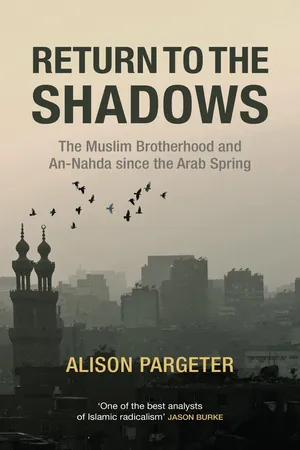
Return to the Shadows
The Muslim Brotherhood and An-Nahda since the Arab Spring
- 300 pages
- English
- ePUB (mobile friendly)
- Available on iOS & Android
eBook - ePub
About this book
The Arab Spring heralded a profound shift in the Middle East, bringing to power Islamist movements which had previously been operating in the shadows. The Muslim Brotherhood stormed to victory in Egypt and emerged as a key player in Libya's nascent political arena. Meanwhile, An-Nahda found itself catapulted into power as the head of Tunisia's coalition government. For a while, it looked as though the region was entering the dawn of a new Islamist age. But navigating their respective countries through difficult and painful transitions ultimately proved too challenging for these forces, and, just as suddenly, the Brotherhood was dramatically overthrown in Egypt and left severely weakened in Libya. In Tunisia, An-Nahda managed to pull itself through the crisis, but its failure to articulate and deliver the hopes and aspirations of a large section of Tunisian society damaged its credibility. In this authoritative account, Alison Pargeter expertly charts the Islamists' ascent and subsequent fall from power. Based on extensive research and interviews with high ranking members of the Brotherhood and An-Nahda, Pargeter offers a comparative analysis of the movement in North Africa since the Arab Spring, and outlines the consequences of the Brotherhood's decline on both the region and the wider Islamist political project.
Information
PART ONE
EGYPT
ONE
THE RISE OF THE BROTHERHOOD
As thousands of young Egyptians poured into the streets on 25 January 2011 to protest against the Mubarak regime, the Egyptian Muslim Brotherhood was thrown into disarray. Despite the events that had unfolded in neighbouring Tunisia, unleashing an air of change across the region, the Brotherhood appeared almost as taken aback by this sudden show of people power as the regime itself. The Brotherhood may have been the country’s oldest and longest-suffering opposition movement, but its leadership was cautious about rushing headlong into what was still a developing situation. Instead, it watched what was unfolding as it deliberated over what stance to take. This cautious approach was driven partly by a strong sense of self-preservation. Having suffered years of repression at the hands of successive regimes, the movement feared making any wrong move that might lead to a further truncation of the limited space for activity that it had so painstakingly carved out over the decades. Although still an outlawed movement whose members were regularly rounded up and imprisoned, the Brotherhood was able nonetheless to operate under the radar, carrying out its educational and charitable activities, and periodically dipping its toe into Egyptian politics. The movement was not about to squander such gains lightly.
More importantly, the Brotherhood had never been a revolutionary movement, either politically or ideologically. Its teachings advocated a gradualist approach that revolved around reforming society from the bottom up, with the aim of preparing it for the eventual establishment of an Islamic state. As former Murshid, or Supreme Guide, Mehdi Akef proclaimed in May 2005, ‘We are not people of revolution. Revolution is not part of our vocabulary.’1 Having held to this principle since its founding in 1928, the Brotherhood was hardly going to rush headlong into protests calling for the overthrow of the regime – or at least not until it became clear where these protests might lead.
In addition, on the eve of the revolution the Brotherhood was already on the back foot, and seemed like a movement that had turned in on itself. The long years of sacrifice, which had yielded so little, were starting to take their toll, and the Brotherhood become embroiled in petty squabbles and turf wars. Furthermore, there was a growing feeling of disenchantment inside the movement. The Brotherhood’s attempts during the 2000s to engage more directly in the political arena, through the development of a new reformist discourse aimed at winning over both a domestic and an international audience, had produced few tangible results, prompting increasing calls inside the movement for it to turn its back on politics and focus instead on its traditional activities of preaching and education. In many ways, it seemed as though the Brotherhood had resigned itself to the role of a semi-clandestine opposition movement that would never have the chance to put its Islamist project into practice.
The revolution thus acted as a wake-up call for the Brotherhood, jolting it out of its inertia. Despite its initial hesitation, once it became apparent that Egypt was on the brink of major change, the movement shed it cautious approach and threw itself fully behind the unfolding events. In the absence of any other opposition movement or force that could match the Brotherhood’s size or weight, it was not long before it was propelled to the fore. Emboldened by events and by a sense of its own mobilising power – which until now had been something it could only guess at, given its status as an outlawed movement – this was a position it seemed to relish. Once it saw its chance, this ‘non-revolutionary’ movement swept up the revolution in its arms, carrying it as if it were its own. Thus, while it is true that the Brotherhood did not initiate the revolution, accusations such as those of the US secretary of state, John Kerry – who claimed that the Brotherhood had ‘stolen’ the revolution from the ‘kids’ in Tahrir Square2 – were overheated. Once the Brotherhood committed itself to the revolution, it became its major driving force. Without the Brotherhood, it is far from clear whether the revolution would have got as far as it did.
The realisation that it was shouldering the revolution gave the Brotherhood a strong sense of entitlement, which was further enhanced by the movement’s sense of its own destiny. Having suffered patiently for so many long years, the Brotherhood felt that its preordained time had finally come. As it internalised the revolution, therefore, it started to direct events according to its own agenda. Less than two weeks after the protests had begun, the Brotherhood opened negotiations with the very regime it was protesting against. Indeed, with its natural aversion to revolutionary action, the Brotherhood jumped at the first opportunity to strike some sort of deal with the regime, despite the fact that those protesting in the streets and squares – including some of its own youth factions – were averse to any kind of compromise with the forces of the past. The Brotherhood was so caught up with itself and its own agenda, however, that it forged ahead, even claiming that it was negotiating with the regime in the name of the ‘the people’.
The Brotherhood continued along this track following Mubarak’s departure, entering into a kind of informal alliance with the military in which these two old powers thrashed out the terms of the transition. In fact, the Brotherhood seemed more comfortable dealing with the familiar furniture of the old regime – however unpalatable it may have been – than with the unknowns of Tahrir Square. Once the Brotherhood realised its own power and strength, it was therefore willing to cut the revolution short in order to achieve its own objectives. Not that it abandoned the revolution entirely. Seeing no contradiction in planting one foot with the regime and the other with the revolution, the Brotherhood continued to mobilise those on the streets to pressurise or dictate its own terms whenever the need arose. The Brotherhood used the revolution, in short, as a tool to try to secure the post-revolutionary order it desired.
This strategy paid off. By the time of the parliamentary elections, held between 28 November 2011 and 11 January 2012, the Brotherhood had positioned itself to dominate the transition. It had mobilised its networks to fill the political space opened up by the fall of the Mubarak regime; steered and taken charge of the revolution, enabling it to claim revolutionary legitimacy; and moulded the transition to derive maximum benefit for itself. In addition, the Brotherhood enjoyed the extra legitimacy arising out of its long years of sacrifice and suffering. It was able to portray itself as a clean and untainted alternative to the deposed regime. More importantly for many Egyptians, it also additional legitimacy through its identification with Islam and for some of its supporters represented Islam itself. It was hardly surprising, therefore, that when the elections came around the Brotherhood stormed ahead, its coalition taking 47.2 per cent of the vote. The Brotherhood looked unstoppable.
This did not mean that the movement had abandoned its traditional caution. Aware of concerns expressed both internationally and at home, the Brotherhood was at pains from the start to dispel any impression that it was power-hungry. It issued repeated promises that it was not seeking to dominate, that it would not be running for the presidency, and that it sought to share power. It was keen to give assurances, too, that it was not intent on Islamicising the state, but simply sought to re-anchor Egypt to its Islamic roots and traditions. The Brotherhood was keen to present an image of itself as a modern political Islamist movement that could meet the challenges of contemporary governance.
Yet as the transition progressed, the Brotherhood struggled to live up to such a heavy responsibility. It quickly fell back on its old way of doing things, entering into marriages of convenience and manoeuvring its way through by making promises it could not keep. It became reactive, responding to events as they arose with no clear vision for how to deal with the transition, let alone the period of rule. The Brotherhood thus gave the impression from very early on that it could not be trusted, and that its only real aim was to get to the end of the transition and into power. But at this stage it hardly seemed to matter. After almost a century in semi-clandestine opposition, the Brotherhood was poised to take over and Egypt looked to be on the dawn of a whole new era.
Reluctant Revolutionaries
It was scarcely a surprise that, when the revolution unfolded, the Brotherhood felt its time had come. Waiting in the wings for over eight decades, the Brotherhood had endured a long and arduous struggle marked by more downs than ups, in which it had paid a heavy price. Although the movement had shown a remarkable capacity for survival, turning itself into the most potent opposition force in the process, it had never come close to power and was always relegated to the margins.
Established by schoolteacher Hassan Al-Banna in 1928, the Brotherhood emerged as a response partly to the colonial presence in Egypt, but also to the sense of crisis engendered by the end of the last caliphate: the Ottoman Empire. Al-Banna, who was deeply preoccupied by what he saw as the moral degeneration of society, drew on the works of late-nineteenth-century reformist scholars such as Rashid Rida and Muhammad Abdu, promoting a simple message holding that the only way the Islamic world could meet the challenges posed by modernisation and encroaching Westernisation was to return to the ‘uncorrupted’ values of the Islamic past. As Egyptian philosopher Hassan Hanafi commented, Al-Banna’s ideas amounted to ‘an Islam that is simple and clear ... His ideas were very clear, very pure, and there was no ideological complexity.’3 Indeed, the Brotherhood’s primary message was that Islam offered a comprehensive system of values and governance that would bring social and moral renewal – hence its famous motto: ‘Islam is the solution’.
The Brotherhood had thus never been a visionary movement, seeking the establishment of an entirely new order. Rather, its conservative ideology sought to imbue the existing order with Islam, focusing on gradual change from the bottom up. To this end the Brotherhood concentrated its attentions on educating and improving the individual, and by extension the family, viewing this as the best means to prepare society for the eventual establishment of an Islamic state. By providing its members with a rigorous Islamic ‘upbringing’, and subsequently enlisting them in religious outreach, the Brotherhood could enlarge the circle of committed Muslims until it encompassed society as a whole.4 Its approach is encapsulated in the words of one of its most prominent thinkers, Sayid Qutb, who replied when asked whether the Brotherhood wanted to kill President Gamal Abdul Nasser, ‘Killing Abdul Nasser is a stupid aim that we do not seek to achieve. The aim of the Brotherhood is to educate Muslims in order that they don’t give birth to the likes of Abdul Nasser.’5
Right from the start, then, the Brotherhood was always more of an organisational force than an intellectual one, reflecting the qualities of Al-Banna himself, who was described by his former secretary, Farid Abdel Khaliq, as someone who ‘wasn’t about absolute ideas. He was an organisational thinker ... He translated theoretical ideas into reality.’6 The Brotherhood was therefore a movement held together by the glue of Islam that presented itself as the guardian of an authentic native tradition, rather than a movement of ideas – least of all revolutionary ones.
Al-Banna’s message proved potent, and the movement soon gathered momentum, spreading quickly across Egypt and beyond. However, while it started out primarily as a social and cultural movement, the Brotherhood’s increasing involvement in politics meant that it soon came into direct conflict with the state. Firstly, in 1948, the monarchy banned the movement after its secret wing was implicated in a series of acts of violence against both British colonising forces and a number of public figures. Secondly, opposition came from the modernising secular regime of President Abdul Nasser, who had come to power in a military coup in 1952. Nasser viewed the Brotherhood as a reactionary opposition force. After a failed assassination attempt against him, he clamped down hard on the movement, carrying out a series of mass arrests that almost wiped it out.
It was during this time that more radical ideas started to emerge inside the movement. This was largely through the works of Sayid Qutb, who penned a series of tracts from prison arguing that, in order to achieve the ideal state, or Al-Hakimiya (‘God’s rule on earth’), the minority who truly understood Allah should be allowed to apply his rules. Only this, he held, would rid society of Jahiliya (pre-Islamic ignorance), and restore a proper moral order. Qutb’s hugely controversial depiction of Egyptian society as jahili, or non-Islamic, as well as his top-down approach to revolution, did not sit comfortably with the main body of the movement. Thus, while Qutb’s ideas held an attraction for more radical elements in the Brotherhood (sometimes referred to as the 1965 group, or generation), they did not result in a more generalised shift away from the core principles upon which the movement had been founded.
The coming to power of President Anwar Sadat in 1970 heralded the start of a period of revival for the Brotherhood. Firstly, Sadat saw that he could use the Brotherhood as a useful counterweight to his leftist and Nasserist opponents, and he released Brotherhood members from prison. Although the movement was still banned and subjected to periodic crackdowns, it at least ha...
Table of contents
- Cover
- Title
- Copyright
- Contents
- Acknowledgments
- Introduction
- Part One: Egypt
- Part Two: Libya
- Part Three: Tunisia
- Conclusion
- Notes
- Bibliography
- Index
Trusted by 375,005 students
Access to over 1.5 million titles for a fair monthly price.
Study more efficiently using our study tools.
Frequently asked questions
Yes, you can cancel anytime from the Subscription tab in your account settings on the Perlego website. Your subscription will stay active until the end of your current billing period. Learn how to cancel your subscription
No, books cannot be downloaded as external files, such as PDFs, for use outside of Perlego. However, you can download books within the Perlego app for offline reading on mobile or tablet. Learn how to download books offline
Perlego offers two plans: Essential and Complete
- Essential is ideal for learners and professionals who enjoy exploring a wide range of subjects. Access the Essential Library with 800,000+ trusted titles and best-sellers across business, personal growth, and the humanities. Includes unlimited reading time and Standard Read Aloud voice.
- Complete: Perfect for advanced learners and researchers needing full, unrestricted access. Unlock 1.5M+ books across hundreds of subjects, including academic and specialized titles. The Complete Plan also includes advanced features like Premium Read Aloud and Research Assistant.
We are an online textbook subscription service, where you can get access to an entire online library for less than the price of a single book per month. With over 1.5 million books across 990+ topics, we’ve got you covered! Learn about our mission
Look out for the read-aloud symbol on your next book to see if you can listen to it. The read-aloud tool reads text aloud for you, highlighting the text as it is being read. You can pause it, speed it up and slow it down. Learn more about Read Aloud
Yes! You can use the Perlego app on both iOS and Android devices to read anytime, anywhere — even offline. Perfect for commutes or when you’re on the go.
Please note we cannot support devices running on iOS 13 and Android 7 or earlier. Learn more about using the app
Please note we cannot support devices running on iOS 13 and Android 7 or earlier. Learn more about using the app
Yes, you can access Return to the Shadows by Alison Pargeter in PDF and/or ePUB format, as well as other popular books in Politik & Internationale Beziehungen & Europäische Politik. We have over 1.5 million books available in our catalogue for you to explore.