- 334 pages
- English
- ePUB (mobile friendly)
- Available on iOS & Android
eBook - ePub
About this book
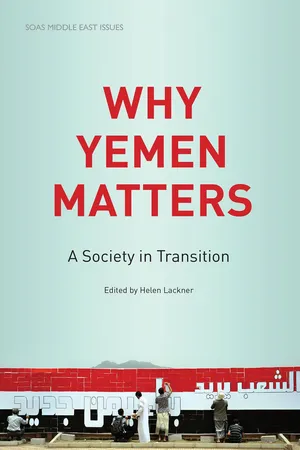
In November 2011, an agreement brokered by the GCC brought an end to Yemen's tumultuous uprising. The National Dialogue Conference has opened a window of opportunity for change, bringing Yemen's main political forces together with groups that were politically marginalized. Yet, the risk of collapse is serious, and if Yemen is to remain a viable state, it must address numerous political, social and economic challenges.
In this invaluable volume, experts with extensive Yemen experience provide innovative analysis of the country's major crises: centralized governance, the role of the military, ethnic conflict, separatism, Islamism, foreign intervention, water scarcity and economic development.
This is essential reading for academics, journalists, development workers, diplomats, politicians and students alike.
Information
PART ONE
POLITICS AND SECURITY
CHAPTER ONE
YEMEN BETWEEN REVOLUTION AND COUNTER-TERRORISM
Sheila Carapico
YEMEN’S LAYERED AND COMPLEX dialectics pit twenty-first-century optimism against twentieth-century cynicism. A struggle is unfolding between, on the one hand, the demographic majority in the most populous corner of the Arabian peninsula and, on the other, entrenched elites from a bygone era, anachronistic neighbouring gerontocracies and post-9/11 American imperialism. Aspirations of the forward-looking youth are thwarted not only by an intransigent domestic ruling class seeking to preserve the status quo, but also by the larger context of the outmoded Saudi-American-GCC ‘stability’ pact. Neither the unarmed movement for domestic political change – blessed with many strong personalities but no overall leader – nor the armed conflicts within Yemeni borders (the Huthi rebellion, al-Qa‘ida jihadis, American and sometimes Saudi airstrikes, militant elements of the southern Hiraak, and battles between rival elements in the armed forces) can be fully understood in purely endogenous terms. Instead, they reflect the profound contradictions of the Arabian peninsula between the wealth and passivity of the Gulf and Yemen’s destitution and chaos.
This chapter juxtaposes these seemingly two quite different storylines – one about Yemeni aspirations for social justice and better governance and the other about American and Saudi operations undertaken in the name of combating terrorism. The so-called GCC Initiative, and in particular the National Dialogue Conference process playing out as this book goes to press, provides the link between them. From the perspective of domestic politics, the Dialogue can be read as the outcome of agitation by the new generation of ‘peaceful youth’, as well as an outgrowth of Yemen’s tradition of dialogue – an historic effort to resolve crisis through broad negotiation between representatives of various political constituencies. In the context of the ‘war on terror’, however, the GCC Initiative and even the donor-sponsored Dialogue among political elites can be seen as security-driven or even hegemonic projects on the part of the US and its ally, the Kingdom of Saudi Arabia.
Fed up with three decades of corrupt, venal dictatorship, suffering from ecological and economic collapse, and inspired by the uprisings that toppled autocrats in Tunisia and Egypt, Yemenis mobilized on an unprecedented scale to express their discontent in early 2011 and continued peacefully to demonstrate for change throughout the year, even as dissidents and loyalists within the military waged war on one another, and as the president was injured, left the country for treatment and then returned. Popular demands were only partly met when Saleh’s deputy, Abd Rabbuh Mansur Hadi, was inaugurated as president on 27 February 2012, after an election organized by international donors in which he was the sole candidate, and only partly addressed by the ambitious National Dialogue negotiations. In the meantime, the Obama administration pursued a military strategy of targeted and ‘signature’ strikes – extrajudicial assassinations – while paying only perfunctory lip service to Yemenis’ legitimate political aspirations.
A CIVIC REVOLUTIONARY MOVEMENT
In February 2011, Tawakkul Karman stood on a stage outside Sana‘a University, a microphone in one hand and the other clenched defiantly above her head, leading a crowd of tens of thousands of cheering, flag-waving protesters. On other days and in other cities, other citizens led the chants. These mass public performances enacted a veritable civic revolution in a south-west Arabia where previous activist surges had never produced democratic transitions, but nonetheless did shape national history. Drawing inspiration from the Tunisian and Egyptian examples, as well as from home-grown, often localized protest repertoires, activists occupied the national commons as never before, animating a public civic renaissance with new forms of protest and expression. Women’s public participation registered seismic sociocultural change. Whether this popular uprising – wracked by intra-elite street battles, perverted by proxy petrodollar machinations and complicated by American counter-terror operations – ends in glory or tragedy, its social, psychological and political significance is inestimable. As in Tunisia and Egypt, the experience of collective, contentious mobilization ‘from below’ energized a veritable cultural transformation. Yemen’s ‘peaceful youth’ (shabab al-silmiyya) are the frontline of revolution against the status quo in the Arabian peninsula.
Frustrations in the poorest Arab country had been mounting for years on a number of fronts. Patronage was rampant.1 Restlessness stirred around the president’s clear intention to ordain his son, already commander of the nation’s Republican Guard, as his successor; postponement of parliamentary elections; widespread unemployment, especially among young people; deteriorating standards of living for all but the upper echelons of the ruling kleptocracy; ecological depredations against a formerly self-sufficient agricultural economy, resulting in serious environmental damage and acute water shortages; abysmal educational and medical facilities, sanitation, and physical infrastructure; crude resort to censorship, harassment, arbitrary detention and brutality against journalists, dissidents and regime opponents; and profound, widespread malaise.
By late 2010, regional demonstrations or uprisings had emerged in various parts of the country with seemingly various complaints. Most dramatically, people in the former PDRY until 1990 formed a movement known simply as Hiraak.2 For several years, its supporters had been marching and staging displays in the Arabian Sea port city of Aden and outlying provinces like Hadhramaut and Abyan.3 The movement revived some slogans, motifs and performative elements of the old anti-colonial struggle in Aden, Abyan, Dhala‘, Hadhramaut and other communities in what were then known as the British ‘Protectorates’.4 Again, these blended Socialist elements with locally distinctive traditions of dance, dress and dialect. Hiraak also depended on human rights organizations and municipal newspapers established during the opening that followed unification in the early nineties. Saleh and his official media could portray their agony as treasonous southern irredentist threats to national unity reminiscent of the 1994 civil war. And indeed some citizens flew the flag of the old People’s Democratic Republic even as others joined the nationalist movement to oust the national regime in Sana‘a. Over the next couple of years the irredentist element of the Southern movement swelled.5 Moreover, there was a more openly armed rebellion rooted in complicated, sometimes counter-intuitive sectarian and tribal frictions in the far northern province of Sa‘ada, seemingly exacerbated by proximity to the Saudi border and unquestionably provoked by Wahhabi Saudi missionaries’ absolutist fundamentalism.6
In cities and provinces between these geographical extremes, people were disheartened by high-level corruption, nepotism, and favouritism towards the president’s Hashid tribal confederation and his own family members. It turned out that the tribulations of Southerners resonated throughout Yemen: the grotesque enrichment of regime cronies at the expense of the multitudes; obscenely bad stewardship of the commons; the skyrocketing price of meat, staples and even clean water; the lack of jobs for college and high school graduates. In a Wikileaked cable, the American ambassador had already noted in 2005 that riots prompted by the lifting of fuel subsidies possibly presaged a mass revolt, especially but not only among the perennially restive tribes of the north-eastern provinces of al-Jawf and Mareb, where truckers and pump-farmers considered cheap fuel their lifeblood.7 Grandiose pageants of presidential power, half-truths in the official media, indignities suffered at military checkpoints, arbitrary arrests and imprisonments: these and other daily insults fed popular alienation, despair and frustration, most notably among young people. While a privileged few cooled off in swimming pools in their luxury compounds, the water table fell, crippling the agricultural economy that remained the livelihood of the rural majority. Farmers and ranchers facing starvation flocked to the cities, where water supplies and social services were swamped. Misery became the new normal; millions barely survived on the equivalent of a dollar or two a day. The economy was in a shambles.8
Demonstrators took to the streets in large numbers in Sana‘a, the capital – now a teeming, sprawling, poorly laid out, still picturesque low-rise city of nearly two million mostly youthful inhabitants who have overwhelmed its schools, sewage disposal system and water supplies. Home to the ruling family and its security apparatus, Sana‘a was also most exposed to its excesses and regulations, and was the prime site for parades of presidential power. After Saleh loyalists laid claim to Sana‘a’s central Midan al-Tahrir – so that it would not follow Cairo’s example of becoming a stage for malcontents – students, faculty and other activists assembled around the university campus on the western edge of the city. They named the space they claimed Change Square (‘Midan al-Taghyir’), and borrowed North African slogans – Irhal (‘Leave!’) and al-Sha’ab Yuridh Isqat al-Nizam (‘The people want the downfall of the regime’).9 Occupiers mainly represented the demographic bulge of fifteen-to-thirty-year-olds who had never known any other leadership: university students, graduates, dropouts, and those hoping for a better future. In Change Square and adjoining spaces, these ‘peaceful youth’ performed music and dance and held poetry readings, displayed posters and street art, and organized collective gestures of defiance like 50,000 pairs of clasped hands held high. The call to prayer became a call to civic engagement, and mass prayers a form of civil disobedience. The crowds around Sana‘a University swelled as villagers, farmers and other tribesmen from outlying areas joined the protests. Many of them pitched tents that eventually grew into a sprawling encampment snaking through the neighbourhood around the university campus with its own sanitation, medical services, teach-ins, and food and water supplies. As the Yemeni journalist Fare‘a al-Muslimi later put it, ‘The tribesman laid down his weapon and came to protest alongside his like-minded civilian compatriot, thus achieving voluntarily what years of attempts at banning weapons could not.’10
Interestingly, unlike in Egypt where some imagined that Facebook and the internet sparked the revolution, in Yemen Facebook membership, blogs and YouTube posts proliferated from being the preserve, in 2010, of mere handfuls of the elite with friends abroad to become major means of communications a year later. It was a cyber-explosion. While thousands joined Facebook during the spring of 2011, others blogged, hundreds practised guerrilla photo-journalism, countless numbers began to tweet. A montage of photos and video images of Ali Abdullah Saleh set to ...
Table of contents
- Cover
- Title
- Acknowledgements
- Note on Transliteration and Abbreviations
- Chronology
- Maps
- Introduction
- Part One
- Part Two
- Part Three
- Part Four
- Select Bibliography
- Notes on Contributors
- Index
- Copyright
Trusted by 375,005 students
Access to over 1.5 million titles for a fair monthly price.
Study more efficiently using our study tools.
Frequently asked questions
Yes, you can cancel anytime from the Subscription tab in your account settings on the Perlego website. Your subscription will stay active until the end of your current billing period. Learn how to cancel your subscription
No, books cannot be downloaded as external files, such as PDFs, for use outside of Perlego. However, you can download books within the Perlego app for offline reading on mobile or tablet. Learn how to download books offline
Perlego offers two plans: Essential and Complete
- Essential is ideal for learners and professionals who enjoy exploring a wide range of subjects. Access the Essential Library with 800,000+ trusted titles and best-sellers across business, personal growth, and the humanities. Includes unlimited reading time and Standard Read Aloud voice.
- Complete: Perfect for advanced learners and researchers needing full, unrestricted access. Unlock 1.5M+ books across hundreds of subjects, including academic and specialized titles. The Complete Plan also includes advanced features like Premium Read Aloud and Research Assistant.
We are an online textbook subscription service, where you can get access to an entire online library for less than the price of a single book per month. With over 1.5 million books across 990+ topics, we’ve got you covered! Learn about our mission
Look out for the read-aloud symbol on your next book to see if you can listen to it. The read-aloud tool reads text aloud for you, highlighting the text as it is being read. You can pause it, speed it up and slow it down. Learn more about Read Aloud
Yes! You can use the Perlego app on both iOS and Android devices to read anytime, anywhere — even offline. Perfect for commutes or when you’re on the go.
Please note we cannot support devices running on iOS 13 and Android 7 or earlier. Learn more about using the app
Please note we cannot support devices running on iOS 13 and Android 7 or earlier. Learn more about using the app
Yes, you can access Why Yemen Matters by Helen Lackner in PDF and/or ePUB format, as well as other popular books in Politics & International Relations & Development Economics. We have over 1.5 million books available in our catalogue for you to explore.