- 463 pages
- English
- ePUB (mobile friendly)
- Available on iOS & Android
eBook - ePub
About this book
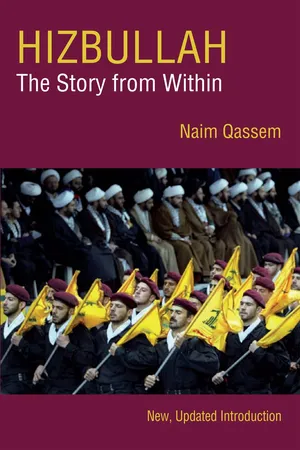
Hizbullah ('Party of God') is one of the Middle East's major political forces. Sheikh Naim Qassem, its Deputy Secretary-General, provides an insider's view of this Shi'ite resistance group turned political party, from its inception to the present day. Formed in 1982 in response to Israel's invasion of Lebanon, Hizbullah was instrumental in forcing Israel to withdraw its troops in 2000. During the 1990s, after many years functioning as both a guerrilla movement and a social-support provider to Lebanese victims of war, Hizbullah moved into mainstream parliamentary politics. The group's mandate is laid out here, allowing access to the mindset of this important party at a crucial stage of its development.
Information
Topic
Theology & ReligionSubtopic
Middle Eastern PoliticsONE
Vision and Goals
Hizbullah’s Foundation
The early 1960s in Lebanon witnessed the beginnings of an active clerical movement that served to re-invigorate Islam’s key principles. Initiated by a number of Islamic clerics just back from the holy schools of religion in Najaf in Iraq, the clerical teachings, speeches and cultural dialogue that ensued prompted many concerns and queries about Islam’s proposed role in life. Until then, neither the cultural nor political scene – both preoccupied with various core concerns – had lent any attention to the Islamic direction or foreseen a role for it.
Activity was initially limited to leading the faithful at mosque prayers and teaching religion at village schools and nearby environs. Gradually, cultural events proliferated across the various Lebanese districts, albeit within tight and limited circles. A number of young men with a serious interest in Islam attended, and then so did whole congregations. They all soon followed the clerics, forming small groups of individuals to watch over communities and playing educational and community service roles, always hinging on the cleric who oversaw and supported all efforts.
University students were rare at these gatherings, while highly motivated men actively participated in community work and gathered around the cleric and his activities. Female presence was scarce and underwhelming, and children who attended mosque prayers at the time were seen as the promising hope of the future. Indeed, this phase witnessed the Islamic condition’s humble, embryonic beginnings.
Soon, three of the active clerics drew the spotlight. Their ideological visions were comprehensive; their cultural capabilities were high and they shared a belief in the necessity of taking action to trigger a change in then-prevalent living conditions. Each had his approach, practical logic and plan of action. They met in many gatherings with peer clerics and engaged in crucial discussions over the requirements for Islamic activity in Lebanon. Each had his personal agenda, and at the practical level their approaches were independent and different, solidifying later depending on the chosen course. While core groups gathered around each cleric and were considered to be his followers, an important number of those faithful attendants participated in the various activities of all three. These clerics are:
1. Imam1 Mussa al-Sadr. The majority of his religious schooling was accomplished in sacred Qum in Iran and later resumed in holy Najaf. His activity started in the Lebanese city of Tyre, particularly through the ‘Charity and Philanthropy Association’. Soon, a regional outreach was reflected in all of his activities, which expanded at the cultural level to cover all of Lebanon. He carried obvious weight on the local scene, with many a speech given at various cultural and educational forums and a number presented inside churches. Prominent figures as well-cultured individuals from diverse backgrounds gathered around him.
His attractive personality, which was easily capable of drawing favourable public opinion, was complemented with solid, substantiated logic. His concern for the socio-political movement was early, and culminated in 1967 in the creation of the Highest Islamic Shi‘ite Council as an official religious institution set up to support and see to the concerns of the Shi‘ite congregation in tandem with peer institutions of other congregations in Lebanon. While this achievement came in spite of the disagreement and plain opposition he faced from prominent Shi‘i politicians, he nevertheless believed that the role of this Council was to group the eminent members of the Shi‘ite congregation, and is thus a specific role. The need to found a framework that bears the concerns and issues of the masses had posed itself.
In response, Imam al-Sadr founded the ‘Movement of the Oppressed’, a socio-political group with the primary mission of alleviating poverty, especially as represented by the hardship befalling South Lebanon, the Eastern Bekaa district and the so-called ‘boroughs of misery’ around the capital, Beirut (resulting from mass urbanization). Both religious as well as other types of groups joined, many simply drawn to the personality of the Imam and his ability to set the movement on its right path irrespective of the variety of individual ideologies present in its ranks. Imam al-Sadr held large-scale events in the name of the movement, rallying to drive his political statements home in the face of a neglectful and derelict government.
Imam al-Sadr also founded ‘The Ranks of Lebanese Resistance [Amal]’ – the military arm of the Movement of the Oppressed whose mission was to resist Israeli occupation. The movement was openly declared in 1974 following a bombing incident at a training camp,2 one that clearly exposed the ongoing military training and necessitated its declaration.
Author of the famous slogan ‘Israel is an utter evil’, Imam al-Sadr never ceased to call for waging war on Israel and freeing the land from its occupation. At the time, the Palestinian Liberation Organization had supervised the majority of resistance activity against occupation in South Lebanon, and Amal’s participation in a number of confrontations with Israel was recorded.
But the Imam’s mission was, alas, discontinued. He was kidnapped in Libya following an invitation received from Libyan President Muammar al-Qaddafi to attend the annual September national celebrations. The date was August 31, 1978. To date, Imam al-Sadr’s fate remains unknown.
2. Ayatullah3 Muhammad Mahdi Shamseddine. Starting his activity in East Beirut, Shamseddine led prayers at the Dekwaneh mosque and looked after the social and cultural aspects of that congregation. He later moved to Beirut’s southern suburb of Chiyah, where he chaired the Cultural and Charity Association, which worked to produce and distribute the set of ‘Cultural Direction’ educational booklets. The association was also active at the forum and discussion levels, later expanding its scope of activity to include a number of auxiliary institutions, the most significant of which was the Islamic Institution of the Arts.
He was notable for his intellectual capacity – a remarkable capability to shape words into well-founded expressions of depth and precision. He gave many lectures, held conferences for intellectuals throughout the Arab world and wrote many books. His prominence and distinguished cultural presence in many an intellectual forum was palpable.
Shamseddine’s participation in public life was initially weak, despite his qualifications, according to many, for the post of Deputy Head of the Highest Islamic Shi‘ite Council. During the tenure of Imam al-Sadr, his involvement was not proactive at the level of the Council, especially given his intellectual orientation. He was thus not part of any existing organizational frameworks, opting to ‘remain at an equal distance from all’ – as he famously chose to put it. Indeed, such a stance summarized his view of the Council’s role: that of taking all of the Shi‘ite congregation’s divergent influences under its wing.
In the context of freedom from Israeli occupation, the Ayatullah’s attempts to establish some form of large-scale civil resistance did not bear fruit, given the scope of the structure suggested by the concept. Though he was clear in his call to fight Israel and achieve liberation, his longing – as he had so many times expressed – was for assigning the larger portion of his efforts to intellectual work.
3. Ayatullah al-Sayyed4 Muhammad Hussein Fadlallah. East Beirut also saw the beginnings of a third cleric’s activity. Al-Sayyed Muhammad Hussein Fadlallah founded the Brotherhood Association in Naba’a, where a cultural centre was built grouping together a mosque, house of worship, school of religion and dispensary. His dedication to mosque activity was apparent, and he adopted a messenger role, continuously preaching across various Lebanese regions and holding regular weekly classes in many Beirut neighbourhoods and suburbs. Relocating to Beirut’s southern suburbs, he led mosque prayers at the Imam al-Rida mosque, which later became an icon of Islamic work in Lebanon.
Cultural work, lectures and education were his primary concerns, in addition to the publication of many books. The messenger role dominated his activities, with political speeches emerging only after the Israeli invasion.
He founded the Association of Philanthropic Organizations, which groups together a large number of educational, religious and social institutions. It was a framework directly falling under his supervision and encompassing the variety of institutional activity that formed part of his concerns.
During the early years of the Party, the name of Ayatullah al-Sayyed Muhammad Hussein Fadlallah was closely associated with its own. He was a symbol of many ideological concepts within the Party, guiding Hizbullah through a mature vision of Islam and of the Islamic movement, supporting the Islamic revolution’s leader in Iran, Ayatullah Khomeini. This prompted many to nominate him for a leading position in this nascent faction. But al-Sayyed Fadlallah refused any participation in organized factional activity, opting to remain a cleric, overseeing all fields from his vantage point and supporting those Party directives that he deemed harmonious with his views.
On a broad spectrum of issues, al-Sayyed Fadlallah’s views and propositions were harmonious with those of the Party, a fact demonstrated through his speeches in the majority of the Party’s chief forums and conferences. In those early days prior to Hizbullah’s formal declaration through the Open Letter (see Chapter Three), the absence of Party leaders, especially at the media and political level, led both local and international media as well as the bulk of political leaderships to consider al-Sayyed Fadlallah as Hizbullah’s spiritual leader, the guiding figure in the arena of active Islamic groups. This impression came in spite of repeated denials by both the Party and al-Sayyed F...
Table of contents
- Cover
- Title
- Contents
- List of Maps
- Preface
- Introduction to the Third English Edition
- 1. Vision and Goals
- 2. Organization and Public Work
- 3. Key Milestones in the History of Hizbullah
- 4. The Palestinian Cause
- 5. Issues and Stance
- 6. Regional and International Relations
- 7. Hizbullah’s Future
- Appendix: Hizbullah’s 1992 Election Programme
- References
- Index
- Copyright
Trusted by 375,005 students
Access to over 1.5 million titles for a fair monthly price.
Study more efficiently using our study tools.
Frequently asked questions
Yes, you can cancel anytime from the Subscription tab in your account settings on the Perlego website. Your subscription will stay active until the end of your current billing period. Learn how to cancel your subscription
No, books cannot be downloaded as external files, such as PDFs, for use outside of Perlego. However, you can download books within the Perlego app for offline reading on mobile or tablet. Learn how to download books offline
Perlego offers two plans: Essential and Complete
- Essential is ideal for learners and professionals who enjoy exploring a wide range of subjects. Access the Essential Library with 800,000+ trusted titles and best-sellers across business, personal growth, and the humanities. Includes unlimited reading time and Standard Read Aloud voice.
- Complete: Perfect for advanced learners and researchers needing full, unrestricted access. Unlock 1.5M+ books across hundreds of subjects, including academic and specialized titles. The Complete Plan also includes advanced features like Premium Read Aloud and Research Assistant.
We are an online textbook subscription service, where you can get access to an entire online library for less than the price of a single book per month. With over 1.5 million books across 990+ topics, we’ve got you covered! Learn about our mission
Look out for the read-aloud symbol on your next book to see if you can listen to it. The read-aloud tool reads text aloud for you, highlighting the text as it is being read. You can pause it, speed it up and slow it down. Learn more about Read Aloud
Yes! You can use the Perlego app on both iOS and Android devices to read anytime, anywhere — even offline. Perfect for commutes or when you’re on the go.
Please note we cannot support devices running on iOS 13 and Android 7 or earlier. Learn more about using the app
Please note we cannot support devices running on iOS 13 and Android 7 or earlier. Learn more about using the app
Yes, you can access Hizbullah by Naim Qassem in PDF and/or ePUB format, as well as other popular books in Theology & Religion & Middle Eastern Politics. We have over 1.5 million books available in our catalogue for you to explore.