eBook - ePub
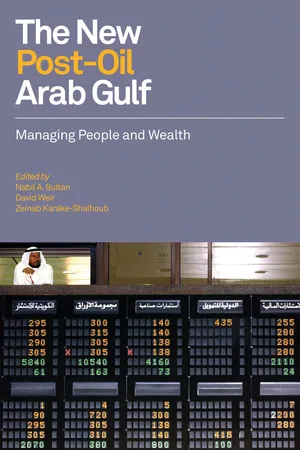
The New Post-oil Arab Gulf
Managing People and Wealth
- 194 pages
- English
- ePUB (mobile friendly)
- Available on iOS & Android
eBook - ePub
The New Post-oil Arab Gulf
Managing People and Wealth
About this book
The sharp increase in oil revenues since 2002 has left the Arab Gulf States with billions of petro-dollars. But how will these countries fare in the post-oil era? The rulers of these states are taking serious measures to ensure the survival of their economies, and indeed their regimes, in a world with scarce mineral resources. This volume explores the extent to which these countries have been and will be able to prepare for the future by transforming themselves into serious international destinations for tourism, finance, healthcare and education. It also considers the implications of failure for the future survival of their regimes. This study will provide food for thought for academics, policy makers and general readers.
Information
Chapter 1
Building the Foundation for a Post-Oil Era: The Case of the GCC Countries
NABIL A. SULTAN
BEVERLY DAWN METCALFE
DAVID WEIR
INTRODUCTION
The Arab Gulf countries are embarking on massive real estate, educational and alternative energy programmes designed to meet the challenges of the post-oil era. Those countries have become increasingly aware of the need to diversify their economies given the finite nature of oil and gas as commodities and the need to react to global efforts aimed at reducing reliance on fossil-based sources of energy for environmental and economic reasons. The ambitions of the leaders of the Arab Gulf countries in this direction were fuelled by massive returns from the sale of oil whose price in the last few years witnessed dramatic increases not seen even during the oil shocks of 1973–4 and 1979–80. But the drive for economic diversification has also a political dimension to it. During the last five decades, the autocratic regimes of the Gulf Cooperation Council (GCC) ensured that their national citizens shared some of the wealth of their countries through an income distribution drive that provided well-paid public sector jobs, free access to health and education, interest-free loans and many other benefits. Failure to maintain this level living standard in a post-oil future could have implications for the sustainability of those regimes. This chapter will explore some of those development programmes and relating issues and provide some thoughts on the potential success of those initiatives.
RADICAL CHANGES
The discovery of oil during the 1930s and 1940s in the Arabian Gulf countries (Saudi Arabia, Oman, UAE, Kuwait, Qatar and Bahrain), now collectively known as the Gulf Cooperation Council (GCC), has transformed those countries from large tracts of desert lands populated by small bedouin tribes into states with highly developed urban cities that have all the modern infrastructural facilities that can be found in most developed countries. The total population of the GCC countries in 1950 numbered just over 4 million inhabitants.1 The level of education was basic, largely traditional, and localised. Economic activity in most of those countries was largely based on pearls, dates, fish and the slave trade.2 Up until the 1960s, the Indian rupee was the main currency used in most of these countries. The GCC countries used the proceeds from oil to modernise their countries. They built well-equipped hospitals, schools and universities, modern airports, large government bureaucracies, roads and so forth. As a result, life expectancy in the GCC area increased by almost ten years to seventy-four years between 1980 and 2000, and literacy rates increased by 20 percentage points to about 80 percent over the same period. Average GDP per capita in the GCC countries was estimated at $50,000 in 2009, with an estimated combined nominal GDP of $897.6 billion for the same year.3 The population of the GCC countries (excluding expatriates) was estimated at 26.4 million for 2010.4
Without those massive revenues from oil, according to Barger,5 countries like Kuwait would still be a small fishing and smuggling centre at the head of the Gulf; Saudi Arabia would still be largely dependent on its foreign exchange on the annual pilgrim; Bahrain, along with Qatar and Abu Dhabi, would be a sleepy island mourning the destruction of their pearling fleets by the development of Japan’s cultured pearls which effectively killed their pearling industries.
FACING UP TO THE FUTURE
With the inflow of substantial revenues, particularly following the great oil shock of 1973–4, the GCC countries embarked on a massive programme of infrastructure building which included: large infrastructure projects (housing, roads, airports, seaports, telecommunications, sewage and power plants), public services (basic health and education), heavy and medium industries (cement, iron and steel, fertilisers, chemicals, petrochemicals, textiles) and agriculture and land reclamation projects.6 Initially, there was too much emphasis by these countries on the need to industrialise.7 However, industrialisation, outside oil processing, remained shallow due to the narrowness of the local markets in those countries and the shortage of their national labour.8
The GCC countries seem to have learnt from the lessons of the past. During the last three decades, the GCC countries have adopted investment and development plans different from those seen during the previous oil booms of the 1970s and 1980s. Wary of boom-bust cycles, the GCC countries have built up reserves, cleared their public debt and accumulated surpluses that have been transferred to oil stabilisation funds,9 sovereign wealth funds (SWFs)10 and other state-controlled investment vehicles. Most interestingly, economic management in the region has substantially improved, asset deployment has become more sophisticated and there is a clear shift from the public to the private sector as the main engine of growth.11
THE BUILDING OF THE 21ST-CENTURY CITIES
After decades of extravagant spending on their infrastructures, there is an increasing awareness among the rulers of the GCC countries that the prospects of relying on oil as a stable source of income for the future of their countries are uncertain. In an effort to address this issue, a number of the GCC countries, particularly the UAE, Kuwait, Qatar, Bahrain and Saudi Arabia, are preparing for what might be termed ‘the post-oil era’ through embarking on mega projects (financed by private and public capital) designed to make these countries new tourist, financial, educational, technological and manufacturing destinations. In doing so, many of the GCC countries invested hundreds of billions of their petrodollars building ‘instant cities’ or ‘cities within cities’12 in one of the most remarkable real estate developments in history.
The global financial crisis of 2008 (which saw the price of oil tumbling to $34 a barrel in December of that year from a peak of $146 in July) caused a major disruption to the speed of this building process. The effects of this crisis were particularly more significant in areas like Dubai where large amounts of debts were used to finance the real estate boom, as will be explained later in this chapter.
THE UAE
The UAE has proven oil reserves of 97.6 billion barrels (mostly located in Abu Dhabi which has the lion’s share, estimated at 92.2 billion barrels). The UAE has invested heavily in tourism, airport infrastructure, re-export commerce and communications, and made progress in shifting its economy from dependence on oil and exploration. In 1975, crude oil accounted for 68 percent of the total economy. By 1998, this figure had fallen to about 22 percent.13 However, it is the emirate of Dubai which was emerging as the star of the UAE. Dubai’s efforts to diversify its economy and reduce its dependence on oil has started much earlier (largely due to its low oil reserves) and its progress has been remarkable. In the mid-1990s, non-oil sectors were already contributing 82 percent of the emirate’s GDP and in 2006 the figure may have been as high as 95 percent.14 During the last two decades or so, Dubai experienced one of the most ambitious real estate developments in the world. It is estimated that one fifth of the world’s cranes were operating in Dubai during the construction boom. The following is a sample of some of those real estate projects:
Dubailand Theme Park:15 This project (dubbed one of the biggest construction projects in the world) is planned in an area of two billion sq feet of land (almost as large as the present built-up area of Dubai) at a cost of $5.5 billion. Dubailand is intended to be ‘the Middle East answer to Disneyland’ and is projected to attract 15 million people a year to the area. Within this project, a city (called Falcon City of Wonders), shaped like a falcon, will be created. This city will have structures based on the ancient and modern wonders of the world such as the Pyramids, the Hanging Gardens of Babylon, the Eiffel Tower, the Taj Mahal, the Great Wall of China and so forth. According to reports, these structures will be larger than the originals.16 The park will comprise of forty-five projects, including a space exploration exhibition, a full-size dinosaur enclosure, the world’s biggest shopping mall, several five-star hotels, a complex of sports stadia, an artificial rain forest under an enormous glass dome, a ski slope with artificial snow and the largest zoo in the Middle East.
Burj Dubai (now renamed Burj Khalifa): This was planned to be (and now is) the world’s tallest tower (dubbed one of the most prestigious addresses on earth by its developing company, Emaar) with over 160 storeys. This tower, which was completed and inaugurated on 4 January 2010 at a cost of over $4 billion, is the centrepiece of a city within a city, Downtown Burj Dubai, which is estimated to bring the total cost of this development to $20 billion. The development as a whole includes 30,000 homes, nine hotels, 6.2 acres of parkland, nineteen residential towers, the Dubai Mall and a 30-acre man-made lake.17
The Palm Islands: This is an artificial island development project, dubbed ‘the eighth wonder of the world’ by its developing company (Nakheel), which involved constructing three of the world’s largest man-made islands which will add 520 km of beaches reclaimed from the sea. The islands, constructed in the shape of date palms, are estimated to cost some $14 billion and employed 14,000 labourers, working day and night.18 These islands are Palm Jumeirah, Palm Deira and Palm Jebel Ali. The islands serve multi functions in that they are residential areas for living, relaxation, leisure and entertainment.
The World: 19 Described by its developer (Nakheel) as ‘today’s great development epic and an engineering odyssey to create an island paradise of sea, sand and sky’, The World is a $1.8 billion project, about five km offshore of Dubai and comprised of a cluster of between 250 and 300 artificial islands shaped like countries of the world. Each island will be themed according to its respective country. Each island will be sold to selected private developers.
Dubai Festival City: This is another project touted as a ‘city within a city’ and is claimed to be the Middle East’s largest, privately funded, mixed-use real estate project. The city was built on 6.5 sq km on the banks of Dubai Creek and comprises fifteen zones of entertainment, shopping, edutainment, sport and leisure, two hotels, residential and office blocks, a golf course and a large dining and entertainment centre set on a waterfront marina.
And the list of mega real estate projects does not stop here. Dubai also has the Dubai Marina: a 3.5 km waterway and an 11 km waterfront, providing a boating lifestyle and offering water-taxis, sunset cruises and dinner cruises; Dubai Media City: a project designed to make Dubai a regional hub for media businesses ranging from news agencies, publishing, online media, advertising, production, and broadcast facilities. There is also Dubai Healthcare City which is hoped to be a centre of excellence and the region’s leading health provider of top-class medical services. With these developments, the UAE, and Dubai in particular, is hoping to be a major tourist attraction and draw substantial income from this industry, thanks to year-round sunshine and tourism facilities and attractions which are among the most unique and sophisticated worldwide. In fact, the indirect contribution of the tourism sector to Dubai’s total GDP amounted to 28 percent by 2003, thus exceeding the contributions from the manufacturing and banking industries sectors, according to official figures.20
Aware of its emerging status as a serious contender on the world’s tourism landscape, Dubai has invested heavily in Emirates, its national airline carrier, claimed to be the world’s fastest growing intercontinental airline, and its airport which is being expanded to handle 120 million passengers per year. In 2007, its airport handled a total of 34.34 million passengers,21 a substantial increase from 5 million passengers in 1990.22 Moreover, the city is expected to receive 15 million tourists by 2020.23
On the trade side, Dubai is also building a new international airport named ‘Al Maktoum International Airport’ in Jebel Ali (Dubai’s port town and main trade route). When completed, it will be the main part of Dubai World Central, a planned residential, commercial and logistics complex scheme. Dubai World Central is designed to be the world’s first integrated logistics platform with transport modes, logistics and value-added services, including manufacturing and assembly, housed in a single bonded and Free Zone environment. Al Maktoum International Airport sits at the heart of this new development and is intended to be the world’s largest passenger and cargo hub, ten times larger than Dubai International Airport and Dubai Cargo Village combined. When completed, the airport will ...
Table of contents
- Cover
- Title
- Copyright
- Contents
- Acknowledgements
- Introduction
- 1. Building the Foundation for a Post-Oil Era: The Case of the GCC Countries
- 2. GCC Sovereign Wealth Funds and Islamic Finance: Financial Foundations for the Post-Oil Gulf?
- 3. The GCC Countries as Knowledge-Based Economies: Future Aspirations and Challenges
- 4. Higher Education in the Gulf States: From Traditional to Modern
- 5. A ‘Smart’ Technology-Enhanced Learning for the Post-Oil Arab Gulf
- 6. The Role of Women in a Post-Oil Arab Gulf Future
- Bibliography
- Notes on Contributors
- Index
Trusted by 375,005 students
Access to over 1.5 million titles for a fair monthly price.
Study more efficiently using our study tools.
Frequently asked questions
Yes, you can cancel anytime from the Subscription tab in your account settings on the Perlego website. Your subscription will stay active until the end of your current billing period. Learn how to cancel your subscription
No, books cannot be downloaded as external files, such as PDFs, for use outside of Perlego. However, you can download books within the Perlego app for offline reading on mobile or tablet. Learn how to download books offline
Perlego offers two plans: Essential and Complete
- Essential is ideal for learners and professionals who enjoy exploring a wide range of subjects. Access the Essential Library with 800,000+ trusted titles and best-sellers across business, personal growth, and the humanities. Includes unlimited reading time and Standard Read Aloud voice.
- Complete: Perfect for advanced learners and researchers needing full, unrestricted access. Unlock 1.5M+ books across hundreds of subjects, including academic and specialized titles. The Complete Plan also includes advanced features like Premium Read Aloud and Research Assistant.
We are an online textbook subscription service, where you can get access to an entire online library for less than the price of a single book per month. With over 1.5 million books across 990+ topics, we’ve got you covered! Learn about our mission
Look out for the read-aloud symbol on your next book to see if you can listen to it. The read-aloud tool reads text aloud for you, highlighting the text as it is being read. You can pause it, speed it up and slow it down. Learn more about Read Aloud
Yes! You can use the Perlego app on both iOS and Android devices to read anytime, anywhere — even offline. Perfect for commutes or when you’re on the go.
Please note we cannot support devices running on iOS 13 and Android 7 or earlier. Learn more about using the app
Please note we cannot support devices running on iOS 13 and Android 7 or earlier. Learn more about using the app
Yes, you can access The New Post-oil Arab Gulf by Nabil Sultan, David Weir, Zeinab Karake-Shalhoub, Nabil Sultan,David Weir,Zeinab Karake-Shalhoub in PDF and/or ePUB format, as well as other popular books in Economics & Development Economics. We have over 1.5 million books available in our catalogue for you to explore.