- 309 pages
- English
- ePUB (mobile friendly)
- Available on iOS & Android
eBook - ePub
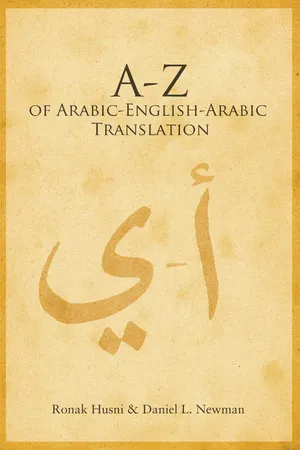
A to Z of Arabic-English-Arabic Translation
About this book
The A to Z highlights common pitfalls faced by translators working on both Arabic-English and English-Arabic texts. Each translation problem is carefully contextualized and illustrated with examples drawn from contemporary literature and the media. Using a comparative analysis approach, the authors discuss grammatical, lexical and semantic translation issues, and offer guidance regarding correct and idiomatic usage. A much-needed addition to the field for university-level students of translation and professional translators alike, the A to Z has been designed with a view to * developing and honing skills in translating between Arabic and English * enhancing idiomatic expression in both languages; * raising awareness of problems specific to Arabic-English and English-Arabic translation; * increasing competency by providing appropriate strategies for effective translation. Alphabetic arrangement of the entries ensures ease of use as both a manual and a reference work. As such, the A to Z is eminently suited for both independent and classroom use.
Information
Abbreviations/acronyms
In English, it is common to abbreviate words. One generally makes a distinction between abbreviations and acronyms in that the latter can be read as words. Consider the difference between ‘ETA’ (expected time of arrival) and ‘NATO’ (North Atlantic Treaty Organization). In the former, each letter is pronounced separately (/i: -ti: -ei/), whereas the latter is read as /neitou/. Whilst acronyms are generally capitalized, abbreviations tend to be in lower case, except if they involve proper nouns or technical terms. e.g. ‘FAO’ (Food and Agricultural Organization’), ‘DNA’ (deoxyribonucleic acid).
In some cases, acronyms become so ‘naturalized’ in the language that their acronymic origins have been forgotten and, consequently, they appear in lowercase. e.g. ‘laser’ (< ‘LASER’, Light Amplification by Stimulated Emission of Radiation), ‘radar’ (< ‘RADAR’, Radio Detection And Ranging).
Acronyms are often added with suffixes. e.g. yuppie (‘young upwardly mobile professional’), dinky (‘double income with no kids [yet]’).
A particular type of abbreviation is so-called ‘clipping’, which is also known as ‘truncation’, and involves the cutting of one or more syllables from a word (usually at the end). Whilst some are part of informal usage (e.g. doc, ‘document’), several have gained independent status. e.g. ad (advertise...
Table of contents
- Cover
- Title
- Contents
- Introduction
- List of abbreviations and symbols
- Abreviations/acronyms
- Beach/shore/coast/seaside
- Can/may/might
- Dare/dare say
- Each/every
- Fairly/quite/rather/pretty
- Genial/genius/genuine/ingenious/ingenuous
- Hal
- If/whether
- Judicial/judicious/judiciary/judicature
- Keep on ...
- Lawyer/solicitor/barrister
- Make/do
- Nevertheless/notwithstanding
- Obligation
- The passive
- Relative pronouns
- Say/tell
- Terms of address
- Until/till/by
- Wa and fa
- Appendix I: Tenses
- Appendix II: Modality
- English Index
- Arabic Index
- Copyright
Trusted by 375,005 students
Access to over 1.5 million titles for a fair monthly price.
Study more efficiently using our study tools.
Frequently asked questions
Yes, you can cancel anytime from the Subscription tab in your account settings on the Perlego website. Your subscription will stay active until the end of your current billing period. Learn how to cancel your subscription
No, books cannot be downloaded as external files, such as PDFs, for use outside of Perlego. However, you can download books within the Perlego app for offline reading on mobile or tablet. Learn how to download books offline
Perlego offers two plans: Essential and Complete
- Essential is ideal for learners and professionals who enjoy exploring a wide range of subjects. Access the Essential Library with 800,000+ trusted titles and best-sellers across business, personal growth, and the humanities. Includes unlimited reading time and Standard Read Aloud voice.
- Complete: Perfect for advanced learners and researchers needing full, unrestricted access. Unlock 1.5M+ books across hundreds of subjects, including academic and specialized titles. The Complete Plan also includes advanced features like Premium Read Aloud and Research Assistant.
We are an online textbook subscription service, where you can get access to an entire online library for less than the price of a single book per month. With over 1.5 million books across 990+ topics, we’ve got you covered! Learn about our mission
Look out for the read-aloud symbol on your next book to see if you can listen to it. The read-aloud tool reads text aloud for you, highlighting the text as it is being read. You can pause it, speed it up and slow it down. Learn more about Read Aloud
Yes! You can use the Perlego app on both iOS and Android devices to read anytime, anywhere — even offline. Perfect for commutes or when you’re on the go.
Please note we cannot support devices running on iOS 13 and Android 7 or earlier. Learn more about using the app
Please note we cannot support devices running on iOS 13 and Android 7 or earlier. Learn more about using the app
Yes, you can access A to Z of Arabic-English-Arabic Translation by Ronak Husni,Daniel L. Newman in PDF and/or ePUB format, as well as other popular books in Languages & Linguistics & Languages. We have over 1.5 million books available in our catalogue for you to explore.