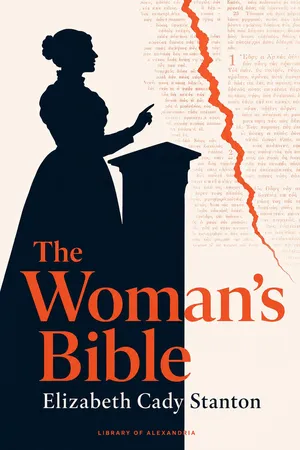
Who has the authority to interpret scripture-and what happens when women claim that authority for themselves?
In The Woman's Bible, Elizabeth Cady Stanton and a committee of women contributors examine biblical passages that have shaped women's place in religion and society. Moving through the Old and New Testaments, they question interpretations used to support women's obedience, silence, and exclusion. Their central challenge is direct: inherited religious authority should not place any interpretation beyond scrutiny.
The commentary considers the creation accounts in Genesis, the story of Eve and the Fall, women in biblical law and history, and the teachings associated with Paul. Alongside passages that subordinate women, the contributors consider figures such as Deborah and Huldah, whose authority complicates claims of universal female dependence. Published in two parts in the 1890s, the work provoked controversy even within the suffrage movement. It remains a revealing encounter between biblical criticism and the struggle for women's rights, asking readers to distinguish sacred principle from the assumptions of those who interpret it.
What readers find inside:
- Genesis reconsidered - The creation narratives and the account of Eve become starting points for questioning the religious foundations of inequality.
- Women in scripture - Named leaders and unnamed women reveal contrasting patterns of dignity, authority, and exclusion.
- Church and household - Readings of the Epistles challenge commands used to restrict women's speech and independence.
- Interpretation and power - The contributors examine how religious readings influence laws, customs, and expectations.
- A collective challenge - Stanton and her collaborators insist that women must participate in interpreting texts that govern their lives.
For readers of feminist theology, students of women's rights history, and anyone interested in the relationship between religion and social power, this work offers a forceful historical perspective on questions that remain unsettled.
Begin reading and encounter a bold demand to reconsider who speaks for scripture.