- 277 pages
- English
- ePUB (mobile friendly)
- Available on iOS & Android
eBook - ePub
About this book
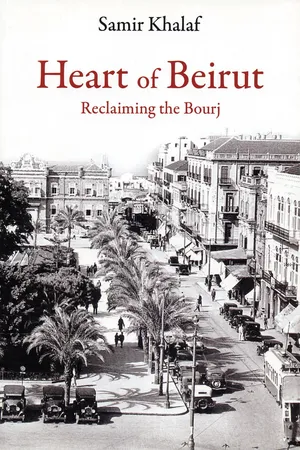
The Bourj in central Beirut is one of the world's oldest and most vibrant public squares. Named after the mediaeval lookout tower that once soared above the city's imposing ramparts, the square has also been known as Place des Canons (after a Russian artillery build-up in 1773) and Martyrs' Square (after the Ottoman execution of nationalists in 1916). As an open museum of civilizations, it resonates with influences from ancient Phoenician to colonial, post-colonial and, as of late, postmodern elements. Over the centuries it has come to embody pluralism and tolerance. During the Lebanese civil war (1975-90), this ebullient entertainment district, transport hub and melting-pot of cultures was ruptured by the notorious Green Line, which split the city into belligerent warring factions. Fractious infighting and punishing Israeli air raids compounded the damage, turning the Bourj into a no-man's-land. In the wake of former Prime Minister Rafik al-Hariri's assassination (14 February 2005), the Bourj witnessed extraordinary scenes of popular, multi-faith and cross-generational protest. Once again, Samir Khalaf argues, the heart of Beirut was poised to re-invent itself as an open space in which diverse groups can celebrate their differences without indifference to the other. By revisiting earlier episodes in the Bourj's numerous transformations of its collective identity, Khalaf explores prospects for neutralizing the disheartening symptoms of reawakened religiosity and commodified consumerism.
Information
Topic
Scienze socialiSubtopic
Storia mondialeONE
On Collective Memory, Central Space and National Identity
Observing Beirut in the throes of reconstruction is a bewitching, often beguiling, experience, both existentially and conceptually. From a close and intimate range, one is not only struck by the massive physical and material transformations under way but one also gains insight into how new socio-cultural spaces and territorial entities are being invested with new meanings. One becomes aware of how disembedded groups and communities are recreating and reinventing their familiar daily rhythms and the city’s social fabric. More compellingly, we become conscious of the artefacts, objects and spaces in the built environment which are being effaced and discarded and those which are being restored, embellished and rendered more pronounced.
Beirut today is akin to a living laboratory where one is in a sustained state of being captivated by the perpetual thrills of new discoveries unfolding, as it were, before one’s very eyes. It is a marvel to live in such an urban milieu where one, literally, never encounters the same familiar and unchanging street or neighbourhood. One is liberated, in an existential sense, from the deadening effects of habit and the sterility of familiar places. A daily stroll always carries with it the visceral sensation of surprise and the prospects of levitating, as it were, into another world. It always heightens one’s visual and aesthetic sensibilities. To borrow one of the metaphors of Ghassan Hage, one is in a sustained state of being pushed, pulled, propelled upward and whirled downward at one and the same time.
More compellingly still, Beirut is at another critical threshold in its chequered history. A restless and buoyant city is in the throes, once again, of redefining itself. I say ‘once again’ because it has been in this predicament many times before. It has reinvented itself on numerous occasions. This is, however, the first time that the process has incited such a contested and public debate regarding the rehabilitation scheme itself and its impact on the envisioned or projected public image of Beirut. Indeed, in the popular imagination a plurality of images is invoked: a future Honk Kong or Monaco, a Mediterranean town or Levantine seaport, a leisure resort, a playground or tourist site. Incidentally, we are not only talking about tourism in its ordinary or conventional form. At least two new types have become salient recently: health or medical tourism and war tourism engendered by the curiosity of travellers to behold sites of the ravages of war and how they are being reconstructed. Beirut is also envisioned as a tempting hub for services, communication networks, popular mass entertainment and faddish consumerism. It is rather ironic that the appeals of Beirut, at this moment in its contested collective identity, are embodied and informed by the dissonant forces of ruination, havoc, loss but also rehabilitation, restoration and well-being.
The spectacular events sparked by the ‘Independence Uprising’ in the wake of Rafik Hariri’s assassination on 14 February 2005 have been so riveting in their manifestations and consequences that they have drawn the attention of the world and driven global powers to take remedial action. Spontaneous and self-propelled, the uprising – largely because it could exploit the commanding setting of Beirut’s historic centre – displayed so much daring and inventiveness that it evolved into a formidable public sphere. Sustained demonstrations and expressions of collective grievances allowed the protesters to articulate a coherent set of demands and to mobilise normally passive and quiescent groups to participate in popular grassroots movements in support of the uprising. Thus far, the by-products have been vast in their immediate consequences and promise to be more consequential in their anticipated future reverberations. The massive sustained uprising forced the resignation of the government and precipitated a sharply contested political crisis. It expedited the formulation of two decisive UN resolutions: 1559, calling for the immediate withdrawal of Syrian troops and security agencies from Lebanon, and 1595, to set up an international commission of inquiry into the assassination of Hariri. Perhaps more compellingly, in view of its future fallouts, the uprising initiated the country’s youth into a hands-on and direct tutelage in civic virtues and emancipatory political struggle.
By virtue of its centrality and commanding historic setting – almost akin to an open museum of the world’s most ancient civilisations – Beirut’s central square has always displayed curious historical features that account for its survival as a fairly open, pluralistic and cosmopolitan urban district. Archaeological findings repeatedly show that this very site, often dubbed the ‘nursery of Homo sapiens’, has served as an abode for humanity almost since its first appearance on the face of the earth. Indeed, some of the implements (mainly stone artifacts) that continue to be unearthed on site may be traced back to the Lower Palaeolithic period, roughly two or three million years ago. The relentless succession of dynasties and civilisations that have left their indelible legacies on this site is truly overwhelming. The massive reconstruction efforts under way, particularly around Beirut’s historic centre, continue to come across almost daily finds that reconfirm the most distinguished heritage of its ancient past.
Stunning as its archaeological relics are, one need not be misled by the prehistoric eminence of Beirut. Nor should one go too far back into the past to disclose the circumstances associated with the distinctive role its central square came to play. Despite its momentous history, its emergence as a modern, cosmopolitan urban centre is of recent vintage. In fact, the most definitive symptoms of urbanisation – rural exodus and the spill of the population beyond its medieval walls – did not really appear in any substantial form until the 1860s. Of course, there were earlier signs of rural exodus. Dislocation in native crafts, the decline in silk production and the shift in the pattern of trade, particularly during the Egyptian occupation (1831–41) had generated a shift in population movement towards coastal towns. These and earlier movements, however, were limited in scale. For example, when Volney visited Beirut in 1773, he described it as a small town with no more than 6,000 people. There was not, it must be noted, any perceptible increase in the population during the next six decades. By 1830 the population was still in the neighbourhood of 8,000.
The decade of Egyptian presence, with its concomitant commercialisation and opening up of Mount Lebanon to western incursions, added only another 2,000 to Beirut’s population. This relatively slow rate of increase (about five hundred annually) was maintained during the 1840s and 1850s. In short, it was not until the outbreak of civil disturbances in the late-1850s and early-1860s that the impact of a massive shift in population began to be felt. Beirut’s population leaped from 22,000 in 1857 to 70,000 in 1863, an annual increase of almost 10,000. During the height of civil disturbances and in the short span of only two months (from August to September 1860), an Anglo-Saxon committee of local missionaries gave aid to more than 20,000 refugees in Beirut.5
Every description of Beirut prior to the 1860s attests to this. Until then, it was no more than a small, fortified medieval town with seven main gates and about half a square kilometre surrounded by gardens. The central core of the city was built around its historic port and mole with defences on the landward side and two towers at the entrance of the port. As in most European towns before industrialisation, people in Beirut lived and worked within the same area and carried on nearly all their daily routines within the same urban quarter. Ethnic and religious affiliation created relatively homogeneous and compact residential neighbourhoods. Daily routines were carried out within clearly defined quarters, and the neighbourhood survived as an almost self-sufficient community with which the individual identified. There was a strong sense of neighbourliness, and patterns of behaviour were largely regulated through kinship and religious ties. Physical and social space, in other words, were almost identical. More importantly, these neighbourhoods offered the urban dweller a human scale and types of social networks that he could comprehend and in which he could find a uniquely individual space.
Gross density was high – around 300 per hectare – and the town gave an overwhelming impression of congestion. Lamartine, who visited Beirut in 1832, said, for example, that the roofs of some houses served as terraces to others. Except for souks, khans, baths, places of worship and other public buildings which dominated the town, the prevailing house types were flat-roofed farmhouses and the traditional two or three-storied, red-tiled villas with elaborate facades and decorative railed stairways and balconies. Sandstone blocks, quarried in the area, were the predominant construction form. Lush, subtropical vegetation graced the well-tended gardens of its houses and lined its winding alleyways.
The cactus-lined alleys were soon converted to macadamised streets. Urban construction leaped beyond the medieval walls of the city to accommodate the persistent inflow of rural migrants into Beirut. The construction of the wharf in Beirut’s port in 1860 to accommodate the increasing maritime traffic, like all the other infrastructural developments and public amenities undertaken throughout the second half of the nineteenth century (e.g. harbour facilities, Damascus railways, gaslights, potable water, electric tramways, telegraph and postal services, quarantine, dispensaries and hospitals along with schools, colleges and printing houses) assisted naturally in the expansion and urbanisation of Beirut. As a residence for consul generals, headquarters for French, American and British missions and a growing centre of trade and services, it gradually began to attract a cosmopolitan and heterogeneous population. It is then that some of the early symptoms of cosmopolitanism, marked by elements of sophistication and savoir-faire in public life, started to surface. This was particularly visible in the opening up and receptivity of seemingly local and provincial groups and neighbourhoods to novel and mixed lifestyles and mannerisms.
But Beirut’s swift urbanisation (the consequences of both internal migration and natural growth rates in the population) carried with it other more disheartening consequences. Since nearly two-thirds of the rural exodus was directed toward Beirut, the capital trebled its residential population between 1932 and 1964 and grew by nearly tenfold between 1932 and 1980. This rapid growth of Beirut was not only due to internal demographic factors, but to a large extent it was also a reflection of external pressures that generated increased demand for urban space. First, the Armenian Massacres of 1914 brought over 50,000 Armenian refugees from Turkey. The waves of Palestinian refugees after 1948 and the political instability in neighbouring Arab countries intensified this demand, as did the subsequent inflow of capital from the Gulf States and foreign remittances, which poured into the already lucrative real-estate and construction sectors of the economy. The building boom of the 1950s and 1960s, with its manifestations of mixed and intensive land-use patterns and vertical expansion, was largely a by-product of such forces. The resulting uncontrolled and haphazard patterns of growth were maintained during the early-1970s. Shortly before the outbreak of civil disturbances in 1975, greater Beirut was probably absorbing 75 per cent of Lebanon’s urban population and close to 45 per cent of all the inhabitants of the country. In addition, its already overcrowded 101–square kilometre area had to accommodate an estimated 120,000 daily commuters from adjoining suburbs.1
By the early-1970s Beirut’s annual rate of growth was estimated at 4 per cent, which implied that the city was bound to double in less than twenty years. The magnitude of this change may be expressed in more concrete terms: if the current rates of growth were maintained, Beirut would have had to accommodate and provide housing, schooling, medical services, transportation and other services for at least 40,000 new residents every year. It is in this sense that Beirut was associated at the time with the phenomenon of primacy and over urbanisation. Insofar as the degree of urbanisation was much more than would be expected from the level of industrialisation, then Lebanon was among the few countries – along with Egypt, Greece and Korea – that may be considered over urbanised.2 We will subsequently explore some of the spatial and socio-cultural implications of such over urbanisation. Suffice it to note that this is one of the most critical problems Lebanon continues to face: a problem with serious social, psychological, economic and political implications. Urban congestion, blight, depletion of open spaces, disparities in income distribution, rising levels of unemployment and underemployment, housing shortages, exorbitant rents, problems generated by slums and shantytowns and, to a considerable extent, the urban violence of the war years, were all by-products of over urbanisation. In short, the scale and scope of urbanisation had outstripped the city’s resources to cope effectively with continuously mounting demand for urban space and public amenities.
Hence, Beirut has always been gripped by a nagging dissonance between conceived and lived space. The city, as we shall see, has never been short on blueprints or the often idealistic conceptions of how planners and builders perceive the defining elements and shape of the spatial environment. For a variety of reasons, such perceptions were not consistent with the concrete spatial realities. In other words, lived space almost always assumed a life of its own, unrelated to its original or intended expectations.
From its eventful past, much like its most recent history, a few distinct but related features stand out. Together, these defining elements continue to be vital in informing the way Beirut, and its central square in particular, could continue to serve as a vibrant and transcending public sphere amenable for collective mobilisation and for forging a hybrid popular culture for tolerance and peaceful coexistence.
City and Mountain
First, and without doubt one of its most striking attributes, is the dual role Beirut managed to embody throughout its eventful history as a port city and a national capital linked to its hinterland. Hence, any understanding of this distinctive feature requires an elucidation of the timeless interplay between the accidents of its geographic and ecological endowments, namely the sea and its mountainous hinterland. Indeed, to many of its historians, philosophers and writers who often evoke these natural gifts with emotive hyperbole, much of their country’s accomplishments are seen as an outgrowth of such seemingly dissonant attributes. Some, like Charles Malik, Michel Chiha, Said Akl and Kamal el-Hajj, speak with more than just a hint of geographic determinism of the ‘horizontal’ effects of the sea and the ‘perpendicular’ effects of the mountain to account for the two most distinctive characteristics that informed its distinguished history: the open, adventurous, itinerant and worldly predispositions generated by its seafaring heritage, along with the role its mountains served as a secure asylum for displaced minorities and dissident groups.
To Albert Hourani, Lebanon’s political culture, particularly its republican and liberal features, managed to reconcile two distinct visions or ideologies which had been tenuously held together since the creation of Greater Lebanon in 1920:
On the one hand, there was the idea of Mount Lebanon: a society rural, homogeneous, embodied in an institution, the Maronite church, with a self-image ... and with a vision of an independent and predominantly Christian political community. On the other, there were the urban communities of Beirut and other coastal cities, mainly Sunni Muslim but with Orthodox and other Christian elements, and with a different idea: that of a trading community open to the world, and serving as a point of transit and exchange, and therefore a community where populations mingled and coexisted peacefully; of a society which needed government and law, but preferred a weak government to which the leaders of its constituent groups had access and which they could control.3
Hourani traces the theoretical basis of this vision and its embodiment in the mithaq or ‘covenant’ of 1943 to the writings of Michel Chiha, in which we can see the marriage of the two ideologies: the mountain and the ci...
Table of contents
- Cover
- Title
- Contents
- Foreword and Acknowledgments
- Preface: Rafik Hariri’s Martyrdom and the Mobilisation of Public Dissent
- 1. On Collective Memory, Central Space and National Identity
- 2. Beirut’s Encounters with the Social Production of Space: A Historical Overview
- 3. The Spaces of Post-War Beirut
- 4. Post-War Construction of Beirut’s Central District
- 5. The Bourj as a Cosmopolitan Public Sphere
- 6. Public Sphere as Playground
- 7. Future Prospects
- Notes
- Bibliography
- Index
- Picture Credits
- Copyright
Trusted by 375,005 students
Access to over 1.5 million titles for a fair monthly price.
Study more efficiently using our study tools.
Frequently asked questions
Yes, you can cancel anytime from the Subscription tab in your account settings on the Perlego website. Your subscription will stay active until the end of your current billing period. Learn how to cancel your subscription
No, books cannot be downloaded as external files, such as PDFs, for use outside of Perlego. However, you can download books within the Perlego app for offline reading on mobile or tablet. Learn how to download books offline
Perlego offers two plans: Essential and Complete
- Essential is ideal for learners and professionals who enjoy exploring a wide range of subjects. Access the Essential Library with 800,000+ trusted titles and best-sellers across business, personal growth, and the humanities. Includes unlimited reading time and Standard Read Aloud voice.
- Complete: Perfect for advanced learners and researchers needing full, unrestricted access. Unlock 1.5M+ books across hundreds of subjects, including academic and specialized titles. The Complete Plan also includes advanced features like Premium Read Aloud and Research Assistant.
We are an online textbook subscription service, where you can get access to an entire online library for less than the price of a single book per month. With over 1.5 million books across 990+ topics, we’ve got you covered! Learn about our mission
Look out for the read-aloud symbol on your next book to see if you can listen to it. The read-aloud tool reads text aloud for you, highlighting the text as it is being read. You can pause it, speed it up and slow it down. Learn more about Read Aloud
Yes! You can use the Perlego app on both iOS and Android devices to read anytime, anywhere — even offline. Perfect for commutes or when you’re on the go.
Please note we cannot support devices running on iOS 13 and Android 7 or earlier. Learn more about using the app
Please note we cannot support devices running on iOS 13 and Android 7 or earlier. Learn more about using the app
Yes, you can access Heart of Beirut by Samir Khalaf in PDF and/or ePUB format, as well as other popular books in Scienze sociali & Storia mondiale. We have over 1.5 million books available in our catalogue for you to explore.