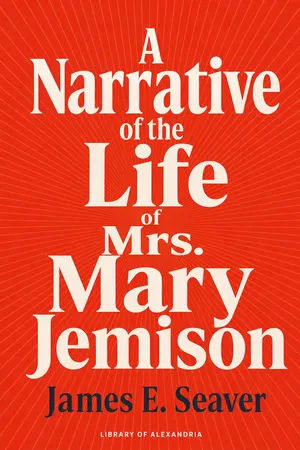
What does it mean to belong when captivity changes the course of a life? Mary Jemison's story reaches beyond survival to questions of family, loyalty, and identity.
Taken captive as a young woman during the French and Indian War and adopted by the Seneca Nation, Jemison experienced the American frontier from an unusual position. In A Narrative of the Life of Mrs. Mary Jemison, James E. Seaver records her account of loss, adaptation, and life within a new community. Her experiences bring the upheavals of eighteenth-century North America into the intimate world of home, kinship, and daily survival.
Both a personal history and a captivity narrative, the work offers accounts of Seneca customs and social life alongside the pressures of conflict and displacement. Its lasting interest lies in the complexity of Jemison's experience: a story that begins in forced separation becomes an account of enduring ties and belonging. Read as a historical document shaped by recollection and Seaver's telling, it invites thoughtful attention to whose voices preserve the past and how those voices reach us.
What readers find inside:
• Frontier upheaval - The French and Indian War forms the background to a life transformed by captivity.
• Seneca adoption - Jemison's account explores the relationships and responsibilities of life in an adoptive community.
• Daily experience - Descriptions of customs and social life offer a personal perspective on Seneca society.
• Survival and loss - Hardship and adaptation give the narrative its emotional force.
• Identity and loyalty - Cultural boundaries complicate familiar ideas about home, family, and allegiance.
A compelling choice for readers of early American history, women's biography, and historical accounts of encounters between Indigenous peoples and European settlers.
Begin Jemison's story and encounter a life that challenges simple accounts of the American frontier.