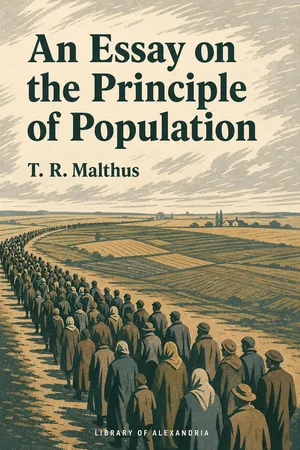
Can prosperity last if human numbers grow faster than the means of feeding them? Malthus made that question a lasting challenge to hopes for unlimited progress.
First published in 1798, An Essay on the Principle of Population argues that unchecked population increases geometrically while food supplies increase only arithmetically. From this contrast, Thomas Robert Malthus develops an unsettling account of poverty and subsistence: improvements in living conditions may encourage growth that places renewed pressure on resources. His argument is not simply about numbers, but about the prospects for lasting social improvement.
Engaging with William Godwin and the Marquis de Condorcet, Malthus tests Enlightenment optimism against historical examples and the constraints of material life. He considers growth in the American colonies, criticizes England's poor laws, and explores the relationship between marriage, family size, and hardship. His reflections also turn toward moral and theological questions about suffering. Influential in the development of economic thought and in Darwin's thinking about natural selection, the essay remains important both for its historical impact and for the objections it invites.
What readers find inside:
• Growth and subsistence - The famous contrast between geometric increase in human numbers and arithmetic increase in food supply anchors the argument.
• Poverty and policy - Malthus examines poor relief and argues that benevolent intentions can have unintended consequences.
• Limits to reform - The hopes of Godwin and Condorcet meet a sustained challenge grounded in scarcity.
• Historical examples - The American colonies and other societies provide evidence for his account of growth and its checks.
• Moral questions - Reflections on hardship connect economic reasoning with questions of virtue, human development, and divine purpose.
This work will appeal to students of classical economics, readers of Enlightenment philosophy, and anyone interested in the historical roots of debates about food security and inequality. It rewards critical reading: understanding Malthus means confronting both the force of his reasoning and the assumptions behind it.
Begin the essay and engage directly with an argument that still challenges how we think about growth, scarcity, and human possibility.