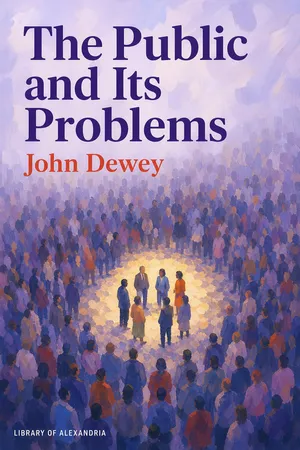
Democracy needs more than elections and institutions. It needs citizens who can understand what binds them together-and act on that knowledge.
In The Public and Its Problems, John Dewey asks how a public comes into being and why it can struggle to recognize itself. His answer begins with the indirect consequences of human action: when decisions affect people beyond those directly involved, shared interests emerge that call for collective attention. From this starting point, Dewey reconsiders the state, political responsibility, and the meaning of democratic participation.
Writing amid the industrial and social changes of the early twentieth century, Dewey examines how vast organizations, economic power, and mass communication can obscure the connections among citizens. His account of the eclipse of the public leads to a constructive question: what would make a Great Community possible? The answer rests on education, open communication, and cooperative inquiry-not simply better governmental machinery. His argument continues to illuminate debates about expertise, media, political disengagement, and the distance between citizens and those who govern.
What readers find inside:
• Shared consequences - Dewey explains how the effects of private actions create matters of collective concern.
• The role of the state - The book tests inherited political theories against the practical conditions that bring governments into being.
• Democratic disconnection - Industrial complexity and concentrated power make common interests harder to identify and organize.
• The Great Community - Communication, education, and social inquiry become foundations for meaningful participation.
• Democracy as lived experience - Democratic life extends beyond formal procedures into the quality of everyday association.
For readers of political philosophy, students of American pragmatism, and anyone concerned about the health of civic life, this is a demanding but rewarding invitation to think beyond institutional fixes.
Begin Dewey's inquiry into how a connected society can become a community capable of governing itself.