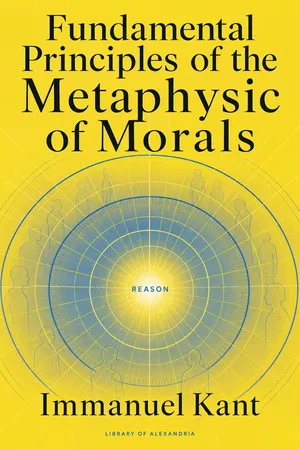
Fundamental Principles of the Metaphysic of Morals: Ethics and the Categorical Imperative
eBook - ePub

Fundamental Principles of the Metaphysic of Morals: Ethics and the Categorical Imperative

Why Duty and Human Dignity Matter

  1. English
  2. ePUB (mobile friendly)
  3. Available on iOS & Android
eBook - ePub

Fundamental Principles of the Metaphysic of Morals: Ethics and the Categorical Imperative

Why Duty and Human Dignity Matter

About this book

Would the rule behind your next decision still make sense if everyone followed it? For Immanuel Kant, that question reaches to the heart of ethical life.

In Fundamental Principles of the Metaphysic of Morals, Kant seeks a basis for morality that does not depend on changing desires, personal advantage, or expected results. Beginning with the idea of a good will, he distinguishes acting from duty from merely acting in accordance with it. His argument asks not simply what we do, but what principle guides our choice-and whether reason can justify that principle for everyone.

At the center of the work stands the categorical imperative: a requirement of reason that binds regardless of what we happen to want. Kant connects this universal demand with respect for humanity, insisting that persons must be treated as ends in themselves, never merely as means. His account of autonomy makes rational agency central to moral obligation. These ideas remain essential to debates about responsibility, dignity, and the limits of using others to achieve our goals.

What readers find inside:

• The good will - Kant examines why moral worth cannot be measured by talent, happiness, or successful outcomes alone.

• Duty and motive - The argument distinguishes a choice made from respect for moral law from one driven by inclination or advantage.

• Universal law - The categorical imperative tests whether the principle of an action could be willed as a law for all.

• Respect for persons - Humanity is presented as an end in itself, placing a moral limit on how people may be used.

• Autonomy and reason - Kant explores how rational beings can understand themselves as subject to laws they give themselves.

This work will reward philosophy students, readers exploring Enlightenment thought, and anyone seeking a rigorous way to examine everyday ethical choices. Its demanding questions offer an enduring alternative to judging conduct solely by convenience or consequences.

Begin with the question of a good will and follow Kant toward a searching account of what duty requires.

Table of contents

  1. Introduction
  2. Preface by the Author
  3. First Section · Transition from Common Rational Knowledge of Morality to Philosophical Knowledge
  4. Second Section · from Popular Moral Philosophy to the Metaphysic of Morals
  5. The Will’s Autonomy as the Supreme Principle of Morality
  6. The Will’s Heteronomy as the Source of All Spurious Principles of Morality
  7. Classification of All Principles of Morality Based on the Concept of Heteronomy
  8. The Concept of Freedom Explains the Autonomy of the Will
  9. Freedom Must Be Presupposed as a Property of the Will of All Rational Beings
  10. The Interest Attached to the Ideas of Morality
  11. How Is a Categorical Imperative Possible?
  12. On the Extreme Limits of All Practical Philosophy
  13. Concluding Remark

Trusted by 375,005 students

Access to over 1.5 million titles for a fair monthly price.

Study more efficiently using our study tools.

Information

Edition
1
Year
2026
eBook ISBN
9781808308055

Frequently asked questions

Yes, you can cancel anytime from the Subscription tab in your account settings on the Perlego website. Your subscription will stay active until the end of your current billing period. Learn how to cancel your subscription
No, books cannot be downloaded as external files, such as PDFs, for use outside of Perlego. However, you can download books within the Perlego app for offline reading on mobile or tablet. Learn how to download books offline
Perlego offers two plans: Essential and Complete
  • Essential is ideal for learners and professionals who enjoy exploring a wide range of subjects. Access the Essential Library with 800,000+ trusted titles and best-sellers across business, personal growth, and the humanities. Includes unlimited reading time and Standard Read Aloud voice.
  • Complete: Perfect for advanced learners and researchers needing full, unrestricted access. Unlock 1.5M+ books across hundreds of subjects, including academic and specialized titles. The Complete Plan also includes advanced features like Premium Read Aloud and Research Assistant.
Both plans are available with monthly, semester, or annual billing cycles.
We are an online textbook subscription service, where you can get access to an entire online library for less than the price of a single book per month. With over 1.5 million books across 990+ topics, we’ve got you covered! Learn about our mission
Look out for the read-aloud symbol on your next book to see if you can listen to it. The read-aloud tool reads text aloud for you, highlighting the text as it is being read. You can pause it, speed it up and slow it down. Learn more about Read Aloud
Yes! You can use the Perlego app on both iOS and Android devices to read anytime, anywhere — even offline. Perfect for commutes or when you’re on the go.
Please note we cannot support devices running on iOS 13 and Android 7 or earlier. Learn more about using the app
Yes, you can access Fundamental Principles of the Metaphysic of Morals: Ethics and the Categorical Imperative by Immanuel Kant, Thomas Kingsmill Abbott in PDF and/or ePUB format, as well as other popular books in Philosophy & Ethics & Moral Philosophy. We have over 1.5 million books available in our catalogue for you to explore.