eBook - ePub
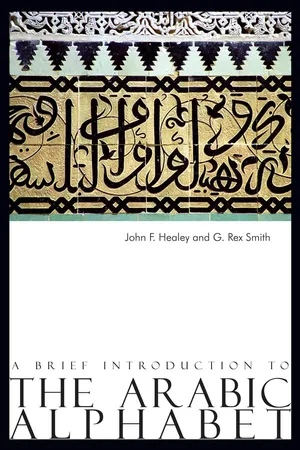
A Brief Introduction to the Arabic Alphabet
Its Origins and Various Forms
- 116 pages
- English
- ePUB (mobile friendly)
- Available on iOS & Android
eBook - ePub
A Brief Introduction to the Arabic Alphabet
Its Origins and Various Forms
About this book
The Arabic alphabet has a rich history, one that is closely linked with the development of culture and society in the Middle East. In this comprehensive introduction the authors trace the origins of the Arabic alphabet back to Aramaic, which also gave rise to the Hebrew and Greek alphabets. Using detailed illustrations the authors investigate early Arabic papyri and early Islamic inscriptions as well as classical Arabic scripts. John F. Healey and G. Rex Smith bring the story up to the present day by examining the practice of calligraphy, printing and computing in Arabic.
Information
II - The Origin of the Arabic Alphabet
Where did the Arabic alphabet come from? It is the intention of this chapter to answer this question, explaining the link between earlier alphabets described in the last chapter and the elaboration of the basic Arabic alphabet which will be pursued in chapters III and following.
As so often in historical discussions of this kind, there is not a complete consensus on the interpretation of the evidence and as a result two different answers have been promulgated in recent times. Both see the Arabic alphabet emerging from writing systems already in existence in the Middle East in continuity with what we have seen in Chapter I.
The predominant view is that the Arabic alphabet is best explained as a development from the Nabataean alphabet of the first few centuries CE. This view is adopted here and will form the basis of this chapter. The other view is that the Syriac alphabet had a central role in the creation of the Arabic alphabet. This hypothesis will be briefly outlined at the end of the chapter.
The Nabataeans and their Alphabet
The Nabataean kingdom was centred on Petra in modern Jordan. It existed as an independent state from at least the fourth century BCE and at times extended to include southern Syria, the Negev of southern Palestine, parts of Sinai and the northern Hijaz. The kingdom came to an end in 106 CE, when the last Nabataean king died and the kingdom was incorporated by the Romans into the “Province of Arabia”. The Nabataeans did not immediately disappear and Petra continued to be an important city within the Roman and later Byzantine administrations.
The inhabitants of Nabataea were very varied. Many of them, especially those in the northern areas of the kingdom, were Aramaic-speakers. Others, in northern Arabia and eastern Jordan, spoke languages closely related to Arabic (though, of course, there is no direct and clear evidence of Arabic itself, in the form of inscriptions in Arabic script, until some time after the end of the Nabataean kingdom). For example, the so-called Safaitic inscriptions of eastern Jordan are written in a language akin to, though not identical with, the later Arabic. While there is considerable uncertainty about which group of Nabataean citizens spoke which language, what is completely clear is that for inscriptions and for legal transactions the Nabataeans used Aramaic, albeit a rather archaic dialect of Aramaic. Aramaic had this public role because, as we have seen, it had become a lingua franca throughout the Fertile Crescent: in other words it was a well-established prestige language which was turned to for official purposes, a bit like Latin in early Medieval Europe, before languages like English were used in formal contexts.
The number of surviving Nabataean inscriptions is very large, around 6,000, though many are very short and contain little more than personal names. Fortunately there is a smaller number of longer and more complicated inscriptions, many of them from tombs and temples, and in addition there have been published in recent years a number of Nabataean legal papyri, some of which are very long indeed (Illustrations 3, 4, 5).
When copies of the inscriptions were first brought to Europe in the late eighteenth century, scholars had difficulty deciphering them. The reason for the difficulty turned out to be the fact that the Nabataean alphabetic script had diverged considerably from its parent script of the Achaemenid Persian period (see Chapter I). This meant that the script of the Nabataean inscriptions did not look much like the Aramaic or Hebrew or Syriac scripts. Eventually in 1840 it wa...
Table of contents
- Cover
- Title
- Copyright
- Contents
- Illustrations
- Note on Transliteration
- Introduction
- I. The Alphabet before Islam
- II. The Origin of the Arabic Alphabet
- III. The Earliest Arabic Scripts – Pre- and Early Islamic Inscriptions
- IV. The Arabic Papyri
- V. The Classical Arabic Scripts – Kufic and naskhī
- VI. The Arabic Scripts beyond the Arabic Heartlands – North Africa, Iran and Turkey
- VII. Arabic Writing Today
- Illustration Sources
- Further Reading
- Index
Trusted by 375,005 students
Access to over 1.5 million titles for a fair monthly price.
Study more efficiently using our study tools.
Frequently asked questions
Yes, you can cancel anytime from the Subscription tab in your account settings on the Perlego website. Your subscription will stay active until the end of your current billing period. Learn how to cancel your subscription
No, books cannot be downloaded as external files, such as PDFs, for use outside of Perlego. However, you can download books within the Perlego app for offline reading on mobile or tablet. Learn how to download books offline
Perlego offers two plans: Essential and Complete
- Essential is ideal for learners and professionals who enjoy exploring a wide range of subjects. Access the Essential Library with 800,000+ trusted titles and best-sellers across business, personal growth, and the humanities. Includes unlimited reading time and Standard Read Aloud voice.
- Complete: Perfect for advanced learners and researchers needing full, unrestricted access. Unlock 1.5M+ books across hundreds of subjects, including academic and specialized titles. The Complete Plan also includes advanced features like Premium Read Aloud and Research Assistant.
We are an online textbook subscription service, where you can get access to an entire online library for less than the price of a single book per month. With over 1.5 million books across 990+ topics, we’ve got you covered! Learn about our mission
Look out for the read-aloud symbol on your next book to see if you can listen to it. The read-aloud tool reads text aloud for you, highlighting the text as it is being read. You can pause it, speed it up and slow it down. Learn more about Read Aloud
Yes! You can use the Perlego app on both iOS and Android devices to read anytime, anywhere — even offline. Perfect for commutes or when you’re on the go.
Please note we cannot support devices running on iOS 13 and Android 7 or earlier. Learn more about using the app
Please note we cannot support devices running on iOS 13 and Android 7 or earlier. Learn more about using the app
Yes, you can access A Brief Introduction to the Arabic Alphabet by John F. Healey,G. Rex Smith in PDF and/or ePUB format, as well as other popular books in Langues et linguistique & Linguistique historique et comparative. We have over 1.5 million books available in our catalogue for you to explore.