- 229 pages
- English
- ePUB (mobile friendly)
- Available on iOS & Android
eBook - ePub
About this book
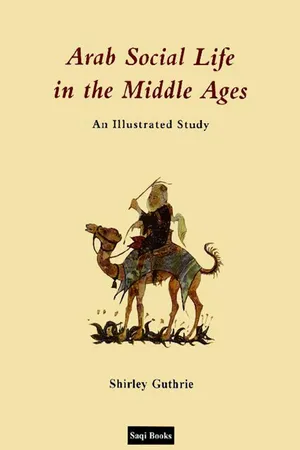
This vivid portrait of everyday life in the medieval Arab world draws on thirteenth century miniatures from collections as far afield as St Petersburg and Istanbul. The wide range of topi covers every aspect of society in the 'Abbasid period, from life at court to the pomp and ceremony of the military, from the dispensing of justice to the bustle of the suq and slave market. The routine of village life is contrasted with the pleasures of urban society, and we are also introduced to the world of musicians and professional mourners. Women are shown not only as virtuous wives, and in childbirth, but as spirited and articulate individuals. The traditions of Arab hospitality are described, with scenes of drinking, feasting and etiquette. The author has illustrated her study with contemporary miniatures, principally those of al-Wasiti which accompany the celebrated Maqamat of al-Hariri. In his text, al-Hariri made no attempt to conceal his admiration for his unprincipled and thoroughly disreputable protagonist, Abu Zayd - who represents the voice of the common man and possibly provides a prototype for the popular picaresque heroes of later European literature. Al-Hariri frequently used the tales as a subtle and indirect way of satirizing the prevailing social order, yet he was insistent that his work had an underlying moral purpose. 'Guthrie's work is scholarly and her book is a mine of information on both basic and recondite features of Islamic society.' Robert Irwin, Times Literary Supplement 'Very lively and informative on a wide range of topi in medieval Islamic history. The book ... is eminently accessible to students and non-specialists, and is certainly one that merits close attention.' Medical History 'An essential read for Arabs and non-Arabs alike.' al-Hayat
Information
1
The Religious Life
Even today, no traveller to the Middle East can fail to be impressed by the very public nature of Islam and the extent to which it impinges upon daily life. Pious exclamations are on the lips of all, whether ‘Praise be to God!’, ‘If God wills!’ or ‘In the safe-keeping of God’. The life of the Prophet and the early Muslims is at the heart of the community’s collective memory as a paradigm for all in society. Social gatherings are preceded by ‘In the Name of God, the All-Merciful, the All-Compassionate’ (the basmallāh) and also frequently by a recitation from the Qur’ān. Five daily calls to prayer in the Sunni tradition punctuate the day, and on Fridays the pavements outside the congregational mosque are thronged with crowds of men and boys. The great festivals of Ramaḍān and the ḥajj (the pilgrimage to Mecca) are joyous communal and public celebrations of a culmination of rigorous deprivation and religious obligation. Coffee shops and restaurants are closed and the fasting population look tired and anxious. The pinched appearance of returned pilgrims is suffused with the quiet pride of the achievement of a lifetime’s goal. All of these are highly visible symbols of the literal meaning of Islam—‘submission to the will of God’—and foster the sense of belonging to a community.
The articulation of Islam into a body of religious sciences and practice took place largely in Iraq during the ‘Abbāsid period. It is therefore not surprising that the illustrations in a work containing several hundred Qur’ānic allusions and numerous pious sentiments should feature rulers as upholders and defenders of the faith, mosques and preachers with great oratorical powers, lawyers expert in the Sharī‘a and tableaux of Ramaḍān and the ḥajj.
Ramaḍān
The ‘Īd al-Fiṭr Sermon (Khuṭba)
Maqāma 7 is set in Barqa‘īd, which was a town of considerable size north of Mosul and south of Naṣībīn. The tale unfolds on the great feast of ‘Īd al-Fịtr, which signals the breaking of the fast at the end of the month of Ramaḍān. It is possible that the author chose this location because it rhymes with the words barq ‘īd at the end of the next clause. These translate literally as the ‘lightning of the festival’ and are a metaphor for its approach. Al-Ḥārith is unwilling to resume his journey on this day of colourful ceremony without observing the obligatory and supererogatory rites. Mindful of a Tradition of the Prophet, he dons new clothes and sets out for the Great Mosque, where he joins the procession of people similarly attired in fine garments. As the congregation gather and arrange themselves in rows, an aged blind beggar appears, guided by an emaciated old woman who hands out petitions for alms.
The painter al-Wāsiṭī has produced a striking illustration in BN 5847 for the interior of the congregational mosque (jāmi‘), where the precher (khaṭīb) delivers the ‘Īd al-Fiṭr address. Textual commentaries are written at the sides in red ink in a decorative zigzag pattern. The three lines of text above the miniature are part of Abū Zayd’s speech. They read:
I am in God’s hands and commit my case to Him;
There is no power or strength but in Him;
To Him alone I look;
For in mankind a source of bounty now no more I find.
He continues in similar vein, then in the two lines of Arabic below, he instructs his companion:
But nevertheless be cheerful and hope for the best,
And now collect the papers together and count them.
She replies:
I have already collected and counted them.
And found that the hand of loss had destroyed one of them.
Whereupon he exclaims, ‘Ruin to thee! Slovenly wretch!’1
Later on, the text indicates that the action takes place when the congregation is gathered and arranged in rows, presumably before the sermon (Khuṭba), although none is mentioned.
Abū Zayd does not conform to the text’s ‘old man in two cloaks’ (shamlataini) with his eyes closed as he feigns blindness, although his left hand rests on his wife’s shoulders. A cloak precluded the need for other clothing; it was therefore eminently suitable for the poorer classes and would have been the ideal garment for Abū Zayd, in this instance, to convey his poverty. This type of robe was also worn by the Jewish poor and it is cognate with the Hebrew term. Instead, Abū Zayd wears a plebeian white robe, albeit with ṭirāz bands on his sleeves. The ṭirāz was a richly embroidered band of material for the embellishment of garments; one would certainly not expect to find it on a poor man’s robe or, as here, on the olive green turban (‘imāma). Under his right arm he carries a coarse sort of wallet from which he produces his poems of supplication for alms. Despite his supposedly penurious circumstances, his hair and beard are well groomed, and his robe snowy-white, so he has evidently made an effort over his appearance. As he says, ‘Far better poverty with patient pride than bitter scorn and insult to abide.’

1. The preacher delivers the ‘Īd al-Fiṭr address.
Abū Zayd’s companion looks neither emaciated nor old; she is well built and is the type of ample, middle-aged female who appears elsewhere in this manuscript, as we shall see. These women are invariably capable-looking and assertive, and here her vivid hand gestures leave no doubt that she is literally empty-handed. She wears an outer wrap (ghilāla) of everyday smokey-grey colour, but it is gold-trimmed and again inappropriate for the effect the couple of the text would wish to display, unless it represents her as a refined woman temporarily down on her luck. Perhaps al-Wāsiṭī sought to inject a vein of humour and to indicate to the reader—although it was hardly necessary by the 7th Maqāma—that these are no ordinary beggars. Alternatively, the garments may be used as compositional markers, to draw attention to the principal characters.
Alms-giving on ‘Īd al-Fiṭr is public, and the exploitative side to Abū Zayd’s nature is well to the fore: fully aware of the obligation upon the faithful to be generous on this occasion, he is prepared to capitalize on this baser, but nonetheless human, spur to giving. Ideally, the deprivations of the fast should afford the congregation some insight into the needs of the poor through their own experience of extreme hunger and thirst, and one would expect them to be moved by compassion to generous giving. That they do not do so serves to highlight the naivety of al-Ḥārith, who is the only member of the congregation to give the woman alms, namely ‘a dirham [a small silver coin] and a mite’. This suggests that the congregation knows something that al-Ḥārith does not—in other words, that the pair are perpetrating a confidence trick.
From the ninth century onwards there had been an interest in the ‘low life’, in the form of itinerant tricksters. We know from Maqāmāt 2 and 49 that Abū Zayd considered himself to be a member of the self-styled ‘Sons of Sāsān’ (Banū Sāsān). Sāsān was the son of a petty ruler of a district in western Persia. He was disinherited, took refuge with the Kurds, and in folklore founded the begging fraternities and became their king; his clan apparently embraced all groups beyond the pale of law-abiding society. Abū Zayd and his wife are clearly not of the criminal class as such, but they are at least on the margins of society and make up the general collectivity of the Banū Sāsān. Abū Zayd’s wife, therefore, is identifiable with a popular underworld female character, one of a begging duo who frequented mosques, who regaled the audience with tales of hardship due to her husband’s blindness.
The viewer is linked to the pair by the pointing finger of the preacher, while the row of turbans emphasizes the outstretched postures of the begging couple. Al-Ḥārith stands at the left-hand side in the mosque, hand to mouth; he is anxious to make the acquaintance of the person who has woven ‘the rich tissue of these verses’ that outline hardship, but is unable to move forward because of the pressing crowd. His hand gesture is taken from Byzantine painting and here conveys a sense of unease and a feeling that all may not be what it seems. Al-Ḥārith is shown in three-quarter profile with the feature of the ‘protruding eye’, a curious feature of western Indian painting from the eleventh and twelfth centuries which also occurs in Coptic illustration. It is not until later in the tale that he suspects ‘that Abū Zayd was indicated by all this’ and his ‘sorrow was excited for what had befallen his eyes’.
The congregation comprises a tight group of six men in the foreground. Four of them watch the couple, while the other two turn their heads towards the preacher; this has the effect of hinting at depth in the composition, and these people comprise part of the crowd who ‘had become such as to be well-nigh suffocating’. Their self-coloured robes are in shades of red, pale blue, smokey-grey, pale saffron, pink/violet and dark green. Folds and patterns are gently delineated to suggest that the materials are fine.
The turbans are in a variety of these colours; two of them are white and belong to the two men who are turned towards the preacher. All the turbans have extremely long waist-length ends, with ṭirāz bands. White turbans occur elsewhere here, in the first tale and in the cemetery. White is uncommon for turbans in the Maqāmāt and it seems to have been employed to draw attention to a specific feature or as a compositional marker. Here, it may also indicate studied indifference to Abū Zayd or rapt attention to the preacher.
The tail (‘adhaba) of the turban usually measured four fingers in length, anything longer being regarded as ostentatious,2 but one should bear in mind that these people are both seeing and being seen in all their finery on a great public occasion. There is an obvious parallel with the artist’s well-dressed women in the Rayy mosque discussed in the analysis of ‘Women in the Mosque’ (see Chapter 6) (Plate 5).
Al-Ṣābi’ describes a typical Ramaḍān scene of worship in the Rules and Regulations of the Court [Rusūm dār al-khilāfa]: shortly after sunrise on ‘Īd al-Fiṭr the people, clothed in their best garments, gathered in the mosque and performed the two prostrations in prayer (rak‘āt) led by the caliph or his appointee, and the alms of the fast (ṣadaqāt al-Fiṭr) were distributed. This was followed by much house-visiting of relatives and friends, the mutual expression of good wishes and the exchange of gifts of clothing and cash. Ramaḍān was, and still is, a time of the greatest hospitality and the wearing of new garments. Another source reveals how a vizier, Ibn ‘Abbād, entertained several thousand people at this time and gave away more in that one month than he did throughout the remainder of the year.3
Several features indicate that this is an official occasion. The pair of black official ‘Abbāsid standards which flank the preacher are twisted like silken skeins. It is likely that the fabric bears epigraphy, for they are identical to the furled standard borne by a horseman on the opposite page, which is clearly inscribed in white (Illust. 2). The finials of the flag-poles are also identical in both illustrations. In Chapter 5 of the Rules and Regulations of the Court, mention is made of the types of banners which were given to princes on their appointment; these bore pious inscriptions on both sides and read, ‘The upholder of Allāh’s command. The Commander of the Faithful’.
Al-Wāsiṭī’s preacher is clad in the black robes which stamp him as an ‘...
Table of contents
- Cover
- Title
- Contents
- List of Illustrations
- Glossary
- A Note on Transliteration and Pronunciation
- Foreword by Robert Hillenbrand
- Preface
- Introduction
- 1. The Religious Life
- 2. Power and Authority
- 3. Trade
- 4. Aspects of Urban Life
- 5. Aspects of Rural Life
- 6. Women
- 7. Hospitality
- Conclusion
- Notes
- Bibliography
- Index
- Sources of Illustrations
- Copyright
Trusted by 375,005 students
Access to over 1.5 million titles for a fair monthly price.
Study more efficiently using our study tools.
Frequently asked questions
Yes, you can cancel anytime from the Subscription tab in your account settings on the Perlego website. Your subscription will stay active until the end of your current billing period. Learn how to cancel your subscription
No, books cannot be downloaded as external files, such as PDFs, for use outside of Perlego. However, you can download books within the Perlego app for offline reading on mobile or tablet. Learn how to download books offline
Perlego offers two plans: Essential and Complete
- Essential is ideal for learners and professionals who enjoy exploring a wide range of subjects. Access the Essential Library with 800,000+ trusted titles and best-sellers across business, personal growth, and the humanities. Includes unlimited reading time and Standard Read Aloud voice.
- Complete: Perfect for advanced learners and researchers needing full, unrestricted access. Unlock 1.5M+ books across hundreds of subjects, including academic and specialized titles. The Complete Plan also includes advanced features like Premium Read Aloud and Research Assistant.
We are an online textbook subscription service, where you can get access to an entire online library for less than the price of a single book per month. With over 1.5 million books across 990+ topics, we’ve got you covered! Learn about our mission
Look out for the read-aloud symbol on your next book to see if you can listen to it. The read-aloud tool reads text aloud for you, highlighting the text as it is being read. You can pause it, speed it up and slow it down. Learn more about Read Aloud
Yes! You can use the Perlego app on both iOS and Android devices to read anytime, anywhere — even offline. Perfect for commutes or when you’re on the go.
Please note we cannot support devices running on iOS 13 and Android 7 or earlier. Learn more about using the app
Please note we cannot support devices running on iOS 13 and Android 7 or earlier. Learn more about using the app
Yes, you can access Arab Social Life in the Middle Ages by Shirley Guthrie in PDF and/or ePUB format, as well as other popular books in History & Social History. We have over 1.5 million books available in our catalogue for you to explore.