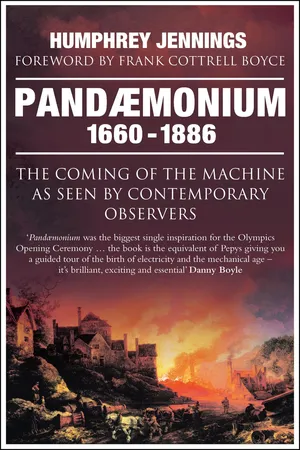
Collecting texts taken from letters, diaries, literature, scientific journals and reports, Pandæmonium gathers a beguiling narrative as it traces the development of the machine age in Britain.
Covering the years between 1660 and 1886, it offers a rich tapestry of human experience, from eyewitness reports of the Luddite Riots and the Peterloo Massacre to more intimate accounts of child labour, Utopian communities, the desecration of the natural world, ground-breaking scientific experiments, and the coming of the railways.
Humphrey Jennings, co-founder of the Mass Observation movement of the 1930s and acclaimed documentary film-maker, assembled an enthralling narrative of this key period in Britain's national consciousness. The result is a highly original artistic achievement in its own right.
Thanks to the efforts of his daughter, Marie-Louise Jennings, Pandæmonium was originally published in 1985, and in 2012 it was the inspiration behind Danny Boyle's electrifying Opening Ceremony for the London Olympic Games. Frank Cottrell Boyce, who wrote the scenario for the ceremony, contributes a revealing new foreword for this edition.
eBook - ePub
Pandaemonium 1660–1886
The Coming of the Machine as Seen by Contemporary Observers
- 416 pages
- English
- ePUB (mobile friendly)
- Available on iOS & Android
eBook - ePub
Pandaemonium 1660–1886
The Coming of the Machine as Seen by Contemporary Observers
About this book
Information
PART ONE
1660–1729
Observations and Reports
1 THE BUILDING OF PANDÆMONIUM c.1660
There stood a Hill not far whose griesly top
Belch’d fire and rowling smoak; the rest entire
Shon with a glossie scurff, undoubted sign
That in his womb was hid metallic Ore,
The work of Sulphur. Thither wing’d with speed
A numerous Brigad hasten’d. As when bands
Of Pioners with Spade and Pickaxe arm’d
Forerun the Royal Camp, to trench a Field,
Or cast a Rampart. Mammon led them on,
Mammon, the least erected Spirit that fell
From heav’n, for ev’n in heav’n his looks and thoughts
Were always downward bent, admiring more
The riches of Heav’ns pavement, trod’n Gold,
Then aught divine or holy else enjoy’d
In vision beatific: by him first
Men also, and by his suggestion taught,
Ransack’d the Center, and with impious hands
Rifl’d the bowels of thir mother Earth
For Treasures better hid. Soon had his crew
Op’nd into the Hill a spacious wound
And dig’d out ribs of Gold. Let none admire
That riches grow in Hell; that soyle may best
Deserve the pretious bane. And here let those
Who boast in mortal things, and wondring tell
Of Babel, and the works of Memphian Kings,
Learn how thir greatest Monuments of Fame,
And Strength and Art are easily outdone
By Spirits reprobate, and in an hour,
What in an age they with incessant toyle
And hands innumerable scarce perform.
Nigh on the Plain in many cells prepar’d,
That underneath had veins of liquid fire
Sluc’d from the Lake, a second multitude
With wondrous Art founded the massie Ore,
Severing each kinde, and scum’d the Bullion dross:
A third as soon had form’d within the ground
A various mould, and from the boyling cells
By strange conveyance fill’d each hollow nook,
As in an Organ from one blast of wind
To many a row of Pipes the sound-board breaths.
Anon out of the earth a Fabrick huge
Rose like an Exhalation, with the sound
Of Dulcet Symphonies and voices sweet,
Built like a Temple, where Pilasters round
Were set, and Doric pillars overlaid
With Golden Architrave; nor did there want
Cornice or Freeze, with bossy Sculptures grav’n,
The roof was fretted Gold. Not Babilon,
Nor great Alcairo such magnificence
Equal’d in all thir glories, to inshrine
Belus or Serapis thir Gods, or seat
Thir Kings, when Ægypt with Assyria strove
In wealth and luxurie. Th’ ascending pile
Stood fixt her stately highth, and strait the dores
Op’ning thir brazen foulds discover wide
Within, her ample spaces, o’re the smooth
And level pavement; from the arched roof
Pendant by suttle Magic many a row
Of Starry Lamps and blazing Cressets fed
With Naphtha and Asphaltus yeilded light
As from a sky. The hasty multitude
Admiring enter’d, and the work some praise
And some the Architect: his hand was known
In Heav’n by many a Towred structure high,
Where Scepter’d Angels held thir residence,
And sat as Princes, whom the supreme King
Exalted to such power, and gave to rule,
Each in his Hierarchie, the Orders bright.
From Paradise Lost Book I by John Milton, published 1667, written c.1660.
The first image, and in some sense the origin of all that follow, is the passage towards the end of Book 1 of Milton’s Paradise Lost describing the fallen angels setting to work to mine, smelt, forge and mould the metals in the soil of hell.
In the lines that follow, Lucifer is equated with Vulcan or Mulciber, also thrown down from heaven and in ancient Greece and Rome the god of the forge:
nor aught avail’d him now
To have built in Heav’n high Towrs; nor did he scape
By all his Engins, but was headlong sent
With his industrious crew to build in hell.
Meanwhile the winged Haralds by command
Of Sovran power, with awful Ceremony
And Trumpets sound throughout the Host proclaim
A solemn Councel forthwith to be held
At Pandæmonium, the high Capital
Of Satan and his Peers. . . .
In this book, the building of Pandæmonium is equated with the industrial revolution and the coming of the machine. One of the early ‘notes for an introduction’ reads: ‘Pandæmonium is the Palace of All the Devils. Its building began c.1660. It will never be finished – it has to be transformed into Jerusalem. The building of Pandæmonium is the real history of Britain for the last three hundred years. That history has never been written. The present writer has spent many years collecting materials for it. From this mass of material the present book is a selection. A foretaste of the full story.’
2 MEMORANDUM 1660
Memorandum that, November 28, 1660, these persons following, according to the usual custom of most of them, mett together at Gresham College, to hear Mr Wren’s lecture, viz., the Lord Brouncker, Mr Boyle, Mr Bruce, Sir Robert Moray, Sir Paule Neile, Dr Wilkins, Dr Goddard, Dr Petty, Mr Ball, Mr Rooke, Mr Wren, Mr Hill. And after the lecture was ended they did, according to the usual manner, withdrawe for mutualle converse. Where, amongst other matters that were discoursed of, something was offered about a designe of founding a Colledge for the promoting of Physico-Mathematical Experimentall Learning; and because they had these frequent occasions of meeting with one another, it was proposed that some course might be thought of to improve their meeting to a more regular way of debating things, and, according to the manner in other countries, where there were voluntary associations of men in academies for the advancement of various parts of learning, soe they might do something answerable here for the promoting of experimentall philosophy.
In order to which it was agreed that this Company would hold their weekly meetings on Wednesday, at 3 o’clock, of the term time, at Mr Rooke’s chamber at Gresham Colledge; in the vacation at Mr Ball’s chamber in the Temple.
This ‘memorandum’ is quoted in an extract from the Journal of the Royal Society in The Royal Society, 1660–1940 by Sir Henry Lyons, 1944. A similar text is printed in The History of the Royal Society by Thomas Birch, 1756.
3 GOD WOULD BE MUCH HONORED c.1660
God would be much honored
- By finding out the use of the fixed stars.
- Of the matter wherewith the Globe of the Earth is fill’d.
- The use of most animalls, vegetables, & mineralls.
- The origins of man & animalls.
- Of animals eating one another.
- Of the paines & evills which animalls suffer.
- Of generation by the way of male & female.
- Of the different ages & gestation of animalls.
- Of germination in animalls, vegeatables &c.
From the MSS of Sir William Petty in The Petty Papers, edited by the Marquis of Lansdowne, 1927.
4 THE BOYHOOD OF GENIUS c.1660
Every one that knew Sir Isaac, or have heard of him, recount the pregnancy of his parts when a boy, his strange inventions, and extraordinary inclination for mechanics. That instead of playing among the other boys, when from school, he always busied himself in making knick-knacks and models of wood in many kinds. For which purpose he had got little saws, hatchets, hammers, and all sorts of tools, which he would use with great dexterity. In particular they speak of his making a wooden clock. About this time, a new windmill was set up near Grantham, in the way to Gunnerby, which is now demolished, this country chiefly using water mills. Our lad’s imitating spirit was soon excited and by frequently prying into the fabric of it, as they were making it, he became master enough to make a very perfect model thereof, and it was said to be as clean and curious a piece of workmanship, as the original. This sometimes he would set upon the house-top, where he lodged, and clothing it with sail-cloth, the wind would readily turn it; but what was most extraordinary in its composition was, that he put a mouse into it, which he called the miller, and that the mouse made the mill turn round when he pleased; and he would joke too upon the miller eating the corn that was put in. Some say that he tied a string to the mouse’s tail, which was put into a wheel, like that of turn-spit dogs, so that pulling the string, made the mouse go forward by way of resistance, and this turned the mill. Others suppose there was some corn placed above the wheel, this the mouse endeavouring to get to, made it turn.
From a letter from Dr Stukeley to Dr Mead, printed in Collections for the History of the Town and Soke of Grantham by Edmund Turnor, 1806.
Note on 2, 3 and 4. The first stage (1660–1730) is a phase of pure science, direct experiments and clear philosophical and materialist thinking. The invention as yet was only on paper. The people – the impact on life – and consequent exploitation had not yet arrived.
Suggestion: when these ideas, scientific and mechanical, began to be exploited by capital and to involve many human beings, was not this the period of the repression of the clear imaginative vision in ordinary folk? And hence for its being possible for them to be emotionally exploited, e.g. by Wesley?
5 THE MOST STUPENDIOUS WORK IN THE WHOLE WORLD c.1660
98. An Engine so contrived, that working the Primum mobile forward or backward, upward or downward, circularly or corner-wise, to and fro, streight, upright or downright, yet the pretended Operation continueth, and advanceth none of the motions above-mentioned, hindering, much less stopping the other; but unanimously, and with harmony agreeing they all augment and contribute strength unto the intended work and operation: And therefore I call this A Semi-omnipotent Engine, and do intend that a Model thereof be buried with me.
99. How to make one pound weight to raise an hundred as high as one pound falleth, and yet the hundred pound descending doth what nothing less than one hundred pound can effect.
100. Upon so potent a help as these two last-mentioned Inventions a Waterwork is by many years experience and labour so advantageously by me contrived, that a Child’s force bringeth up an hundred foot high an incredible quantity of water, even two foot Diameter, so naturally, that the work will not be heard even into the next Room; and with so great ease and Geometrical Symmetry, that though it work day and night from one end of the year to the other, it will not require forty shillings reparation to the whole Engine, nor hinder ones day-work. And I may boldly call it The most stupendious Work in the whole world: not onely with little charge to drein all sorts of Mines, and furnish Cities with water, though never so high seated, as well to keep them sweet, running through several streets, and so performing the work of Scavengers, as well as furnishing the Inhabitants with sufficient water for their private occasions; but likewise supplying Rivers with sufficient to maintaine and make them portable from Towne to Towne, and for the bettering of Lands all the way it runs; with many more advantageous, and yet greater effects of Profit, Admiration, and Consequence. So that deservedly I deem this Invention to crown my Labours, to reward my Expences, and make my Thoughts acquiesce in way of further Inventions: this making up the whole Century, and preventing any further trouble to the Reader for the present, meaning to leave to Posterity a Book, wherein under each of these Heads the means to put in execution and visible trial of all things belonging to them, shall be printed by Brass-plates.
From A Century of Inventions by the Marquis of Worcester, 1663.
6 THAT HELLISH AND DISMALL CLOUD 1661
For first, the City of London is built upon a sweet and most agreeable Eminency of Ground, at the North-side of a goodly and well-conditioned River, towards which it hath an Aspect by a gentle and easie declivity, apt to be improved to all that may render her Palaces, Buildings, and Avenues usefull, gracefull, and most magnificent: The Fumes which exhale from the Waters and lower Grounds lying Southward, by which means they are perpetually attracted, carried off or dissipated by the Sun, as soon as they are born, and ascend.
Adde to this, that the Soil is universally Gravell, not onely where the City itself is placed, but for severall Miles about the Countreys which environ it: That it is plentifully and richly irrigated, and visited with Waters which Christalize her Fountains in every Street, and may be conducted to them in such farther plenty, as Rome herself might not more abound in this liquid ornament, for the pleasure and divertisement, as well as for the use and refreshment of her Inhabitants. I forbear to enlarge upon the rest of the conveniences which this August and Opulent City enjoies both by Sea and Land, to accumulate her Encomiums, and render her the most considerable that the Earth has standing upon her ample bosome...
Table of contents
- Cover
- Praise for Pandæmonium
- Title Page
- Copyright
- Contents
- About the Authors
- Foreword: Frank Cottrell Boyce
- Introduction: Humphrey Jennings
- To the Reader
- Humphrey Jennings and This Book: Marie-Louise Jennings
- Acknowledgements
- The Images: a Chronological List
- List of Illustrations
- Part One: 1660–1729: Observations and Reports
- Part Two: 1730–1790: Exploitation
- Part Three: 1791–1850: Revolution
- Part Four: 1851–1886: Confusion
- Theme Sequences
- Index
Trusted by 375,005 students
Access to over 1.5 million titles for a fair monthly price.
Study more efficiently using our study tools.
Frequently asked questions
Yes, you can cancel anytime from the Subscription tab in your account settings on the Perlego website. Your subscription will stay active until the end of your current billing period. Learn how to cancel your subscription
No, books cannot be downloaded as external files, such as PDFs, for use outside of Perlego. However, you can download books within the Perlego app for offline reading on mobile or tablet. Learn how to download books offline
Perlego offers two plans: Essential and Complete
- Essential is ideal for learners and professionals who enjoy exploring a wide range of subjects. Access the Essential Library with 800,000+ trusted titles and best-sellers across business, personal growth, and the humanities. Includes unlimited reading time and Standard Read Aloud voice.
- Complete: Perfect for advanced learners and researchers needing full, unrestricted access. Unlock 1.5M+ books across hundreds of subjects, including academic and specialized titles. The Complete Plan also includes advanced features like Premium Read Aloud and Research Assistant.
We are an online textbook subscription service, where you can get access to an entire online library for less than the price of a single book per month. With over 1.5 million books across 990+ topics, we’ve got you covered! Learn about our mission
Look out for the read-aloud symbol on your next book to see if you can listen to it. The read-aloud tool reads text aloud for you, highlighting the text as it is being read. You can pause it, speed it up and slow it down. Learn more about Read Aloud
Yes! You can use the Perlego app on both iOS and Android devices to read anytime, anywhere — even offline. Perfect for commutes or when you’re on the go.
Please note we cannot support devices running on iOS 13 and Android 7 or earlier. Learn more about using the app
Please note we cannot support devices running on iOS 13 and Android 7 or earlier. Learn more about using the app
Yes, you can access Pandaemonium 1660–1886 by Humphrey Jennings, Marie-Louise Jennings in PDF and/or ePUB format, as well as other popular books in History & British History. We have over 1.5 million books available in our catalogue for you to explore.