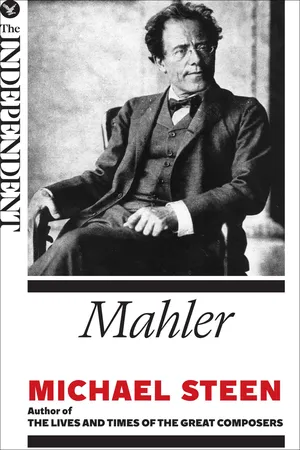
Welcome to The Independent's new ebook series The Great Composers, covering fourteen of the giants of Western classical music.
Extracted from Michael Steen's book The Lives and Times of the Great Composers, these concise guides, selected by The Independent's editorial team, explore the lives of composers as diverse as Mozart and Puccini, reaching from Bach to Brahms, set against the social, historical and political forces which affected them, to give a rounded portrait of what it was like to be alive and working as a musician at that time.
Mahler's brilliance as a conductor has never been in doubt. Tyrannical and difficult, he immeasurably improved standards of musical performance, and was partly responsible for revolutionising how operas are presented. But it is only relatively recently that his genius as a composer has come to the fore. His epic symphonies and the song symphony Das Lied von der Erde only really began to be enthusiastically appreciated after the Second World War, by audiences who could relate to the complicated and angst-ridden world they evoke.
Michael Steen traces the twists and turns of Mahler's life, lived out in the decaying Habsburg Empire with its constant rumbles of anti-Semitism. After a hard childhood, Mahler went to study in Vienna. Despite the disadvantage of his Jewish birth, he eventually secured top conducting positions, first in Hamburg, then in Vienna and New York. In the spare time of the career of a conductor as great and extensive as Toscanini himself, he succeeded in composing ten symphonies of immense range and reach. He also had an exceptional number of successful love affairs, although his marriage to Alma Schindler, 'the most beautiful girl in Vienna', and nearly twenty years younger than him, did not work out well. His struggles during the great years at the Imperial Opera, the climax of his conducting achievement, were compounded by the anti-Semitism prevalent in the prosperous, but superficial, fin-de-siècle Vienna.
Trusted by 375,005 students
Access to over 1.5 million titles for a fair monthly price.
BRIDGING THE 19TH and 20th centuries, there were two composers, one from Moravia, the other from Bavaria, who, each in their own way, took forward the Wagnerian Romantic tradition. Both often used a very large canvas, and a very large orchestra: the title of Mahler’s Eighth Symphony, the ‘Symphony of a Thousand’, speaks for itself; and, in the tone poem EinHeldenleben, Strauss requires eight horns, five trumpets and quadruple woodwind. Both composers could also produce music of exquisite delicacy. In this chapter, we shall describe the turbulent life of Mahler, and in the next, that of Richard Strauss.1
After a hard childhood, Mahler went to study in Vienna. Despite the disadvantage of his Jewish birth, he eventually secured top conducting positions, first in Hamburg, then in Vienna and New York. ‘In the spare time of the career of a conductor as great and extensive as Toscanini himself ’, he succeeded in composing ten symphonies ‘of immense range and reach’.2 He also seems to have had an exceptional number of successful love affairs, although his marriage to Alma Schindler, ‘the most beautiful girl in Vienna’,3 and nearly twenty years younger than him, did not work out well. His struggles during the great years at the Imperial Opera, the climax of his conducting achievement, were compounded by the anti-Semitism prevalent in the prosperous, but superficial, fin-de-siècle Vienna.
Mahler died before his 51st birthday, after an unsatisfactory period in both his professional life in New York and his marriage. However, just over eight months before his death in May 1911, he experienced the thrill of hearing the first performance of his Eighth Symphony. This was only a very short time after Arnold Schoenberg began to compose music of a very different order. Just before Mahler returned to New York for the last time, he attended an exhibition of Schoenberg’s experimental paintings.4 It was now, after all, the 20th century.
MAHLER’S EARLY YEARS
Gustav Mahler was born on 7 July 1860, in the village of Kali
t
on the Bohemian side of the Moravian border, not too far from the farm where, five years before, Smetana’s father had decided to settle. The word kali
t
means a trap for hunting wild animals;5 the village is in the middle of the countryside, and is tiny. It is over twenty miles from the large market town of Jihlava, which was then called Iglau.
Mahler’s father, Bernard, was the sole German in the village. He went from door to door in a barouche, selling mainly liquor. His market can only have comprised the 500 inhabitants of Kali
t
, a few other villages and the larger Humpolec, over four miles away. It was a tough life; and discrimination against the Jews made it particularly difficult. Perhaps as a result of this hardship, Bernard was violent. He would beat up and abuse his frail and limping wife,* the daughter of a prosperous soap manufacturer.
However, there was reason to be hopeful about the future. Recently, there had been a considerable easing of the restrictions on the Jews, which had been severe. Since the early 17th century, Jews could only enter Iglau for the market through one gate, on payment of a poll tax; they could not spend the night there. Since the early 18th century, the number of Jews allowed to live in the whole of Moravia was restricted, by decree, to 5,106 families. A father could bequeath his right of residence to his eldest son, who alone was allowed to get married. The rest of the males had to leave the country, and many left for Poland and Hungary. When a family had only daughters, the line was considered extinct. This law applied until 1848, when Bernard was 21.
Empress Maria Theresa had wanted to expel the Jews from her domains, but was persuaded of the wisdom of letting them stay, so long as they paid a hefty tax. Her son Joseph, with a mixture of despotism and humanitarianism, attempted to integrate the Jews, and issued an Edict of Tolerance in 1781.* But anti-Semitism continued: Jews were burdened with heavy taxes. And there was a spy scandal implicating the mistress of a privy counsellor: the girl was a rabbi’s daughter.7 Perhaps, therefore, it is not surprising that when Bernard was ten, there were only seventeen Jews resident in Iglau, out of a population of 16,000; a few years later, some were deported for illegal residence.8
Even after many of the restrictions were lightened, the situation remained difficult. In May 1850, by which time the number of Jews in Iglau had increased to around 100, there were anti-Jewish riots. But the future was brighter. After the Italian military disasters of 1859, Emperor Franz Joseph realised that he had to take steps to prevent the collapse of the rest of his empire. Very shortly after the emperor decreed far-reaching changes and improvements in late October 1860,** the enterprising and determined Bernard Mahler was in Iglau with his wife and three-month-old son. A week later, he was given permission to open up a grocery business, which was soon extended to include the sale of liquor. Before long, at the Mahlers’ store, one could buy Bordeaux wine, Jamaican rum, kümmel, maraschino, chartreuse and fine Russian and Chinese teas; or, if one preferred, one could simply drink a glass of hot punch.9
The domestic side of life was troubled and became terribly sad. Gustav’s mother had fourteen children,† of whom eight died in infancy. Gustav never knew his older brother. Karl died aged two in December 1865; Rudolf died aged one in December 1866. When Gustav was eleven, both the two-year-old Arnold and the eight-month-old Friedrich died. Alfred, aged one, died eighteen months later, and so it went on. When Gustav was thirteen, the death of twelve-year-old Ernst must have been a particular blow. By the time he was 21, the death of two-year-old Konrad might have appeared almost routine.10
On Gustav’s sixth birthday, 1,600 wounded were brought in from the Battle of Königgrätz (now Sadowa), which had taken place four days before, about 60 miles to the north.11 There had been great jubilation as the Habsburg army went north to meet the Prussians; but now, just a few days later, the victorious Prussians took occupation, and billeted their officers all over the town. Bernard’s shop must have experienced their depredations, but the worst legacy of the two-month occupation was a cholera epidemic which carried away over 80 Prussian soldiers and over 300 inhabitants.12 After the Prussians had gone, there was a visit from Emperor Franz Joseph who was keen to revive morale. The royal visit was, of course, accompanied by appropriate festivities.13
Because Iglau continued to be a military depot, there were regular parades. As Gustav walked to school, he would have heard the bands playing, and also the folk groups which frequented the town’s enormous market square. He was a conscientious schoolboy, and it is recorded that he handed in a purse which he found with a lot of money in it.14 His musical studies were begun on an old piano in his grandparents’ attic. The deaths of Karl and Rudolf were marked by an early composition: ‘Polka with an introductory funeral march’.15More happily, when he was ten, Gustav gave a recital.
The Mahlers’ business must have prospered considerably because, when Gustav was eleven, he was sent to a prestigious school in Prague. Earlier that year, the railway line had opened, and the journey must have been a novel and exciting experience.16 But, away from home, Gustav was very unhappy. He did very badly in his schoolwork and came bottom of the class. He learnt something, however: he apparently saw one of the sons of the house where he was lodging having the maidservant.17
Bernard retrieved Gustav back to Iglau to continue his education. To obtain an opinion on Gustav’s musical ability, he consulted a friend, a keen musician. The boy should become a professional musician, he was told; so, when he was hardly fifteen, Bernard took Gustav to Vienna to see Professor Julius Epstein at the Conservatoire. Epstein immediately accepted him for that autumn, and paid half his fees.
Mahler arrived in the city of Brahms. As he looked at the brand new Imperial and Royal Opera House, opened only five years previously, a boy with Mahler’s ambition might well have dreamt, or determined, that he would some day be its musical director. He will have heard of the Opera’s magnificent performances of Wagner’s works, before the stock market crash of December 1873 depleted its audiences overnight. By the time of Mahler’s arrival in Vienna, the Opera was recovering, and works like Carmen, recently rejected by Paris, were being well received.18 Verdi came there to conduct Aïda and his Requiem; and Wagner stayed there to supervise performances of Tannhäuser and Lohengrin. But there was much more than music, because Vienna was above all a centre for art. Art provided the illusion which enabled the people of the capital to escape from the reality of the relentless deterioration of the Habsburg regime.
Mahler returned periodically to Iglau to complete his general education and to perform in concerts. Despite the distractions of music, he scraped through his exams sufficiently to matriculate at the philosophical faculty of Vienna University, which he attended between 1877 and 1880. Alongside the study of history and philosophy, he heard some of Bruckner’s lectures.19 Somehow he managed to keep reasonably clear of Brahms, who was so vir-u lently opposed to the influence Bruckner was having on the younger generation.
Mahler led a bohemian life, and was close to members of the radical student movements, where he made several lasting friendships. One of his musical friends was Hugo Wolf who was about four months older than him. Wolf would make a major contribution to the Lied (song), before, in his mid-30s, he became insane with syphilis. Mahler and Wolf shared lodgings and at times one bed; they often lived on cheese-parings, and slept rough.20
At the Conservatoire, Mahler excelled, and won piano and composition prizes. After he graduated there, he had to complete his university studies. To keep going, he earned a little on the side, by teaching. For a time, he was piano tutor to a family in Hungary.
Mahler came under the spell of an anthology of old popular legends and songs, Des Knaben Wunderhorn, which had been collected by the German writers Clemens Brentano and Ludwig Achim von Arnim, on their travels through parts of Germany, in the first decade of the century. This collection, named after the opening poem, which tells of a youth who brings the empress a magic horn, was highly influential in the Romantic movement. The poems express a wide variety of moods: the cuckoo and the nightingale have a song contest which the donkey judges; dead soldiers answer the reveille, the sentry sings a night-song, a prisoner sings a song with his sweetheart, St Anthony preaches to the fishes.21 These songs were to influence many of Mahler’s compositions. He used Wunderhorn poems in ‘Das Klagende Lied’ and the Lieder Eines Fahrenden Gesellen, and in the Second, Third and Fourth Symphonies. In the 1890s, he wrote settings of twelve Wunderhorn poems for voice and piano.
‘Das Klagende Lied’ was completed on 1 November 1880, when Mahler was aged twenty. He entered it for the 1880 Beethoven Prize sponsored by the Vienna Philharmonic Society. It probably did not help Mahler’s cause that the jury was headed by Brahms and his colleague, the critic Eduard Hanslick. Mahler’s composition was rejected. Bruckner was more supportive and asked him and another student to make a piano duet arrangement of his disastrous Third Symphony.22
CONDUCTOR
Mahler was still only twenty but impoverished: one way to earn a living was to become a conductor. This was a time when even small towns like Rostock, Oldenburg and Trier had opera houses, and concert life flourished. ‘Regular performances were given in almost all towns, large or small, and smaller still.’23 Besides, ‘neither courts nor cities ever expected their theatres to show a profit or even to be self-supporting’.24
Mahler began his meteoric career as a conductor in summer 1880 in a tiny wooden theatre seating about 200 people at Bad Hall, a small spa set in rolling agricultural countryside near Linz. Its waters, strong in iodine, were recommended for heart and vascular complaints; in earlier years, the poet Franz Grillparzer had frequented it. Mahler conducted musical farces and comedies, and was general factotum: he tidied up after performances, and during the intervals he pushed the musical director’s child around in its pram.25
Mahler conducted at Laibach (now Ljubljana) during the following year. His first significant appointment, however, was when he became conductor to the theatre at Olmütz (now Olomouc) in Moravia, in January 1883. There, he conducted a repertoire including Bizet’s Carmen and works by, among others, Meyerbeer and Verdi. No Mozart or Wagner w...
Table of contents
INTRODUCTION
MAHLER’S EARLY YEARS
Notes
Other Books in the Series
Frequently asked questions
Yes, you can cancel anytime from the Subscription tab in your account settings on the Perlego website. Your subscription will stay active until the end of your current billing period. Learn how to cancel your subscription
No, books cannot be downloaded as external files, such as PDFs, for use outside of Perlego. However, you can download books within the Perlego app for offline reading on mobile or tablet. Learn how to download books offline
Perlego offers two plans: Essential and Complete
Essential is ideal for learners and professionals who enjoy exploring a wide range of subjects. Access the Essential Library with 800,000+ trusted titles and best-sellers across business, personal growth, and the humanities. Includes unlimited reading time and Standard Read Aloud voice.
Complete: Perfect for advanced learners and researchers needing full, unrestricted access. Unlock 1.5M+ books across hundreds of subjects, including academic and specialized titles. The Complete Plan also includes advanced features like Premium Read Aloud and Research Assistant.
Both plans are available with monthly, semester, or annual billing cycles.
We are an online textbook subscription service, where you can get access to an entire online library for less than the price of a single book per month. With over 1.5 million books across 990+ topics, we’ve got you covered! Learn about our mission
Look out for the read-aloud symbol on your next book to see if you can listen to it. The read-aloud tool reads text aloud for you, highlighting the text as it is being read. You can pause it, speed it up and slow it down. Learn more about Read Aloud
Yes! You can use the Perlego app on both iOS and Android devices to read anytime, anywhere — even offline. Perfect for commutes or when you’re on the go. Please note we cannot support devices running on iOS 13 and Android 7 or earlier. Learn more about using the app
Yes, you can access Mahler by Michael Steen in PDF and/or ePUB format, as well as other popular books in Media & Performing Arts & Music. We have over 1.5 million books available in our catalogue for you to explore.