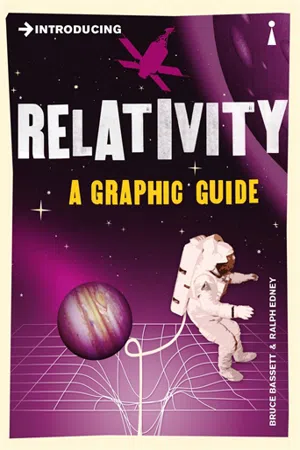
A superlative, fascinating graphic account of Albert Einstein's strange world and how his legacy has been built upon since.
It is now more than a century since Einstein's theories of Special and General Relativity began to revolutionise our view of the universe. Beginning near the speed of light and proceeding to explorations of space-time and curved spaces,
Introducing Relativity plots a visually accessible course through the thought experiments that have given shape to contemporary physics.
Scientists from Isaac Newton to Stephen Hawking add their unique contributions to this story, as we encounter Einstein's astounding vision of gravity as the curvature of space-time and arrive at the breathtakingly beautiful field equations. Einstein's legacy is reviewed in the most advanced frontiers of physics today - black holes, gravitational waves, the accelerating universe and string theory.
- 176 pages
- English
- ePUB (mobile friendly)
- Available on iOS & Android
eBook - ePub
About this book
Information
Topic
Physical SciencesSubtopic
Mathematics GeneralThe Conditions of Space and Time
The German philosopher Immanuel Kant (1724–1804) delved into the critical limits of knowledge in his revolutionary text, The Critique of Pure Reason (1781). He expounded the view that space and time do not exist independently of our consciousness.
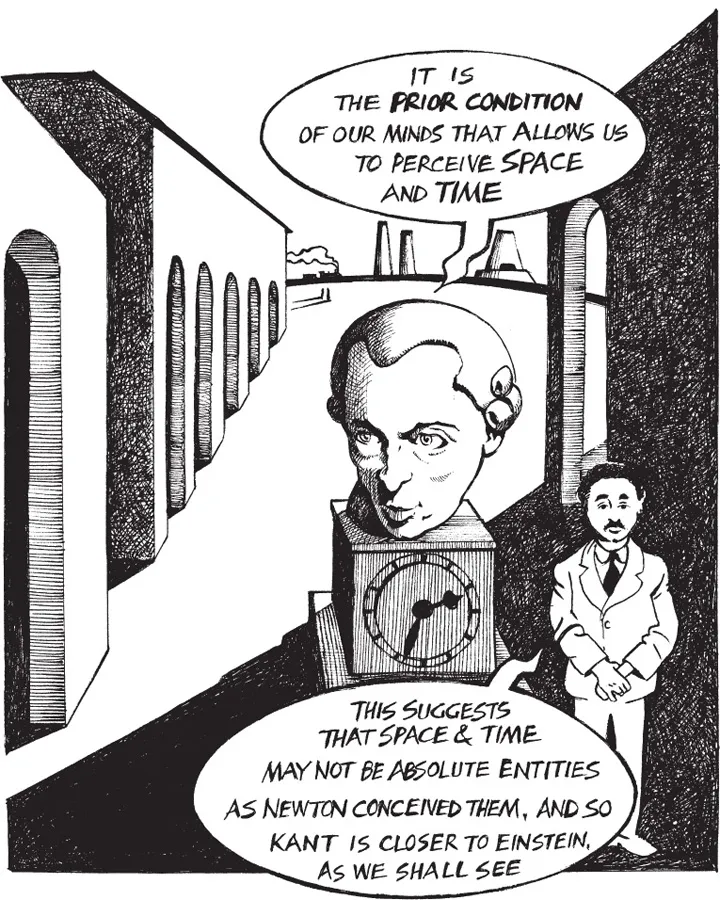
IT IS THE PRIOR CONDITION OF OUR MINDS THAT ALLOWS US TO PERCEIVE SPACE AND TIME
THIS SUGGESTS THAT SPACE & TIME MAY NOT BE ABSOLUTE ENTITIES AS NEWTON CONCEIVED THEM, AND SO KANT IS CLOSER TO EINSTEIN, AS WE SHALL SEE
THIS SUGGESTS THAT SPACE & TIME MAY NOT BE ABSOLUTE ENTITIES AS NEWTON CONCEIVED THEM, AND SO KANT IS CLOSER TO EINSTEIN, AS WE SHALL SEE
Nevertheless, until Einstein, the dominant philosophy of physicists was inherited from Sir Isaac Newton (1643–1727).
Newton’s Classical Laws of Physics
Newton was arguably the greatest of physicists and mathematicians. He contributed significantly to optics, formulated his three laws of motion, and developed differential and integral calculus independently of G.W. Leibniz (1646–1716). But, in terms of understanding Einstein’s relativity, Newton’s law of universal gravitation is the most crucial for us.
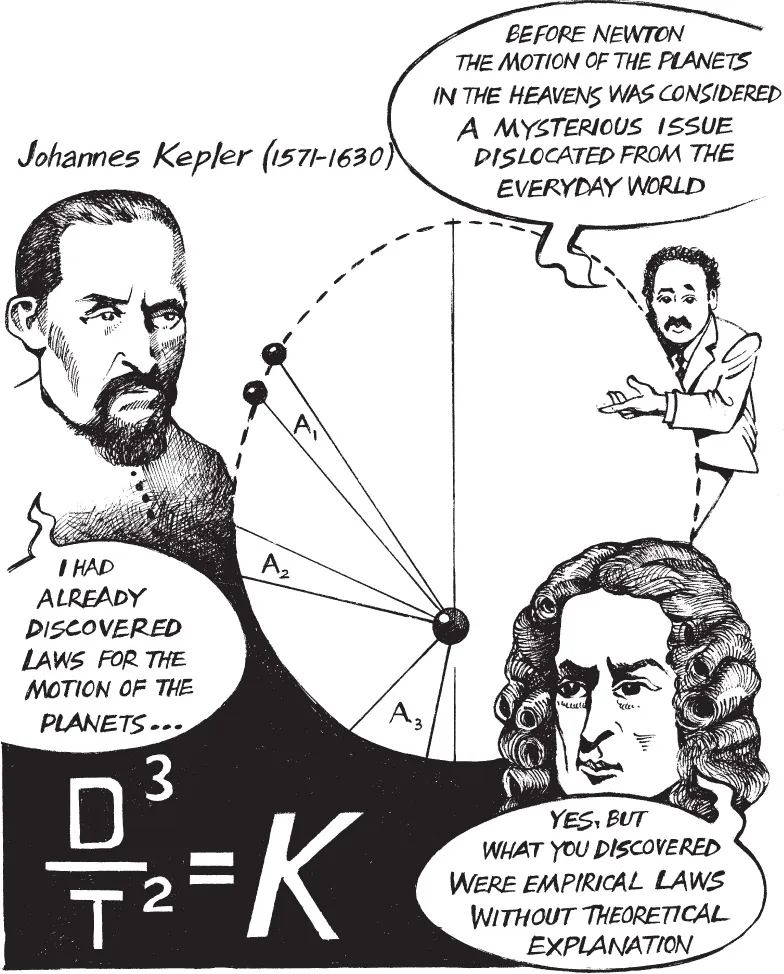
BEFORE NEWTON THE MOTION OF THE PLANETS IN THE HEAVENS WAS CONSIDERED A MYSTERIOUS ISSUE DISLOCATED FROM THE EVERYDAY WORLD
I HAD ALREADY DISCOVERED LAWS FOR THE MOTION OF THE PLANETS...
YES, BUT WHAT YOU DISCOVERED WERE EMPIRICAL LAWS WITHOUT THEORETICAL EXPLANATION
I HAD ALREADY DISCOVERED LAWS FOR THE MOTION OF THE PLANETS...
YES, BUT WHAT YOU DISCOVERED WERE EMPIRICAL LAWS WITHOUT THEORETICAL EXPLANATION
A famous but untrue story has Newton sitting under an apple tree when his great discovery of gravity literally hit him on the head.
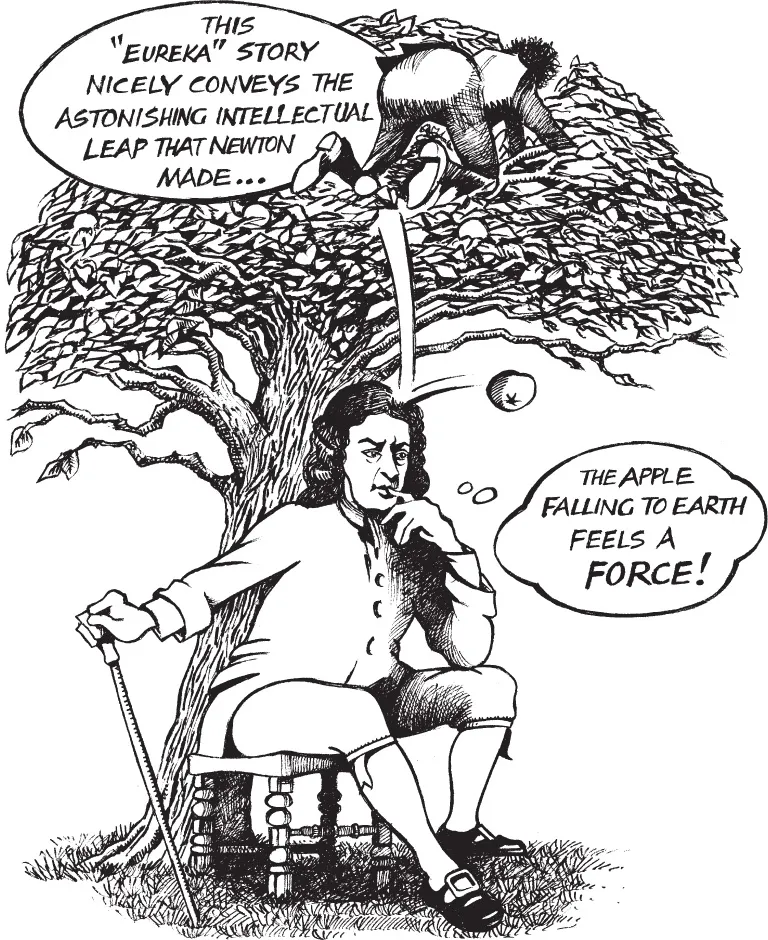
THIS “EUREKA” STORY NICELY CONVEYS THE ASTONISHING INTELLECTUAL LEAP THAT NEWTON MADE...
THE APPLE FALLING TO EARTH FEELS A FORCE!
THE APPLE FALLING TO EARTH FEELS A FORCE!
The specific importance of Newton’s law of universal gravitation is that it explains and unites several phenomena within a single theory. This quest for a single unifying theory would become the driving force of 20th- and 21st-century physics.
The Law of Gravity
Newton’s law of universal gravitation states that the force of gravity (F) between two objects of masses m and M is given by …
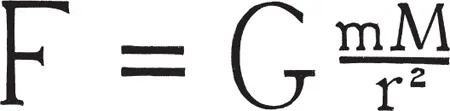
where r is the distance between the two objects and G is Newton’s constant. G is very small since gravity is very weak.
There are at least two implications to this law of gravity …
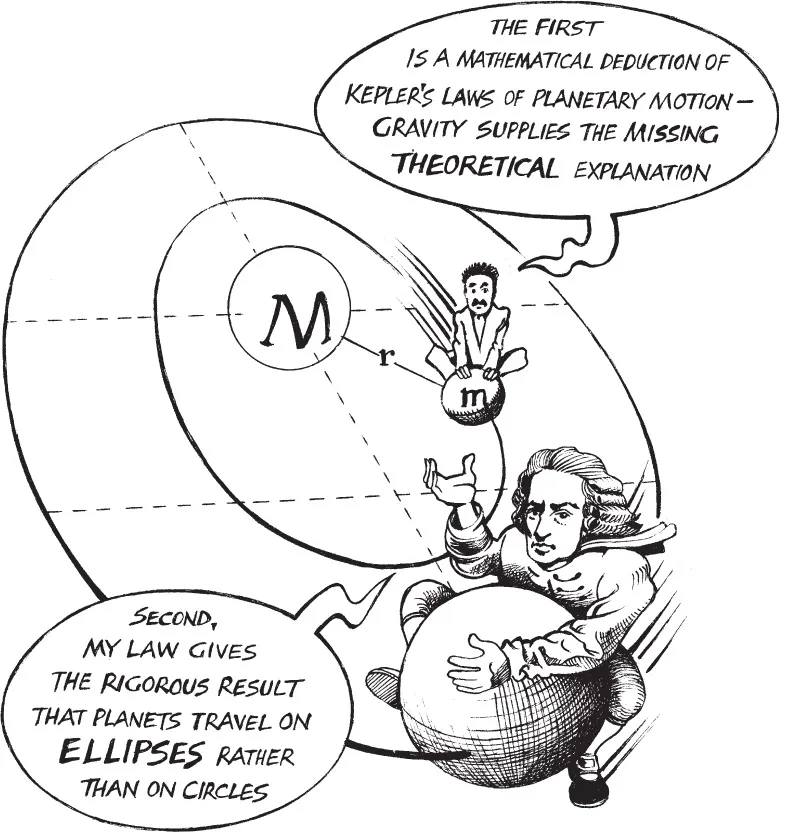
THE FIRST IS A MATHEMATICAL DEDUCTION OF KEPLER’S LAWS OF PLANETARY MOTION - GRAVITY SUPPLIES THE MISSING THEORETICAL EXPLANATION
SECOND, MY LAW GIVES THE RIGOROUS RESULT THAT PLANETS TRAVEL ON ELLIPSES RATHER THAN ON CIRCLES
SECOND, MY LAW GIVES THE RIGOROUS RESULT THAT PLANETS TRAVEL ON ELLIPSES RATHER THAN ON CIRCLES
Newton took several things for granted in his theory. While the earth was no longer the centre of the universe – and had not been so in the eyes of many scientists since Nicolaus Copernicus (1473–1543) – it was assumed that space and time were fundamentally different things and that both were absolute, set in marble.
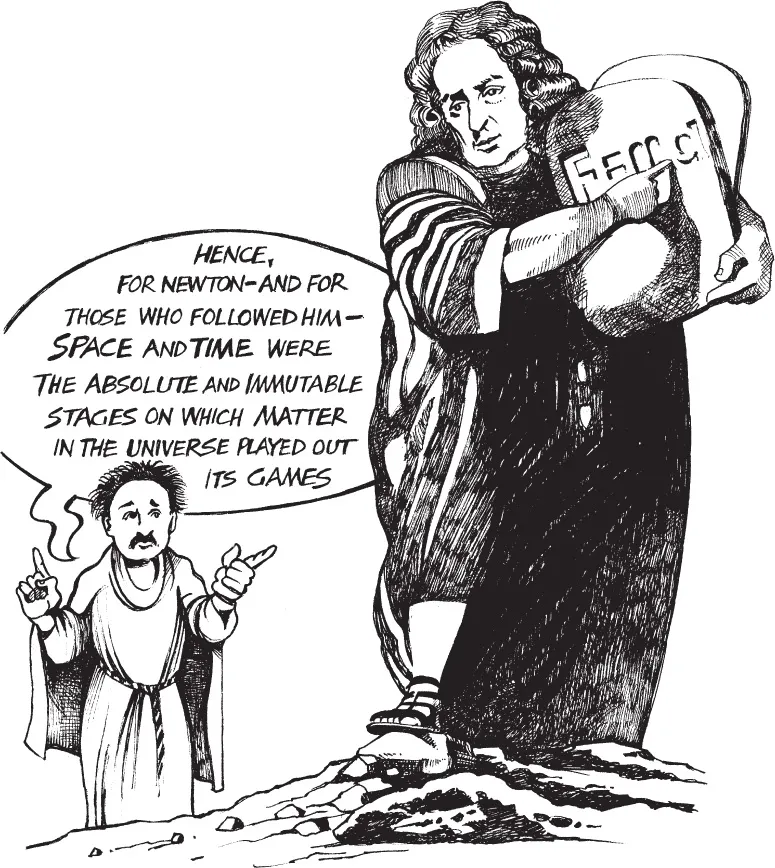
HENCE, FOR NEWTON-AND FOR THOSE WHO FOLLOWED HIM-SPACE AND TIME WERE THE ABSOLUTE AND IMMUTABLE STAGES ON WHICH MATTER IN THE UNIVERSE PLAYED OUT ITS GAMES
The idea of unifying the two, apparently different, concepts of space and time fell to Einstein, as we’ll later discuss.
Maxwell’s Theory of Electromagnetism
Theoretical physics had made significant progress before Einstein. In particular, James Clerk Maxwell (1831–79) had unified magnetism with electricity to give electromagnetism.
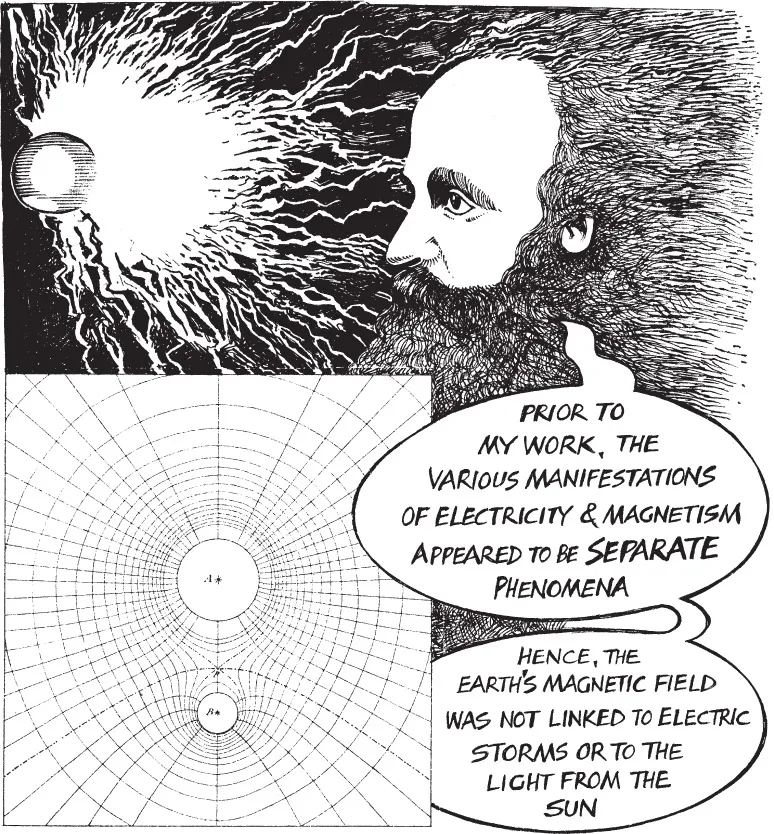
PRIOR TO MY WORK, THE VARIOUS MANIFESTATIONS OF ELECTRICITY & MAGNETISM APPEARED TO BE SEPARATE PHENOMENA
HENCE, THE EARTH’S MAGNETIC FIELD WAS NOT LINED TO ELECTRIC STORMS OR TO THE LIGHT FROM THE SUN
HENCE, THE EARTH’S MAGNETIC FIELD WAS NOT LINED TO ELECTRIC STORMS OR TO THE LIGHT FROM THE SUN
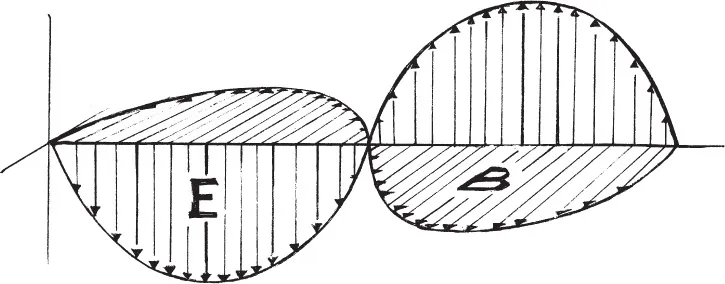
By means of four equations, Maxwell explained all the different manifestations of electricity and magnetism – from the emission of light and electric currents to the earth’s magnetic field. Maxwell’s equations linked the electric and magnetic fields to each other and showed how each of their various manifestations arose as special cases of a general theory.

Simple magnetic fields can occur when there is no electric field (and vice versa).
But, in general, if the intensity of an electric field varies in time, it will generate magnetic fields … and vice versa.
This happens in the case of light, which consists of oscillating electric and magnetic fields propagating through space and time – at the speed of light.
The unification that Maxwell achieved is thus similar conceptually to that of Newton when Newton realized that the force acting on the apple is the same as that holding the earth in orbit around the sun.
Problems in Classical Physics
A number of problems had been identified in this progressive story of physics. One of these concerned gravity itself. Newton’s theory of gravity correctly predicted that planets should move in elliptical orbits.
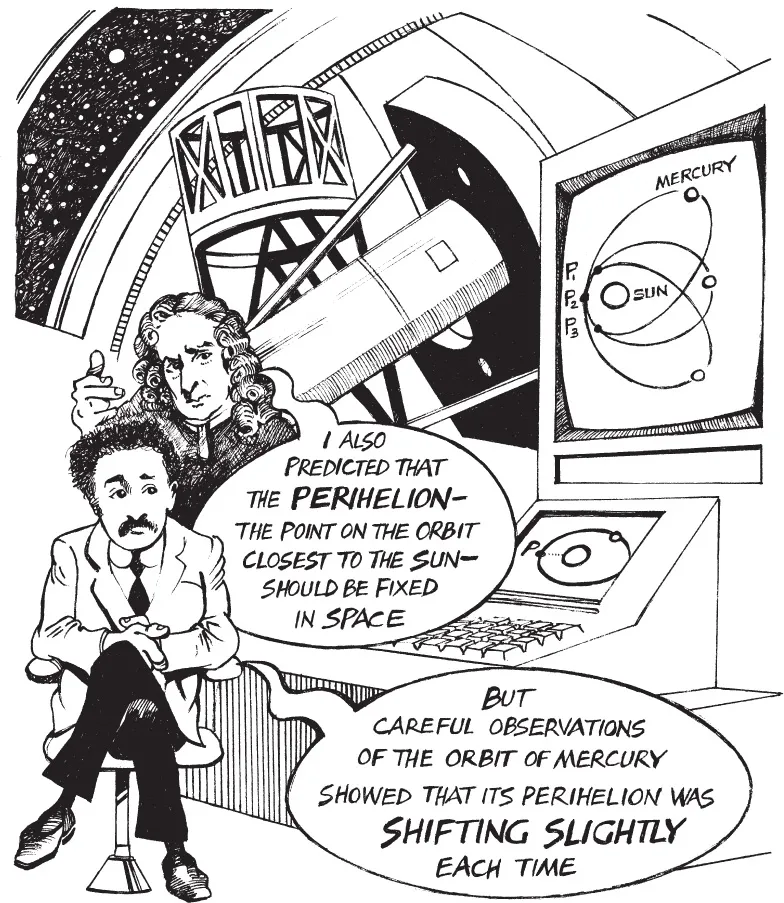
I ALSO PREDICTED THAT THE PERIHELION-THE POINT ON THE ORBIT CLOSEST TO THE SUN-SHOULD BE FIXED IN SPACE
BUT CAREFUL OBSERVATIONS OF THE ORBIT OF MERCURY SHOWED THAT ITS PERIHELION WAS SHIFTING SLIGHTLY EACH TIME
BUT CAREFUL OBSERVATIONS OF THE ORBIT OF MERCURY SHOWED THAT ITS PERIHELION WAS SHIFTING SLIGHTLY EACH TIME
Puzzle of the Atom
The atom was another major thorn in the flesh of physicists. The prevailing picture around the turn of the 20th century was that atoms are made up of a positively charged nucleus surrounded by negatively charged – and much less massive – electrons. The electrons must orbit the nuc...
Table of contents
- Cover
- Title Page
- Copyright
- Contents
- The Conditions of Space and Time
- Further Reading
- About the Author and Artist
- Acknowledgements
- Index
Trusted by 375,005 students
Access to over 1.5 million titles for a fair monthly price.
Study more efficiently using our study tools.
Frequently asked questions
Yes, you can cancel anytime from the Subscription tab in your account settings on the Perlego website. Your subscription will stay active until the end of your current billing period. Learn how to cancel your subscription
No, books cannot be downloaded as external files, such as PDFs, for use outside of Perlego. However, you can download books within the Perlego app for offline reading on mobile or tablet. Learn how to download books offline
Perlego offers two plans: Essential and Complete
- Essential is ideal for learners and professionals who enjoy exploring a wide range of subjects. Access the Essential Library with 800,000+ trusted titles and best-sellers across business, personal growth, and the humanities. Includes unlimited reading time and Standard Read Aloud voice.
- Complete: Perfect for advanced learners and researchers needing full, unrestricted access. Unlock 1.5M+ books across hundreds of subjects, including academic and specialized titles. The Complete Plan also includes advanced features like Premium Read Aloud and Research Assistant.
We are an online textbook subscription service, where you can get access to an entire online library for less than the price of a single book per month. With over 1.5 million books across 990+ topics, we’ve got you covered! Learn about our mission
Look out for the read-aloud symbol on your next book to see if you can listen to it. The read-aloud tool reads text aloud for you, highlighting the text as it is being read. You can pause it, speed it up and slow it down. Learn more about Read Aloud
Yes! You can use the Perlego app on both iOS and Android devices to read anytime, anywhere — even offline. Perfect for commutes or when you’re on the go.
Please note we cannot support devices running on iOS 13 and Android 7 or earlier. Learn more about using the app
Please note we cannot support devices running on iOS 13 and Android 7 or earlier. Learn more about using the app
Yes, you can access Introducing Relativity by Bruce Bassett, Ralph Edney in PDF and/or ePUB format, as well as other popular books in Physical Sciences & Mathematics General. We have over 1.5 million books available in our catalogue for you to explore.