A full-colour illustrated tour through philosophy's most famous – and most mind-bending – ideas
I Think Therefore I Am, Existentialism, Dialectical Materialism? The Socratic Method and Deconstruction? Sure, you know what they all mean. That is, you've certainly heard of them. But do you know enough about them to join a dinner party debate or dazzle the bar with your knowledge?
30-SECOND PHILOSOPHIES takes a revolutionary approach to getting a grip on the 50 most significant schools of philosophy. The book challenges leading thinkers to quit fretting about the meaning of meaning for a while and explain the most complex philosophical ideas – using nothing more than two pages, 300 words, and a metaphorical image.
Here, in one unique volume, you have the chance to pick the potted brains of our leading philosophers and understand complex concepts such as Kant's Categorical Imperative without ending up in a darkened room with an ice pack on your head.
eBook - ePub
30-Second Philosophies
The 50 Most Thought-provoking Philosophies, Each Explained in Half a Minute
- 160 pages
- English
- ePUB (mobile friendly)
- Available on iOS & Android
eBook - ePub
30-Second Philosophies
The 50 Most Thought-provoking Philosophies, Each Explained in Half a Minute
About this book
Information
Topic
PhilosophySubtopic
Philosophy History & Theory
GRAND MOMENTS
GRAND MOMENTS
GLOSSARY
a posteriori A Latin term which means “from what is after.” Philosophers use it to refer to knowledge that comes after perceptual experience or depends upon experience for its justification.
a priori A Latin term which means “from what is before.” Philosophers use it to refer to knowledge that comes before experience (so-called innate knowledge) or, less controversially, knowledge that does not depend on experience for its justification.
atom Derived from the Ancient Greek word atomos, meaning “not cuttable.” The Atomists held that everything in the Universe was made up of tiny, indivisible building blocks, moving about in the void, and colliding and combining to form visible objects.
Epicurean Having to do with the philosophy of Epicurus, an ancient Greek Atomist, Hedonist, and perhaps the earliest Empiricist. Sometimes the word points only to a misunderstanding of Epicurus’ hedonistic, moral theory, and means, roughly, “a person devoted to base, bodily pleasures.”
external world The world of objects as they exist apart from our experience of them, as opposed to our inner world of thoughts, perceptions, feelings, and the like.
forms Perfect, unchanging, paradigmatic concept-objects, or archetypes, of the many types of things we see all around us, as posited by Plato. There are, for example, many beautiful things—beautiful paintings, people, landscapes, musical scores, etc.—and what they all have in common is that they resemble the Form, Beautiful. Contemplating the Beautiful, getting to know it, makes one a better judge of beautiful things. The Forms enabled Plato to find a bit of permanence out there, which he thought was necessary for the existence of genuine knowledge.
good Possibly the ultimate Form, according to Plato. According to many commentators, Plato thought that one could only have wisdom—one could really know the other Forms—only after one grasped the Form of the Good.
ideas A component notion of George Berkeley’s idealism. Ideas are the passive objects of human knowledge, which can exist only in the mind that perceives them.
indirect awareness Our precarious perceptual connection to the world. If we are directly aware of inner, mental representations of objects in the external world, then we are only indirectly aware of the external world.
material substratum A something, we know not what, supposedly underpinning our perceptions of physical objects. It’s nothing but a philosopher’s fiction, according to George Berkeley.
mind A component notion of George Berkeley’s idealism. The mind is a container of ideas or, rather, a thing that knows them, and acts upon them.
purpose A fundamental feature of almost any explanation, for Aristotle. While modern science attempts to understand things by viewing them as purposeless, Aristotle saw purposes, goals, and ends everywhere: smoke rises because it “aims for the heavens,” acorns grow because their end is an oak tree, and so on.
Sun The representation of the Form of the Good in Plato’s cave allegory. Once outside the cave, one is able to see real objects, not just shadows. Just as we are able to see the objects in the world because of the light of the Sun, so, too, Plato suggests, can we understand the Forms once we apprehend the Good itself.
SOCRATES’ METHOD
the 30-second philosophy
Socrates was said to be the wisest man in Athens because he knew that he knew nothing. In the dialogues of Plato, Socrates attempted to spread such wisdom by going around asking people what they thought about a subject, and then asking them tricky questions until they contradicted themselves. For instance, in the dialogue Republic, he asks what “justice” is, and Cephalus suggests it is telling the truth and paying your debts. So, Socrates asks, if you borrow a sword from someone, you owe it to them to give it back, right? But then, what if you know that the person who wants their sword back has gone raving mad? “There have to be exceptions,” admits Cephalus. So, then, in this case justice requires not giving someone what they are due. Cephalus has undermined his own argument, revealing he doesn’t know what he thought he knew about justice. Socrates rests his case, and then starts on someone else. This method can seem very negative, but if you want to end up with true beliefs, you have to test the ones you have very thoroughly, and Socrates’ contention was that, if you do so, you’ll find that most of what you think is wrong.
3-SECOND THRASH
Ask questions, pick holes, and convince people they don’t know what they’re talking about.
3-MINUTE THOUGHT
Many have adopted what they call a “Socratic method,” although this often bears little resemblance to the highly negative approach of Socrates himself. Sometimes, the term is broadly used to refer to a rigorous examination of ideas by means of question and answer. Others in the practical philosophy movement have developed Socratic dialogue, in which the discussion is very democratic and cooperative—utterly unlike the way in which Socrates destroyed the arguments of his interlocutors.
RELATED PHILOSOPHIES
HEGEL’S DIALECTIC
3-SECOND BIOGRAPHIES
SOCRATES
469–399 BCE
PLATO
428/27–348/47 BCE
30-SECOND TEXT
Julian Baggini
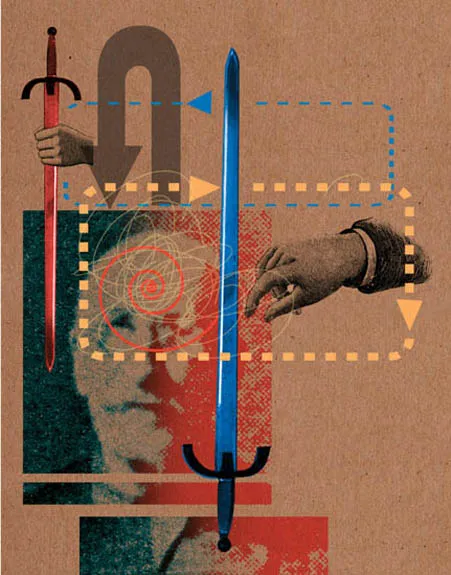
Socrates was wise; Socrates was a man; all men are wise. No, hang on, that can’t be right. Let’s try it again.
PLATO’S CAVE
the 30-second philosophy
Here is a picture of the human condition. People sit in a dark cave, watching shadows cast on the wall, thinking that they ...
Table of contents
- Cover Page
- Title Page
- Copyright Page
- Contents
- Foreword
- Introduction
- How to become a philosopher
- Language & Logic
- Science & Epistemology
- Mind & Metaphysics
- Ethics & Political Philosophy
- Religion
- Grand Moments
- Continental philosophy
- Notes on contributors
- Resources
- Acknowledgments
Trusted by 375,005 students
Access to over 1.5 million titles for a fair monthly price.
Study more efficiently using our study tools.
Frequently asked questions
Yes, you can cancel anytime from the Subscription tab in your account settings on the Perlego website. Your subscription will stay active until the end of your current billing period. Learn how to cancel your subscription
No, books cannot be downloaded as external files, such as PDFs, for use outside of Perlego. However, you can download books within the Perlego app for offline reading on mobile or tablet. Learn how to download books offline
Perlego offers two plans: Essential and Complete
- Essential is ideal for learners and professionals who enjoy exploring a wide range of subjects. Access the Essential Library with 800,000+ trusted titles and best-sellers across business, personal growth, and the humanities. Includes unlimited reading time and Standard Read Aloud voice.
- Complete: Perfect for advanced learners and researchers needing full, unrestricted access. Unlock 1.5M+ books across hundreds of subjects, including academic and specialized titles. The Complete Plan also includes advanced features like Premium Read Aloud and Research Assistant.
We are an online textbook subscription service, where you can get access to an entire online library for less than the price of a single book per month. With over 1.5 million books across 990+ topics, we’ve got you covered! Learn about our mission
Look out for the read-aloud symbol on your next book to see if you can listen to it. The read-aloud tool reads text aloud for you, highlighting the text as it is being read. You can pause it, speed it up and slow it down. Learn more about Read Aloud
Yes! You can use the Perlego app on both iOS and Android devices to read anytime, anywhere — even offline. Perfect for commutes or when you’re on the go.
Please note we cannot support devices running on iOS 13 and Android 7 or earlier. Learn more about using the app
Please note we cannot support devices running on iOS 13 and Android 7 or earlier. Learn more about using the app
Yes, you can access 30-Second Philosophies by Julian Baggini,Stephen Law, Barry Loewer in PDF and/or ePUB format, as well as other popular books in Philosophy & Philosophy History & Theory. We have over 1.5 million books available in our catalogue for you to explore.