In Science for Life acclaimed science writer Brian Clegg cuts through the vested interests and confusing contradictory statements that litter the media and the internet, to give a clear picture of what science is telling us right now about changing our lives for the better.
Discover the much-advertised antioxidants that aren't good for you, the truth about fat and sugar and why one of the healthiest foods contains carcinogens and 21 E-numbers. Find out what does and what doesn't enhance brainpower – from the failure of playing Mozart to babies to the surprising abilities of caffeine and nicotine. Understand the tools that advertisers use to persuade us and how to turn the psychological pressure back on them.
From the shortcomings of the five second rule to the truth about phone masts and nuclear power, kept up-to-date on a partnering website, Science for Life is your guide to surviving and thriving in the modern world.
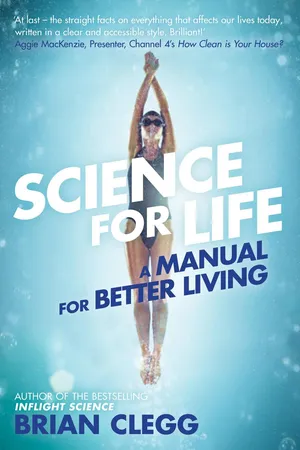
- 400 pages
- English
- ePUB (mobile friendly)
- Available on iOS & Android
eBook - ePub
About this book
Information
DIET

Anyone writing a diet book (and that seems to be every celebrity and nutritionist you can name) faces a problem – there is absolutely no rocket science involved. In the case of some diet books, there’s no science at all. The embarrassing fact is that all the dietary advice you ever need could be fitted comfortably into a single paragraph. Here we go:
Don’t eat too much – if you are putting on weight, eat less. Eat plenty of fruit and vegetables (and don’t make them into smoothies as this ruins the valuable fibre). Make around one third of your diet starchy foods, preferably wholegrain. Don’t eat too much processed meat. Drink alcohol moderately, if you must. Avoid sugar and salt as much as possible and don’t go overboard on fats, avoiding trans fats entirely. It’s not strictly part of a diet, but add ‘don’t smoke’ and ‘take sensible exercise’ and you’ve got an instant health plan.
That’s it – that’s what you pay hard-earned cash to get a diet book for. Every other page in such a book is padding. If you write a diet book you have to find some way to make yours different from the rest. Some do this by straying away from what is most beneficial to include mystical mumbo jumbo. Others find different ways to expand those basics to fill a whole volume by adding lots of rules, or filling it out with healthy recipes (which is fair enough). But that single paragraph is all the diet book you’ll ever need.
The problem is that it is very natural to want a quick fix, to hope for a magic wand we can wave to improve our health. But there is very strong evidence that short-term diets do no good whatsoever. It’s far better to make small changes that you carry through from year to year than to go on a crash diet, returning to overdoing it a few weeks later.
In part because of this desire for a quick fix, there are always new miracle foods and dietary wonders that are splashed across the newspapers. The reason this section is a lot more than just that single paragraph is partly to clarify the value of all these different suggested wonder foods and drinks. Some are just nonsense. Others have a grain of truth behind them and are worth considering – but even these aren’t magic bullets. Keep coming back to my core paragraph and you can’t go too far wrong.
A major problem that we all face in trying to work out what’s good for our health is that it is very difficult to spot whether eating a particular thing is good or bad for you. This is why we get so many reports in newspapers telling us that something is good or bad for our health. This is also why we were told for so long that saturated fats were worse for us than unsaturated fats, where this no longer seems to be the case.
The problem is that, unlike testing a medication, it is very difficult to do a proper, scientific blind-controlled trial on what we eat. Most dietary studies are observational – they tell us, for instance, that people in the Mediterranean suffer from less heart disease than people in Glasgow. We can also observe that these people have a different kind of diet. But it’s hard to say for certain that it is the diet that is giving the benefit – and even harder to identify a particular aspect of the diet, like olive oil or tomatoes – because there are so many other differences between life in the Mediterranean and life in Glasgow, and we don’t know what the actual cause is, merely that people in one environment, with their typical lifestyle, are healthier in this aspect than people in the other.
For instance, in 2001 an Australian study was portrayed in the media as showing that people who consume more olive oil get fewer wrinkles. So journalists (often without a science background) got all excited, telling us that consuming olive oil is good for your skin. But the study was not done by taking two similar groups of people and feeding one olive oil while the other received another oil, with neither the people involved nor the scientists knowing which was which, as would be the case in a proper double blind trial. Such a trial on a big enough sample of people over a long enough period would, indeed, show whether eating olive oil helps reduce wrinkles.
Instead, what the trial did was to bring together information on different groups of people from widely varying backgrounds – Australians, Swedes and Greeks, for instance – and find that the level of wrinkling they experienced corresponded reasonably well to the level of olive oil in their diets. But to deduce that the oil reduced wrinkles is to fall for the oldest statistical error in the book – that correlation (where two things vary in a similar fashion) is the same as causation (saying that one causes the other). See the section on Paracetamol and childhood asthma, which explores causality and correlation (page 313), for more on this.
In practice, all manner of other differences were likely to be common in the olive oil and wrinkles study. For instance, dietary variations often relate to levels of income, education, living conditions, environment, stress levels, moisturiser use, sleeping patterns and many other things that could have been responsible for the lower levels of wrinkles. To make the assumption that the consumption of olive oil caused the reduction in wrinkles makes no sense. You could almost certainly find some other factor (say reading newspapers) that also varied with the wrinkle levels.
A lot of the media stories seem to be about a particular food or drink (red wine, say, as this is the favourite substance) causing or preventing cancer. It can seem baffling that the same thing potentially has both effects, and it’s easy to think that science has got it wrong. But in reality it is the interpretation put on the science by journalists and nutritionists (who often don’t have proper scientific training) that is at fault. We’ve already seen one way this can be the case with observational studies. Comparing populations who do and don’t drink red wine is fraught with difficulties in determining what causes differences in health. But there’s another problem.
When it’s claimed that something causes or cures cancer, for instance, what is often the case is that someone has either tested the substance on cells in a laboratory or fed it in large doses to rats and observed the outcome. This can contribute to very valuable research, leading to proper testing of the active chemicals in a way that will see if there are real benefits. But almost all the trials quoted this way don’t show that the substance being tested, when consumed, will have that effect on cells in the human body. As Bad Science author Ben Goldacre points out: ‘Fairy Liquid will kill cells in a test tube, but you don’t take it to cure cancer.’
Welcome, then, to the diet section.
A

Alcohol
Alcohol is bad for us – but in moderation, for those without related health issues, the risk is sufficiently low that it’s perfectly reasonable to enjoy a drink.
Most of the things we consume have pros and cons as far as a contribution to a healthy diet goes. For alcohol, though, the only thing to be said is that in moderation its risks are relatively low, so tolerable.
You may have seen newspaper articles saying that, for instance, red wine is good for you. This is a rather mixed assessment, as we’ll explore in the Red wine section, but this is a result of the many other constituents of red wine. Alcohol itself, a simple organic compound, is a poison, pure and simple – but one that we can tolerate in low doses and that has sufficient pleasurable effects to make it worth tolerating.
Similarly, there was a lot of coverage in 2014 of a claim that anything up to a bottle of wine a day is fine. This came from a retired professor who did not present any evidence to back up his claim, when there is a huge amount of evidence for the harmful nature of drinking more than recommended amounts. In any science you will get mavericks coming up with an alternative view in good faith, but the only sensible approach is to go with the view held by the majority unless there is remarkable new evidence to suggest otherwise. No such evidence was provided here.
One myth is worth dismissing immediately. Alcohol is alcohol, and it doesn’t matter what type of drink it is in. Mixing drinks makes no difference. There are some drinks, like whisky, that contain a range of other chemicals that are likely to make a hangover worse, but in terms of the impact on the body of alcohol itself, there is no difference. Some people think the mixing effect in cocktails somehow makes them more potent – it doesn’t. But because many cocktails combine a high alcohol content with enough sweetness to conceal its potency, it can be easy to consume more alcohol than you realise when drinking cocktails.
The risks from moderate consumption – beyond a hangover – are usually due to inappropriate or illegal behaviour when we’ve had a couple too many, whether it is driving a car or simply doing things we wouldn’t normally do and may regret afterwards. However, for heavier drinkers there are a number of concerns.
Most alcoholic drinks contain significant calories. Heavy beer drinkers, particularly, will tend to pile on the weight, as a pint of beer has as many calories as a packet of crisps, while the average wine drinker will consume around 2,000 kcal (see Calorie intake, page 17) a month from alcohol. This isn’t a huge daily calorie consumption, but it is significant.
Alcohol is also a carcinogen – it causes cancer. In fact, alcohol is by far the biggest direct cancer-causing substance in our diets. It also increases blood pressure and risk of heart attack. And then there is the impact of the alcohol on the systems that take alcohol out of the body. The liver particularly can suffer with excess alcohol consumption, in the extreme case failing altogether.
Typical recommendations are that men do not regularly drink more than three or four units a day, and women do not regularly drink more than two or three units a day. We should know what units are by now, but they still cause confusion. Half a pint of 4 per cent alcohol beer is around one unit, a small glass of wine (125ml) is 1.5 units, and a single spirit is one unit. It is also recommended that you go at least two days a week without any alcohol.
To get a feel for the impact, if you go over the recommended limits to between five and eight units (men) or four and six units (women), you are 1.8–2.5 times (men) or 1.2–1.7 times as likely to get cancer of the mouth, neck and throat. Women are 1.2 times as likely to get breast cancer. Men are twice as likely to develop liver cirrhosis, and women are 1.7 times as likely. And men are 1.8 times as likely to develop high blood pressure, where women are 1.3 times as likely. Go beyond those limits into the higher risk zone and you can at least double those risks.
The best advice is still that pregn...
Table of contents
- Copyright Page
- About the author
- Contents
- Introduction
- And there’s more …
- Diet
- Exercise
- Brain
- Psychology
- Health
- Environment
- Fun
Trusted by 375,005 students
Access to over 1.5 million titles for a fair monthly price.
Study more efficiently using our study tools.
Frequently asked questions
Yes, you can cancel anytime from the Subscription tab in your account settings on the Perlego website. Your subscription will stay active until the end of your current billing period. Learn how to cancel your subscription
No, books cannot be downloaded as external files, such as PDFs, for use outside of Perlego. However, you can download books within the Perlego app for offline reading on mobile or tablet. Learn how to download books offline
Perlego offers two plans: Essential and Complete
- Essential is ideal for learners and professionals who enjoy exploring a wide range of subjects. Access the Essential Library with 800,000+ trusted titles and best-sellers across business, personal growth, and the humanities. Includes unlimited reading time and Standard Read Aloud voice.
- Complete: Perfect for advanced learners and researchers needing full, unrestricted access. Unlock 1.5M+ books across hundreds of subjects, including academic and specialized titles. The Complete Plan also includes advanced features like Premium Read Aloud and Research Assistant.
We are an online textbook subscription service, where you can get access to an entire online library for less than the price of a single book per month. With over 1.5 million books across 990+ topics, we’ve got you covered! Learn about our mission
Look out for the read-aloud symbol on your next book to see if you can listen to it. The read-aloud tool reads text aloud for you, highlighting the text as it is being read. You can pause it, speed it up and slow it down. Learn more about Read Aloud
Yes! You can use the Perlego app on both iOS and Android devices to read anytime, anywhere — even offline. Perfect for commutes or when you’re on the go.
Please note we cannot support devices running on iOS 13 and Android 7 or earlier. Learn more about using the app
Please note we cannot support devices running on iOS 13 and Android 7 or earlier. Learn more about using the app
Yes, you can access Science for Life by Brian Clegg in PDF and/or ePUB format, as well as other popular books in Biological Sciences & Biology. We have over 1.5 million books available in our catalogue for you to explore.