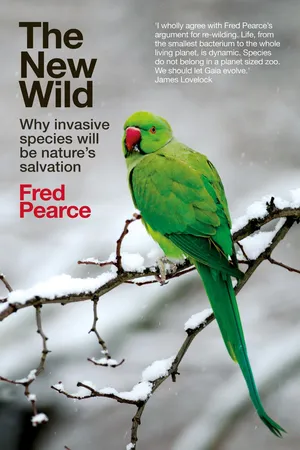
Veteran environmental journalist Fred Pearce used to think of invasive species as evil interlopers spoiling pristine 'natural' ecosystems. Most conservationists would agree. But what if traditional ecology is wrong, and true environmentalists should be applauding the invaders? In The New Wild, Pearce goes on a journey to rediscover what conservation should really be about. He explores ecosystems from Pacific islands to the Australian outback to the Thames estuary, digs into the questionable costs of invader species, and reveals the outdated intellectual sources of our ideas about the balance of nature.Keeping out alien species looks increasingly flawed. The new ecologists looking afresh at how species interact in the wild believe we should celebrate the dynamism of alien species and the novel ecosystems they create.In an era of climate change and widespread ecological damage, we must find ways to help nature regenerate. Embracing the 'new wild' is our best chance.
- 288 pages
- English
- ePUB (mobile friendly)
- Available on iOS & Android
eBook - ePub
About this book
Trusted by 375,005 students
Access to over 1.5 million titles for a fair monthly price.
Study more efficiently using our study tools.
Information
PART ONE
ALIEN EMPIRES
All round the world, alien species are on the march, often with human help. But mostly they are moving into places we have messed up. They are often helping nature’s recovery.
1
On Green Mountain
Standing on the summit of an extinct volcano on Ascension Island in the tropical South Atlantic, I was at one of the most remote spots on the planet. I watched the British military plane that had delivered me there, midway between Brazil and Africa, take off and head on south to the Falkland Islands. I felt rather alone. Down below was a harsh, black and treeless moonscape of volcanic clinker, baking in the sun. Beyond was ocean for a thousand kilometres in every direction. But in the cool mountain air, I was surrounded by lush greenery. As noon approached, a lone cloud formed over the summit and then suddenly descended, shrouding me and the mountain in mist.
The Ascension locals – a mix of British contract workers, American service personnel, and families from St Helena, another remote South Atlantic island – call this oasis Green Mountain. The island’s British administrator has a bungalow up here, complete with a pair of old cannons pointing out across the ocean. But away from his lawns, where I later had afternoon tea, the mountain and its cloud forest felt primeval, a leftover perhaps from the days before sailors began visiting here five centuries ago.
My instincts couldn’t have been more wrong, however. The greenery was relatively new. When Charles Darwin visited Ascension Island in July 1836, homeward bound after his long journey aboard HMS Beagle, he had complained about its ‘naked hideousness’. The mountain where I now stood was ‘entirely destitute of trees’. Another visitor of the day, William Henry Webster, had called the island ‘an awful wilderness amid the solitude of the ocean’. Peering through the mist, my guide, the mountain’s genial warden Stedson Stroud, explained: ‘Nothing you see here is native. Except for a few ferns, everything has been introduced in the past 200 years.’ The cloud forest of Green Mountain is an entirely man-made ecosystem, a pot-pourri of foreign species shipped in by the British Navy during the early and mid-19th century at the whim of Victorian botanists. Every passing ship had delivered more trees for the local garrison to plant.
On our way up the mountain, Stroud and I had walked through stands of Bermuda cedar, South African yews, Persian lilacs, guava fruit trees from Brazil, thickets of Chinese ginger, New Zealand flax, taro from Madeira, European blackberries, Japanese cherry trees and screw pines that grow taller here than at home on the islands of the Pacific. The summit was improbably covered in a dense stand of Asian bamboo, and rattled like a huge wind chime in the brisk trade winds that suddenly blew the mist away.
I was on Ascension because the very existence of this forest is creating controversy. It is more than a patch of trees, more than a botanical garden. It is possibly the most cosmopolitan tropical forest in the world, and it is said to be the only one that is entirely man-made. Moreover, researchers who have visited herald it as a fully functioning ecosystem, created from scratch in little more than a century from fragments assembled at random from around the world. The vegetation, insects and other species interact in numerous ways, providing vital services for each other. Forest ecosystems are not supposed to happen like that. Conventional ecology says their complex interactions emerge only as a result of long-term evolution of species. As Stroud put it, in a paper with David Catling of the University of Washington, the species on Green Mountain ‘have bucked the standard theory that complexity emerges only through co-evolution’.1
Stroud had been tending the mountain for a decade, ever since he came here from St Helena to be the island’s conservation officer. He admitted that, as a conservationist, he should probably be rooting out all those foreign trees, in order to allow the natives to regain their terrain. But if he did, there would be almost nothing left. And in any case, he said, he was presiding over something profoundly interesting. This confected cloud forest was prime evidence in a growing movement among ecologists to reconsider many of their nostrums about how ecosystems function. It suggested that species with no previous contact can get along with each other much more intimately than assumed. It suggested that perhaps many more forests and other complex ecosystems around the world are the result of chance meetings rather than complex co-evolution. If that is true, it may hold vital clues for regenerating nature in the 21st century.
Ascension Island, which is almost twice the size of Manhattan, erupted from the Atlantic floor a million years ago. It was not barren for long. Remote as it was, some life soon arrived. Millions of seabirds occupied the lowlands, their spattered excretions turning the piles of black clinker white. Green turtles swam thousands of kilometres to nest on its sandy beaches. And the island’s mysterious land crabs arrived from who knows where – and who knows how – to make a life scuttling on the slopes of the volcano. But – apart from a few ferns and mosses on the mountain, and an endemic shrub called Ascension spurge along the shore – the black desert for a long time remained almost entirely devoid of vegetation.
The first known human visitors to Ascension Island were early Portuguese mariners who dropped anchor on Ascension Day 1503, on their way to the Indian Ocean. Hence the island’s name. But the first permanent occupation was by the British Royal Navy. It set up a garrison in 1815, to patrol the surrounding oceans and prevent the rescue of the most famous international prisoner of the day, the former French emperor Napoleon Bonaparte, whom the British had captured and incarcerated on St Helena, its equivalent of Guantánamo Bay, 1,300 kilometres to the south. After Napoleon’s death, the British used the island as a base for hunting down transatlantic slave ships, and to store fuel for warships heading to India, the ‘jewel’ in the British imperial crown.
Ascension Island has kept coming in handy. At the end of the 19th century, it became a hub for transatlantic telecommunications, with cables stretching to Europe, South Africa, Brazil and Argentina. These days, the island is peppered with aerials that track orbiting spacecraft, talk to nuclear submarines, and listen in secretly to cable and satellite-relayed communications. The electronic spies of Britain’s GCHQ are the biggest employers. The island’s band of temporary residents, who number about 800, say it has more antennae than people. It also has one of the longest airstrips in the world, built by the US Air Force during the Second World War to provide a secure stopping-off point for flights into Africa. When I arrived in early July 2013, I was amazed to see nine large US military aircraft sitting on the tarmac, all busy protecting President Obama during a visit to the continent.2
Inevitably, such human traffic has brought alien species, both accidental and deliberate. Recent arrivals on the lowlands include fast-spreading tobacco plants and Mexican thorn, or mesquite, which the BBC shipped here in the 1960s to brighten up gardens in a new settlement for operators of a transmission station serving Africa. Much was deliberately introduced. From the first, the naval garrison brought in species to make the remote outpost as self-sufficient as possible. Documents in Ascension’s archive, in the toy-town capital of Georgetown, show how it first established a farm on one of the few patches of natural soil on the mountain. The farm grew introduced fruit trees like guava from Brazil, Cape gooseberries from South Africa, bananas from the Far East and lychees from China. Then there were vegetables such as cabbages, spinach and potatoes, as well as some grains, herds of South African pigs, and cattle and sheep from England.
The farm operated until the 1990s and is now overgrown. But it is the trees that fascinate in the 21st century. Britain planted on this volcanic hulk specimens from across its global empire. In the early days, the sailors grew New Zealand flax to make rope for ships, and straight-trunked Norfolk pine for masts. British colonial botanist Sir Joseph Hooker – a friend of Darwin and future head of the famous botanical gardens at Kew in London – visited in 1843. He came up with the idea of growing trees to gird the mountain and green the arid island. The archive preserves a letter that Hooker wrote in 1847 with a long list of recommended introductions to ensure that ‘the fall of rain will be directly increased’. The new vegetation on the mountaintop would scavenge moisture from passing clouds, he promised. Further down the slopes, trees and bushes would encourage soil growth. Hooker’s ambition was nothing less than remaking the volcanic island – or ‘terra-forming’ it, as Stroud and Catling put it.
In 1845, a naval transport ship from Argentina delivered the first batch of seedlings. In 1858, more than 200 species of plants arrived from the Cape Botanic Gardens in South Africa. In 1874, Kew sent 700 packets of seeds, including those of two types of plants that especially liked the place: bamboo and prickly pear. The sailors got to work, planting several thousand trees a year. The bare mountain was soon verdant – and renamed Green Mountain. An Admiralty report in 1865 praised the new cloud forest. The island ‘now possessed thickets of upwards of 40 kinds of trees besides numerous shrubs’, it said. ‘Through the spreading of vegetation, the water supply is now excellent, and the garrison and ships visiting the island are supplied with an abundance of vegetables.’
Today, the island has around 300 introduced species of plants, says David Wilkinson, an eclectic botanist from Liverpool John Moores University who made a rare research visit to Green Mountain. Many are spreading. Above about 600 metres, Green Mountain is now completely vegetated. On my walk back down the mountain, Stroud pointed out coffee bushes, vines, monkey puzzle trees, jacaranda, juniper, bananas, buddleia, palm trees, clerodendrum, the pretty pink flowers of the Madagascan periwinkle and the bell-shaped blooms of the American yellow trumpetbush. He confirmed that the vegetation captures more cloud moisture on the mountain, just as Hooker had hoped. This even though there has been a decline in rainfall in the lowlands around.3
The Victorian terra-formers did not just bring plants. The island’s military inhabitants joined the 19th-century craze among expatriate Europeans to fill their new worlds with birds and animals from home. The regular ships to Ascension brought hedgehogs and rooks, ferrets and owls, bees to pollinate, and guinea fowl as quarry for hunting. Ascension never quite became the ‘Little England’ that they had hoped. Of the introduced birds, only the tropical canaries and mynas have stuck around. But the mammals did better. Rats and rabbits can still be found in numbers, along with feral sheep, cows and chickens let loose from the now-abandoned farm. And donkeys – descended from the beasts of burden that once carried water from mountain springs to the coastal garrison – still wander the landscape, eating mesquite fruit and getting hit by cars.
The introduced rats were trouble. They swiftly saw off a couple of local endemic birds, the Ascension crake and the Ascension rail, and possibly also a night heron.4 For a long time, there were also feral cats. Originally brought in to control the rats, they tyrannized the seabird colonies, forcing most to nest instead on a tiny offshore mound known as Boatswain Bird Island. Ornithologists began a cat-eradication programme, and the last cat was hunted down in remote Cricket Valley in 2006. Since then, boobies have begun returning to the main island. When I visited, the island conservationists were crossing their fingers for the survival of the first nest established by a returning pair of endemic Ascension frigatebirds.5 Meanwhile, 2013 saw a record nesting season for the green turtles – a great comeback after decades during which they were slaughtered for the pot. The last victim, they say, was fed to the Duke of Edinburgh when he visited back in 1957.6
The incomers have added hugely to the island’s biodiversity and now make up at least 90 per cent of its species. The local people like them. When, in the 1980s, the island authorities issued twelve postage stamps bearing pictures of local insects, all twelve were aliens. The national flower, dubbed the Ascension lily, actually comes from South America. Nevertheless, some would like to encourage the resurgence of native species by launching an eradication programme against foreign plants. They blame the environmental anarchy perpetrated by Hooker and his successors for the loss of three endemic ferns, and perhaps some insects that may once have depended on them – though the lost species may still be hiding here somewhere amid the steep valleys around the mountain. As we stood on one of the mountain paths, gazing south over an abandoned NASA tracking station, Stroud pointed out below us the cliff face where, in 2009, he rediscovered a single specimen of a fern species believed lost, Anogramma ascensionis, or Ascension Island parsley fern. It is now being propagated in the labs at Hooker’s old fiefdom in Kew, ready for reintroduction.
The British government’s environment policy for the island is to carry out the ‘control and eradication of invasive species’ in order to ‘ensure the protection and restoration of key habitats’. But this is dogma rather than considered policy based on research. A closer look would reveal that the ‘control and eradication’ of the aliens could now cause some natives, including endemic ferns, to go extinct. The ‘key habitats’ for some native species are provided by the alien trees on Green Mountain. Xiphopteris ascensionis, an indigenous fern that once clung to the bare mountainside, now lives only on the mossy branches of introduced plants. Bamboo is a favourite. ‘The ferns like the shade,’ says Stroud. ‘If it weren’t for the trees and other plants, I doubt if the ferns would be here any more.’
On our walk down the mountain, we saw native mosses clinging to an old stone wall, and alien insects and birds pollinating trees of a kind they had probably never encountered before arriving here. After the rains, we watched the distinctive yellow and pink land crabs – the island’s largest native land animals – rush out of their burrows to feast on the fruits of alien trees like the guava. The only researcher to have studied these endemic land crabs in recent times, Richard Hartnoll of the University of Liverpool, says that the foreign vegetation ‘increases the area of shade and shelter for crabs, and also provides a large resource of food’ – perhaps replacing their former scavenging on seabird colonies. Removing the aliens would likely have some nasty consequences for the natives.
You might think that this ecological snugness among species thrown here from across the world would be of some interest to conservationists. Yet, until now, they have shunned it, says Stroud. Most of the handful of researchers who have made the long journey to Ascension – the only practical way is aboard a British military flight – have concentrated on the island’s charismatic populations of seabirds and green turtles. A detailed study of the island’s flora conducted in the 1990s by the University of Edinburgh catalogued only the natives and characterized the rest – the great majority – as simply a continuing threat to them.7
As a result of this wilful blindness, simple but important ecological questions go unanswered. ‘As you walk through the forest, you see lots of leaves that have had chunks taken out of them by various insects’, Wilkinson says. ‘There are caterpillars and beetles around. But where did they come from? Are they endemic or alien? If alien, did they come with the plants on which they feed, or did they discover those plants on arrival?’
Wilkinson is among the scientists who propose that the complex ad hoc interactions between native species and aliens from many lands on Ascension are good evidence for an ecological theory that contradicts mainstream ideas about co-evolution. Ecological fitting, a term coined by US ecologist Daniel Janzen, holds that ecosystems are typically much more random. ‘The Green Mountain system is a spectacular e...
Table of contents
- Copyright Page
- Contents
- About the author
- Acknowledgements
- On language
- Introduction: Nature in a world of humans
- Part One: Alien Empires
- Part Two: Myths and Demons
- Part Three: The New Wild
- Appendix: Latin names
- References
- Index
Frequently asked questions
Yes, you can cancel anytime from the Subscription tab in your account settings on the Perlego website. Your subscription will stay active until the end of your current billing period. Learn how to cancel your subscription
No, books cannot be downloaded as external files, such as PDFs, for use outside of Perlego. However, you can download books within the Perlego app for offline reading on mobile or tablet. Learn how to download books offline
Perlego offers two plans: Essential and Complete
- Essential is ideal for learners and professionals who enjoy exploring a wide range of subjects. Access the Essential Library with 800,000+ trusted titles and best-sellers across business, personal growth, and the humanities. Includes unlimited reading time and Standard Read Aloud voice.
- Complete: Perfect for advanced learners and researchers needing full, unrestricted access. Unlock 1.5M+ books across hundreds of subjects, including academic and specialized titles. The Complete Plan also includes advanced features like Premium Read Aloud and Research Assistant.
We are an online textbook subscription service, where you can get access to an entire online library for less than the price of a single book per month. With over 1.5 million books across 990+ topics, we’ve got you covered! Learn about our mission
Look out for the read-aloud symbol on your next book to see if you can listen to it. The read-aloud tool reads text aloud for you, highlighting the text as it is being read. You can pause it, speed it up and slow it down. Learn more about Read Aloud
Yes! You can use the Perlego app on both iOS and Android devices to read anytime, anywhere — even offline. Perfect for commutes or when you’re on the go.
Please note we cannot support devices running on iOS 13 and Android 7 or earlier. Learn more about using the app
Please note we cannot support devices running on iOS 13 and Android 7 or earlier. Learn more about using the app
Yes, you can access The New Wild by Fred Pearce in PDF and/or ePUB format, as well as other popular books in Biological Sciences & Ecology. We have over 1.5 million books available in our catalogue for you to explore.