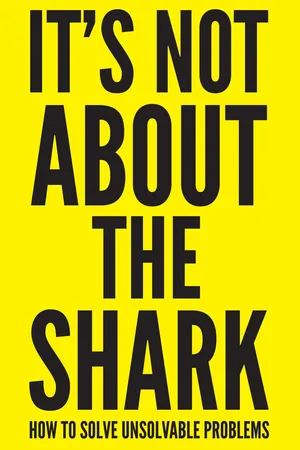
When we have a problem, most of us zero in, take it apart, and focus until we have it solved. Steven Spielberg tried that when the scenes with his expensive prosthetic shark just weren't scary. Psychologist, social scientist and million-selling author David Niven shows us that focusing on the problem is exactly the wrong way to find an answer. And Jaws built its famous menace precisely because the shark hardly ever appears in shot.Putting problems at the centre of our thoughts shuts down our creative abilities, depletes stamina, and feeds insecurities. Niven shows how working harder, and having absolute confidence in finding a solution, actually hides answers. It's Not About the Shark shows how to transform your daily life with a simple but rock-solid principle: If you start by thinking about your problems, you'll never make it to a solution. If you start by thinking about a solution, you'll never worry about your problems again.
- 288 pages
- English
- ePUB (mobile friendly)
- Available on iOS & Android
eBook - ePub
About this book
Trusted by 375,005 students
Access to over 1.5 million titles for a fair monthly price.
Study more efficiently using our study tools.
Information
Topic
PsicologíaSubtopic
Psicología aplicadaCHAPTER 1
Imaginary Philip and the Problem of Problems
WHAT IF THE bumblebee knew it couldn’t fly?
We all know what would happen: He’d sit around worrying about how fat he is, and he’d never get off the ground again.
But there’s another side to that story. In 1934, when entomologist August Magnan concluded that flying bumblebees defied the laws of physics, he never bothered to tell the bees. And they kept right on flying.
Problems infect our thinking in many ways—but the basic equation is simple. If we let problems define who we are, if we let problems serve as our guide, then our problems tell us what we can’t do. We can’t do this. We can’t do that. Our lives become negatives and absences.
A problem, no matter how important, no matter how significant to our well-being, doesn’t belong in the center of our thoughts.
A problem is a barrier. We thrive as thinkers, as doers, as people when we take barriers down. Think about any great advance in any field of endeavor: a great thing, a great idea, a great product, a great story, a great cure. That greatness came about because somebody brought down a barrier. A problem is a barrier. You have to bring it down, or it will bring you down. Just like the bees.
THE ODDSMAKERS LABELED him a 300-to-1 shot. Which is a polite way of saying he had no chance of winning the tournament. But the rookie golfer Ben Curtis was just glad to be there, having barely snuck into the field by qualifying two weeks earlier.
There were good reasons for the modest expectations. As he teed off at the 2003 British Open, Ben Curtis had never won a professional golf tournament. In fact, he had yet to finish among the top 25 at any event. Curtis even shared the oddsmakers’ views of his abilities. He was there for the experience, he explained, to have fun and to try to get better by playing against the best players on one of golf’s toughest and most famous courses.
Still, the joy of a small-town Ohioan incongruously standing on golf’s brightest stage delighted fans and commentators. Their delight was eclipsed only by their shock as Ben Curtis sank his 8-foot putt on the 72nd hole and hoisted the famous Claret Jug as the winner of the British Open.
How improbable was his victory? It had been ninety years since any golfer had won the first major tournament he had entered.
In the space of a weekend, everything changed for him. An anonymous golfer who had never won anything, Ben Curtis now stood beside the kings of the sport, living out what he admitted was a “fairy tale come true.” He had to clear time on his schedule to visit the White House, because the president wanted to congratulate him personally. And among the many prizes afforded the winner of a major championship in golf, he collected something of the sport’s golden ticket—a champion’s exemption that allowed him to pick exactly which tournaments he wanted to enter for years to come.
By 2011, that champion’s exemption had expired. Worse, it had been five years since Curtis’s last win on the PGA Tour, and he was playing just to hold on to the status of a full-time professional golfer.
Curtis was desperate to stay on the tour. And the desperation shaped his game.
“Every time I walked onto the course I thought to myself, ‘OK, how am I not going to have a disaster?’” he said.
His sole focus on each hole was avoiding mistakes. “Out there, I’m trying to do everything I can to not make bogeys and double bogeys,” he said. “That’s what my game has become.”
The effort to avoid mistakes clearly had an effect: He made more of them.
“What I was doing, the way I was thinking, was adding more pressure on myself,” Curtis said. “More pressure you don’t need.”
Worse, he was carrying his mistakes from one hole to the next. “In my head I would see replays of a bad tee shot two holes later. I would think about a missed par putt on the next green,” he said. “Even when I had opportunities to put up a good score on a hole, I would think of ways I might make a mistake.”
Staring at the problem left Ben Curtis stuck—exactly where Steven Spielberg would have been if he had kept his focus on his rotting mechanical shark. Fortunately for Curtis, he finally hit bottom.
At the end of the 2011 season, having failed to win or even contend for a title, Curtis’s standing on the PGA Tour was reduced to conditional status. He would, in effect, need to ask for special permission from the sponsors of golf tournaments to let him play anywhere in 2012.
Each week he sat by the phone, hoping to hear that the tournament director had picked him from among the 50 or 100 players asking for one of about eight late-entry slots into the tournament. Most weeks, the phone didn’t ring.
But something happened to him on those weeks when he did get into a tournament. Suddenly, the pressure was gone. Because he had no status to protect, the prospect of a bad round didn’t scare him so much. He began to just play golf again.
Four months into the 2012 season, playing in just his fourth tournament of the year, Curtis ended a winless streak that had stretched out over more than 2,000 days. His win in the Texas Open restored his full-time professional status and, more importantly, reminded him of what he was capable of doing.
“Golf is that way,” he said. “It will come up and surprise you if you let it.”
YOU ARE AN advanced engineering student. Your class is about to be given what amounts to a pop quiz. In a moment, you’ll be asked to sketch out designs for a product.
You rub your hands together in anticipation. Whatever the task, there’s no doubt you’ll come up with something great.
You smooth out your paper and keep your drafting pencil close at hand.
You’re asked to come up with a bicycle rack to mount bicycles on a car. You are given various requirements, but the most important objective is to make a rack that is easy to attach to the car and easy to mount bicycles on.
You are shown an example of an existing but inefficient roof-mounted bicycle rack. It has metal tubes running across the car’s roof. Into the tubes, a bicycle’s tires are secured. It is, you are told explicitly, very difficult for users to secure the tubes to the roof of the car. Meanwhile, the center tube is nearly impossible for all but the tallest and strongest users to access.
You are asked to come up with as many designs as you can that meet the requirements. You have an hour. Now get to work.
You think about bicycles and cars, their shapes and sizes. You think about people having to lift their bicycles and secure them.
You didn’t become an engineer to be mediocre. You’re not trying for a merely acceptable design. You are there to be the best. So you put pencil to paper and get started.
You can do anything within the parameters of the task in terms of materials or shapes or approaches. So you spin the paper around to get a look at things from a different angle. Your pencil starts flying.
But one image keeps coming to mind. That roof-mounted rack with the tubes. The one with the flaws.
Your first sketch looks just like it. So does your second. Try as you might, your designs keep coming back to roof-mounted tube racks—ideal if your customer base is comprised of NBA centers.
What you didn’t know is that at the same time you were creating variations of that failed design, another group of engineers in the next room was also drawing up plans for bicycle racks.
The only difference is that they were never shown the picture of the bad design. And they were never told to try to avoid putting bikes in the middle of the car’s roof. They were just told to come up with the best design they could.
When researchers David Jansson and Steven Smith lined up all the designs from your group, and all the designs from the other group, the differences were enormous. The group that saw the bad example came up with fewer total designs, far fewer original approaches, and was much more likely to wind up with bikes mounted where no one could reach.1
It wasn’t that the second group was any more talented than the first. They weren’t. It wasn’t that the second group knew anything more about bicycles or bike racks. They didn’t.
The difference between the two groups was just this—the first group was asked to solve a common problem with bike racks, and they flailed against the challenge. The second group was asked to design the best bike rack they could, and they did. In the process, they solved a problem they didn’t even know existed.
Jansson and Smith repeated their experiment with other challenges and other engineers, and each time the same thing happened. When asked to design a measuring cup for the blind, the majority of engineers shown a design problem couldn’t solve it. More than 80 percent of the group that wasn’t shown the problem solved it without even knowing what they were up against. When asked to design a spill-proof coffee mug, those shown the design problem with the mug were seventeen times more likely to fail than those who weren’t shown the problem.
These were all very talented engineers. All knowledgeable, capable, skilled, and driven. Yet their likelihood of succeeding varied tremendously based on what they were trying to do. The group that had never seen a bad example let their natural talents carry them to a good design. They wasted not a moment on the problem and spent all their time on the solution. The group that saw the problem wanted to solve it so badly they couldn’t think straight. Just like Ben Curtis couldn’t golf when he was focused on his flaws, these engineers couldn’t design when focused on the problem. But they stayed focused on the problem because problems are so seductive and compelling. It is hard to think about anything else.
“PEOPLE WHO DON’T hate their jobs, they just look at you with dread, like what you have is contagious and they don’t want to catch it,” Michael observed.
“Or, they say, ‘Hey, suck it up, it’s eight hours of your day, you can survive it,’” he added. “But the problem with hating your job isn’t so much the eight hours you’re there, it’s the other sixteen.”
Just like all those engineers who wanted to fix the bike rack problem, and just like Ben Curtis’s fear of bogeys, Michael’s problem consumed his entire field of vision.
“Because when you hate doing something, it’s all you can think about,” Michael said. “When you’re at work you count the minutes until you can leave, but right when you leave you think about how you have to go back again. Sunday’s just the day before you have to go back there.”
Michael knows many people have the same frustrations. “A lot of people are bad at their jobs, right?” he said, “But try being bad at your job in front of an audience.”
Teaching five sections of algebra at a community college meant thirty-five or so witnesses every time Michael stood at the front of the room, struggling to hold anyone’s attention. He knew the formulas, could recite them backwards and forwards, could probably teach this stuff in his sleep. Unfortunately, his students weren’t learning much in theirs.
“I didn’t get sleepers every day,” he said. “Some of those once-a-week night classes—with the double period—wow, I would probably lose half the class by the end. And I don’t think they were dreaming of polynomials.”
It wasn’t just a feeling that Michael was underwhelming in his work; there was ample evidence. “We use a common final exam across the college, to test how much progress everyone is making, or, for my students, not making.” Michael’s students consistently ranked fourteenth, fifteenth, or sixteenth out of groups of students taught by sixteen instructors. And the student reviews of his teaching were not exactly encouraging. One student said that they should use Michael’s classes as an interrogation technique—forced to sit through one of his lectures, any bad guy would crack and confess.
“The worst part of all this is that I care,” Michael said. “I care that my students do well, I care that my classroom be a place where math comes alive instead of where math goes to die.”
So Michael did what almost anyone in his situation would do—he tried hard to get better. He read every article and book he could find on great teaching. He watched videos on teaching techniques. He went to every teaching workshop on campus and flew to teaching conferences across the country.
“By the time I finished being taught all I could find about teaching, I wound up trying just about everything and then trying to undo it. I sped things up, I slowed things down,” he said. “I built assignments for people to go at their own pace, then assignments to keep everyone together. I put absolutely every note and problem in a packet and handed it to them so that they really didn’t need to show up, and then I tried handing out nothing at all so that everything had to be written down in class.”
Michael read one book that claimed the only thing that mattered to students was that you were concerned about them. So then he went to great lengths to engage students in conversations about themselves. One student that term wrote in a review that “it’s like he’s pretending to be our friend because he’s not a very good teacher.” Which, in truth, was exactly what he was doing.
“I was like a dog chasing its tail. I was going after something I could not get no matter how fast I went or how hard I tried,” Michael said.
Michael had run out of new things to try when a chance conversation with a former student turned him around. “She said to me, as delicately as possible, ‘Why are you still a bad teacher when you could be a great something else?’
“And I had no answer,” Michael said. “I had looked at my failures in teaching from so many different angles, but not from the most basic, the most obvious, one. Maybe I’m just not meant for that kind of work.”
The wheels started spinning in Michael’s mind. He had always wanted to be a paramedic. No, that would be crazy, he thought. Then again, maybe he could still be a paramedic. Granted, he would be the rare paramedic with an advanced mathematics degree, but surely he could work around that.
Five years into the job now, Michael still feels the charge of adrenaline every time he steps into the ambulance to begin his shift. “Nobody cares if the paramedic isn’t interesting when he comes to save you,” he said. “In fact, in this job, boring is a comfort to people.”
“I WILL NEVER forget the feeling the first time they had us all line up in school to measure our height and weight,” Tess said. “Our teacher stood next to an old-fashioned scale, the kind where you have to nudge the little weighted box over the numbers and try to get the bar to stay straight between the lines. And she just kept nudging and nudging and nudging. And everyone in class could see that box had to be moved way over to the edge when she stopped to write down my numbers.”
Tess vowed that day to lose enough weight so that the next time they measured the class, no one would stare at the scale.
Forty-some years later, Tess wa...
Table of contents
- Copyright Page
- Dedication
- Contents
- Introduction: Problem or Godsend?
- Chapter 1: Imaginary Philip and the Problem of Problems
- Chapter 2: Humans, Swamp People, and the Survival Problem
- Chapter 3: Power and the Farb Problem
- Chapter 4: Don’t Come Home for Christmas and Other Lessons on Trying Harder and Making It Worse
- Chapter 5: Would You Get on the Bus to Abilene?
- Chapter 6: Four Points and the Wrongness of Always Being Right
- Chapter 7: Miss Iceland, the Gangster, and the Cat: What Happens When You Burn the First Draft
- Chapter 8: The Knowledge Is Like a Toothache: The Value of Taking the Long Way
- Chapter 9: Dark, Soft, Smooth, and Slow: The Power of Opposites
- Chapter 10: What Are These Bells For? The Art of Listening to Yourself
- Conclusion: What Do You Do with Water?
- Acknowledgments
- Sources
- Endnotes/Research Studies
- Index
Frequently asked questions
Yes, you can cancel anytime from the Subscription tab in your account settings on the Perlego website. Your subscription will stay active until the end of your current billing period. Learn how to cancel your subscription
No, books cannot be downloaded as external files, such as PDFs, for use outside of Perlego. However, you can download books within the Perlego app for offline reading on mobile or tablet. Learn how to download books offline
Perlego offers two plans: Essential and Complete
- Essential is ideal for learners and professionals who enjoy exploring a wide range of subjects. Access the Essential Library with 800,000+ trusted titles and best-sellers across business, personal growth, and the humanities. Includes unlimited reading time and Standard Read Aloud voice.
- Complete: Perfect for advanced learners and researchers needing full, unrestricted access. Unlock 1.5M+ books across hundreds of subjects, including academic and specialized titles. The Complete Plan also includes advanced features like Premium Read Aloud and Research Assistant.
We are an online textbook subscription service, where you can get access to an entire online library for less than the price of a single book per month. With over 1.5 million books across 990+ topics, we’ve got you covered! Learn about our mission
Look out for the read-aloud symbol on your next book to see if you can listen to it. The read-aloud tool reads text aloud for you, highlighting the text as it is being read. You can pause it, speed it up and slow it down. Learn more about Read Aloud
Yes! You can use the Perlego app on both iOS and Android devices to read anytime, anywhere — even offline. Perfect for commutes or when you’re on the go.
Please note we cannot support devices running on iOS 13 and Android 7 or earlier. Learn more about using the app
Please note we cannot support devices running on iOS 13 and Android 7 or earlier. Learn more about using the app
Yes, you can access It's Not About the Shark by David Niven in PDF and/or ePUB format, as well as other popular books in Psicología & Psicología aplicada. We have over 1.5 million books available in our catalogue for you to explore.