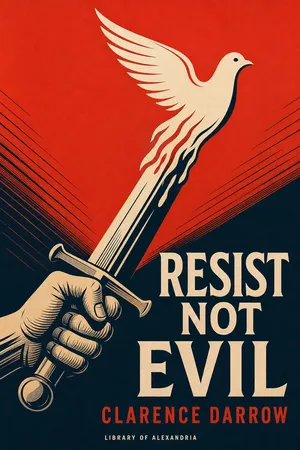
Can a society punish its way to justice? Clarence Darrow challenges the conviction that violence becomes moral when the law commands it.
In Resist Not Evil, the celebrated defense attorney turns his scrutiny toward punishment, government coercion, and war. His argument reaches beyond opposition to cruelty: he questions the moral foundations of retaliation itself, whether carried out by an individual or sanctioned by the state. Legal authority, he insists, does not settle the question of right and wrong.
This work of moral and political philosophy asks what justice might become if it abandoned revenge. Darrow places compassion, education, and understanding against the belief that suffering can correct wrongdoing. His skepticism toward coercive power gives the book its force, while its central questions remain urgent: Why do societies punish? What does violence accomplish? And what obligations do we have toward those we condemn?
What readers find inside:
• The case against retaliation - Darrow examines the belief that answering harm with further harm can produce justice.
• Punishment under scrutiny - Criminal penalties become a test of society's moral assumptions rather than an unquestioned necessity.
• War and state power - The argument connects organized violence with the authority governments claim over human lives.
• Compassion as a principle - Understanding and education offer alternatives to vengeance and coercion.
• A challenge to conscience - Readers are asked to judge accepted institutions by their effects on people, not merely by their legal standing.
For readers of pacifist philosophy, critics of punitive justice, and anyone interested in the ethical limits of government, this is a direct encounter with an uncompromising argument. It offers a starting point for thinking about the difference between enforcing order and doing what is right.
Begin with Darrow's challenge and reconsider what it means to answer wrongdoing without repeating it.