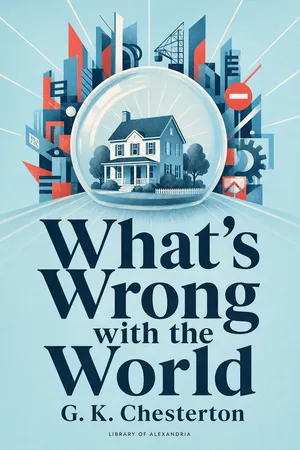
Before we decide how to change society, shouldn't we agree on what a good society is for? Chesterton turns that question into a witty challenge to the modern faith in progress.
First published in 1910, What's Wrong with the World examines the ideals behind social reform rather than accepting novelty as proof of improvement. G. K. Chesterton brings his characteristic paradoxes and argumentative humor to industrialism, education, feminism, and politics, asking whether powerful institutions serve ordinary people-or require ordinary people to serve them.
At the heart of the book is a defense of the home, the family, and the independence of everyday life. Chesterton questions concentrated wealth and bureaucratic authority while disputing reformers' assumptions about women, schooling, and social equality. Some of his positions will provoke disagreement, especially his arguments about gender roles. That friction is part of the book's continuing interest: it asks readers to examine not only their proposed solutions, but also their picture of the life those solutions should make possible.
What readers find inside:
• The meaning of progress - Chesterton argues that reform needs a clear human ideal before it can claim to improve society.
• Home and independence - Domestic life becomes the starting point for a wider argument about liberty and power.
• Education and authority - The book explores what schools transmit and whose values shape the teaching of children.
• Women and social reform - Chesterton's critique of feminism reveals the convictions and tensions within his defense of family life.
• Wit and paradox - Unexpected comparisons and reversals challenge familiar political and social assumptions.
For readers of classic social criticism, political philosophy, and essays that mix serious argument with humor, this is an invitation to think beyond familiar divisions between tradition and change.
Begin with Chesterton's central question and reconsider what progress ought to mean.