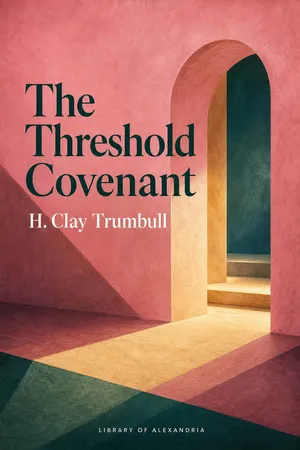
A doorway can mark more than the boundary of a house. It can mark the beginning of a sacred relationship.
In The Threshold Covenant, biblical scholar H. Clay Trumbull examines the religious significance of entrances to homes and temples. Drawing on customs from Egypt, India, Arabia, Syria, and other regions, he considers how these everyday spaces became associated with sacrifice, protection, divine witness, and binding promises. His central argument connects the act of crossing an entrance with entry into a relationship governed by sacred obligations.
This nineteenth-century study brings biblical interpretation into conversation with comparative religion and the study of custom. Trumbull explores blood rites, household ceremonies, and the symbolism of the Passover, seeking links between domestic practices and wider religious traditions. Read as a historical work of scholarship, it offers both a rich collection of ritual parallels and an opportunity to consider how earlier scholars explained the origins of religion. Its enduring question remains compelling: how do ordinary places acquire extraordinary spiritual meaning?
What readers find inside:
For readers of comparative religion, students of biblical symbolism, and anyone interested in the history of everyday customs, this work opens an unusual path into the study of sacred life.
Step into Trumbull's inquiry and discover how an ordinary doorway became a meeting place of home, community, and belief.