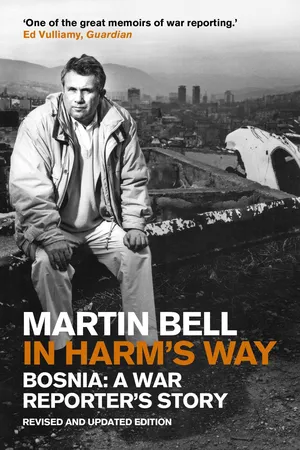
Martin Bell's was BBC TV's principal correspondent during the war in Bosnia from 1992 to 1995. The original version of this passionate and personal account of the conflict was written while the war was still going on, some of it late at night in the Holiday Inn in Sarajevo.
In Harm's Way is not only about the progress of the war; it is about its origins, how it began and how it could have been avoided; it is about the human costs of war in which all the peoples of Bosnia became the victims; it is about a massive failure by the United Nations, beginning with an inadequate peace-keeping mandate and ending with the Srebrenica massacre; and it is about the practices of war reporting itself. And it is about the journalists in the thick of it, the oddballs and the idealists, the wild adventurers and hardened professionals who were caught up in this war and tried to make some sense of it.
In the introduction to this new edition, marking the twentieth anniversary of the outbreak of hostilities, Martin Bell reflects on the impact of what he calls the most consequential war of our time.
- 300 pages
- English
- ePUB (mobile friendly)
- Available on iOS & Android
eBook - ePub
About this book
Information
Subtopic
Journalism1
Marching As To War
As the most junior soldier in the British army, Private 23398941 Bell M., I reported to Gibraltar Barracks in Bury St Edmunds on 18 June 1957. It was at that time the regimental headquarters and training depot of the Suffolk Regiment, in the days when there still was a Suffolk Regiment. It was built like a fortress in Victorian red brick, and indeed for all practical purposes it was a fortress. It kept the soldiers in and the rest of the world out with walls as high as a prison’s, and for all practical purposes it was a prison too. But I had no choice but to turn up for this particular rendezvous with destiny. For those were still the years of National Service.
My platoon sergeant, ‘Mac’ Sennett, was one of those larger-than-life characters, loud and proud, without whom the army would cease to function. Then as now it was run by its non-commissioned officers. Upon the arrival of yet another intake of unschooled recruits his first task was to instil into us a sense of our good fortune in happening to belong to the finest regiment the army had ever known. Others might be more fashionable, ours was the best. His way of doing this was to shout abuse at us. ‘Private Bell,’ he would exclaim, on spotting some perceived misdemeanour in my turnout or bearing, probably both, ‘you are a horrible little man. What are you?’
‘A horrible little man, Sergeant,’ I dutifully replied, since one’s faults are usually more obvious to others, and he didn’t seem open to persuasion. And so he went on down the line of Suffolk’s finest.
For one who was to hang out so much with soldiers from so many armies in so many wars, my own career in uniform was short and inglorious. I spent two years with the Suffolks, mostly on Internal Security duties, which was how the army classified its mission in trying to deal with the EOKA insurgency in Cyprus, then a British colony (I was one of those who failed to capture Colonel Grivas) and in putting down countervailing riots by Turkish Cypriots in Nicosia. Riots were our regimental specialty. They were to us as polo was to the cavalry or Arctic warfare to the Marines. The casualties in the riots of 1958 were not insignificant, and few of them were ours. Yet we were one of the more docile and disciplined county regiments. The Scots and Irish were exiled to the Troodos mountains. And so innocent of the politics was I, that I never for a moment inquired why we were there, or doing what we were doing.
The training depot also provided me with the first of life’s hurdles to fall at. This was the dreaded WOSB, the War Office Selection Board, the process used by the army to separate its sheep from its goats. Our intake included an unusually high number of recruits identified by the regular staff as ‘college boys’ – to be singled out for double punishment, extra fatigues and possible selection as officers. This led to a daunting leadership and initiative test in the grounds of a decaying country house in Wiltshire. We were divided into competing teams and given impossible tasks, for instance crossing an imaginary river using an assembly of poles, planks and ropes. I failed the test emphatically – on the grounds, I was told, of being too aggressive. (For ‘aggressive’ read ‘insecure’: I knew I was out of my league.)
Years later one of my favourite brigadiers, Robin Searby of the 9th/12th Lancers, was posted from duty in Bosnia to Westbury in Wiltshire, to preside over the Regular Commissions Board, and precisely the ordeal that I had failed in the place where I had failed it. (It hadn’t changed: this was a system that knew an ‘other rank’ when it saw one.) He kindly looked out my records from thirty-seven years back and sent them to me.
Unusually this candidate was invited to sit his intelligence tests twice. The first sitting disclosed an intellect that could best be described as adequate. An enlightened educational adviser was suspicious of the precision of the first result and ordered a resit. On the second paper clear evidence of the powerful intellect of which we are all aware shone through.
(Brigadiers use sarcasm as one of their principal weapons – they learn it on the sarcasm course at Staff College.)
According to the record, the deputy president of the board was wavering. But the president was adamant: ‘He directed that the candidate’s application was unsuccessful.’ Brigadier Robin concluded, ‘Was the nation robbed of the services of a great general?’ Hardly, I think: not even the services of an adequate second lieutenant. For two years I laboured in the intelligence section of the First Battalion, moving pins on maps and rising slowly through the ranks, but doing little to endear myself to the officer class that I had so signally failed to join.
‘The trouble with you, Corporal Bell,’ said Captain Pat Hopper, the Signals Officer, ‘is that you think too much.’ This was because I had amended one of his signals to improve the grammar. It was an unanswerable charge. I did then, and still do. The Intelligence Officer, Lieutenant (later Brigadier) Charles Barnes, put it more sweepingly: ‘Why,’ he asked, ‘am I always blessed with idiots in my section?’
The duties were not arduous and spare time was plentiful. To make use of it, I became secretary of the Corporals’ Mess and editor of the regimental magazine, Castle and Key. The first of these positions gave me a grandstand view of the drinking habits of the British soldier (a defending officer at a court martial described the absorption of nineteen pints at one sitting as ‘normal social drinking’). The second provided me with a platform for opinions about army life which, expressed otherwise, would have led me straight to the guardroom under close escort. Looking back on the file, I realize that the selection board fiasco was not forgotten. Rank still rankled. The following anonymous offering was entitled ‘Chain Reaction’:
The Major General cut himself while shaving,
And cursed the Brigadier, who madly raving,
Then cast the most chastising and infernal
Aspersions on the morals of the Colonel,
Who passed them to the Major; and he, rapt in
The darkest thoughts, relayed them to the Captain,
Who rocketed the Subaltern, who rose
To loose all hell among the NCOs,
Who in their wrath and mad acerbity
Picked on one last poor buckshee private – me.
The army in those days was still under Indian influence, and indeed had Indian camp-followers, but I am not sure that the word ‘buckshee’ is still understood today. In this context it means the last and most expendable character at the end of the chain of command. I am convinced that the process still happens.
Yet I learned. I learned so much that, against all probabilities and predictions, I am proud to have done my time in the Twelfth of Foot. I even acquired a tape of the regimental quick march and played it on Radio Two at Christmas 1993 along with ‘The Love Songs of Willie Nelson’ in what my foreign editor assured me was a selection of the most tasteless music he had ever heard. I counted that as a real achievement. I wear the regiment’s tie and attend some of its reunions. This is not simply because in this company I am one of the youngest old soldiers (it was amalgamated out of existence with a lesser-known outfit from Norfolk shortly after I left). It is also because of what Sergeant Sennett taught me all those years ago, on hazy summer afternoons in a field overlooking the Bury St Edmunds to Newmarket railway line. Some of it, about the naming of parts and judging of distances and identification of bushy-topped trees, has long since vanished from all but the vaguest memory. Nor have I been called on again to strip and reassemble a bren gun, or name its parts. But the fieldcraft stays with me still – about lines of fire and the uses of dead ground and the art of staying alive in dangerous places. I used it just about every day of my working life in Bosnia. I am convinced that helped to save my life and the lives of those I worked with. For which much thanks to Sergeant Sennett, who could galvanize the barracks and sound reveille with the unaided power of the human voice. It was actually worth being shouted at.
These days the BBC has devised its own form of National Service. It offers a Hostile Environments Course, run by exsoldiers, to teach fieldcraft and other survival skills to its camera teams and reporters. I excused myself on the grounds that I had already done mine – the theory with the Suffolk Regiment and the practice on various battlefields over the long years.
I left the army in June 1959 without regrets, except that I had been briefly and improbably promoted to the rank of acting sergeant, and I had wished to keep as souvenirs the red sash and swagger stick that went with it. Not many national servicemen got to be sergeants outside the Education Corps, and it was my single accomplishment in life to date, although I noticed that no one else was much impressed. I had no idea what the future held in store for me, except that it would begin with three years at King’s College, Cambridge. (If I had been smart enough to do the studying first, I could have avoided the soldiering altogether.) Of two things I was absolutely sure. One was that nothing I had learned in the army would ever be of the slightest use to me. The other was that I would never again be called on to wear its uniform. I was quite wrong on both counts.
There cannot be many people who get out of uniform at the age of twenty and back into it thirty-two years later, but that was what happened to me. They were different uniforms, of course. The old and scratchy battledress of ‘Dad’s Army’ had long since been replaced by more practical combat fatigues. My possible eligibility for these had to do with Saddam Hussein’s invasion of Kuwait in August 1990. I calculated that there would clearly be an opening there for old-fashioned war correspondents, and I volunteered for the job at the same time as it came looking for me. It somehow seemed the natural thing to do – my last hurrah as a war reporter. So it was that in October 1990 I headed north on the highway from Dhahran into the Saudi desert, in search of one of the lost tribes of the British army. At least that was how I thought of them. I already suspected that my fate would depend on theirs.
What I found in their encampment was an hierarchical society in which power passed from one generation to another through the same ruling families, as it had done for hundreds of years. The chief man took advice from the elders of the tribe, but when he spoke they listened and obeyed. They had a strong sense of tradition and reverence for their predecessors. Their codes of dress were strict and sometimes eccentric. They not only lived in tents but wore them: after sundown, the tribe’s leaders sported strange green and gold tent-like hats, for no other reason than that they always had. Though they had a reputation as fearsome warriors, their conversation was generally pacific, about their pastimes of hunting and horse-riding. If they had ever touched strong drink before (and they sometimes spoke wistfully of it), they had none of it here. And much the same applied to their womenfolk, to whom they referred feelingly but with something of the same affection that they reserved for their horses. Neither wine nor women nor horses were with them here. This was my introduction to the British cavalry.
For the duration of the Gulf war – which was a short war with a long preamble – I was disconnected from civilian life and attached to the Queen’s Royal Irish Hussars, whose predecessors had charged at Balaclava but who were now better equipped for survival with the latest Challenger tanks. They belonged to the army’s Seventh Armoured Brigade, also known as the Desert Rats, part of the allied force arrayed against the Iraqis occupying Kuwait. Since they were preparing for what Baghdad had announced as the ‘Mother of All Battles’, I had expected to find them studying at least the Order of Battle of the Revolutionary Guards. They were immersed instead in back copies of Horse and Hound and Field and Stream.
They were professional soldiers, quite as tough as any infantry, but disguised as Irishmen of uncertain provenance, country gentlemen and various sorts of adventurer. Only the Londonderry accent of Arthur Currie, the Gunnery Officer, spoke plainly of where he came from. None came tougher, or gentler, than their commanding officer, Lieutenant-Colonel Arthur Denaro, a former secret soldier whose exploits in the SAS were spoken of in whispers. Their numbers included a Deceptions Officer, Robin Watt, who was actually the regimental artist, with a sideline in sketching the desert wildlife. And they had resolved the problem of their Irish identity: the Irish Tricolour and the Red Hand of Ulster flew side by side among them. I liked them at once. But they knew as little of us as we did of them, and the period of mutual astonishment lasted for a while. They described us as PONTIs – Persons Of No Tactical Importance.
Each of the two brigades, the Seventh and the Fourth, had a team of seven journalists attached to it. These were divided into three categories: the pencils, the snappers and the oily rags. The pencils were newspaper reporters, the snappers were photographers and the oily rags were television people; a TV reporter was a hybrid, part pencil and part oily rag. The veteran pencil, Phil Jacobson of The Times, narrowly saved me from being the oldest man on the field of battle, for even brigadiers come so much younger nowadays. We were issued with finely printed accreditation cards: ‘Authority for a British War Correspondent Accompanying an Operational Force’. Mine had the serial number 001. The fiction held that we were with the army but not of it (which was supposed to be a significant distinction in the event of our being captured, though we somehow doubted if the Iraqis would see it that way). For all practical purposes we were soldiers without the means of self-defence. We were thrust into desert camouflage uniforms topped with a choice of steel helmets or sun hats. (Hats, floppy, ridiculous was the quasi-military way in which we described them, and only Kate Adie had the courage to wear one on camera – but then probably only she could have got away with it.)
We were under army command and discipline, we took battlefield first-aid courses, we were trained and equipped against chemical warfare, and we dug trenches. Did we ever dig trenches! We dug trenches until our picks broke and our hands blistered. We dug trenches until our news editors wondered why we weren’t filing any more. We dug trenches and then fell into them, because we were ordered to observe a total blackout at night. Our chief minder, Major James Myles, an infantryman of great charm but matching zeal, assured us that this was the professional and soldierly thing to do. It would earn us the respect of our peers, he said. He also then fell into a trench, and nearly missed the war on account of it. We dug trenches in the sand, and in the rock which lurked just under the sand, at every stop in that trackless desert from Saudi Arabia to Kuwait.
I had supposed that the era of trench warfare was over, but it was as if the new doctrines of rapid manoeuvre were for Staff College use only and did not apply to us peons in the desert. It gave the real soldiers great amusement to watch us, even more to photograph us for their family albums, with special focus on the discomfort of supposed television ‘celebrities’. And they never failed to advise us on our shortcomings. The Royal Engineers, the world’s leading experts in trenches and bunkers, and serious hoarders of mechanical diggers, talked a very good game indeed. One of them, surveying our attempt at a bomb shelter, said he would give us a nine point five for artistic impression but a rather lower mark for technical merit. I later forgave them in Bosnia, but only just, because of the dangers we shared.
At the time I suspected that these media response teams were no more than an ingenious scheme to raise the morale of the troops in the field and take their minds off the forthcoming war. We were the pick and shovel brigade, the Desert Storm cabaret act: we gave them something to laugh at and write home about. But what this was in fact, following the chaotic press arrangements of the Falklands campaign, was the army’s new way of dealing with the press.
It was not the preferred way. The preferred way, at least of the old army (cavalry and guards), was to summon the hacks to battlefield or barracks, inform them of the latest triumphs and achievements, and then send them packing back to their ink-stained lairs. But this was thought to be hardly appropriate in the world of the 1990s. The new way wa...
Table of contents
- In Harm’s Way
- About the author
- Title page
- Copyright
- Dedication
- Contents
- Map of Bosnia Herzegovina
- Introduction to the 2012 edition
- 1. Marching As To War
- 2. Peacekeepers’ Accomplices
- 3. The Road To War
- 4. Homes From Home
- 5. Staying Alive
- 6. One Day in August
- 7. Tuna
- 8. Of Serbs and Satellites
- 9. Panorama – The Destination of Choice
- 10. Forcing the Peace
- 11. ‘Something Must Be Done’
- 12. Colonel Bob
- 13. Soldiervision
- 14. Court Martial By Blue-Eyed Stare
- 15. Of Men and Mandates
- 16. Shading the Truth
- 17. War is a Bad Taste Business
- 18. Arm Your Children
- 19. Days of Foreboding
- 20. A Day in the Life
- 21. Showdown
- 22. Darkest Before Dawn
- 23. Fainthearts Confounded
- Epilogue
Trusted by 375,005 students
Access to over 1.5 million titles for a fair monthly price.
Study more efficiently using our study tools.
Frequently asked questions
Yes, you can cancel anytime from the Subscription tab in your account settings on the Perlego website. Your subscription will stay active until the end of your current billing period. Learn how to cancel your subscription
No, books cannot be downloaded as external files, such as PDFs, for use outside of Perlego. However, you can download books within the Perlego app for offline reading on mobile or tablet. Learn how to download books offline
Perlego offers two plans: Essential and Complete
- Essential is ideal for learners and professionals who enjoy exploring a wide range of subjects. Access the Essential Library with 800,000+ trusted titles and best-sellers across business, personal growth, and the humanities. Includes unlimited reading time and Standard Read Aloud voice.
- Complete: Perfect for advanced learners and researchers needing full, unrestricted access. Unlock 1.5M+ books across hundreds of subjects, including academic and specialized titles. The Complete Plan also includes advanced features like Premium Read Aloud and Research Assistant.
We are an online textbook subscription service, where you can get access to an entire online library for less than the price of a single book per month. With over 1.5 million books across 990+ topics, we’ve got you covered! Learn about our mission
Look out for the read-aloud symbol on your next book to see if you can listen to it. The read-aloud tool reads text aloud for you, highlighting the text as it is being read. You can pause it, speed it up and slow it down. Learn more about Read Aloud
Yes! You can use the Perlego app on both iOS and Android devices to read anytime, anywhere — even offline. Perfect for commutes or when you’re on the go.
Please note we cannot support devices running on iOS 13 and Android 7 or earlier. Learn more about using the app
Please note we cannot support devices running on iOS 13 and Android 7 or earlier. Learn more about using the app
Yes, you can access In Harm's Way by Martin Bell in PDF and/or ePUB format, as well as other popular books in Languages & Linguistics & Journalism. We have over 1.5 million books available in our catalogue for you to explore.