'A work of engaging pop philosophy and accessible social science [and] a boisterous dissection of the forces jellifying our minds'
Sunday Times
Includes brand new material covering the US election and Brexit
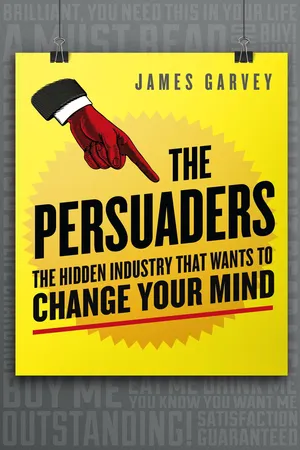
Every day, many people will try to change your mind, but they won't reason with you. Instead, you'll be nudged, anchored, incentivised and manipulated in barely noticeable ways. It's a profound shift in the way we interact with one another.
Philosopher James Garvey explores the hidden story of persuasion and the men and women in the business of changing our minds. From the covert PR used to start the first Gulf War to the neuromarketing of products to appeal to our unconscious minds, he reveals the dark arts practised by professional persuaders.
How did we end up with a world where beliefs are mass-produced by lobbyists and PR firms? Could Google or Facebook swing elections? Are new kinds of persuasion making us less likely to live happy, decent lives in an open, peaceful world?
Is it too late, or can we learn to listen to reason again?
The Persuaders is a call to think again about how we think now.
- 288 pages
- English
- ePUB (mobile friendly)
- Available on iOS & Android
eBook - ePub
About this book
Information
Subtopic
OperationsIndex
Social Sciences1
The Robin Hood on Butcher Lane
‘I find I am much prouder of the victory I obtain over myself, when, in the very ardour of dispute, I make myself submit to my adversary’s force of reason, than I am pleased with the victory I obtain over him through his weakness.’
MICHEL DE MONTAIGNE
When George III began his slide into insensibility and the American colonies were in open rebellion, the people of London insisted on being completely reasonable with one another. It all started some years earlier, with a small group of men who met in a pub called the Robin Hood on Butcher Lane.1
Up the stairs, out of earshot of the clamour of the labourers, artisans and Strand girls below, they booked a private room on Monday nights. Notoriously finicky about membership – boors need not apply – as many as fifteen of them turned up to smoke, drink and politely beg to differ with each another. They took sides, for or against any question that caught their attention, sometimes choosing an agreeably subversive topic, perhaps objecting to the government’s policy towards France’s expansion, debating whether Scripture might admit of personal interpretation, arguing the merits of popular books recommending reform, and enquiring into whether virtue or vice might afford superior pleasures. They took it in seven-minute turns, the time carefully observed by a vigilant factotum. After about two hours of spirited debate, when everyone had had enough, the chair summarised the arguments and brought the proceedings satisfactorily to a close. Although anyone was entitled to speak, some sat quietly and simply listened, enjoying the splendid sound of points eloquently made.
Perhaps an enterprising publican spotted the quiet ones and thought to open the doors to spectators – for a small admission fee of course. By the 1730s, the Robin Hood Society was a going concern, joined a decade later by the Queen’s Arms Society, and on it quietly but resolutely went, with just three or four groups scheduling regular debates, ranks swelled a little by budding lawyers, politicians and, oddly enough, actors – all keen to gain experience of speaking in public. But in the winter of 1780, something unexpected happened.
It had the shape of an epidemic centred in the heart of the city, with debating societies springing up around the Robin Hood at first, then fanning out all the way to what were then nearly London’s borders. Every neighbourhood succumbed. As far north as Islington, the Summer Lyceum met at Smith’s Tea Rooms. In the south, the Theological Debating Society convened in St George’s Fields. As far east as Rotherhithe, the School of Oratory scheduled regular discussions in China Hall. In the west, the Black Horse Tavern on New Bond Street was home to the Lyceum for the Investigation of Historical, Political, Literary and Theological Subjects. A newspaper editor baulked at the ‘rage for disputation, which has so suddenly spread itself in every part of the metropolis’.2 Another worried that ‘the Disorder is become so epidemical, that we are in Danger of dying a Nation of Orators’.3
Seven clubs met in the autumn of 1779, but in a few short months 35 debating societies, catering to every conceivable intellectual taste, shoehorned hundreds of people into taverns, auction houses and dancing halls each night of the week. People of every rank rubbed shoulders in the debating rooms – at least anyone who could come up with entry fees, sometimes not much less than the cost of a pricey theatre ticket. As a patron described it: ‘After a dirty walk, we were admitted, through the mediation of sixpence, into a spacious room, well lighted up and uncommonly crowded. The group was one of the most whimsical I had ever seen, and the countenances were in general divided into the classical, the supercilious, and the vacant, and the ranks would have been equally distinguishable, but that our introductory sixpence, like death and stage-coaches, had levelled all distinctions, and jostled wits, lawyers, politicians and mechanics, into the confusion of the last day.’4
Every large venue in the city was given over to ‘rational amusements’, and every self-respecting Londoner had views about where to go for a good argument. The Robin Hood could now expect 600 attendees a night – as many as 1,200 wedged themselves in for a big event. The largest brains in the country – the likes of Burke, Boswell and Pitt – weighed in.
Competition for custom was fierce. The societies distinguished themselves however they could, specialising in theological questions, political discussion, even sly takes on otherwise mundane matters to do with everyday life. Love, sex, and the proper relationship between a man and a woman were topics regularly revisited. Which is the more contemptible character: the effeminate man or the masculine woman? Is marriage or celibacy more desirable? Is the love of the intellectual or ‘the personal charms’ of a woman more likely to induce a man to marriage? Is the ‘deliberate seduction of the fair, with an intention to desert, under all circumstances worse than murder’? Can men and women ever truly be ‘platonic friends’? A vote was taken at the end of this debate and the matter decided in the negative.
The Temple of Taste offered music, poetry and acrobatics in the run-up to the main event, while the Female Inquisition attracted attention with the potentially titillating prospect of ‘fair orators’, famous lady speakers whose gifts for argument were matched only by their beauty. Unamused, La Belle Assemblée banned men. Some clubs banned alcohol. Others banned women. One banned women and alcohol.
The better halls were commodious and grandly illuminated by fine chandeliers, with plush sofas and chairs arranged in gradually elevated circles to enable as many as possible to catch sight of all the action. The Lycée François held all its debates in French. For its part, the Carlisle House School of Eloquence encouraged frank debate by permitting speakers to conceal their identities behind masks, sternly warning that ‘if any improper behaviour or expression shall be used under the concealment of a masque, the person offending shall submit, at the injunction of the President, to unmask or retire’.
It’s easy to imagine these rooms as occasionally rowdy places, packed with eighteenth-century Londoners thrilling to verbal fisticuffs, baying for oratorical blood, but in fact it was incredibly civilised. The chair was expected to keep order, which usually wasn’t difficult, as people turned up to hear incisive points made with style and eloquence, not mere knock-about. You can get a feel for it in this letter to the editor of the Gazetteer, gushing about a recent debate in the Queen’s Arms:
I was present on Friday evening last, and much pleased was I to observe so numerous an audience assembled, for the laudable purpose of edifying each other, by a search after truth. The question (which related to the indulgence lately granted by Parliament to the Roman Catholics of this kingdom) was discussed with the greatest candour and ingenuity by several gentlemen, long and well known in the society for their eminent abilities as to sound knowledge and real argument. Some new and juvenile speakers made their first essay, and were received with all that warmth of applause which is so fostering to the budding genius, and for which the society has always been remarkable, from its early institution to the present time.5
Not exactly bear-baiting is it?
But if it’s easy for us to get it wrong when we try to imagine the urbanity of those taking part in London’s grand debates, how unrecognisable would our world seem to them? Teleport the members of the Robin Hood Society to the present day, and subject them to a few of our forums for argument and debate: talk shows, reality television, blog posts and tweets, newspaper opinion pieces, late-night radio, hostile interviews, party political broadcasts, electioneering, and Prime Minister’s Questions. What would they make of what argument has become? Would they see anything more than shouting back and forth, contradiction, accusation, insult, point-scoring, bickering and smearing? Would they find anything to admire in us at all?
In the end, London’s flirtation with rationality did not last long. Largely in fearful reaction to the brewing French Revolution, the debating societies were violently repressed by the government – thugs were hired to break up debates, police constables blocked the doors, landlords were threatened with fines or worse, popular speakers were roughed up, and finally Parliament voted in the Seditious Meetings Act, effectively making public debate a treasonous offence.6
When the Robin Hood held its final meeting before being forced to close its elegant rooms, it was a kind of high-water mark in the history of reasoned discussion in the English-speaking world. No doubt we’re the beneficiaries of progress along all sorts of intellectual lines, but our Georgian forebears would almost certainly wipe the floor with us in an argument. We wouldn’t stand a chance.
What happened to us?
*
As the members of the Robin Hood might have had it, an argument was not merely disagreement. It was two or more people presenting and backing up their positions and then scrutinising one another’s claims. If they were on top of things, they would have considered two fundamental features of argument: the logic of the presentation and the truth of the premises therein. Those arguing were expected to respond to points fairly made and accept them when that was where the argument led. It meant that one might change one’s view in the light of criticism – and one might even do so gladly, because the essence and aim of a decent argument, for them, was largely the discovery of truth. No doubt the debating halls were sometimes filled with people arguing for the fun of it, for prestige, or for practice, but truth was the highest goal that could be shared by both sides. On a good night, they worked towards that goal together, enlightening one another, to the edification and applause of those in attendance.
When we think of an argument today, we mostly imagine something else entirely: entrenched positions, shouting matches, red faces and the butting of heads. There’s rarely give and take, often no conception of one’s interlocutor as a person with views up for consideration, no thought of modifying one’s position in response to a good point. In fact the demonisation of your opponent is now an excellent and effective tactic, as is the deliberate misunderstanding of his or her claims. We appeal to emotion and authority, distract with irrelevancies, stoop to fallacy if it helps, and ignore good points no matter how well made they are. We stick to our guns, and we seek to undermine each other by any means.
Worries about this sort of carry-on are in the air at the moment. In a recent TED Talk the philosopher Michael Sandel put it bluntly: ‘If you think about the arguments we have, most of the time it’s shouting matches on cable television, ideological food fights on the floor of Congress.’7 Much the same point is made, this time with regard to written argument, by Lee Siegel, columnist and editor-at-large for the New York Observer: ‘The name-calling and yelling on cable TV and the Internet have made us forget [the power of the written word]. Polemic seems to have gone the way of the typewriter and the soda fountain. The word was once associated with the best practitioners of the form: Voltaire, Jonathan Swift, George Orwell, Rebecca West. Nowadays, if you say “polemic,” you get strange looks, as if you were referring not to refined argument, especially written argument, but to some sort of purgative.’8
Maybe something has happened to us. Contemporary persuasion is now rarely done through argumentation. It now seems to operate mostly outside of reason.
In nearly every hour of your waking life, a lot of people will try to change your mind. Estimates vary from several hundred to several thousand persuasive messages encountered by the average adult each day, and almost none of it consists in giving you good reasons in support of a conclusion. Instead, you’ll experience product placement, infoganda, sock-puppeteering, decoy pricing, viral marketing, astroturfing, crowd manipulation, newsjacking, framing, spinning, propagandising, agenda setting, message carpet-bombing, anchoring and the nudging of your choices – all in an effort to affect your beliefs, desires, values, decisions and actions. You are very rarely reasoned with. Instead, you are nudged, anchored and incentivised.
It may well be a profound shift in the way human beings interact with one another. Even if it is, a glance at history will tell you that the picture is nevertheless complicated. We haven’t always been entirely reasonable or unreasonable – it hasn’t been a slow march out of the darkness and into the light. There have been peaks and troughs – great moments like the days of the grand London debates, and much less reasonable times, perhaps like the ones we’re in now.
At this odd moment, to consider just a corner of it, many of those engaged in debates in America about the budget, gun policy, healthcare, abortion, taxation and so on are barely able to speak to one another without anger. Religious debates between new atheists and believers can sometimes consist only in insult and slur. Objections to war in the Middle East are met with questions about one’s patriotism rather than reasoned argumentation. Compare this to what human beings have been capable of in the past.
As recently as two hundred years or so ago, Americans with considerably different political opinions and agendas were able to sit down together, engage in something approaching dialogue, and ratify the Articles of Confederation. Dominican friars in the Middle Ages thought it their religious duty to converse with unbelievers, calmly and carefully, to help them see the divine light through civilised discussion. In the eighteenth century, while British soldiers were in action in India, a London debating society invited people to enjoy refreshments, listen to music, and then join polite company in addressing the question, ‘Is not the war now carrying on in India disgraceful to this country, injurious to its political interest, and ruinous to the commercial interests of the [East India] Company?’ This kind of thing is all but beyond us now.
In pointing to all of this I don’t mean to suggest that the past was a watercolour of uniformly rosy rationality. When we think about the attack ads and mudslinging of contemporary political campaigning, for example, it’s easy to pine for what we imagine were simpler and better times – bold men holding forth to attentive crowds of modest but reflective townsfolk, running for office on nothing less than the power of their excellent ideas. It’s worth remembering that candidates for the US presidency did not actually engage in campaigning until 1840, when William Henry Harrison was forced to make a personal appearance at rallies to rebut the devastatingly effective but on reflection highly unlikely charge that he was, in actual fact, a ‘caged simpleton’.
So there have been peaks and troughs, but we seem to be in a particularly deep trough at the moment. Why? That’s a good but also hard question, and in trying to answer it, I know I’m setting myself an impossible task. A complete answer would require a long and detailed history of the social, economic, political and psychological forces that have landed us where we are. That kind of thing is beyond me – and anyway it’s not the sort of book I’d want to read, much less write. Some of the larger moments in the explanation of our current malaise, if that’s what it is, are themselves fascinating and enough to satisfy my own curiosity. So I won’t raise the Titanic, but I will dive for pearls.
The topics considered here reflect my own odd path through the tangled history of persuasion. I sometimes used the unimpeachably scientific method of discussing discoveries with friends in the pub, and if an experiment or event or personality got them talking it probably made it into these pages. Someone else with different friends in another pub might have chosen differently. In the end this book contains a mix of history and theory, good stories and large personalities, experimental evidence and ridiculous ideas that somehow managed to catch on. Among many other things, you’ll read about contemporary propaganda, new theories influencing the minds of our leaders and policy-makers (and in turn changing our lives too), the manipulative language of political campaigns, the rise of psychologica...
Table of contents
- Copyright Page
- Contents
- About the Author
- Preface
- 1. The Robin Hood on Butcher Lane
- 2. The Art of Steering Heads Inside
- 3. On Second Thoughts
- 4. When Push Comes to Shove
- 5. Lost for Words
- 6. Retail Therapy
- 7. Left to Our Devices
- 8. The Lost Art of Argument
- Notes
- Bibliography
- Index
- Back Cover
Trusted by 375,005 students
Access to over 1.5 million titles for a fair monthly price.
Study more efficiently using our study tools.
Frequently asked questions
Yes, you can cancel anytime from the Subscription tab in your account settings on the Perlego website. Your subscription will stay active until the end of your current billing period. Learn how to cancel your subscription
No, books cannot be downloaded as external files, such as PDFs, for use outside of Perlego. However, you can download books within the Perlego app for offline reading on mobile or tablet. Learn how to download books offline
Perlego offers two plans: Essential and Complete
- Essential is ideal for learners and professionals who enjoy exploring a wide range of subjects. Access the Essential Library with 800,000+ trusted titles and best-sellers across business, personal growth, and the humanities. Includes unlimited reading time and Standard Read Aloud voice.
- Complete: Perfect for advanced learners and researchers needing full, unrestricted access. Unlock 1.5M+ books across hundreds of subjects, including academic and specialized titles. The Complete Plan also includes advanced features like Premium Read Aloud and Research Assistant.
We are an online textbook subscription service, where you can get access to an entire online library for less than the price of a single book per month. With over 1.5 million books across 990+ topics, we’ve got you covered! Learn about our mission
Look out for the read-aloud symbol on your next book to see if you can listen to it. The read-aloud tool reads text aloud for you, highlighting the text as it is being read. You can pause it, speed it up and slow it down. Learn more about Read Aloud
Yes! You can use the Perlego app on both iOS and Android devices to read anytime, anywhere — even offline. Perfect for commutes or when you’re on the go.
Please note we cannot support devices running on iOS 13 and Android 7 or earlier. Learn more about using the app
Please note we cannot support devices running on iOS 13 and Android 7 or earlier. Learn more about using the app
Yes, you can access The Persuaders by James Garvey in PDF and/or ePUB format, as well as other popular books in Social Sciences & Operations. We have over 1.5 million books available in our catalogue for you to explore.