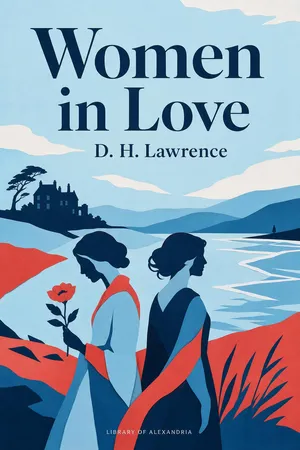
How close can two people become without trying to possess each other? Two sisters and the men they desire turn that question into a struggle over how to live.
In Women in Love, D. H. Lawrence follows Ursula and Gudrun Brangwen into relationships with Rupert Birkin, a restless intellectual, and Gerald Crich, a wealthy industrialist. Their contrasting hopes for intimacy bring affection into conflict with pride, independence, and the wish to control. Moving from the English Midlands to the snowy Alps, the novel sets private passions against a world shaped by industry and changing social expectations.
A sequel to The Rainbow that also stands on its own, this work of literary modernism resists the reassuring patterns of conventional romance. Conversations become contests of belief; attraction exposes differences that desire alone cannot resolve. Lawrence's lyrical descriptions and searching psychological attention give physical force to questions of gender, friendship, sexuality, and emotional honesty. The result remains unsettling because its central dilemma is so recognizable: how to belong to another person while remaining oneself.
What readers find inside:
• Two sisters - Ursula and Gudrun pursue distinct visions of fulfillment and independence.
• Intimacy and power - The couples' attachments reveal the uneasy boundary between devotion and domination.
• Male friendship - Birkin and Gerald's bond complicates the novel's questions about desire and human connection.
• An industrial world - Gerald's position as an industrialist links personal authority with wider structures of control.
• Modernist intensity - Symbolic landscapes, charged dialogue, and close psychological observation challenge familiar romantic expectations.
For readers of psychological fiction, classic English literature, and novels that confront the contradictions of relationships, this is a demanding and absorbing encounter with the inner life.
Enter Lawrence's charged world and discover four people testing what intimacy can ask of them.