Did Charlotte Brontë take opium? Did the Reverend Brontë carry a loaded pistol? What, precisely, does 'wuthering' mean?
Distinguished literary critic John Sutherland takes an idiosyncratic look at the world of the Brontës, from the bumps on Charlotte's head to the nefarious origins of Mr Rochester's fortune, by way of astral telephony, letterwriting dogs, an exploding peat bog, and much, much more.
Also features 'Jane Eyre abbreviated' by John Crace, author of the Guardian's 'Digested Reads' column – read Charlotte Brontë's masterpiece in five minutes!
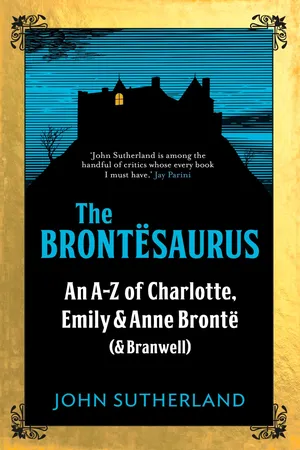
eBook - ePub
The Brontesaurus The Brontesaurus
An A–Z of Charlotte, Emily and Anne Brontë (and Branwell)
- 288 pages
- English
- ePUB (mobile friendly)
- Available on iOS & Android
eBook - ePub
The Brontesaurus The Brontesaurus
An A–Z of Charlotte, Emily and Anne Brontë (and Branwell)
About this book
Information
OPIUM (1)
Few observations of Marx’s are more quoted, and few less understood, than ‘Religion is the opium of the people’. It is, in context, a faute de mieux, approving comment. Religion is the only painkiller available to the oppressed proletariat. Until revolution. The mieux.
Marx made his comment in 1844, around the time that Branwell is first recorded as taking opium. In 1839 he began to eat it (or drink it, as laudanum). He was sometimes bothered by a facial tic, and probably also suffered from epilepsy, and the opium brought some relief. At this period the drug had romantic associations. De Quincey, the famous opium ‘eater’, and Coleridge, author of ‘Kubla Khan’, were among Branwell’s idols. It was the vice of poets, as TB was the poets’ disease. No one could have written ‘Kubla Khan’ on a bellyful of beer, or ‘Ode to a Nightingale’ with sound lungs (or, come to that, Wuthering Heights). Or so the mythology went.
The young Brontës all devoured the Confessions of an English Opium Eater. In various forms opium was available, legally and cheaply, at every corner apothecary and public house. Some book-shops even sold it for their browsing patrons. You could read Mr Coleridge’s latest work as high as he was when he wrote it. Consumption, nationwide, was enormous. Opium was given to babies as soothing medicine and to the dying as painkiller and euphoriant. Opium was the opium of the people.
India flooded the English market with the drug as efficiently as (with the aid of British gunboats) it flooded the Chinese market. Its overall effect was tranquillising – it was Prozac, avant la lettre, for troubled times. In excess, alcohol provoked ugly violence. No husband beat his wife or children as the result of a lump or two of opium. No child went on a rampage, tearing up the nursery, as the result of a teaspoonful too many of Godfrey’s Cordial (the best-known of the narcotic preparations given to infants and children).
The word ‘lump’, and De Quincey’s ‘eating’ are, however, crucial. Laudanum, one of the favourite means by which opium was ingested, mixed opium and alcohol, in a 90/10 mixture. As Charlotte Brontë astutely observed in Villette, too much alcohol, and the multiplier effect of multi-drug intake could be very bad.
Branwell, like many alcoholics, began as a social drinker who, as he became steeped in the stuff, drank over-socially. The old story. What little evidence there is suggests he had a poor head for liquor.
On the rebound from the Robinson imbroglio (see above, ‘Branwell’s Robinsoniad’, page 22) he ran up bills in public houses. In 1846 his drinking debts brought a sheriff ’s officer to Haworth. Branwell had given his father’s name. Either the family paid up, or Branwell would be hauled up in York for debt. Shame all round. The rows which followed are unrecorded. They surely followed.
About the same time he is recorded as using opium, together with alcohol, to ease his suffering, having been shunned by the widowed Mrs Robinson. By 1848, in the months leading up to his death, his intake was, it is suggested, self-destructive, and was aimed to be.
His use of alcohol was always, for the brilliant son of a clergyman (and a thoroughly decent human being), socially degrading. He was letting the family down. How could his father preach temperance, as did his evangelical brethren?
All one needs to know about the later stages of Branwell’s drinking career is evident in a letter he wrote to his ally in booze, John Brown, clearly in a state of agonising withdrawal. The note was written on a Sunday, at noon:
Dear John
I shall feel very much obliged to you if you can contrive to get me Five pence worth of Gin in a proper measure.
Should it be speedily got I could perhaps take it from you or Billy at the lane top.
Brown, one assumes, was being asked to send a boy to the Black Bull, bring back a bottle, and keep a penny for himself.
It’s sordid, as is the late career of most drinkers. Branwell could not have it delivered to the house because he was watched there. At night his father slept with him. If one trusts Mrs Gaskell, Branwell would turn in with a knife, his father with his trusty pistol (see below, ‘Pistol-Packing Parson’, page 131) – albeit one rather disbelieves this nocturnal standoff. One suspects this arrangement may have been for fear that Branwell would choke on his vomit during the night. After one night, he is reported as saying, blurrily, ‘The poor old man and I have had a terrible night of it; he does his best – the poor old man! but it’s all over with me.’
He probably stole his sixpence for his flagon of mother’s ruin (time had passed from the Hogarthian days when it was ‘drunk for 1d, dead drunk for 2d, clean straw for nothing’). Branwell, if he got his bottle, would neck the five pennies’ worth of gin, splutteringly, in the lane, and stagger back to collapse before the family returned from evensong.
According to the standard account subscribed to by most biographers, Branwell was all this time masking, by inebriation, the TB that actually killed him. Mrs Gaskell, drawing on the scenario relayed to her by Charlotte, writes a gothic account of self-destruction. She had no time for him. He drank alcohol because he was an alcoholic and (as was medical orthodoxy at the time) morally diseased, like all inebriates. But opium, Gaskell suggests, he swallowed massively in his last three years to ‘stun his conscience’.
Most addicts (I’m an alcoholic myself)1 will wonder about the sketchy outline one has of Branwell Brontë’s drinking and drugging, and what look like clear improbabilities in Charlotte’s account, which is all the world now has by way of biographical narrative.
Alcoholic self-destruction takes time, access to money, and good supply systems. Incarcerated as he was at Haworth, Branwell would have as much difficulty pickling himself in drink as Dantès in Château d’If (in The Count of Monte Cristo – a late 1840s bestseller Branwell might well have looked at, blearily).
‘He drank,’ says Mrs Gaskell, ‘whenever he could get the opportunity.’ The opportunities at Haworth parsonage would have been chronically few and far between. Opium presented fewer problems to the abuser because its lumps were ‘portable’. Unlike a bottle of gin, they could be secreted – in apertures of the body, if necessary. And the effect was less florid. Given his family name, Branwell could ‘cajole’ (Gaskell’s word) the local apothecary to supply him on credit. He displayed, observes Gaskell, ‘all the cunning of the opium-eater’ in procuring what he needed.
Branwell’s death certificate gives as the cause of death ‘chronic bronchitis and marasmus [wasting of the body]’. It’s not true. It was a combination of drugs and TB that killed him. But, having said that, the accounts left us by Charlotte of his last hours do not ring true.
Two days before his death, Branwell was able to take a walk in the village – an act which does not invoke death throes. The next day he was confined to bed. He answered, obediently and articulately, we are told, to his father’s advice on seeking, even at this terminal moment, salvation by true repentance.
On his last evening on earth, in conversation with his gin provider, John Brown, he is reported as crying out: ‘In all my past life I have done nothing either great or good. Oh John, I am dying!’
At nine the next morning (a Sunday), we are told, the family (what was left of them) gathered round Branwell’s bed. He remained ‘perfectly conscious to the end’, praying all the while. As he left this life, his last word, as his father prayed, was ‘amen’.
There is no doubt he died at Haworth in bed; but anyone who has witnessed a drink-and-drugs death will be suspicious. Nor, in the condition of final collapse, do the terminally tubercular go for country walks 48 hours before expiring. My hunch is that it was, one way or another, suicide – perhaps by self-stored medicine and opium. It would have been a calculated kindness to his family to have eased their misery with a ‘good’ death.
It takes a lot to make that most level-headed of biographers, Juliet Barker, angry. But in the last paragraph in her great work she turns to denounce Mrs Gaskell for her wilful inconsideration of the son of Haworth:
The Branwell who was his family’s pride and joy, the leader and innovator, artist, poet, musician and writer, is barely touched upon, despite the fact that without him, there would probably have been no Currer, Ellis, or Acton Bell.
Footnote
1. Non-practising for thirty years.

Branwell’s last walk?
The main street in Haworth, at the period the Brontës lived there.
The main street in Haworth, at the period the Brontës lived there.
OPIUM (2)
Mrs Gaskell knew all about opium. The working-class hero of her first novel, Mary Barton, is an addict. Indeed the whole of working-class Manchester was addicted. As Mrs Gaskell wrote:
Many a penny that would have gone little way enough in oatmeal or potatoes, bought opium to still the hungry little ones, and make them forget their uneasiness in heavy troubled sleep. It was mother’s mercy.
As gin was mother’s ruin.

A Punch cartoon illustrating the uses of opium around this time.
Anyone who has read Villette will remember Chapter 38, ‘Cloud’. The heroine, Lucy Snowe, is given a medicinal dose of laudanum, to help her sleep through a terrible headache. But too much alcohol has been put in the potion (perhaps deliberately, by her rival, Mme Beck). The mixture renders Lucy high as a kite, and, somnambulistically, she goes wandering, entranced, through the night-time streets of Brussels.
A fairground Lucy wanders into is a surreal sensory experience:
a land of enchantment, a garden most gorgeous, a plain sprinkled with coloured meteors, a forest with sparks of purple and ruby and golden fire gemming the foliage; a region, not of trees and shadow, but of strangest architectural wealth – of altar and of temple, of pyramid, obelisk, and sphinx: incredible to say, the wonders and the symbols of Egypt teemed throughout the park of Villette.
A freak-out, as we used to call it in the sixties. Miss Snowe is tripping. Arguably this is the most accurate, and sympathetic, description of opiate intoxication in Victorian fiction, until the degenerates of the fin de siècle came along with their rhapsodies to hemp, opium, and cocaine. And devoting a chapter to it suggests a more than passing interest on Miss Brontë’s part.
Mrs Gaskell, who confessed to having used the stuff herself, was curious.
I asked her whether she had ever taken opium, as the description given of its effects in Villette was so exactly like what I had experienced, – vivid and exaggerated presence of objects, of which the outlines were indistinct, or lost in golden mist, etc. She replied, that she had never, to her knowledge, taken a grain of it.
She had merely ‘wondered’, Charlotte claimed, about the experience, in bed, before going to sleep. And then dreamed the details. Very realistically, as Mrs G. confirmed.
One is tempted to take it with a grain of something stronger than salt. But the jury is out. And we’ll never know and always wonder. The usual situation with the Brontës.
PILLAR
Branwell it was who painted the famous group portrait of Charlotte, Emily and Anne. As a work of art it does not confirm the touching family belief that he was a born genius with the brush. But it demonstrates promise and high teenage competence.
Mrs Gaskell, who saw the painting, declared it ‘admirable’. But the picture was marred, as she observed, ‘almost in the middle, by a great pillar’.
Gaskell was shown the portrait in 1853. Thereafter it disappeared, and was thought lost. The National Portrait Gallery’s notes record that it was found, folded up in quarters on top of a cupboard ‘by the second wife of Charlotte Brontë’s husband, the Reverend A.B. Nicholls, in 1906’. Why, one wonders, was it put (one might almost say ‘thrown’) away? Why scrunched up?

Anne, Emily, large pillar, Charlotte.
The portrait, scarred by its careless folding, was acquired by the gallery and a large simulacrum was painted for the Haworth museum.
Over time, the reason for the pillar has become apparent. As the NPG further notes: ‘In the centre of the group a male figure, previously concealed by a painted pillar, can now be discerned; it is almost certainly a self-portrait of the artist, their brother Branwell Brontë.’ Custodians at the NPG are said to have observed that, over the decades, Branwell is ‘coming through’. Breaking, as it were, through the obscuring pillar.
No other novelists have inspired as many legends about ghosts as the Brontës, and it is te...
Table of contents
- Copyright Page
- About the Author
- Contents
- Preface
- Anne’s last journey
- Attic matters
- Bigamy
- Bog people
- Branderham
- Branwell’s Robinsoniad
- Branwell’s Robinsoniad II
- Bumps on the head
- The confession box
- Creole
- Dates
- Elementary
- Extradiegesis
- Flossy
- Ghosts
- Grace
- Guadeloupe
- Hands
- The hound of Haworth
- Idiot child
- The idiot child and me
- Jane! Jane! Jane!
- Jane’s change of heart
- Letters
- Liverpool
- Masculinities
- Mononymity
- Mr Charlotte Brontë
- Mrs Arthur Bell Nicholls
- Murder?
- Myopia
- No Coward Soul
- Normality?
- Obstinate fasting
- Opium (1)
- Opium (2)
- Pillar
- Pistol-packing parson
- Plain Jane
- Privacy
- Publishers
- Rochester’s wealth
- Self-murder
- Spirit-written
- Steel
- Survivor’s privileges
- Tat
- Teething
- That name
- Three-decker
- Toothsome
- Transformation
- Vampirology (1)
- Vampirology (2)
- Vegetarianism
- Villainy
- Whither wuther?
- Windows
- Appendix: Jane Eyre abbreviated by John Crace
Trusted by 375,005 students
Access to over 1.5 million titles for a fair monthly price.
Study more efficiently using our study tools.
Frequently asked questions
Yes, you can cancel anytime from the Subscription tab in your account settings on the Perlego website. Your subscription will stay active until the end of your current billing period. Learn how to cancel your subscription
No, books cannot be downloaded as external files, such as PDFs, for use outside of Perlego. However, you can download books within the Perlego app for offline reading on mobile or tablet. Learn how to download books offline
Perlego offers two plans: Essential and Complete
- Essential is ideal for learners and professionals who enjoy exploring a wide range of subjects. Access the Essential Library with 800,000+ trusted titles and best-sellers across business, personal growth, and the humanities. Includes unlimited reading time and Standard Read Aloud voice.
- Complete: Perfect for advanced learners and researchers needing full, unrestricted access. Unlock 1.5M+ books across hundreds of subjects, including academic and specialized titles. The Complete Plan also includes advanced features like Premium Read Aloud and Research Assistant.
We are an online textbook subscription service, where you can get access to an entire online library for less than the price of a single book per month. With over 1.5 million books across 990+ topics, we’ve got you covered! Learn about our mission
Look out for the read-aloud symbol on your next book to see if you can listen to it. The read-aloud tool reads text aloud for you, highlighting the text as it is being read. You can pause it, speed it up and slow it down. Learn more about Read Aloud
Yes! You can use the Perlego app on both iOS and Android devices to read anytime, anywhere — even offline. Perfect for commutes or when you’re on the go.
Please note we cannot support devices running on iOS 13 and Android 7 or earlier. Learn more about using the app
Please note we cannot support devices running on iOS 13 and Android 7 or earlier. Learn more about using the app
Yes, you can access The Brontesaurus The Brontesaurus by Jon Sutherland in PDF and/or ePUB format, as well as other popular books in Literature & English Literary Criticism. We have over 1.5 million books available in our catalogue for you to explore.