Spanning ten historic years, from the discovery of nuclear fission in 1939 to 'Joe-1', the first Soviet atomic bomb test in August 1949, Atomic is the first fully realised popular account of the race between Nazi Germany, Britain, America and the Soviet Union to build atomic weapons.
Rich in personality, action, confrontation and deception, Jim Baggott's book tells an epic story of science and technology at the very limits of human understanding.
eBook - ePub
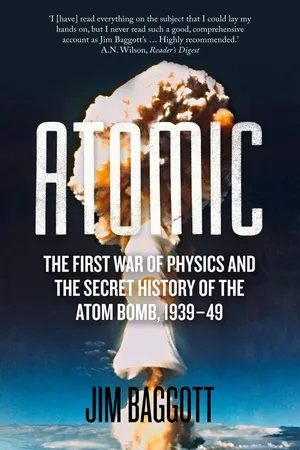
Atomic
The First War of Physics and the Secret History of the Atom Bomb 1939-49
- 576 pages
- English
- ePUB (mobile friendly)
- Available on iOS & Android
eBook - ePub
About this book
Trusted by 375,005 students
Access to over 1.5 million titles for a fair monthly price.
Study more efficiently using our study tools.
Information
Subtopic
Science HistoryIndex
HistoryPART I
MOBILISATION
Chapter 1
THE URANVEREIN
September 1939–July 1940
Werner Heisenberg loved his country. He was a patriot and, by his own standards, a ‘good’ German. Slightly built, blond, with a warm and welcoming smile, he might have seemed to some the very essence of Aryan manhood. As an impressionable young student in his late teens he had dreamt of a romanticised Third Reich with fellow members of the New German Pathfinders, a youth movement composed of upper-middle-class adolescent males. This was a Reich that was to be forged through a return to the spirit of community and noble leadership characteristic of the medieval crusader knights. It demanded a complete rejection of the corruption and hypocrisy of modern German society and extolled moral purity, honour and chivalry. The movement was firmly apolitical.
The older Heisenberg might have been able to persuade himself that a German victory in the war that had just been unleashed would be ultimately good for Europe, but it was painfully obvious that Hitler’s National Socialism was a gross corruption of his youthful ideals. He had managed to convince himself that Hitler’s regime would surely be transitory, giving way in the fullness of time to a more moderate and honourable form of government.
In the meantime, many of Heisenberg’s Jewish colleagues had fled the country, fearing for their lives and the lives of their families. Heisenberg himself preferred the inner exile of political reticence and conformity to the prospect of physical exile that had been afforded by the offers of academic positions he had received from abroad. In reaching this conclusion he was guided by Max Planck, the great grandfather of the quantum, now president of the Kaiser Wilhelm Society. Planck had counselled that emigration would be an empty gesture, and that Heisenberg could perform a higher service by offering support to the next generation of German physicists, needed by the country long after the Nazis had gone.
It was a morally ambiguous position. Physics and physicists had to be defended without offence to Nazi ideology, a task requiring painstakingly careful steps along a very fine line. It was a path that was to involve considerable personal danger and many shameful compromises.
Heisenberg himself was intimately aware of the dangers. He had been publicly denounced two years before for his association with the kind of physics that Nazi purists had branded ‘Jewish’, largely because of its departure from classical preconceptions and because of the prevalence of Jews in its discovery and development. The archetypal Jewish physicist was Einstein, and Einstein’s theories of relativity had come to epitomise Jewish physics.
At that time Heisenberg had been waiting for news about his appointment to a professorial chair at the University of Munich. This was a position vacated by Arnold Sommerfeld, Heisenberg’s former doctoral adviser, who had retired a few years previously. His appointment had seemed certain. Then came an article by Nazi physicist Johannes Stark in the SS newspaper, Das Schwarze Korps, on 15 July 1937. ‘How secure the “White Jews” feel in their position,’ Stark wrote, ‘is proven by the actions of the Professor for Theoretical Physics in Leipzig, Prof. Werner Heisenberg, who … declared Einstein’s theory of relativity to be “the obvious basis for further research …”’ Stark went on to accuse Heisenberg of anti-regime views, of being a ‘Jew lover’ and a ‘Jewish pawn’.
In itself the attack proved enough to deny Heisenberg the Munich chair. But he was now faced with a dark choice. Silence in the face of such accusations would imply complicity, placing both himself and his new (and now pregnant) wife Elisabeth in a danger from which physical exile from Germany and German science would be the only escape. The Nazi dogs would hound him out of the country he loved. The alternative was to defend what he saw to be his ‘honour’, declare his patriotism and, by inference, his loyalty to the Nazi cause. ‘Now I actually see no other possibility but to ask for my dismissal [from his professorship in Leipzig] if the defence of my honour is refused here’, he wrote to Sommerfeld.
Towards the end of July, Heisenberg wrote directly to Heinrich Himmler, asking that Himmler either approve or disapprove of Stark’s attack on him. Approval of Stark’s denouncement by Himmler would lead Heisenberg to resign his position. Disapproval would lead him to demand that his honour be restored and that he be protected from any future such attacks.
This was not a letter that could be trusted to the usual channels, as these would work too slowly, if at all. Instead Heisenberg’s mother offered to pass the letter to Himmler via Himmler’s mother, whom she knew personally. They met in either late July or early August 1937, Heisenberg’s mother appealing to Mrs Himmler’s maternal instincts: ‘… we mothers know nothing about politics – neither your son’s nor mine,’ she confided, ‘But we know that we have to care for our boys. That is why I have come to you.’
Himmler probably received the letter later that August, and launched a preliminary internal investigation. This evolved into a more intensive SS investigation that lasted more than eight months. Heisenberg would have come to know real fear during this time. The Gestapo bugged his home and placed spies in his physics classes. An apparent preference for the company of young men and the apparently unseemly haste with which the 35-year-old Werner had married twenty-year-old Elisabeth Schumacher evolved into dark hints of homosexuality, a crime punishable by immediate imprisonment in a concentration camp. Such allegations were frequently used by the SS to extract confessions for lesser crimes.
What, one wonders, might have been said to Heisenberg during his interrogations in the notorious cellars of SS headquarters in Prinz Albert Strasse in Berlin, where a sign hanging on the wall reminded all exposed to such questioning to ‘Breathe calmly and deeply’? Heisenberg was not physically harmed, but would return home from each interrogation exhausted and deeply disturbed.
Several of the SS investigation team had studied physics and Heisenberg had actually acted as doctoral thesis examiner in Leipzig for one of them. The investigation concluded positively, clearing Heisenberg of all the charges levelled by Stark. The application of some further, gentle diplomatic pressure on Himmler finally led to a compromise, and a conclusion of the affair, a year after Stark’s accusations had first appeared in print. Himmler expressed his disapproval of the attack, his belief that ‘… Heisenberg is decent, and we could not afford to lose or silence this man, who is relatively young and can educate a new generation’. He instructed Reinhard Heydrich, head of the Nazi intelligence service – the SD – that Heisenberg should be protected from any future attack.
Such protection was dearly bought. The compromise meant that relativity theory could continue to be taught to the next generation of German physicists, but it had to be divorced from Einstein’s name. Indeed, the argument went, the foundations of relativity theory had, surely, been laid by good Aryan physicists. The Jew Einstein had merely profiteered from their ideas. Compared to the evils visited upon Jews by the Nazis in the time since they had come to power, denial of the role they had played in the development of modern physics was, perhaps, a bargain that was not so difficult for Heisenberg to accept. But the Faustian nature of the bargain was now crystal clear.
Preventing catastrophe
Heisenberg’s American colleagues, and those European physicists who had found sanctuary in America, could not understand his decision to stay in Germany.
He visited America in the summer of 1939, probably judging this to be the last opportunity to do so for some time to come. He lectured in Chicago and at Purdue University in Indiana, before moving on to Ann Arbor to attend a summer school organised by Dutch physicist Samuel Goudsmit, then on the faculty of the University of Michigan.
It was in America that Fermi caught up with him, and together they discussed the prospect for a new kind of super-weapon based on nuclear chain reactions. Heisenberg shared the commonly-held view that this was a remote, long-term possibility. Fermi insisted that, should war break out, nuclear physicists of all nations would surely be expected to devote all their energies to building these new weapons. Heisenberg conceded the point but played down the potential for success: ‘I believe that the war will be over long before the first atom bomb is built’, he said.
In Ann Arbor Heisenberg faced a friendlier, though no less intense, interrogation. What was Heisenberg going to do? Why was he staying on in Nazi Germany? How could he continue to do physics under the auspices of such an evil regime? Why was he in such a hurry to get back? Goudsmit pursued him relentlessly. Laura Fermi remarked that anyone must be crazy to stay in Germany. Exasperated, Heisenberg responded in kind: ‘People must learn to prevent catastrophes,’ he argued, ‘not to run away from them.’
Before returning to Germany Heisenberg stopped over in New York, where once again he received the offer of an academic position at Columbia University, an offer that had first been made during his darkest hours in 1937. Once again he turned the offer down.
Perhaps Heisenberg had not received the kind of reception in America that he had anticipated. His insensitivity to the effect on his friends and colleagues of some of his more casual remarks – emphasising that he needed to return to his German army reserve unit for machine-gun practice, for example – would certainly not have helped. He boarded the SS Europa in early August. It was virtually empty. On the journey back to Germany he would have had plenty of time to ponder what the future held.
Warfare for physics
As each day had passed since the outbreak of war on 1 September 1939, Heisenberg had anticipated the arrival of his call-up papers, just as he had nervously, but eagerly, anticipated a call to arms with his reserve infantry brigade during the Sudeten crisis a year before, a crisis averted when Czechoslovakia’s allies traded appeasement of Hitler’s aggressive expansionism for ‘peace in our time’. When Erich Bagge returned to Leipzig on 25 September and advised him that he was to report not to the infantry but to the next meeting of the Uranverein, he was both greatly relieved and excited. He had been presented with an opportunity to contribute to Germany’s war effort by doing what he loved most: research.
In his own mind Heisenberg had already dismissed the prospect of an atomic super-weapon as a remote one, but the German military authorities were nevertheless willing to engage the services of nuclear physicists and provide research funds and facilities to explore the possibilities. Here was an opportunity to contribute to the war effort and at the same time carry out fundamental research. ‘We must make use of physics for warfare’, was the official slogan of the Nazi government. Heisenberg thought to turn this on its head: ‘We must make use of warfare for physics’, he wrote years later of his reaction to the news.
Many scientists down the centuries have fallen prey to such impeccable, but arrogant, logic. When the ends are deemed to be improbably achievable or irrelevant, the means become the most important consideration. But these same scientists have tended to fail spectacularly to see all possible ends. So, Werner Heisenberg, Nobel laureate, discoverer of quantum mechanics and the uncertainty principle, and one of the most talented theoretical physicists of his time, accepted the challenge to work on atomic weapons for Hitler’s Nazi Germany. He accepted eagerly and without hesitation. A darker and potentially much more dangerous Faustian bargain had now been struck.
The Uranverein was to meet again in Berlin the very next day, 26 September. Heisenberg journeyed to Berlin that night.
Reactors and bombs
The second meeting of the Uranverein, whose very existence was now classified as a military secret, was held in the research offices of German Army Ordnance in Berlin. The research branch of Army Ordnance was headed by Erich Schumann,1 who had wrested control of the Uranverein from Esau at the Reich Research Council, part of the Ministry of Education. Schumann appointed Diebner to direct the project, supported by Bagge. Diebner had studied physics in Innsbruck and in Halle before joining the German Bureau of Standards and the Army Weapons Bureau in 1934. Bagge had studied in Munich and Berlin and gained his doctorate under Heisenberg at Leipzig in 1938. Both were loyal Nazis.
Heisenberg now joined Diebner, Bagge, Harteck, Hahn and other Uranverein physicists, including Carl Friedrich von Weizsäcker, one of Heisenberg’s former students and a close friend. Weizsäcker had studied in Berlin and Copenhagen before gaining his doctorate under Heisenberg in Leipzig in 1933. He was a talented young theoretical physicist and philosopher, the son of Ernst von Weizsäcker, Secretary of State under Foreign Minister Joachim von Ribbentrop. Just 24 days prior to the Uranverein meeting, on the second day of the war, his younger brother Heinrich had been killed fighting with the Ninth Infantry Regiment near Danzig.
Diebner and Bagge had drafted an outline of the research programme a few days prior to the meeting, and had allocated tasks to each of the scientists involved. There was still considerable uncertainty regarding the physical principles of a fission chain reaction in uranium and there were few hard measurements available, but there was enough understanding to make a start.
Bohr and Wheeler had argued that U-235 is responsible for fission in uranium, and that fission can be triggered by bombardment of U-235 with slow neutrons. Fission in the much more abundant isotope U-238 requires much faster, higher-energy neutrons. However, there are certain characteristic neutron energies, called ‘resonant’ energies, at which a U-238 nucleus will capture a neutron to form the unstable isotope U-239 without undergoing fission. At these relatively high energies, neutrons would therefore be removed from any chain reaction, the U-238 nuclei acting as a ‘sink’, preventing the neutrons from going on to fission more U-235 nuclei.
Obtaining a self-sustaining chain reaction in a nuclear reactor based on naturally-occurring uranium was therefore a simple matter of population statistics. Secondary neutrons produced by fission of U-235 would be formed with a range of energies, or speeds. If, on average, one or more neutrons survived long enough to encounter other U-235 nuclei, then there was a chance that these would cause fission, sustaining the chain reaction. If, on the other hand, the secondary neutrons were captured by the more abundant U-238, leaving, on average, less than one neutron to find a U-235 nucleus, then the chain reaction would be unsustainable and would quickly fizzle out.
The solution was obvious. To give the secondary neutrons as much chance as possible of finding and fissioning more U-235 nuclei, it would be necessary to incorporate a moderator in the reactor design. This would be a material containing light atoms capable of slowing the neutrons down without absorbing them. By slowing the neutrons down to an energy below the threshold of the U-238 resonance, they would be prevented from being absorbed in their turn by the U-238 nuclei. Suitable candidates for a moderator included so-called ‘heavy’ water, in which the hydrogen atoms of ordinary water are replaced by heavier deuterium isotopes,2 or pure carbon in some readily available form, such as graphite. Harteck had already done some preliminary work on a reactor design consisting of alternating layers of uranium and heavy water.
It was also fairly clear at this early stage that a compact reactor or a bomb could not be built without separating U-235 from U-238 or, at the very least, greatly enriching the proportion of U-235 present in a mixture. There were few options available and, as Bohr had observed months earlier to his colleagues in Princeton, the prospects for large-scale separation of U-235 were dim. A thermal diffusion...
Table of contents
- Copyright Page
- Dedication
- Contents
- List of illustrations
- Foreword
- Preface
- Prologue: Letter from Berlin
- Part I: Mobilisation
- Part II: Weapon
- Part III: War
- Part IV: Proliferation
- Epilogue: Mutual Assured Destruction
- Timeline
- List of Key Characters
- Notes and Sources
- Bibliography
- Index
- Back Cover
Frequently asked questions
Yes, you can cancel anytime from the Subscription tab in your account settings on the Perlego website. Your subscription will stay active until the end of your current billing period. Learn how to cancel your subscription
No, books cannot be downloaded as external files, such as PDFs, for use outside of Perlego. However, you can download books within the Perlego app for offline reading on mobile or tablet. Learn how to download books offline
Perlego offers two plans: Essential and Complete
- Essential is ideal for learners and professionals who enjoy exploring a wide range of subjects. Access the Essential Library with 800,000+ trusted titles and best-sellers across business, personal growth, and the humanities. Includes unlimited reading time and Standard Read Aloud voice.
- Complete: Perfect for advanced learners and researchers needing full, unrestricted access. Unlock 1.5M+ books across hundreds of subjects, including academic and specialized titles. The Complete Plan also includes advanced features like Premium Read Aloud and Research Assistant.
We are an online textbook subscription service, where you can get access to an entire online library for less than the price of a single book per month. With over 1.5 million books across 990+ topics, we’ve got you covered! Learn about our mission
Look out for the read-aloud symbol on your next book to see if you can listen to it. The read-aloud tool reads text aloud for you, highlighting the text as it is being read. You can pause it, speed it up and slow it down. Learn more about Read Aloud
Yes! You can use the Perlego app on both iOS and Android devices to read anytime, anywhere — even offline. Perfect for commutes or when you’re on the go.
Please note we cannot support devices running on iOS 13 and Android 7 or earlier. Learn more about using the app
Please note we cannot support devices running on iOS 13 and Android 7 or earlier. Learn more about using the app
Yes, you can access Atomic by Jim Baggott in PDF and/or ePUB format, as well as other popular books in History & Science History. We have over 1.5 million books available in our catalogue for you to explore.