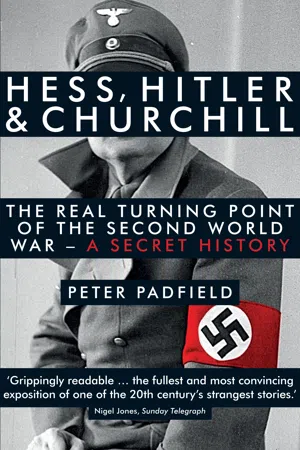
When Hitler's deputy Rudolf Hess set off for Britain on a peace mission in May 1941, he launched one of the great mysteries of the Second World War. Had he really acted alone, without Hitler's knowledge? Who were the British he had come to see? Was British intelligence involved?
Award-winning historian Peter Padfield presents striking new evidence that demands the wholesale reappraisal of the episode. For, allied to a powerful argument that Hess must have had both Hitler's backing and considerable encouragement from Britain, Padfield demonstrates that he also brought with him a draft peace treaty committing Hitler to the evacuation of occupied European countries. Made public, this would have destroyed Churchill's campaign to bring the United States into the war.
Expertly woven into a compelling narrative that touches on Lord (Victor) Rothschild and the Cambridge spy ring, possible British foreknowledge of Operation Barbarossa and the 'final solution', MI6's use of Hess to prevent the bombing of London and the mysterious circumstances of his death in Spandau prison – including the previously unseen witness accounts from that day – Hess, Hitler and Churchill is among the most important history books of recent years.
eBook - ePub
Hess, Hitler and Churchill
The Real Turning Point of the Second World War - A Secret History
- 480 pages
- English
- ePUB (mobile friendly)
- Available on iOS & Android
eBook - ePub
Hess, Hitler and Churchill
The Real Turning Point of the Second World War - A Secret History
About this book
Trusted by 375,005 students
Access to over 1.5 million titles for a fair monthly price.
Study more efficiently using our study tools.
Information
CHAPTER ONE

Death in the summer house
17 August 1987: to all appearances, just another morning. Prisoner Number Seven eased himself from bed with the painful movements of age. He was 93. His hair was grey and thin on top, his eyes deep-set beneath bushy brows. Once he had been second man in Hitler’s Reich. Despite the changes wrought in him by age, those who had seen him then leading the massed ranks of the Nazi Party in ringing acclamation of the Führer would have had little difficulty in recognising him. He believed he was still due the dignity of that station. He had never accepted the jurisdiction of the victor powers at the Nuremberg war crimes trials, nor reconciled himself to his sentence.
Six other leading Nazis confined with him in Spandau jail, West Berlin, had been freed long since. He alone remained, the sole inmate of a cell complex built to house 600, watched over by a prison directorate, warders, guards, kitchen and laundry staff and a platoon of soldiers provided by one of the four victor powers of the war on a monthly rota. August was the American month.
He had been held for just over 40 years in Spandau, in total 14,640 days, and for six years before that in captivity in Britain and Nuremberg, altogether almost half his life span. Appeals for his release made by his family, groups of sympathisers and prominent individuals in the West appalled by the unprecedented length of his imprisonment had been rejected by the Russians. At Nuremberg they had wanted him hanged as a prime mover in the Nazi assault on their country. They had not forgotten nor forgiven;1 and now, in the Cold War with the West, Spandau provided them with a convenient listening post in the British sector of Berlin.
There had been recent signs of change. A thaw in East–West relations inspired by a new Soviet leader, Mikhail Gorbachev, had been accompanied by hints of clemency for the prisoner in Spandau;2 and in June the German-speaking service of Radio Moscow had held out the prospect of ‘the long-standing endeavours for the release of the war criminal Rudolf Hess soon being crowned with success’.3 His supporters felt that such a sensational statement must have been approved at the highest level in the Kremlin.
Over the past two decades his living conditions had been rendered easier. He now occupied a double cell, formerly used as the chapel for the seven. The cell door was no longer locked, in case he needed to get out quickly to the lavatory. Beside his bed he had a table with a mug, a ceramic pot with an immersion heating coil for boiling water, the wherewithal for making tea and coffee and an anglepoise reading lamp. On the wall behind the bedhead were large charts of the moon’s surface sent to him by NASA in Texas. He had made himself a lay expert in space exploration over the years. The study of history, philosophy and the latest developments in space travel, and brief periods listening to his favourite composers – Beethoven, Schumann, Schubert – on an old record player whose sound was no longer true, had been his release from the emptiness of his solitary confinement without end.
Outside, the garden provided solace. It had been created by the prisoners from a wild area of some twelve acres between the rear of the cell block and the high red-brick wall enclosing the prison grounds. Prisoner Number Four, Albert Speer, formerly Hitler’s architect and armaments minister, had designed a scheme of paths and lawns and overseen the planting of roses, forsythia, lavender and hydrangia bushes and lilac trees among the existing trees. Birds flitted among the branches.
Besides the warders who guarded him in shifts, Number Seven had a male nurse to attend him, a Tunisian named Abdallah Melaouhi, who lived in a flat just outside the prison walls. An experienced senior nurse, Melaouhi had looked after the old man in Spandau for five years, and the two had come to trust and like one another. Melaouhi had entered the prison at 7.00 that morning, as he did on most mornings;4 he now escorted his charge from the lavatory to the wash cell and helped him shower, shave and dress; thence to the First Aid Room or dispensary, where he weighed him, measured his blood pressure, pulse and temperature, trimmed his hair and gave him his daily massage before counting out the pills he was prescribed for hypertension, heart and circulatory ailments.5
After escorting him back to his cell, Melaouhi left and went back to his apartment, returning to the prison shortly after 9.00. Meanwhile, the old man lay back on his bed, tired, and dozed off. On most mornings he slept for an hour or so before going out into the garden, but on this morning he stayed in, and later, as it was a Monday, made out his weekly requisition form, this time for 30 packets of paper tissues, three rolls of lavatory paper, a sheet of writing paper and a ruler. The form was handed in to the chief warder at 10.20.6 Ten minutes later his lunch was wheeled in to the cell block. As always, Melaouhi took the first mouthful, indulging the suspicion of poison the old man had manifested long ago during the first days of his captivity in England. Shortly afterwards he asked Melaouhi to go to the nearby shops in his lunch break and buy a replacement for the ceramic pot he used as a kettle. Melaouhi was logged leaving the prison at 11.07.
At 12.15 a black American warder named Tony Jordan relieved the British warder on cell duty. During the previous American tour of guard duty in April, Number Seven had requested Jordan’s dismissal on the ground that the man’s poor education, rudeness and antagonism towards him endangered his health.7 The request had been refused. It was believed among prison staff that the real reason for the complaint was Number Seven’s prejudice against black people, manifested on earlier occasions.
The August day was warm and bright. Shafts of sunlight filtered through the small barred windows high in his cell, and at about 1.30 he sought permission for his usual outing in the garden. Jordan helped him dress for the walk – as always a protracted process, finishing with a light tan raincoat and a wide-brimmed straw sombrero hat. He then escorted him slowly to the lift that had been installed specifically to ease his passage to ground level. The two were logged going down together at 2.10.8
At the bottom Jordan left his charge and went outside, taking a path through the garden that led to a metal cabin some twelve feet by seven, variously termed the ‘summer house’, the ‘garden house’ or the ‘resthouse’. Reaching it, Jordan unlocked the single door in the cabin wall facing the prison. There was a small window in the same side; the opposite side facing the perimeter wall of the prison grounds was formed of sliding glass doors. The two ends were windowless. Inside was a straw mat on the floor, two chairs, a bench and a table and four electric reading lamps. Here the old man liked to sit alone, whatever the weather, and read or think or frequently just doze off. The warders, instructed to watch him at all times, usually respected his privacy and sat outside, checking him at intervals.9
But this was no ordinary day: it was the last day of the old man’s life, and a subsequent Military Police investigation was to find he had been planning it for some time. The witness statements on which this conclusion is based, released a quarter of a century later, leave little room for doubt about the sequence of events.
THE MILITARY POLICE INVESTIGATION
Names have been redacted from the statements; witnesses are identified only by numbers. The American soldier who had the most comprehensive view of the unfolding drama from the beginning is numbered Nine. His post was in observation tower number three of altogether six towers built above the perimeter wall and numbered clockwise in ascending order. Tower number three was opposite and something under 100 yards from the rear of the prison building and the exit from the lift to the garden. When Nine looked towards the prison from his observation platform some 20 feet above ground, the ‘summer house’ was diagonally to his left some 30 yards away, glass side towards him but partly obscured by the foliage of a nearby tree.
At about 2.20 p.m. his shift supervisor, Sergeant Ten, approached the foot of the tower on his rounds and called up to make sure all was in order. As Nine responded he heard the door at the rear of the prison complex open and saw Jordan emerge alone. The warder walked to the dirt path leading towards the summer house and on reaching the little cabin unlocked the single door on the prison side – although all Nine could actually see from his elevated position was the top of the door swing outwards beyond the flat roof. Jordan, by his own account, supported by the testimony of Sergeant Ten, then went inside and unlocked the glass doors on the side facing Nine’s tower before walking back along the path to the prison building and in via the door from which he had first emerged. A moment later he came out and again took the path towards the summer house. Nine noticed that ‘as the warder walked to and from the resthouse he was looking around all the time, as though he was checking the area. On one occasion I saw him look directly up at the sky as though he was checking the weather.’10
Sergeant Ten meanwhile climbed up Nine’s tower to the observation platform and checked the telephone that connected to the prison switchboard. Watching him, Nine heard him exclaim, ‘He’s out!’ and turning towards the prison building saw Prisoner Number Seven, in wide-brimmed straw sombrero and tan raincoat, emerge from the door Jordan had come from and walk slowly with the aid of a cane along the same path leading to the summer house. He stared. He had never seen the prisoner before. ‘Allied Prisoner No. 7 took only a few steps at a time and would then stop and look around as though he was looking at the sights,’ recalled Nine. ‘He would then take a few more steps. On one occasion I saw [him] look upwards at my tower for what I would describe as a quick glance. I would say that it took Allied Prisoner No. 7 about ten minutes to walk from the main prison building to the resthouse where I lost sight of him.’
He had also lost sight of the warder, Jordan. Meanwhile he had alerted US soldier Thirteen at the prison switchboard to the fact that the prisoner was out in the grounds if he wanted to have a look; Thirteen had never seen the prisoner either. Hoping to catch a glimpse of him, Thirteen had another member of the guard relieve him at the switchboard and went out into the garden, walking anti-clockwise past observation towers five and four towards the summer house. As he neared it he saw the warder, Jordan, wearing a blue jacket and tie sitting on a bench by a tree some fifteen feet to the right of the cabin. He walked on, passing the cabin on his right some twelve feet away, noting that the single door was shut. He looked in through the window, but could see no one.
He carried on walking until he came opposite observation tower number three and called over to Nine, ‘Can you see him?’
‘No, I can’t see him, he’s inside,’ Nine replied – meaning inside the rest house.
‘I didn’t see him,’ Thirteen said before waving his hand and continuing his anti-clockwise walk towards tower number two and back to his post at the switchboard.
By this time Sergeant Ten had left Nine’s tower, and the Guard Commander, Lieutenant Three, also on his rounds, had climbed up to the observation platform in tower number three. He witnessed the incident:
I believe I had been in the tower two minutes when one of the sentries, 13, came up to the bottom of the tower and informed me he had not seen the prisoner in the gardenhouse, although this is a little bit unusual because normally Prisoner No. 7 sits in the gardenhouse in such a way he could be seen through a window located in the wall nearest the prison building … I did not attach any importance to this at the time.
In the light of subsequent events, Thirteen’s observation was crucial. Jordan was sitting outside under the tree; the single door to the cabin was shut and the prisoner could not be seen through the window. It is not surprising the significance was not appreciated at the time. Lieutenant Three left the tower and walked away from the summer house in a clockwise direction to the guardroom by the front gate of the prison.
* * *
A few minutes later, perhaps 2.35 p.m., Jordan got up from the bench and went to the summer house to check on his charge. According to his own statement, looking in through the single window, ‘I immediately saw that Allied Prisoner No. 7 was lying on his back on the floor … slumped against the wall in which the window I was looking in was situated.’
He ran in through the door and saw that the prisoner had one shoulder – ‘I think it was the right one’ – against the wall, his legs stretched out on the floor and an electrical cable around his neck. This was taut and appeared to be supporting him. The upper end was tied to the window handle. He lifted the prisoner to relieve the tension on the cable and pulled it from around his neck; it seemed to come away quite easily: ‘The prisoner’s eyes were open and he appeared to be alive. I spoke to him … He was moving slightly and appeared to understand what I said or at least that I had spoken to him.’
Jordan laid him on his back and placed what he thought was a blanket, but which proved to be the prisoner’s tan raincoat, under his head; he undid the prisoner’s top shirt buttons and loosened his shirt, afterwards running out to seek assistance.
From tower number three, sentry Nine saw Jordan, without the blue jacket and tie he had been wearing earlier, running towards the prison building, cutting across the grass instead of following the path, but turning before he reached the building and running back towards the summer house. Before reaching it, he turned and again ran towards the prison, this time going inside. Realising something was wrong, Nine alerted the switchboard with the intercom radio that, as in all the observation towers, supplemented the telephone. At much the same time, Jordan called the switchboard from a telephone at the rear of the prison, at the bottom of a spiral staircase leading up to the cell block. The call is logged in the duty warder’s log at 14.30, although it was surely later. The ‘3’ of the ‘30’ obscures another, now indecipherable figure.11
Lieutenant Three, who had been in the guardroom barely ten minutes since leaving tower number three, replied to Nine’s radio call, instructing him to remain at his post; he would deal with it. Jordan meanwhile ran out into the garden and over to Nine’s tower, calling up and asking if Nine could do first aid. ‘Yes,’ Nine replied, and started telling him his orders were to remain at his post, but the warder ran off back to the summer house, thence again towards the prison building.
Lieutenant Three meanwhile left the guardhouse and walked through the garden anti-clockwise past towers numbers five and four to tower number three, where he called up to ask Nine where the warder was. The sentry pointed towards the prison building. Seeing Jordan there, the lieutenant call...
Table of contents
- Title Page
- Dedication
- Contents
- List of illustrations
- Acknowledgements
- Dramatis personae
- Chapter One: Death in the summer house
- Chapter Two: The big question
- Chapter Three: Hess
- Chapter Four: The Jewish question
- Chapter Five: Struggle for peace
- Chapter Six: Churchill – and the Jews
- Chapter Seven: Clandestine approaches
- Chapter Eight: Deception operations
- Chapter Nine: Two-front war
- Chapter Ten: Take off!
- Chapter Eleven: Reactions
- Chapter Twelve: Conflicting statements
- Chapter Thirteen: Negotiations?
- Chapter Fourteen: The story leaks
- Chapter Fifteen: The ‘final solution’
- Chapter Sixteen: The real story?
- Chapter Seventeen: Spandau
- Chapter Eighteen: Final audit
- Chapter Nineteen: The answer?
- Postscript
- Notes
- Bibliography
- Index
- Plates
- About the Author
- Also by Peter Padfield
- Copyright
Frequently asked questions
Yes, you can cancel anytime from the Subscription tab in your account settings on the Perlego website. Your subscription will stay active until the end of your current billing period. Learn how to cancel your subscription
No, books cannot be downloaded as external files, such as PDFs, for use outside of Perlego. However, you can download books within the Perlego app for offline reading on mobile or tablet. Learn how to download books offline
Perlego offers two plans: Essential and Complete
- Essential is ideal for learners and professionals who enjoy exploring a wide range of subjects. Access the Essential Library with 800,000+ trusted titles and best-sellers across business, personal growth, and the humanities. Includes unlimited reading time and Standard Read Aloud voice.
- Complete: Perfect for advanced learners and researchers needing full, unrestricted access. Unlock 1.5M+ books across hundreds of subjects, including academic and specialized titles. The Complete Plan also includes advanced features like Premium Read Aloud and Research Assistant.
We are an online textbook subscription service, where you can get access to an entire online library for less than the price of a single book per month. With over 1.5 million books across 990+ topics, we’ve got you covered! Learn about our mission
Look out for the read-aloud symbol on your next book to see if you can listen to it. The read-aloud tool reads text aloud for you, highlighting the text as it is being read. You can pause it, speed it up and slow it down. Learn more about Read Aloud
Yes! You can use the Perlego app on both iOS and Android devices to read anytime, anywhere — even offline. Perfect for commutes or when you’re on the go.
Please note we cannot support devices running on iOS 13 and Android 7 or earlier. Learn more about using the app
Please note we cannot support devices running on iOS 13 and Android 7 or earlier. Learn more about using the app
Yes, you can access Hess, Hitler and Churchill by Peter Padfield in PDF and/or ePUB format, as well as other popular books in History & World War II. We have over 1.5 million books available in our catalogue for you to explore.