eBook - ePub
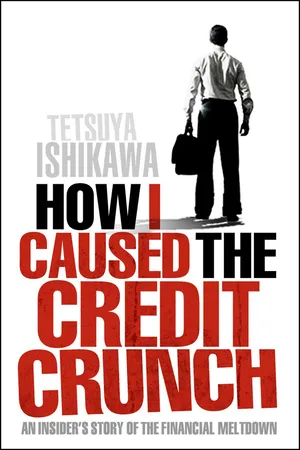
How I Caused the Credit Crunch
An Insider's Story of the Financial Meltdown
- 364 pages
- English
- ePUB (mobile friendly)
- Available on iOS & Android
eBook - ePub
About this book
This is a vivid and personal account of 21st century banking excess. "How I Caused the Credit Crunch" traces seven years at the forefront of the credit markets - a tale from the heart of the bewildering banking maelstrom whose catastrophic collapse has plunged the world towards the worst recession since the 1930s. Tetsuya Ishikawa's story reveals how a young Oxford graduate finds himself in command of vast sums of other people's money; how a novice to the mysteries of hedge funds, subprime mortgages and CDOs can fix complex deals for billions of dollars in the exclusive bars, brothels and trading floors of London, New York, Frankfurt and Tokyo, and reap the benefits in a colossal annual bonus and an international luxury lifestyle. Ishikawa's book, which deftly explains the arcane financial instruments now grimly associated with the credit crunch, is both a powerful tale of lost innocence and an expose of the disturbing truth of the collective folly, frailty and greed at the heart of the banking crisis.
Information
Subtopic
Banks & BankingIndex
EconomicsChapter 1
'Please can you go in to see Zoe? Room 3G.'
I put down the phone. Faye, my secretary, still refused to walk the four-metre divide between our desks after a year of working for me. Like other secretaries, she reserved this honour for those with the revered status of a Managing Director. Ultimately, though, it was Faye's ever-expanding backside that suffered, and it made me smile to know that today I'd be doing it a favour. Today was going to be the last day she would be calling me.
I had just taken the first bite of my muesli, part of a concerted diet to be healthy again after seven years of neglect and abuse to my once ripped body, a function of working hard and an irresponsible lifestyle. Usually I would peruse the emails I had received overnight, but with the credit crunch in full swing I didn't have any emails to look through – not this morning, nor any other morning for the last three months. Getting out of bed was harder and harder these days, completely deflated as I was by the prospect of having nothing to do. My BlackBerry was now just a play console with its one solitary game, BrickBreaker.
How I missed the days when I would wake up in the morning with a list of a hundred things to do, all of which would be profitable, and would frantically deal with as many emails as possible on my BlackBerry before reaching the office. Now I was getting fewer emails in a day than I used to receive in a minute. I missed the constant adrenalin rush of doing business, at the very least because it helped maintain some degree of order over my ever-growing waistline. The only other thing I could do was perhaps read some news articles, but I had got bored with that a long time ago, quickly realising that the only contribution made by the press was popularising the term 'credit crunch' with no idea what it was really about. Instead, I was thinking of a new job title to give to myself – Chief Websurfer, Chief Wikipedia Reader, Chief Movie Review Follower, Chief Bum.
Without the pleasure my breakfast usually gave me when it consisted of a crispy bacon butty, I gladly walked over to room 3G. I didn't care too much that I was about to be fired. There was no bitterness, no sense of 'why me', no regrets. I had enjoyed my seven years working in credit and I had profited well from it, but the journey was over. The journey was beginning to end as early as 2006 and by the time so-called financial experts had called the credit crunch in August 2007, those in the credit markets had already seen events unfolding for a very long time. With declining house prices, redundancies being commonplace (if anything, it was amazing I wasn't fired earlier) and the global economy heading into recession, it was perhaps only right that I was getting fired. Yet, walking through the trading floor on my way to room 3G, I saw my soon-to-be ex-colleagues still slogging away in self-denial, hoping that things would get better again soon.
The last year had been a soul-destroying time. Apart from a few exceptional individuals who had done very well during the credit crunch, almost everyone I knew hated their jobs. We were no longer building skyscrapers but using our bare hands to clear the rubble after every mighty tower we had ever built had collapsed down to its foundations. Moreover, I had begun to wonder how low I had stooped when I saw the credit crunch bringing out the worst in bankers. The drugs, prostitutes, strippers, booze and general excessive nightlife that many bankers were engaged in behind the respectable façade was one thing – despicable but harmless to others – but what I saw around me now was another: the office politicking to protect their own jobs at the expense of others; the even greater sense of self-importance that bankers adopted to protect their diminishing status in the industry and the world; the inevitable lack of support for clients who once bought the credit products that enabled the wealth creation that many bankers benefited from during the bubble, and who were now struggling to hold on to their much more modestly-paid jobs. We had moved on to hurting others in our quest for self-preservation.
I had had enough of the bullshit, the lack of honesty with ourselves. It seemed ridiculous to me that bankers who had profited so handsomely during a bubble were not prepared to take the pain when the bubble burst. In fact, I had already begun to positively despise those bankers who couldn't see a life beyond a job in the finance industry, no matter what. It was almost as if their existence was justified on them being able to call themselves an 'investment banker' so they could sit on the high ground with the respectability it supposedly brought. What respectability, I was wondering? That was it – any bitterness I felt was only for people I wasn't going to be seeing any more, not at losing my crap job. And that made me smile.
Zoe greeted me with an uncomfortable smile. She was my boss, the Global Head of Credit Sales at Irwin May, a genuinely kind and maternal figure who had an unnerving ability to clinically pick off her rivals one by one to move up the ranks. She was also the one who had hired me on a $3m guaranteed bonus the year before to do a job that didn't really exist by the time I had started. In all fairness, Irwin May had paid me a lot of money to cover clients that started folding from the day I joined. I had done nothing for them, yet it was a great return no matter how you looked at it.
'As you know, we've been resizing our business in this market downturn and we've had to make some harsh decisions.'
A human resources lady sat next to her, observing proceedings to make sure that only the lawyer-approved speech rolled off her tongue. What she really wanted to say was: 'You're expensive, you're not producing, and I don't particularly care how much of a superstar in credit we thought you were, there's nothing for you any more – you're out.'
'We'll endeavour to place you in another job at Irwin May as we have been expanding greatly in other regions, such as Dubai and Mumbai.' I just laughed. We both knew she was spouting total and utter crap, but she kept a straight face because of human resources, who probably did think I would relocate to Mumbai so I could work in a call-centre for the sake of having a job at an 'investment bank'.
'We do have to ask you to go back to your desk, collect all your belongings and leave the office immediately. Your security pass is no longer operational as of now and we ask that you leave all work-related documents and materials in the office.'
As the charade finished, I shook hands with Zoe, stood up, turned round and let off a big grin. Perhaps it was the realisation that my last seven years had been one big charade, and with it all over, I could now rediscover my true self. Yet walking back to my desk, it didn't seem like my epiphany was shared by many. There were some packing up their desks looking disappointed, others who seemed to accept it matter-of-factly. Some just looked angry, but no one seemed happy – truly happy. And then I saw one structurer crying, the emotional toll of being fired too much to handle. A few days earlier, he had been telling me there was no loyalty or integrity in the business. The sheer hypocrisy of this just stank. He had spent the last five years going after the next client that might buy his products, strangling them until they squealed 'I buy', before watching them get hurt by the credit crunch from afar, totally uninterested in their predicament. How many people did he get fired from their modest jobs, I wondered? He conveniently ignored the luxury that his six-figure salaries and bonuses had brought him for the last five years, even though one of his three Aston Martins was still waiting to be driven home to his drug-filled penthouse riverside apartment, a plethora of escorts waiting to be called from his phone book. What did he have to complain about?
As I got back to my desk, my muesli looking even more like bird droppings now that the milk had been soaked up, Jeff Nordberg came to my desk. He glanced at the muesli before deciding perhaps it might not be appropriate to comment. Jeff was the Global Head of Sales at Irwin May, or in layman's terms, the man who was responsible for all the firm's clients globally and who had pushed through my hire the previous year.
'I'm sorry,' he started sombrely, 'but we didn't have much say in this matter. We think there are still a lot of opportunities in this market and we need people like you, but we just had to let people go, and the decision was made by the CEO.'
'Jeff, I understand,' I replied unconvincingly. Look around us, Jeff! What opportunities? All the clients we ever made money off had either folded or were in such a bad state that we didn't even know if they were going to be in their job the next day. Sure, we could make some money helping those clients restructure the deals we sold them so they looked aesthetically better, but this was only going to make things worse in the future. Of course Jeff knew this, but he was first and foremost a very well-paid employee of Irwin May.
'I want you to know that personally, I was marking you out as a star of the future, so I'm sorry you've become a victim of this credit crunch.'
And that was it. My moment of clarity. I wasn't a victim of the credit crunch. None of us on that floor were victims of the credit crunch. Victims are those who get caught in the crossfire when they're minding their own business. The victims of the credit crunch were out there, everyday people who were unaware of what was unravelling, the general public who had been taken advantage of through a system that fed the credit bubble so that bankers like us could become rich. We weren't victims. We were the cause. Very much the cause. And it was this that made me so at peace with myself. This was why I was so happy to be fired. I had deserved it.
Chapter 2
'It's all about leverage!!'
Ben stormed into my room, excitedly waving the copy of Richard Branson's autobiography that I had given to him a few days earlier in hospital.
'It's all about leverage!! Leverage!! Leverage!! Leverage!!'
I was working frantically to get my politics essay done in time for my tutorial the next morning. This was a weekly ritual – I'd pick up some textbooks the day before from the New Bodleian which I'd speed read even though I couldn't speed read, get some ideas and rattle off an essay, all in eighteen hours.
'Andy, you have to listen to me. This guy is a genius.' I listened but pretended to ignore him, knowing that even if he had just come out of hospital and most people would expect a big hug and a nice cup of tea, he wouldn't take offence.
'The guy can't read or write but what use is that when there's leverage? Whether he knew it or not, he leveraged all over the place, investing small amounts of money and making millions. Actually, even better! He borrowed that money, multiplied it, paid back the original amount and walked off with the profits. I think it's genius.'
He waited for a response. It actually sounded great but I still needed to get my politics essay done.
'Let's do it. You and me. We can borrow, what, £2,000 between us and play the stock markets. If we can make £10,000 by the end of the year, we would have made £8,000 from nada!'
Ben Carrington had always been a perfect student before Oxford. He was not only bright and had never failed to get the top grade possible in any test he had ever taken, but, unlike most boarding school yuppies, he didn't smoke, had never done drugs and only drank modestly in respectable social circumstances such as family dinners, galas and balls. He sang in the choir at school – as a soprano until he was sixteen, so late did his voice break, and then as a tenor – although a major throat infection meant he missed out on the chance to be a choral scholar at Oxford.
Ben was the first person I met at Oxford. We were together when we interviewed for our places, and he told me of his vision to be in the clergy, to bring support, light and comfort through the teaching of God to many. He was one seriously committed seventeen-year-old, and that was the issue. He didn't know any better about how good that apple really tasted. But we became friends nevertheless; I was only too happy that there was some purity in my life.
Whether our friendship ultimately led to the infiltration of life's temptations into his purity or whether it would have happened regardless because his purity lacked inner conviction, I never figured out. But it didn't take long into our freshers' week at Oxford to realise that his purity was being undermined in a major way. Before the week was up, he had lost his virginity, gained one enormous hangover, and was on his way to becoming a reformed man.
The clergy was no longer part of the plan, his theology degree now nothing more than a nuisance. He just wanted to make money and get lots more of the sex he had just tasted for the first time. By virtue of humbly thinking small his entire life, his revised life plan was outrageously oversized. We went through the career possibilities. Modelling? Not good-looking enough, though money could change that. Acting? Couldn't act, but then Arnold Schwarzenegger got rich and got an acting tutor, and look where he was. Sportsman? Not talented enough. Start a business? Yes, but need money. Actually, for everything we talked about, money was the means to that end, or was it the end in itself?
Ben's father was a senior banker who had done very well for himself, even if he drove a four-year-old Volvo. But when Ben speculated that he made at least £5m a year, I guessed he must have been a senior investment banker, something I had only recently learnt was very different from a commercial banker. Commercial banks did the boring business that we deal with every day – provide bank accounts and make loans. Most commercial bankers earned a healthy but modest salary. Investment banks, on the other hand, were in a much more lucrative game, brokering deals for companies in 'corporate finance', and providing research and trading capabilities for investors in 'sales and trading'. Both businesses dealt with billion-dollar-plus deals and, accordingly, the fees that these investment banks reaped were enormous. Only investment bankers could earn as much as Ben thought his father did.
My guess was right. I soon discovered that he was a prominent TMT banker – one of the late-1990s banking masters of the universe who advised these telecom, media and technology companies into initial public offerings (IPOs) and mergers and acquisitions (M&A) which generated the highest fees in history – except he didn't act like a master of the universe. But he did know all the chief executives, presidents and board members of his clients and spent a lot of time with them playing golf and entertaining them in the trendiest restaurants, all in the name of winning business. And with the TMT bubble in full swing, Ben's father was at the forefront.
In contrast to his own career, his father was proud to see Ben wanting to go into the clergy – he always felt that banking was morally void, and even though he was now in a position of seniority, it was only the lack of opportunities in his childhood that spurred him on to give Ben a freedom of choice. Besides, he didn't want Ben to go through the hell of being a junior banker. With CEOs and Presidents not particularly keen on dealing with kids in their twenties, there was a distinct hierarchy where the junior bankers would slave away into the early hours of most mornings, drawing up Powerpoint presentation after Powerpoint presentation of possibilities and ideas that the senior guys would then pitch to their clients, often with no business to show for it and feedback consisting of a few typing errors.
Ben's take on investment banking changed considerably when I told him about the six months' work experience I had done on a sales and trading floor at an investment bank before our Oxford matriculation. Sitting alongside corporate finance as the other main business unit within most investment banks, sales and trading were involved in the financial markets – the 'movers and shakers' as it were of the equity, foreign exchange, interest rate, credit and commodities markets. Corporate finance bankers with important relationships were remunerated handsomely, but it meant waiting twenty years until reaching a position of seniority, whereas sales and trading bankers were remunerated on what they made through trading in their specialised market in any given year. Much more short-termist, it also had two major appeals for us. One, the easy...
Table of contents
- About the author
- Preface
- Chapter 1
- Chapter 2
- Chapter 3
- Chapter 4
- Chapter 5
- Chapter 6
- Chapter 7
- Chapter 8
- Chapter 9
- Chapter 10
- Chapter 11
- Chapter 12
- Chapter 13
- Chapter 14
- Chapter 15
- Chapter 16
- Chapter 17
- Chapter 18
- Chapter 19
- Glossary
Trusted by 375,005 students
Access to over 1.5 million titles for a fair monthly price.
Study more efficiently using our study tools.
Frequently asked questions
Yes, you can cancel anytime from the Subscription tab in your account settings on the Perlego website. Your subscription will stay active until the end of your current billing period. Learn how to cancel your subscription
No, books cannot be downloaded as external files, such as PDFs, for use outside of Perlego. However, you can download books within the Perlego app for offline reading on mobile or tablet. Learn how to download books offline
Perlego offers two plans: Essential and Complete
- Essential is ideal for learners and professionals who enjoy exploring a wide range of subjects. Access the Essential Library with 800,000+ trusted titles and best-sellers across business, personal growth, and the humanities. Includes unlimited reading time and Standard Read Aloud voice.
- Complete: Perfect for advanced learners and researchers needing full, unrestricted access. Unlock 1.5M+ books across hundreds of subjects, including academic and specialized titles. The Complete Plan also includes advanced features like Premium Read Aloud and Research Assistant.
We are an online textbook subscription service, where you can get access to an entire online library for less than the price of a single book per month. With over 1.5 million books across 990+ topics, we’ve got you covered! Learn about our mission
Look out for the read-aloud symbol on your next book to see if you can listen to it. The read-aloud tool reads text aloud for you, highlighting the text as it is being read. You can pause it, speed it up and slow it down. Learn more about Read Aloud
Yes! You can use the Perlego app on both iOS and Android devices to read anytime, anywhere — even offline. Perfect for commutes or when you’re on the go.
Please note we cannot support devices running on iOS 13 and Android 7 or earlier. Learn more about using the app
Please note we cannot support devices running on iOS 13 and Android 7 or earlier. Learn more about using the app
Yes, you can access How I Caused the Credit Crunch by Tetsuya Ishikawa in PDF and/or ePUB format, as well as other popular books in Economics & Banks & Banking. We have over 1.5 million books available in our catalogue for you to explore.