The première in 1816 in Rome of Gioachino Rossini's famous opera was a fiasco comparable to those of Wagner's Tannhäuser and Bizet's Carmen. But Il barbiere di Siviglia was soon recognised as being among the greatest of comic operas, comparable to those of Mozart. Even Beethoven was enthusiastic.
Figaro, Seville's barber, is confident of a good pay-off for facilitating the elopement of Rosina with the Count of Almaviva. Her guardian also has designs on her and her fortune. Who will get there first? The story is based on a comedy by the French playwright Beaumarchais, whose The Marriage of Figaro was used by Mozart.
The Barber is packed with famous tunes, displaying Rossini's glittering coloratura, trademark crescendos and patter: Figaro's famous Largo al factotum and Zitti, zitti, piano, piano; the Count's serenade with guitar, Ecco ridente; Rosina's Singing Lesson and Una voce poco fa; Doctor Bartolo's patter song A un dottor; Don Basilio's La calunnia. These are just some of the ingredients of this feast of humour and good tunes.
Written by Michael Steen, author of the acclaimed The Lives and Times of the Great Composers, 'Short Guides to Great Operas' are concise, entertaining and easy to read. They are packed with useful information and informed opinion, helping to make you a truly knowledgeable opera-goer, and so maximising your enjoyment of a great musical experience.
Other 'Short Guides to Great Operas' that you may enjoy include The Marriage of Figaro, Così fan tutte and Lucia di Lammermoor.
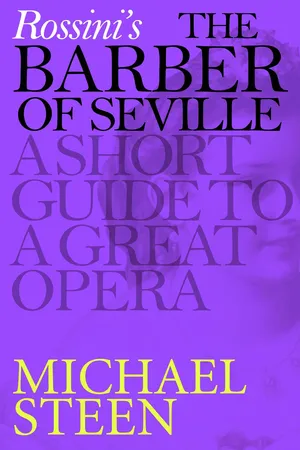
- 32 pages
- English
- ePUB (mobile friendly)
- Available on iOS & Android
eBook - ePub
About this book
Information
Subtopic
Opera MusicROSSINI’S THE BARBER OF SEVILLE
A SHORT GUIDE TO A GREAT OPERA
The opera and its composer
Who’s who and what’s what
The interval: talking points
Act by act
THE OPERA AND ITS COMPOSER
Rossini’s Il barbiere di Siviglia has been called ‘perhaps the greatest of all comic operas.’ When he selected the story of ‘The Barber of Seville’ for the 1816 carnival season in Rome, he was being particularly brave. This was a well-known story with a great track record. Forty years earlier it had been sketched by the distinguished French playwright Beaumarchais as an informal opera to entertain house-guests in a château. He later developed it into a straight play – so successfully that he was subsequently persuaded to write a sequel about Figaro in love, La folle journée, ou Le mariage de Figaro (1784).
By the time Mozart used this for his opera, an opera about ‘The Barber’ had been composed by the famous Neapolitan composer Paisiello. This had been very popular indeed: it ran every season in Vienna in the mid-1780s.
Paisiello was in his mid-seventies by the time Rossini composed his opera. He was a distinguished, if contentious, figure: when the Bourbon monarchy was restored in Naples in 1815, he was sacked from all his posts; he had backed the wrong side. He had no interest in Rossini having a success.
It was to no avail that, to avoid upsetting him, Rossini changed the title to Almaviva, ossia l’Inutile Precauzione (Almaviva, or the Useless Precaution). The disruption by Paisiello’s supporters of the première in Rome on 20 February 1816 has been called one of the three major operatic fiascos, the others being the 1861 Paris production of Wagner’s Tannhäuser and the first night of Carmen in 1875.
At the première, the part of the Count was taken by the famous tenor Manuel Garcia. Early in Act 1, when Garcia, disguised as ‘Lindoro’, began to serenade Rosina, a string on his guitar broke, so he had to stop and mend it. The derision of the partisan audience increased when Figaro was seen entering with a replacement guitar. Soon after the Count resumed his serenade,1 Rosina urged him on with Segui, o caro (‘Continue, my love, continue’). This caused a further hullabaloo. It was disastrous. At the end of Act 1, Rossini shrugged his shoulders and clapped, an attitude which so annoyed the audience that Act 2 could not be heard for the disruption.
There were other problems that night: apparently the music teacher, Don Basilio, tripped over a trapdoor and had a persistent nosebleed; and a cat – not part of the cast – walked onto the stage and caused havoc.
Rossini’s libretto was reluctantly provided by Cesare Sterbini, a civil servant and dilettante who had supplied him with the libretto for an unsuccessful opera Torvaldo e Dorliska, which Rossini had already composed for that same 1816 carnival season. Sterbini was competent in French, and kept very close to Beaumarchais’s text. He also had the Paisiello opera to use as a model. He delivered his libretto of The Barber in twelve days.2
Rossini was said to have composed his score in a fortnight, although in fact it was more like six weeks. He borrowed (as was the custom) considerably from other works of his. The overture had already been heard in his Elisabetta, Regina d’Inghilterra and that in turn had been borrowed from his Aureliano. The music for Don Basilio’s well-known aria La calunnia came from Rossini’s Sigismondo. The music for the cavatina Ecco ridente had also done service in Aureliano.
Although the first night was a fiasco, the mood quickly changed. On the second night, Rossini thought it prudent to stay at home and went to bed. He was woken by the sound of applause outside his lodgings, people shouting ‘bravissimo Figaro’. The opera has been a resounding success ever since. According to a mid-19th century English critic, Rossini, with his vivacity, ‘the freshness of his melodies, the richness of his combinations’ succeeded in ‘intoxicating the general public as no other composer earlier or later has done.’ The critic admired ‘his wondrous grace, his fertility of invention, his admirable treatment of the voice, and his simple and effective taste in arrangement of the orchestra.’
And his music invited comparison with that of Mozart. But few today would accept the view of the distinguished French novelist Stendhal, who in 1823 reckoned ‘the slow sad strains of Mozart’ were ‘dull and heavy’ compared to the music of Rossini; and that if Mozart were to appear anew, in Italy, ‘at the première, he [too] would be hissed off the stage.’ Stendhal however emphasised the Italianness of Rossini, and pointed out that ‘Love is not the same in Bologna as it is in Königsberg.’
Doubtless, Rossini succeeded in providing a ‘kind of freshness, which evokes a smile of pleasure at every bar.’ The Barber is full of great tunes, the best known being Figaro’s famous Largo al factotum. The roles are very balanced and all the principals have great music. Some of the memorable items are the Count’s serenade Se il mio nome, Rosina’s cavatina Una voce poco fa, the Doctor’s patter song A un dottor della mia sorte, and the quintet when Don Basilio is sent off home to bed, Buona sera, mio Signore.
However, Rossini went out of fashion in the 1830s. His music was regarded as ‘overcharged and out of taste.’ As the century wore on, and ‘commentators wrangled about outer forms and inner meanings’, he seemed simply superficial, ‘the spoiled idol of fashion, a mere tune-spinner whose seductions must prove transient, palling, unreal.’ Amazingly, we hear that ‘there were some good and cultivated Englishmen, who, on principle, when Signor Rossini entered one music shop, repaired to another.’
It has been suggested that Rossini brought comic opera, the opera buffa, to its peak. Although composers such as Donizetti (in Don Pasquale and L’Elisir d’Amore) wrote some good comedies, there was nothing quite like The Barber until Verdi’s Falstaff in 1893.
When Rossini visited Beethoven towards the end of his life, the great composer complimented him on The Barber and suggested that he restrict his output to comic opera. As this was regarded as a relatively inferior form of opera, the compliment may have been suitably backhanded. Looked at in retrospect however, it seems certain that ‘Signor Rossini will endure so long as the art of Music lasts.’
Gioachino (Joachim) Rossini was born in a leap year, on 29 February 1792, in Pesaro, on the Adriatic coast near Ravenna. As a boy he was a gifted singer. He studied at the academy in Bologna. His first opera, a one-act farce, was staged in Venice when he was only eighteen. By the time of Tancredi (which includes the well-known tune Di tanti palpiti), a further seven of his operas had been staged, and he was still only twenty. Tancredi assured his fame. Although both The Barber and La Cenerentola were written for theatres in Rome, Rossini moved to Naples where he was able to build his fortune, not least from his partnership in the gambling business run in the theatre foyer.
In 1822, Rossini married Isabella Colbran, a Spanish soprano and mistress of Domenico Barbaja, the colourful theatre director in Naples. He had composed many operas for her, including La donna del lago and Semiramide, but not the opera buffa for which he is best known today.
In 1823 he moved to London, and then to Paris, where he directed the Théâtre-Italien, and later the Opéra. By the age of 31, he had already written 34 operas. His pace slowed and he adapted earlier operas – for example, much of Le Comte Ory was taken from Il viaggio a Reims.
After Guillaume Tell in August 1829, he composed no further operas, even though he lived for a further 40 years. There are various explanations: pre...
Table of contents
- Title page
- Copyright
- Contents
- PREFACE
- USING THIS EBOOK
- ABOUT THE AUTHOR
- ROSSINI’S THE BARBER OF SEVILLE
- NOTES
- Short Guides to Great Operas
Trusted by 375,005 students
Access to over 1.5 million titles for a fair monthly price.
Study more efficiently using our study tools.
Frequently asked questions
Yes, you can cancel anytime from the Subscription tab in your account settings on the Perlego website. Your subscription will stay active until the end of your current billing period. Learn how to cancel your subscription
No, books cannot be downloaded as external files, such as PDFs, for use outside of Perlego. However, you can download books within the Perlego app for offline reading on mobile or tablet. Learn how to download books offline
Perlego offers two plans: Essential and Complete
- Essential is ideal for learners and professionals who enjoy exploring a wide range of subjects. Access the Essential Library with 800,000+ trusted titles and best-sellers across business, personal growth, and the humanities. Includes unlimited reading time and Standard Read Aloud voice.
- Complete: Perfect for advanced learners and researchers needing full, unrestricted access. Unlock 1.5M+ books across hundreds of subjects, including academic and specialized titles. The Complete Plan also includes advanced features like Premium Read Aloud and Research Assistant.
We are an online textbook subscription service, where you can get access to an entire online library for less than the price of a single book per month. With over 1.5 million books across 990+ topics, we’ve got you covered! Learn about our mission
Look out for the read-aloud symbol on your next book to see if you can listen to it. The read-aloud tool reads text aloud for you, highlighting the text as it is being read. You can pause it, speed it up and slow it down. Learn more about Read Aloud
Yes! You can use the Perlego app on both iOS and Android devices to read anytime, anywhere — even offline. Perfect for commutes or when you’re on the go.
Please note we cannot support devices running on iOS 13 and Android 7 or earlier. Learn more about using the app
Please note we cannot support devices running on iOS 13 and Android 7 or earlier. Learn more about using the app
Yes, you can access Rossini's The Barber of Seville by Michael Steen in PDF and/or ePUB format, as well as other popular books in Media & Performing Arts & Opera Music. We have over 1.5 million books available in our catalogue for you to explore.