eBook - ePub
A Practical Guide to Positive Psychology
Achieve Lasting Happiness
- 224 pages
- English
- ePUB (mobile friendly)
- Available on iOS & Android
eBook - ePub
About this book
Positive psychologists seek to find and nurture genius and talent, and to make normal life more fulfilling, rather than treat mental illness.This Practical Guide explores how we can all have a "life of enjoyment", in which we savour the positive emotions that are part of healthy living; a "life of engagement" where we feel confident we can tackle the tasks we face; and a 'life of affiliation', being part of something larger than ourselves.Free of jargon but full of straightforward advice, case studies and step-by-step instructions, this is the perfect concise start to making your life better.
Information
Topic
Personal DevelopmentSubtopic
Self Improvement1. What is happiness?
One of the criticisms often levelled at positive psychology is that it’s all about the ‘big H’: happiness. I mean, happiness is a frivolous topic isn’t it? Certainly not one worthy of serious scientific endeavour. Yet when you start digging deeper, it becomes clear that happiness is not at all straightforward. In fact, it’s a pretty complex concept. In this chapter we’ll explore some of the components of happiness (or well-being as it’s often called), look at how they’re measured and why they matter.
Probably the simplest way to get a handle on happiness is to divide it initially into two basic components:
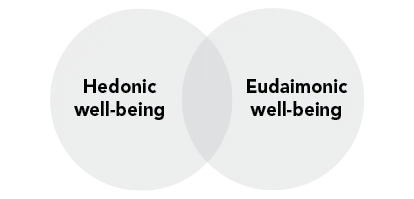
The distinction between these two aspects of happiness dates way back to the ancient Greek philosophers Aristippus (c. 435–356 BCE), who championed hedonism, and Aristotle (384–322 BCE), who advocated eudaimonism.
According to Aristippus, the goal of life is to maximize pleasure and minimize displeasure or pain. In positive psychology hedonic well-being is often used to refer to the happiness you get from feeling pleasure in the moment, pure and simple; it’s the ‘wine, women and song’ variety of happiness, the one which usually springs to mind when you’re asked what happiness is. It’s typically short-lived though; we have to keep topping up our reserves in order to maintain its effects (see more about this in Chapter 2). One of the problems with defining happiness solely in terms of sensory pleasure is that, paradoxically, some human desires, even if they are pleasure–producing in the short term, are not good for you in the long term.
And what about eudaimonic well-being? If happiness can ever have a serious side, this is it! As we suggested above, some people believe that pleasure on its own isn’t sufficient to describe the totality of human well-being. According to Aristotle, merely pursuing pleasure is vulgar; he advocated eudaimonism because he believed that true happiness is found in doing what is worth doing, not in having a good time. Eudaimonic well-being is a broad term used by positive psychologists to refer to the happiness we gain from having meaning and purpose in our lives, fulfilling our potential and feeling that we are part of something bigger than ourselves.
But even eudaimonic well-being is not problem-free. Some psychologists dislike its moral overtones; they argue that it isn’t psychology’s job to prescribe what is good for people. And paradoxically, eudaimonic well-being may not provide any pleasurable feelings at all! In fact, it may involve considerable personal hardship and effort over the longer term. Yet it is suggested that eudaimonia leads to greater life satisfaction than pure pleasure alone.
In practice, positive psychologists don’t agree on the definition of eudaimonic well-being (terms include ‘self-actualization’, ‘personal expressiveness’, ‘meaning’, ‘personal growth’, ‘engagement’ and ‘flow’). Nor do they agree on how it should be measured, and often the term eudaimonic well-being is used as a catch-all for any type of happiness that isn’t hedonic. But even if we’re not yet sure how to define eudaimonic well-being, most people would acknowledge that there’s more to true happiness than a few pints in the pub on Friday night and a game of golf on Sunday! Psychology research concurs with this: a recent study of over 13,000 people suggests that pursuing engagement or meaning are more strongly related to well-being than pursuing pleasure.
Another area of disagreement for positive psychologists is whether happiness is a subjective or objective phenomenon. Some definitions of eudaimonic well-being suggest that there is an objective standard against which people’s lives can be judged. On the other hand, there are psychologists who insist that happiness is a subjective phenomenon. They argue that it can only be measured by asking people to rate their own happiness. This leads us to another definition of happiness often used in positive psychology – Subjective Well-Being (SWB) – which is expressed in the following formula:
Satisfaction with Life + Positive Emotion – Negative Emotion
In simple terms this means that subjective happiness consists of three elements, one cognitive (or evaluative) and two affective:
Satisfaction with life: what I think about my life (does it measure up to my expectations and resemble my ‘ideal’ life?)
plus
The presence of positive emotion: how positive I feel
less
The presence of negative emotion: how negative I feel
Using Subjective Well-Being as the measure suggests that to increase our level of happiness overall we should focus on minimizing our negative mood and maximizing our life satisfaction and positive mood.

Measuring your Subjective Well-Being
First of all, measure your life satisfaction. You can use Diener and colleagues’ Satisfaction with Life Scale.
Then measure how you feel. To do this you can use the Positive and Negative Affect Scale (PANAS) which we look at in Chapter 11, or the Scale of Positive and Negative Experience (SPANE). See the Resources section for details of these assessment tools.
How did you fare? Were you surprised by the outcome? If the results weren’t as high as you’d like, how might you increase your life satisfaction and your positive mood, or decrease your negative mood? Write some notes in your well-being journal.
A positive psychology model of well-being
In his most recent book, Flourish, Martin Seligman, one of the founding fathers of the positive psychology movement, describes his new theory of well-being. His model (PERMA), which consists of five separate elements, draws on aspects of both hedonic and eudaimonic well-being:

Positive emotion is exactly what it says – the experience of positive mood and feelings which are uplifting. As we have already mentioned, there are various questionnaires you can use to measure positive (and negative) emotional states. We’ll explore positive emotions, their role in your happiness and their benefits in Chapter 3, and the concept of emotional intelligence in Chapter 11.
Engagement (or ‘flow’ as it’s often called) refers to the well-being you get from being totally absorbed in the task in hand, so much so that you lose track of time and feel completely at one with what you’re doing. When sportspeople talk about ‘being in the zone’, they’re referring to their experience of flow. Flow is usually measured by asking people to reflect back on their day and record flow experiences or by having them carry an electronic beeper which randomly prompts them to think about and record what they’re doing at that moment in time. For more about flow, see Chapter 4.
Relationships are included in Seligman’s model because research suggests that good, caring and supportive interpersonal connections are essential to your well-being at any age in life. For more about positive relationships, see Chapter 5.
Meaning is important because it provides both a stable foundation and a sense of direction in life. Pursuing meaningful activities has been found to be more strongly related to happiness than pursuing pleasurable ones. There are many different measures of meaning, although it’s still a relatively under-researched area. The Sources of Meaning and Meaning in Life Questionnaire (SoMe) measures 26 different sources, including self-transcendence (such as spirituality), self-actualization (such as challenge and knowledge), order (such as tradition and holding on to values), and well-being and caring for others (such as community and love). For more on meaning, see Chapter 6.
Accomplishment is the latest psychological component in Seligman’s well-being model. It’s another broad category which includes everything from achievement, success and mastery at the highest level possible to progress towards goals and competence. For more information, activities and insights into accomplishment and its relationship to well-being, turn to Chapter 7.
Now let’s explore how these five facets of well-being appear in your life at the moment.
The Wheel of Well-Being
- Thinking about your life in general, which of your day-to-day activities give you pleasure or joy? Which ones are engaging (put you into flow)? Which ones are centred on building supportive relationships (e.g. with family, friends, colleagues, customers or others)? Which activities are meaningful? And which ones give you a sense of accomplishment, and make you feel that you have made a difference?
- Once you have formed a snapshot of these in your m...
Table of contents
- Title page
- Copyright
- About the author
- Acknowledgements
- Author’s note
- Contents
- Introduction
- 1. What is happiness?
- 2. Barriers to well-being
- 3. Positive emotions
- 4. Engagement or flow
- 5. Positive relationships
- 6. Meaning and purpose
- 7. Accomplishment
- 8. Appreciative inquiry
- 9. Character strengths
- 10. Choice
- 11. Emotional intelligence
- 12. Gratitude
- 13. Mindfulness
- 14. Mindsets
- 15. Motivation and goals
- 16. Nutrition
- 17. Optimism
- 18. Physical exercise
- 19. Resilience
- 20. Savouring
- 21. Positive psychology of time
- 22. Where next?
- Resources
Trusted by 375,005 students
Access to over 1.5 million titles for a fair monthly price.
Study more efficiently using our study tools.
Frequently asked questions
Yes, you can cancel anytime from the Subscription tab in your account settings on the Perlego website. Your subscription will stay active until the end of your current billing period. Learn how to cancel your subscription
No, books cannot be downloaded as external files, such as PDFs, for use outside of Perlego. However, you can download books within the Perlego app for offline reading on mobile or tablet. Learn how to download books offline
Perlego offers two plans: Essential and Complete
- Essential is ideal for learners and professionals who enjoy exploring a wide range of subjects. Access the Essential Library with 800,000+ trusted titles and best-sellers across business, personal growth, and the humanities. Includes unlimited reading time and Standard Read Aloud voice.
- Complete: Perfect for advanced learners and researchers needing full, unrestricted access. Unlock 1.5M+ books across hundreds of subjects, including academic and specialized titles. The Complete Plan also includes advanced features like Premium Read Aloud and Research Assistant.
We are an online textbook subscription service, where you can get access to an entire online library for less than the price of a single book per month. With over 1.5 million books across 990+ topics, we’ve got you covered! Learn about our mission
Look out for the read-aloud symbol on your next book to see if you can listen to it. The read-aloud tool reads text aloud for you, highlighting the text as it is being read. You can pause it, speed it up and slow it down. Learn more about Read Aloud
Yes! You can use the Perlego app on both iOS and Android devices to read anytime, anywhere — even offline. Perfect for commutes or when you’re on the go.
Please note we cannot support devices running on iOS 13 and Android 7 or earlier. Learn more about using the app
Please note we cannot support devices running on iOS 13 and Android 7 or earlier. Learn more about using the app
Yes, you can access A Practical Guide to Positive Psychology by Bridget Grenville-Cleave in PDF and/or ePUB format, as well as other popular books in Personal Development & Self Improvement. We have over 1.5 million books available in our catalogue for you to explore.