- 320 pages
- English
- ePUB (mobile friendly)
- Available on iOS & Android
eBook - ePub
About this book
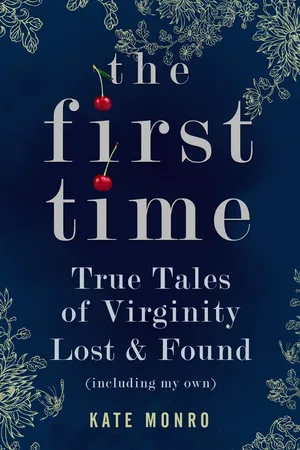
A groundbreaking and very personal insight into modern sexuality. Losing our virginity - it happens to all of us. How did it happen for you? What do other people think and feel about it? In February 2007, Kate Monro went on a mission to find out. She decided to ask as many people as possible - how did you lose your virginity? Men and women, old and young, gay, straight, Christian and Muslim; the stories range from the funny and the sad to the happy and occasionally, the unbelievable. Thus was born her much reviewed blog, The Virginity Project, and now this book. How do we define the loss of our virginity? What, if any, impact does the first time have on the rest of our lives? And in some cases how do we know for sure when that moment has occurred? After all sorts of conversations with all sorts of people, Kate will reveal the truth about other people's most intimate sexual stories. She also discovers that the answers are not always as straightforward as you might think.
Information
Subtopic
Popular CultureIndex
Social Sciences1
Like a Virgin?
‘Virginity can be lost by a thought.’
ST JEROME, 340–420 (FATHER OF THE CATHOLIC CHURCH)
Virginity loss has taken me on a fascinating quest. I thought I was just going to record an interesting bunch of stories and be done with it, but no. Along the way, it has come to my attention that there are very few subjects in life that raise as many questions – or eyebrows – as the subject of virginity and its loss. Maybe it is just because I was ever-so-slightly obsessed with my subject but as I looked around me, I realised that virginity is more or less everywhere you look.
One of the first stories that we are taught is about virginity loss. We all know the story of Adam and Eve. No sooner had these two hapless teenagers given in to the temptation of the ‘fruit’ than the course of their lives, and ours, was irrevocably changed. Once that bridge had been crossed, there was no turning back for Adam and Eve. This irrevocability has been a constant theme throughout the history of virginity loss. Mostly, it must be said, for women.
Christianity and its iconic female representative, the Virgin Mary, continue to play a role in the lives of millions of men and women every single day. Virginity, particularly outside of marriage, is revered, respected and on some occasions demanded, not just by the Christian faith but by many faiths. But if you think that virginity only has significance for religious people, you are wrong.
Virginity packs just as big a punch in the secular world. In 2008, 22-year-old Nathalie Dylan decided to auction her virginity on the internet to pay for her master’s degree. Over 10,000 people were motivated enough to make a bid. The highest came from a 39-year-old businessman who was allegedly prepared to pay £2.6 million for this once-only offering. This probably isn’t the first time you have heard a story like this and I doubt it will be the last, but it does tell us something about the value and the power of virginity, even to people who have no religious leanings whatsoever.
Some of us might find the idea repellent. After all, what kind of man would pay such a large sum of money to ‘win’ a woman’s virginity? Is this the twisted modern-day equivalent of a hunting trophy, albeit a rather expensive one? And what motivates a woman from an affluent Western country to auction her virginity in so public a manner? Either way, here were two people who understood the power of virginity only too well; not only that, but both of them were prepared to leverage it to their own advantage.
We still use virginity as a metaphor for something precious and unique. Once it is ‘broken’, it can never be replaced. Or so you might think. I have found some fairly weird virginity-related news stories in my time but this one took the biscuit. In 2005, the Wall Street Journal ran a story about a 40-year-old medical assistant who couldn’t think what to give her husband of seventeen years for their wedding anniversary. Here was a man who already had everything, so she went one step further. Yep, you guessed it; she gave him her virginity. Jeanette Yarborough paid a surgeon $5,000 to reattach her hymen, just so that she could lose her virginity all over again. ‘What an awesome gift to give to the man in my life who deserves everything’, she said. ‘It was the most amazing thing I could give him as a woman.’ This operation has grown in popularity in recent years, although, sadly for the women concerned, not usually for Jeanette’s reason.
These are extreme examples. But for most of us, male or female, religious or not, whether we want to hold on to our virginity for as long as we can or shake free of it at the first opportunity, notions of virginity and its loss have concerned us since the beginning of time.
The Romans placed virginity on a pedestal, quite literally, by creating the concept of the vestal virgins. The vestal virgins were female priestesses. They entered into a 30-year contract of chastity and service to the state but in return, they were accorded phenomenal power and influence. A pardon from a passing vestal virgin could save a condemned man from the gallows. A vestal virgin could own property and write a will, rights unheard of for a woman in ancient Rome. But as you might expect, there was a price to pay for this freedom. A vestal virgin who dared to break her vow of celibacy came to a very sticky end, buried – alive – in a chamber beneath the streets of Rome.
By contrast, sometimes just when you think that virginity might have had some stature, it has been completely disregarded. In 1554 a German physician, Johannes Lang, described the ominously named ‘green sickness’ as ‘peculiar to virgins’. His controversial solution? Sufferers should ‘live with men and copulate. If they conceive, they will recover.’ ‘Green sickness’ is in fact a form of anaemia. Iron is found in blood and when women menstruate, they have the potential to lose iron and can occasionally turn a rather ghostly shade of green. Even in an age when virginity was generally revered, not everybody thought that hanging on to the ‘V’ card was such a great idea.
I found these deviations into the world of virginity fascinating, but one question remained timeless and unanswered. If virginity is so important to us, then how do we define its loss? Do we have one blanket definition to cover all eventualities? Or a hundred? Because no matter where I went or to whom I talked, it never ceased to amaze me how many different and very creative ways people found to define one experience. We might think we are in agreement about this, but we are not.
People have often searched for physical proof of virginity, particularly a woman’s. Medical literature begins to mention the hymen, the inconsequential piece of skin that can partially cover the entrance to a woman’s vagina, in around the seventeenth century. The story goes that when a woman first has sexual intercourse, this piece of skin can break and cause the woman to bleed. This explains why even today, some cultures believe that the bloody bed sheet is proof enough of a woman’s (freshly lost) virginity.
One of my female interviewees surprised me by telling me that she had lost her virginity on the back of a bike. She explained further:
OK, so people say they know when they lose their virginity. I didn’t know. But I did know that I took the dog for a walk, I was feeling lazy so I thought I’ll tie the dog to the bike and I’ll ride down the road and the dog can run beside me. And that started really well until the dog saw another dog across the road and shot in front of the bike. Of course I went over and I hit myself on the crossbar and I started to bleed. So it wasn’t really a big thing for me, losing my virginity. Although it did hurt.
This story makes my next point for me. Using the female hymen as a barometer with which to test a woman’s virginity is clearly not a good idea. When it comes to the hymen, the only thing that can be proven is this: if it existed in the first place – because many women do not have hymens – it can be broken easily and in a variety of different ways, including sports (particularly horse riding), the use of tampons and of course the one to really watch out for, dog walking.
History relates a number of equally tenuous ways in which we have sought to define the existence of female virginity, whether by physical means or occasionally by slightly more ephemeral methods. I turned to Anke Bernau and her brilliant book, Virgins: A Cultural History, for some examples:
The late-thirteenth-century Women’s Secrets, popular and influential well beyond its own period, suggests that apart from downward-pointing breasts, other ‘signs of chastity’ are: Shame, modesty, fear, a faultless gait and speech, casting eyes down before men and the acts of men. Urine also features prominently in such discussions: ‘The urine of virgins is clear and lucid, sometimes white, sometimes sparkling’. A virgin urinates from ‘higher up than other women, because ‘the vagina of a virgin is always closed, but a woman’s is always open’. Certain plants, such as ground up lilies, or the ‘fruit of a lettuce’ will make a virgin ‘urinate immediately’.
She makes similar discoveries about the absence of virginity:
A nineteenth-century expert takes a different approach in listing alleged signs of lost virginity: ‘Swelling of the neck, rings around the eyes, the colour of the skin and urine.’ He also mentions the popular story of a monk who claimed he could tell a virgin by her smell.
It’s easy to laugh at such stories (and to wonder how a monk, of all people, managed to gain such finely honed olfactory skills), but not a lot has changed when it comes to the testing of virginity loss, whether for men or women. We are still evaluating its existence with methods not much more reliable than our sense of smell.
Perhaps it is precisely because virginity is such a nebulous, ever-changing proposition that we have often chosen to fall back on such unreliable and unproven tests of its existence. Men were just as confused. All sorts of people engaged me in conversation about this project, including my car mechanic, and I can still picture the look of utter confusion on his face as he asked me the question: ‘But Kate, how does a man know when he has lost his virginity?’ To which I can only say this. During the course of almost 50 interviews and many more conversations with people of all persuasions, around the beer-soaked bar tables of my local pub and the kitchens and living rooms of various friends, I discovered that the definition of virginity loss is a deeply personal issue. It can be defined in any number of ways, largely depending on how we feel.
But as a generalisation, it often comes down to technicalities. Even if we don’t articulate it as such, the first incidence of penetrative sex is frequently the one that counts. For this reason, I was tempted to entitle this first story with a cheap quip like ‘getting off on a technicality’. Because this story does involve the technical loss of virginity, but perhaps just not in the way that we were expecting.
Charlie Thomas. Born 1962. Lost virginity in 1978 aged sixteen
I always knew that I wanted to interview lots of different types of people for this book. In the 1990s, during my tenure at a magazine called Dazed & Confused, we collaborated with fashion visionary Lee Alexander McQueen to produce a special issue of the magazine. The theme? Fashion and disability. Lee put Olympic athlete and double amputee Aimee Mullins on the cover of the magazine wearing nothing but a sleek pair of Adidas track pants and her custom-made running ‘legs’. It was challenging and it was brilliant. Sexuality and disability are not always seen as comfortable bedfellows. The experience made an impact on me. Over a decade later, I knew that I didn’t want to present a homogenised, two-dimensional view of virginity loss. I wanted every section of society represented in all their shapes, sizes and permutations. I certainly didn’t want to fall victim to the underlying assumption that just because a person might find it physically harder to have sex, that this might be analogous to their level of interest in the matter. What I didn’t realise was that I already had made an assumption. A really big one. When I finally did find a disabled person who was prepared to share their story with me, I never expected it to be one of the best virginity loss stories that I had ever heard.
Born in 1962, Charlie Thomas was the unfortunate victim of thalidomide, a drug that was given to thousands of women in the 1950s and 1960s to relieve morning sickness. Tragically, and unbeknown to them, it also caused dramatic birth defects. Charlie Thomas is a tall, handsome man who just happens to have arms that finish at his elbows. A smart, popular boy, we join his story at the age of sixteen, just as the Sex Pistols were ransacking the late 1970s and just as Charlie’s mother and stepfather had moved from very ‘happening’ London to the very non-happening Welsh countryside:
It was the late seventies and my school consisted of Welsh people who were into Elvis and absolutely everyone wore flares. But there were also the children of the hippies who had moved to the country and formed all these hippy communes. One of them was a lesbian commune. Can you imagine how popular they were with the local villagers? They were lesbian, dope-smoking, patchouli-smelling English people and they were all witches as far as the Welsh were concerned.
There I was, in the middle of all this and then she walked into the room. She was the daughter of one of these lesbian couplings and she was called Stella. Stella had huge bosoms, reeked of ‘teenage’ and sashayed down the hall in a way that stopped everybody in their tracks.
Our village was having a village hall disco one night. Imagine my surprise that day when Stella came up to me on the bus and said, ‘Are you going to be at the disco tonight because I’d like to dance with you?’ Pan...
Table of contents
- Cover
- Title page
- Copyright
- Contents
- About the Author
- Introduction
- 1: Like a Virgin?
- 2: The History Girls
- 3: Boys Don’t Cry
- 4: The Invisible Virgins
- 5: Love Bites
- Epilogue
- Acknowledgements
- Resources
Trusted by 375,005 students
Access to over 1.5 million titles for a fair monthly price.
Study more efficiently using our study tools.
Frequently asked questions
Yes, you can cancel anytime from the Subscription tab in your account settings on the Perlego website. Your subscription will stay active until the end of your current billing period. Learn how to cancel your subscription
No, books cannot be downloaded as external files, such as PDFs, for use outside of Perlego. However, you can download books within the Perlego app for offline reading on mobile or tablet. Learn how to download books offline
We are an online textbook subscription service, where you can get access to an entire online library for less than the price of a single book per month. With over 1.5 million books across 990+ topics, we’ve got you covered! Learn about our mission
Look out for the read-aloud symbol on your next book to see if you can listen to it. The read-aloud tool reads text aloud for you, highlighting the text as it is being read. You can pause it, speed it up and slow it down. Learn more about Read Aloud
Yes! You can use the Perlego app on both iOS and Android devices to read anytime, anywhere — even offline. Perfect for commutes or when you’re on the go.
Please note we cannot support devices running on iOS 13 and Android 7 or earlier. Learn more about using the app
Please note we cannot support devices running on iOS 13 and Android 7 or earlier. Learn more about using the app
Yes, you can access The First Time by Kate Monro in PDF and/or ePUB format, as well as other popular books in Social Sciences & Popular Culture. We have over 1.5 million books available in our catalogue for you to explore.