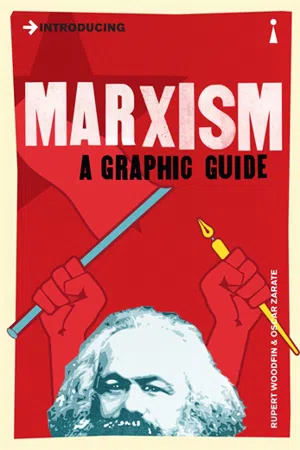
- 176 pages
- English
- ePUB (mobile friendly)
- Available on iOS & Android
eBook - ePub
About this book
Was Marx himself a 'Marxist'? Was his visionary promise of socialism betrayed by Marxist dictatorship? Is Marxism inevitably totalitarian? What did Marx really say? "Introducing Marxism" provides a fundamental account of Karl Marx's original philosophy, its roots in 19th century European ideology, his radical economic and social criticism of capitalism that inspired vast 20th century revolutions. It assesses Marxism's Russian disciples, Lenin, Trotsky and Stalin who forged a ruthless dogmatic Communism. The book examines the alternative Marxist approaches of Gramsci, the Frankfurt School of critical theory and the structuralist Marxism of Althusser in the 1960s. It marshals postmodern interpretations of Marxism and raises the spectre of 'post-Marxism' in Derrida's confrontation with Fukuyama's 'end of history' doctrine.
Information
Topic
PhilosophySubtopic
Economic HistoryThe Origins
In February 1848, Karl Marx and Friedrich Engels published the Communist Manifesto, on behalf of a group of idealistic workers. Originally drafted as a programme for an international “Communist League” which had its roots in the 19th-century tradition of workers’ mutual improvement societies, it became one of the most important political documents of all time. It has been as influential as the American Declaration of Independence (1776) and the French Declaration of Rights (1789).
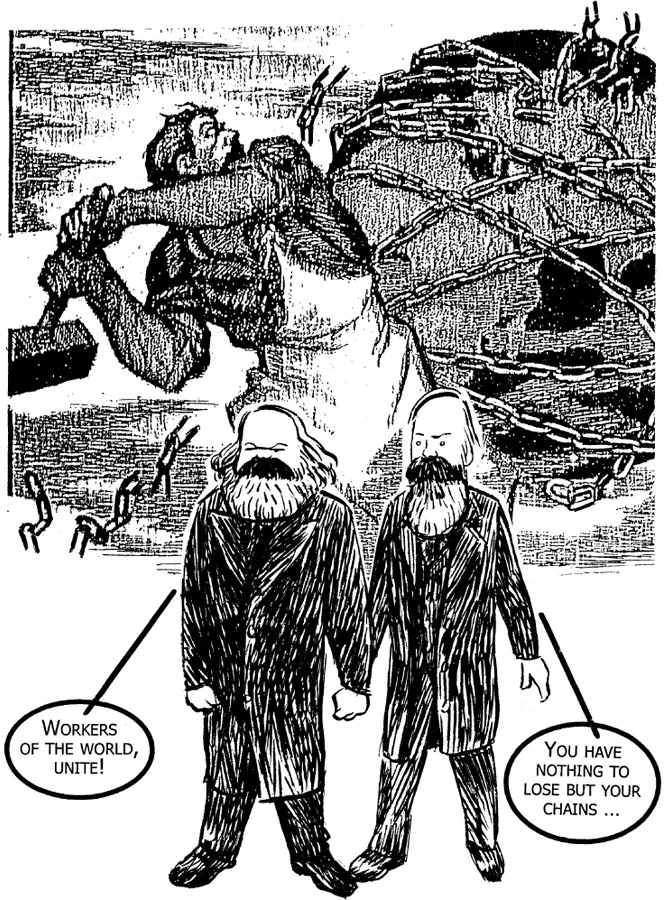
WORKERS OF THR WORLD, UNITE! YOU HAVE NOTHING TO LOSE BUT YOUR CHAINS ...
The Communist Manifesto
The Manifesto has left an indelible mark on human progress and still today forms the basis for a system of political beliefs that motivates millions. Even after the fall of the Berlin Wall in 1989, and the collapse of Communism in Russia and Eastern Europe, its authority and prestige remain for many. What did it say that seemed so important and revolutionary? The key demands, in the authors’ own words, were ...
1. Abolition of property in land and application of all rents of land to public purposes.
2. A heavy progressive or graduated income tax.
3. Abolition of all rights of inheritance.
4. Confiscation of the property of all emigrants and rebels.
5. Centralization of credit in the banks of the state, by means of a national bank with state capital and an exclusive monopoly.
6. Centralization of the means of communication and transport in the hands of the state.
7. Extension of factories and instruments of production owned by the state; the bringing into cultivation of waste lands, and the improvement of the soil generally in accordance with a common plan.
8. Equal obligation of all to work. Establishment of industrial armies, especially for agriculture.
9. Combination of agriculture with manufacturing industries; gradual abolition of all the distinction between town and country by a more equable distribution of the populace over the country.
10. Free education for all children in public schools. Abolition of children’s factory labour in its present form. Combination of education with industrial production, etc.
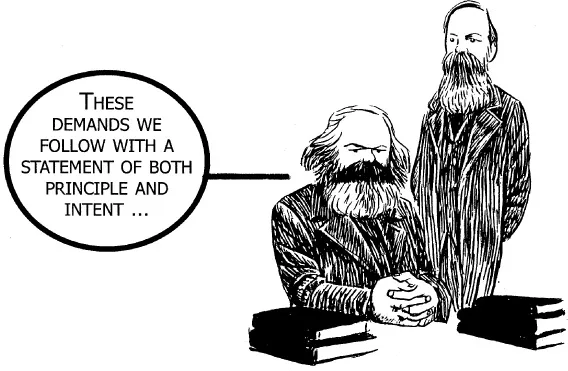
THESE DEMANDS WE FOLLOW WITH A STATEMENTS OF BOTH PRINCPLE AND INTENT ...
“If the proletariat during its contest with the bourgeoisie is compelled, by the force of circumstances, to organize itself as a class; if, by means of a revolution, it makes itself the ruling class, and, as such, sweeps away by force the old conditions of production, then it will, along with these conditions, have swept away the conditions for the existence of class antagonisms and of classes generally, and will thereby have abolished its own supremacy as a class. In place of the old bourgeois society, with its classes and class antagonisms, we shall have an association in which the free development of each is the condition for the free development of all.”
It is from these words that, during the next century and a half, revolutionary action swept first across Europe and then across the world.
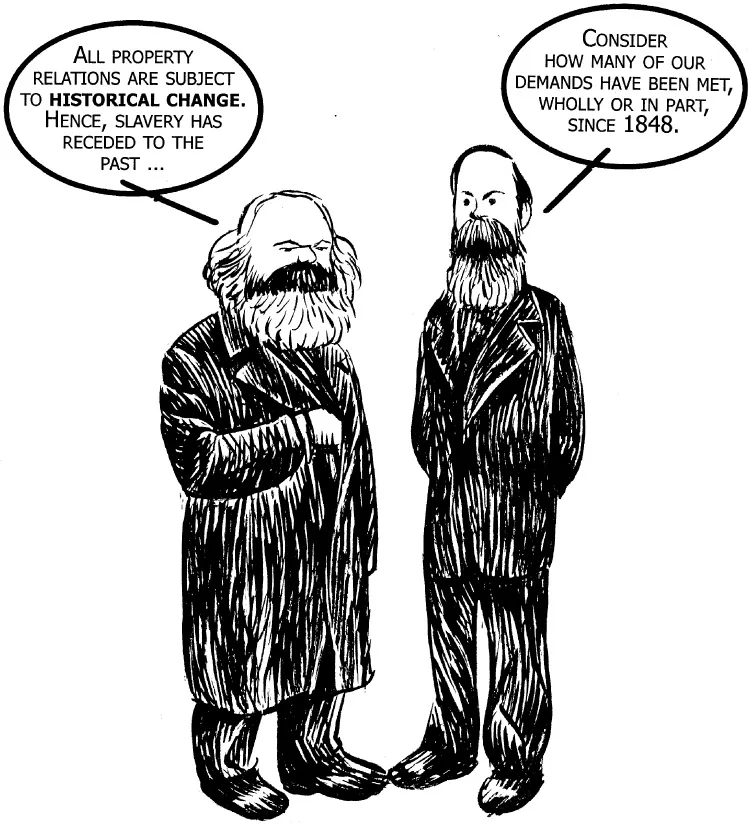
ALL PROPERTY RELATIONS ARE SUBJECT TO HISTORICAL CHANGE. HENCE, SLAVERY HAS RECEDED TO THE PAST ... CONSIDER HOW MANY OF OUR DEMANDS HAVE BEEN MET, WHOLLY OR IN PART, SINCE 1848.
Brief Life of Marx
Karl Marx was born in 1818 in Triers in the Rhineland of Germany. He was Jewish and came from a line of rabbis but his own father was a lawyer. When he was six, his family converted to Christianity and he grew up a Lutheran.
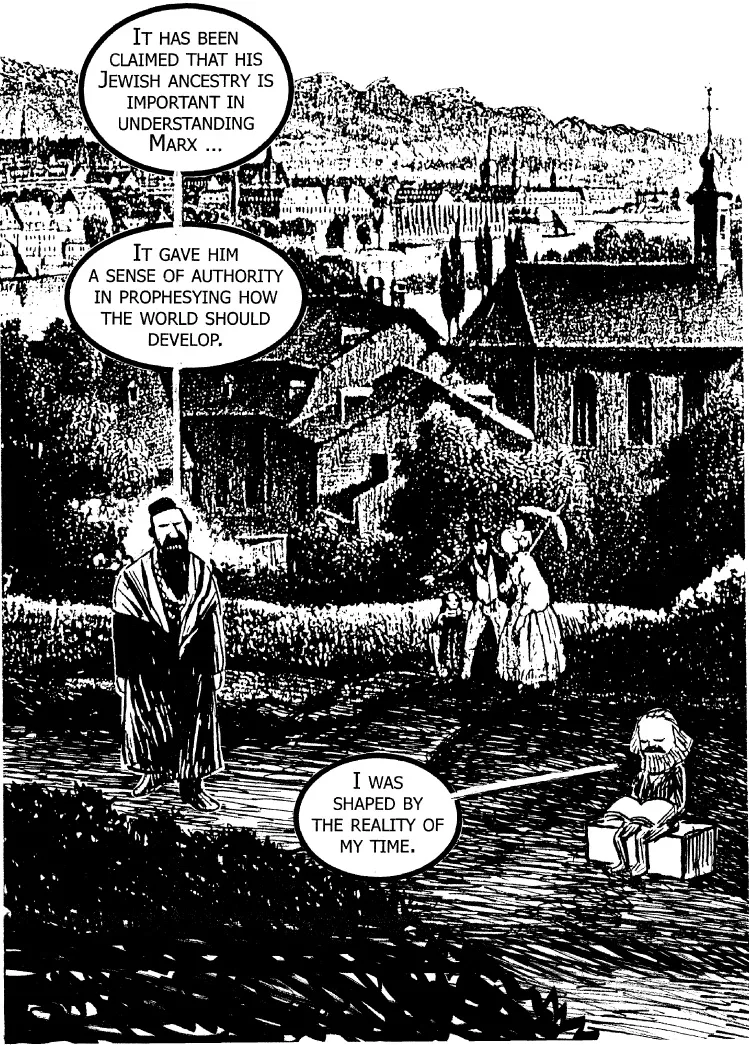
IT HAS BEEN CLAIMED THAT HIS JEWISH ANCESTRY IS IMPORTANT IN UNDERSTANDING MARX ... IT GAVE HIM A SENSE OF AUTHORITY IN PROPHESYING HOW THE WORLD SHOULD DEVELOP. I WAS SHAPED BY THE REALITY OF MY TIME.
As a student, philosophy influenced him greatly, particularly the works of G.W.F. Hegel (1770–1831). He came to reject the mystical and idealistic nature of Hegel’s work and turned to the materialistic ideas of a “Young Hegelian” disciple, Ludwig Feuerbach (1804–72). He was soon to move far beyond Feuerbach to the view that the everyday material conditions under which people live actually create the way they see and understand the world.
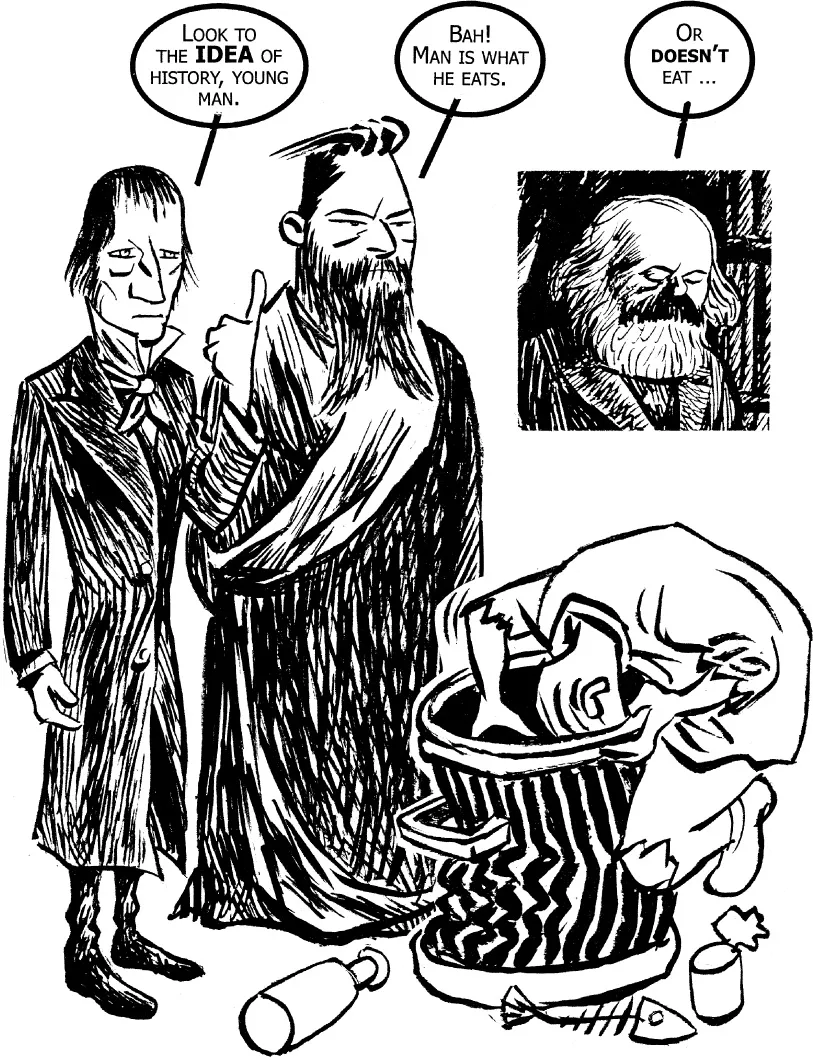
LOOK TO THE IDEA OF HISTORY, YOUNG MAN. BAH! MAN IS WHAT HE EATS. OR DOESN’T EAT ...
Meeting Engels
In 1842 he was employed by the Neue Rheinische Zeitung newspaper in Cologne and became editor. Within a year, the newspaper had been shut down by the Prussian authorities because of one of Marx’s articles. He moved to Paris, then the centre of socialism, and met the influential French socialist Pierre-Joseph Proudhon (1809–65) and the Russian anarchist Mikhail Bakunin (1814–76) (later to become his greatest enemy). He also met Friedrich Engels (1820–95) again.
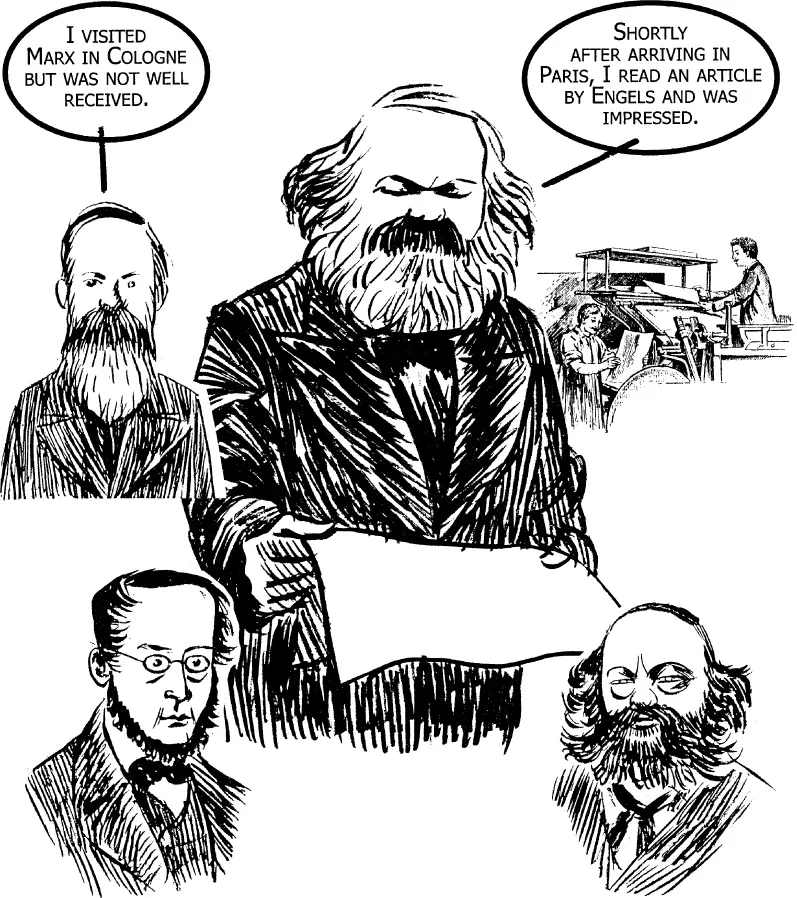
I VISITED MARX IN COLOGNE BUT WAS NOT WELL RECEIVED. SHORTLY AFTER ARRIVING IN PARIS, I READ AN ARTICLE BY ENGLES AND WAS IMPRESSED.
When Engels introduced himself again in Paris, Marx welcomed him as an intellectual equal and political brother-in-arms.
Together they went on to establish Marxism as an intellectual force. Engels’ family were rich owners of cotton-spinning factories in Manchester and Westphalia. He was able to support Marx financially in the hard times to come. But this was not his most important contribution. Marx might have spent his life in an ivory tower of intellectual speculation.
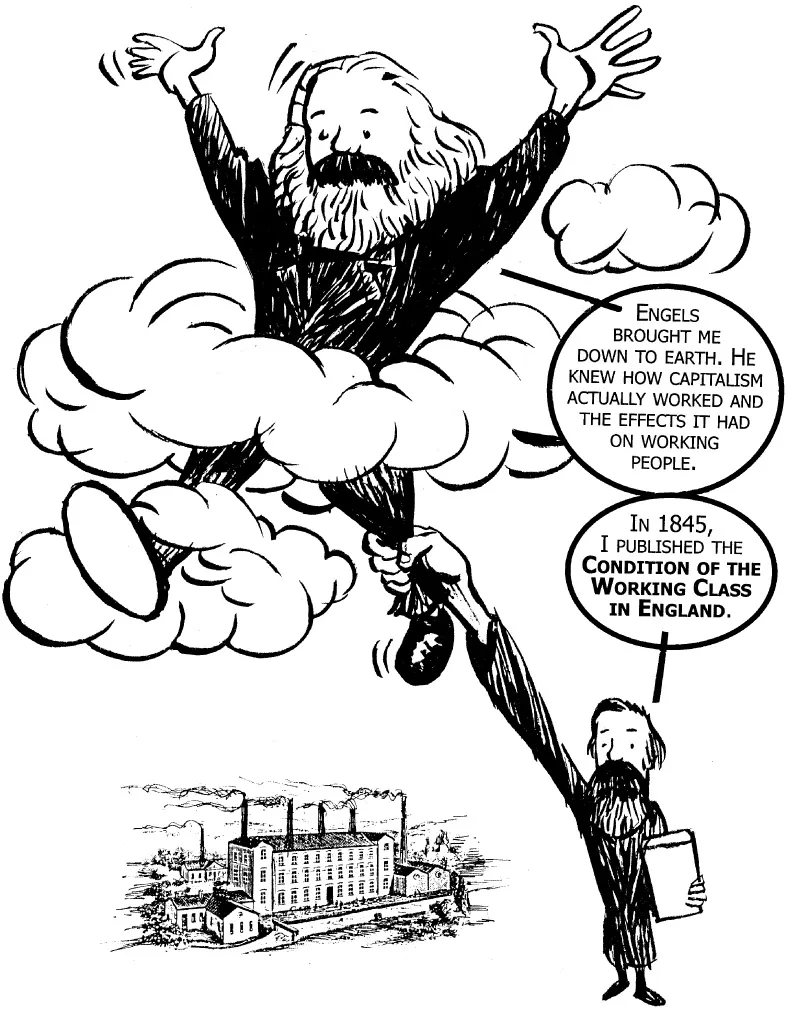
ENGELS BROUGHT ME DOWN TO EARTH. HE KNEW HOW CAPITALISM ACTUALLY WORKED AND THE EFFECTS IT HAD ON WORKING PEOPLE. IN 1845, I PUBLISHED THE CONDITION OF THE WORKING CLASS IN ENGLAND.
Engels also alerted Marx to the importance of Great Britain for the development of capitalism.
The Exile, Agitator and Writer
The Prussian state asked the French authorities to give Marx a hard time. He was duly thrown out of Paris in 1845. He went to Brussels and began a life of political agitation and propaganda.
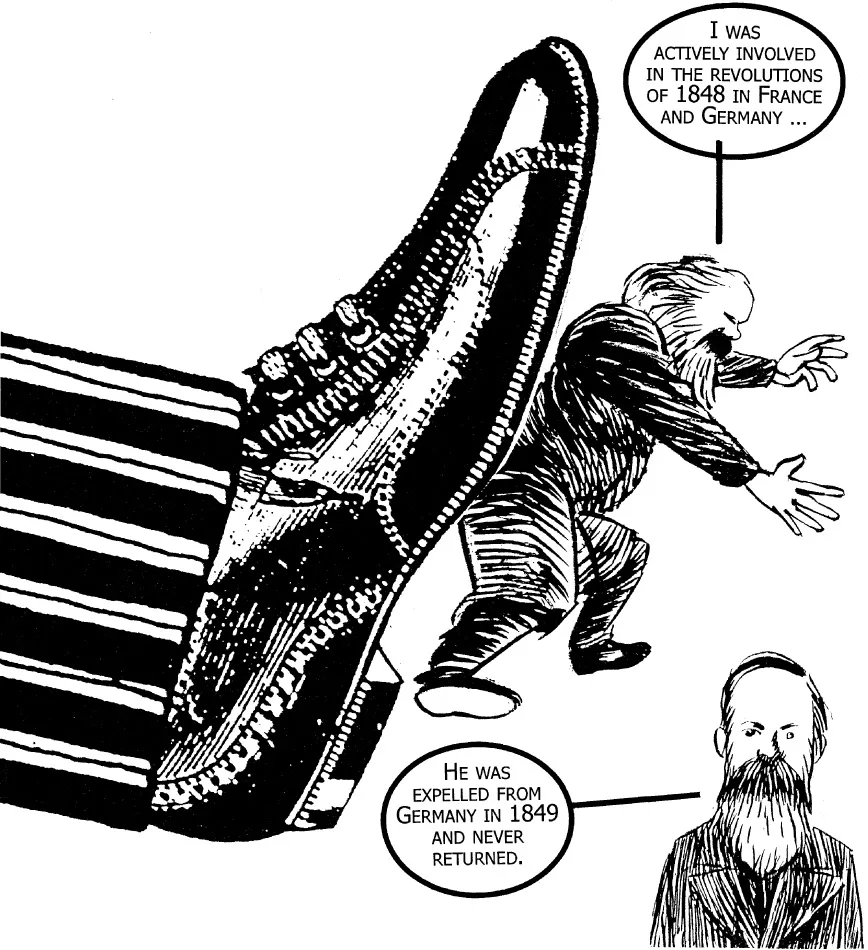
I WAS ACTIVELY INVOLED IN THE REVOLUTIONS OF 1848 IN FRANCE AND GERMANY ... HE WAS EXPELLED FROM GERMANY IN 1849 AND EVER RETURNED.
Marx even renounced his Prussian citizenship. This may have been a mistake because, some 20 years later, the first serious workers’ movement was established there, and Marx was able only to influence it from the sidelines.
Marx lived in London in relative poverty, but always rescued by Engels, for the rest of his life.
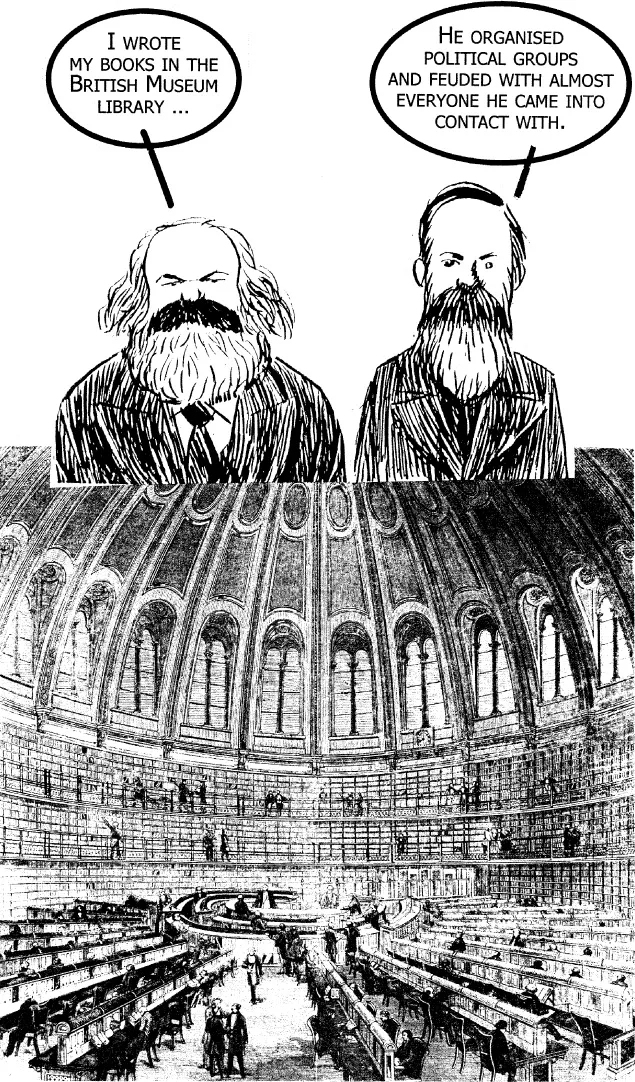
I WROTE MY BOOKS IN THE BRITISH MUSEUM LIBRARY ... HE ORGANISED POLITICAL GROUPS AND FEUDED WITH ALMOST EVERYONE HE CAME INTO CONTACT WITH.
Marx died in 1883 and was buried in Highgate cemetery in London. Engels died in 1895 and left everything that he had to Marx’s children.
Understanding Marx’s Theories
The Communist Manifesto was a powerful and coherent call to arms but was not scientific. It provided no thorough theoretical basis for revolution and the end of Capitalism. This would be provided by Marx and Engels’ vast output of other books, pamphlets and polemics, some published after Marx’s death.
Perhaps the best account of all their thinking is Engels’ Anti-Dühring. Professor Eugen Dühring was a German Social Democrat with whom they profoundly disagreed.
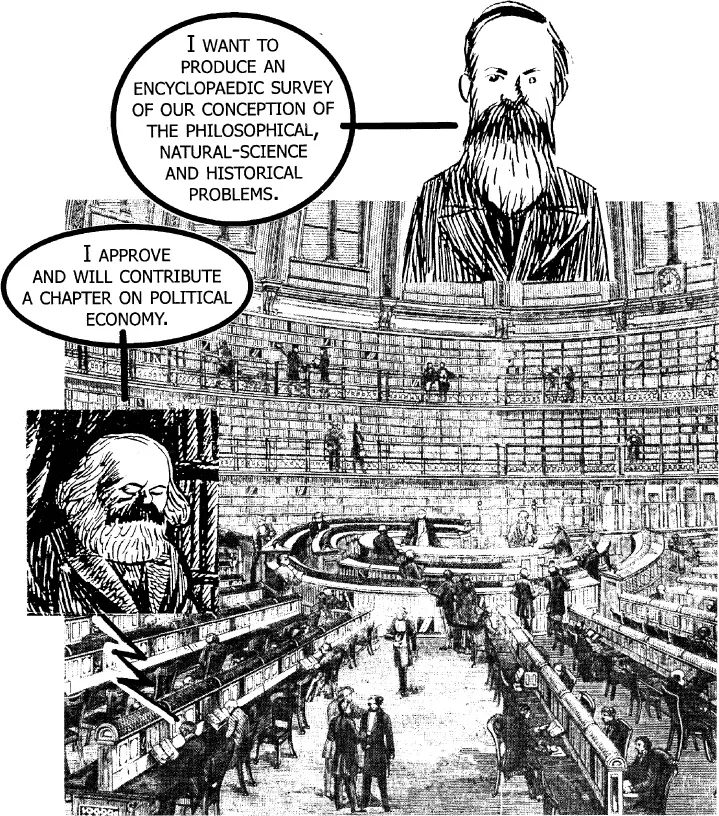
I WANT PRODUCE AN ENCYCLOPAEDIC SURVEY OF OUR CONCEPTION OF TH...
Table of contents
- Cover
- Title Page
- Copyright
- Contents
- The Origins
- Further Reading
- Index
Trusted by 375,005 students
Access to over 1.5 million titles for a fair monthly price.
Study more efficiently using our study tools.
Frequently asked questions
Yes, you can cancel anytime from the Subscription tab in your account settings on the Perlego website. Your subscription will stay active until the end of your current billing period. Learn how to cancel your subscription
No, books cannot be downloaded as external files, such as PDFs, for use outside of Perlego. However, you can download books within the Perlego app for offline reading on mobile or tablet. Learn how to download books offline
Perlego offers two plans: Essential and Complete
- Essential is ideal for learners and professionals who enjoy exploring a wide range of subjects. Access the Essential Library with 800,000+ trusted titles and best-sellers across business, personal growth, and the humanities. Includes unlimited reading time and Standard Read Aloud voice.
- Complete: Perfect for advanced learners and researchers needing full, unrestricted access. Unlock 1.5M+ books across hundreds of subjects, including academic and specialized titles. The Complete Plan also includes advanced features like Premium Read Aloud and Research Assistant.
We are an online textbook subscription service, where you can get access to an entire online library for less than the price of a single book per month. With over 1.5 million books across 990+ topics, we’ve got you covered! Learn about our mission
Look out for the read-aloud symbol on your next book to see if you can listen to it. The read-aloud tool reads text aloud for you, highlighting the text as it is being read. You can pause it, speed it up and slow it down. Learn more about Read Aloud
Yes! You can use the Perlego app on both iOS and Android devices to read anytime, anywhere — even offline. Perfect for commutes or when you’re on the go.
Please note we cannot support devices running on iOS 13 and Android 7 or earlier. Learn more about using the app
Please note we cannot support devices running on iOS 13 and Android 7 or earlier. Learn more about using the app
Yes, you can access Introducing Marxism by Rupert Woodfin,Oscar Zarate in PDF and/or ePUB format, as well as other popular books in Philosophy & Economic History. We have over 1.5 million books available in our catalogue for you to explore.