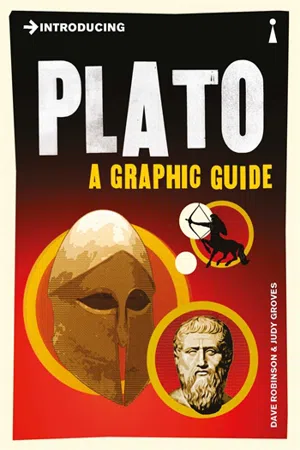
- 176 pages
- English
- ePUB (mobile friendly)
- Available on iOS & Android
eBook - ePub
About this book
"Introducing Plato" begins by explaining how philosophers like Socrates and Pythagoras influenced Plato's thought. It provides a clear account of Plato's puzzling theory of knowledge, and explains how this theory then directed his provocative views on politics, ethics and individual liberty. It offers detailed critical commentaries on all of the key doctrines of Platonism, especially the very odd theory of Forms, and concludes by revealing how Plato's philosophy stimulated the work of important modern thinkers such as Karl Popper, Martha Nussbaum, and Jacques Derrida.
Information
Topic
PhilosophySubtopic
Philosopher BiographiesThe King of Philosophers
Plato was probably the greatest philosopher of all time, and the first to collect all sorts of different ideas and arguments into books that everyone can read. He wanted to know about everything and constantly pestered his friends and fellow philosophers for answers to his disturbing questions. He also had resolute ideas of his own, some of which seem sensible enough, and some of which now seem extremely odd. But, from the start, he knew that “doing philosophy” was a very special activity…

ALL PHILOSOPHERS MUST SOAR WITH UNWEARIED PASSION UNTIL THEY GRASP THE TRUE NATURE OF THINGS AS THEY REALLY ARE.
The World of Athens
Plato was born in 427 B.C.E. into an aristocratic family, and lived in Athens for most of his life. The 5th century city-state of Athens was probably the most civilized place in the world – a home to astronomers, biologists, logicians, artists, mathematicians, and all sorts of thinkers then loosely categorized as “lovers of wisdom” or “philosophers”.

THE ATHENIAN EMPIRE EXTENDED THROUGHOUT THE MEDITERRANEAN. AND IT WAS MAINTAINED WITH RUTHLESS EFFICIENCY.
All of the dull hard physical work was performed by slaves, so most Athenians had plenty of leisure time in which to think and talk about ideas.

BUT THEY AVOIDED THINKING TOO HARD ABOUT THE ETHICAL ISSUE OF SLAVERY ITSELF. WOMEN DIDN’T HAVE MUCH SAY IN THE INTELLECTUAL OR PUBLIC LIFE OF THE STATE.
The actual city of Athens was small enough for everyone to know everyone else, which means that Plato’s philosophy was probably directed at a specific elite audience of intellectual friends and acquaintances.
The Decline of Athens
Plato lived through a turbulent and finally disastrous period of Athenian history. In the Golden Age of Athens, the great statesman Pericles (c. 495-429 B.C.E.) had been able to unite nearly all of the other Greek city-states into a temporary alliance against the Persians, who were always threatening to invade. The union was short-lived.

THE CITY-STATES OF ATHENS AND SPARTA SPEND MOST OF THEIR TIME FIGHTING FUTILE AND INCONCLUSIVE WARS AGAINST EACH OTHER. UNTIL THE YEAR 405 B.C.E., WHEN SPARTA FINALLY WON A DECISIVE VICTORY.
It is extremely likely that Plato fought in this last war as a cavalryman. It would have been very odd for a citizen like him not to have done so. Like other young upper-class Athenians, he was probably rather ambivalent about the war.

WE ADMIRED SPARTA AS AN ARISTOCRATIC SOCIETY THAT WAS EFFICIENT AND STABLE BECAUSE IT STOOD NO NONSENSE FROM THE LOWER ORDERS.
After the war, Sparta imposed a puppet government on Athens. Plato would probably have become a part of it, like his relatives Critias and Charmides, if history had been slightly different.
Socrates
Plato met a charismatic philosopher called Socrates (470-399 B.C.E.) who completely changed his life. Socrates was a popular guru for many young Athenians, even though his appearance, personal habits and philosophical views were mocked and lampooned in the Athenian theatres and in public life. Socrates maintained that philosophy couldn’t be taught, because it was really an attitude of mind rather than a body of knowledge. And like all gurus, he usually spoke in riddles and paradoxes.

THE WISE MAN IS THE ONE WHO KNOWS THAT HE IS IGNORANT. SOCRATES INSISTS THAT PHILOSOPHERS HAVE TO QUESTION CONVENTIONAL WISDOM AND CHALLENGE TRADITIONAL BELIEFS. YOUNG PEOPLE MUST THINK FOR THEMSELVES AND TAKE NOTHING FOR GRANTED.
Socrates was encouraging the sort of rebellious behaviour that governments and authorities usually hate. The citizens of Athens eventually threw out the puppet government of the “Thirty Tyrants”, restored a democratic government, and in 399 B.C.E. had Socrates executed by forcing him to drink poison. The rather unconvincing charges against him were that he was blasphemous and that he was corrupting young people. In fact, he was probably condemned because of his continuing close friendship with two ex-pupils – Critias (“The Tyrant”) and Alcibiades (“The Spartan Traitor”). Socrates, like his pupil, Plato, seems to have made disastrous choices when it came to friends.
Foreign Travels
Socrates’ execution was a highly traumatic event for many young Athenians, including Plato, who left the city disgusted with all Athenian politics and politicians. At the time, he said that…
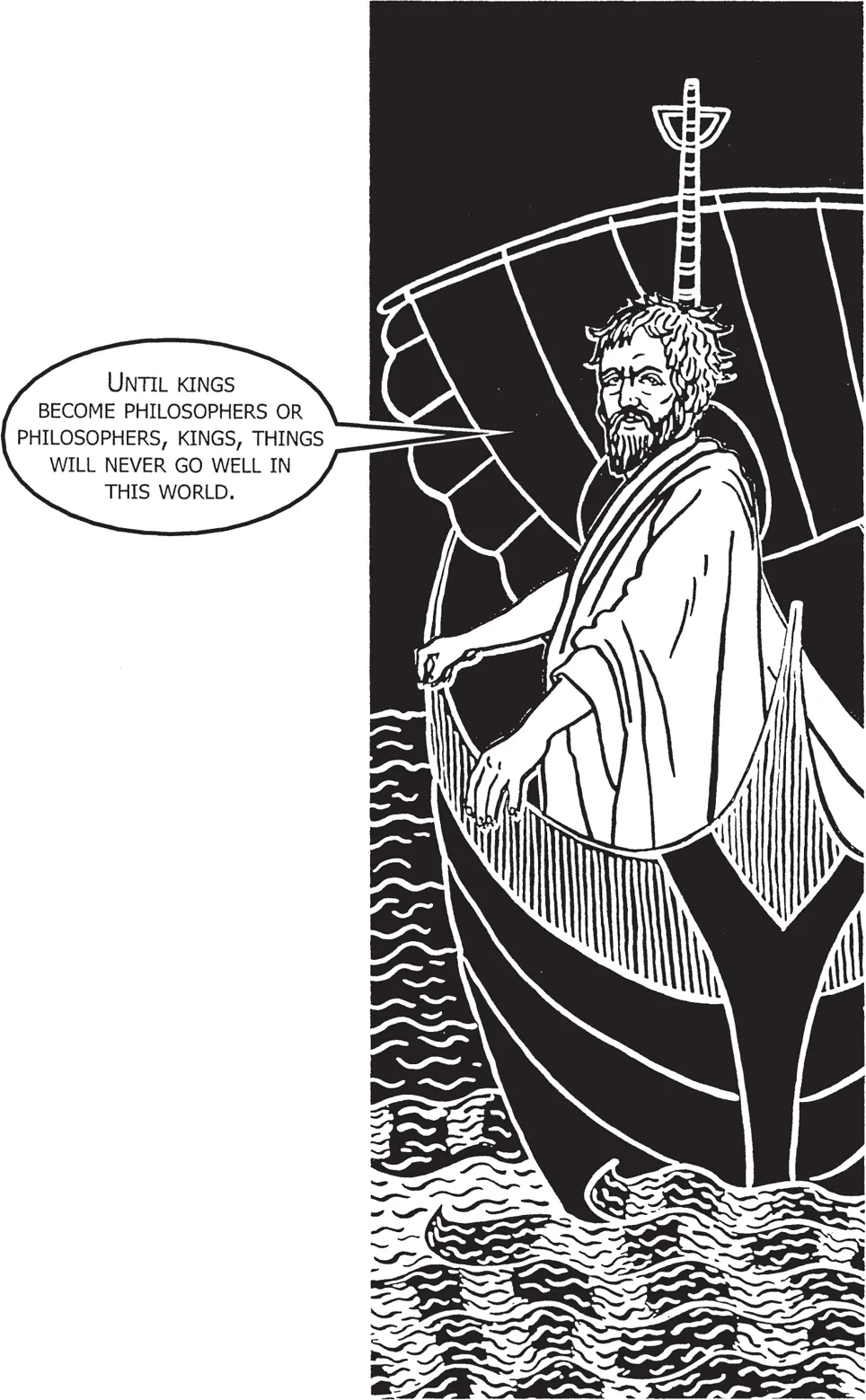
UNTIL KINGS BECOME PHILOSOPHERS OR PHILOSOPHERS, KINGS, THINGS WILL NEVER GO WELL IN THIS WORLD.
He travelled around the Mediterranean, may have visited Egypt, may have been kidnapped and ransomed by pirates, and almost certainly did visit some Greek colonies in Southern Italy, before he finally settled briefly in Sicily at the court of King Dionysius I. Here he met an attractive young man called Dion, who made a big impression on the middle- aged Athenian refugee. He also met the philosopher Archytas of Tarentum, who encouraged his interest in Pythagorean mathematics.
The Academy
The homesick Plato eventually returned to Athens where, circa 387 B.C.E., he established the first ever European university – called “The Academy” – in the western suburbs. In this educational institution, fulltime scholars ate around the same table, argued about everything that was known, and kept the spirit of Socratic debate alive. Plato gave lectures to students on mathematics, astronomy and his theory of “Forms” whilst walking around his garden. He had a small library and perhaps even a mechanical model of the planetary orbits. Like the Pythagorean scholars of southern Italy, the members of the Academy believed that a study of mathematics held the key to all understanding.
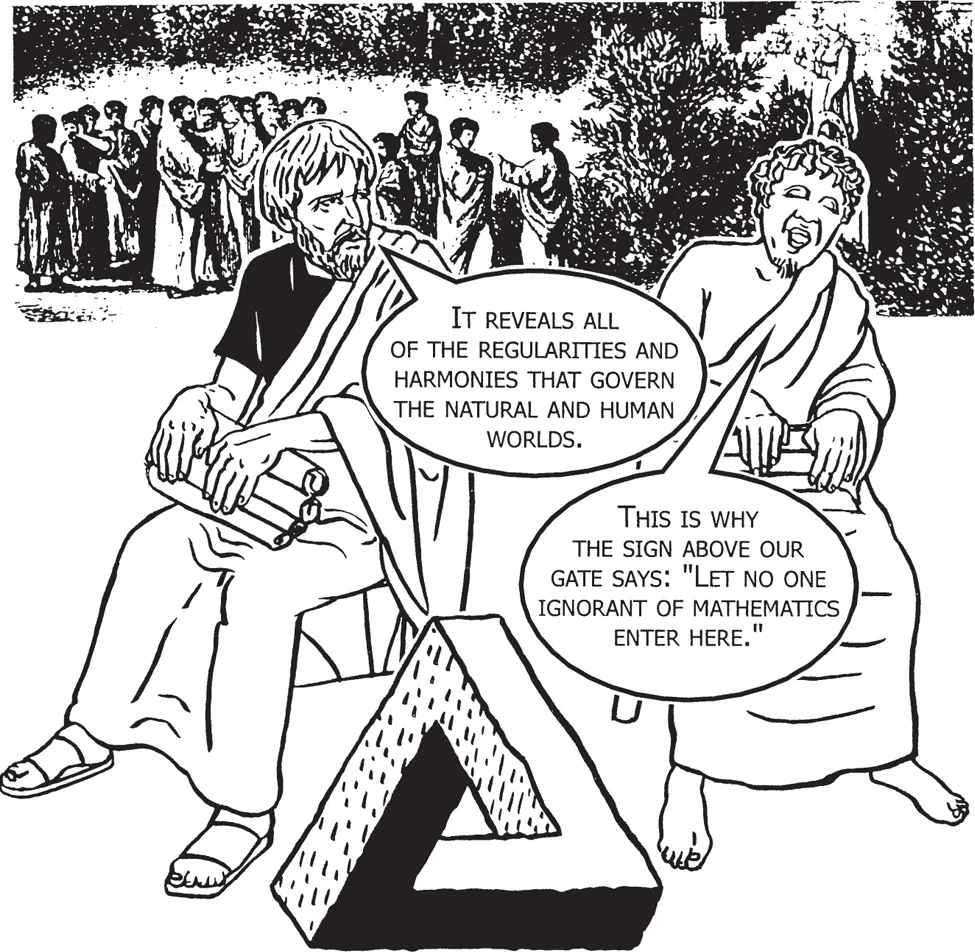
IT REVEALS ALL OF THE REGULARITIES AND HARMONIES THAT GOVERN THE NATURAL AND HUMAN WORLDS. THIS IS WHY THE SIGN ABOVE OUR GATE SAYS: “LET NO ONE IGNORANT OF MATHEMATICS ENTER HERE.”
The purpose of the Academy could sometimes confuse less studious Athenians. On one occasion, many citizens responded enthusiastically to an advertised public talk on “The Good Life”, expecting to hear about happ...
Table of contents
- Cover
- Title Page
- Copyright
- Contents
- The King of Philosophers
- Further Reading
- Acknowledgements
- Index
Trusted by 375,005 students
Access to over 1.5 million titles for a fair monthly price.
Study more efficiently using our study tools.
Frequently asked questions
Yes, you can cancel anytime from the Subscription tab in your account settings on the Perlego website. Your subscription will stay active until the end of your current billing period. Learn how to cancel your subscription
No, books cannot be downloaded as external files, such as PDFs, for use outside of Perlego. However, you can download books within the Perlego app for offline reading on mobile or tablet. Learn how to download books offline
Perlego offers two plans: Essential and Complete
- Essential is ideal for learners and professionals who enjoy exploring a wide range of subjects. Access the Essential Library with 800,000+ trusted titles and best-sellers across business, personal growth, and the humanities. Includes unlimited reading time and Standard Read Aloud voice.
- Complete: Perfect for advanced learners and researchers needing full, unrestricted access. Unlock 1.5M+ books across hundreds of subjects, including academic and specialized titles. The Complete Plan also includes advanced features like Premium Read Aloud and Research Assistant.
We are an online textbook subscription service, where you can get access to an entire online library for less than the price of a single book per month. With over 1.5 million books across 990+ topics, we’ve got you covered! Learn about our mission
Look out for the read-aloud symbol on your next book to see if you can listen to it. The read-aloud tool reads text aloud for you, highlighting the text as it is being read. You can pause it, speed it up and slow it down. Learn more about Read Aloud
Yes! You can use the Perlego app on both iOS and Android devices to read anytime, anywhere — even offline. Perfect for commutes or when you’re on the go.
Please note we cannot support devices running on iOS 13 and Android 7 or earlier. Learn more about using the app
Please note we cannot support devices running on iOS 13 and Android 7 or earlier. Learn more about using the app
Yes, you can access Introducing Plato by Dave Robinson,Judy Groves in PDF and/or ePUB format, as well as other popular books in Philosophy & Philosopher Biographies. We have over 1.5 million books available in our catalogue for you to explore.