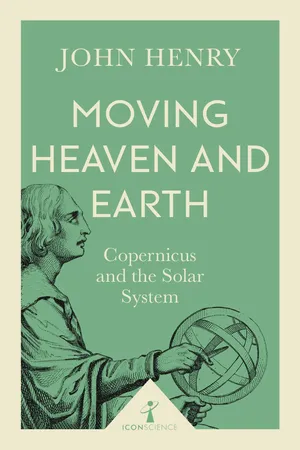
When Nicolaus Copernicus claimed that the Earth was not stationary at the centre of the universe but circled the Sun, he brought about a total revolution in the sciences and consternation in the Church.Copernicus' theory demanded a new physics to explain motion and force, a new theory of space, and a completely new conception of the nature of our universe. He also showed for the first time that a common-sense view of things isn't necessarily correct, and that mathematics can and does reveal the true nature of the material world. As John Henry reveals, from his idea of a swiftly moving Earth Copernicus sowed the seed from which science has grown to be a dominant aspect of modern culture, fundamental in shaping our understanding of the workings of the cosmos.
- English
- ePUB (mobile friendly)
- Available on iOS & Android
eBook - ePub
About this book
Trusted by 375,005 students
Access to over 1.5 million titles for a fair monthly price.
Study more efficiently using our study tools.
Information
Topic
Physical SciencesSubtopic
Science & Technology Biographies• CHAPTER 1 •
YOU’D HAVE TO BE CRAZY TO
SAY THE EARTH MOVES
SAY THE EARTH MOVES
Science or insanity?
Death and taxes are often said to be the only certainties, but there’s something else. The Earth certainly doesn’t seem to be moving. No matter what the scientists tell us about the way the Earth rotates on its axis, so that someone standing at the equator is moving around the centre of the Earth at a speed of over a thousand miles per hour, it all seems perfectly still. We all believe what we are told about the Earth’s revolutions around the Sun, covering a distance of about 584 million miles in a year (which is another 66,000 mph or more), but we are taking it on trust – we can’t feel ourselves moving.
Those of us who have read a little further, or who have watched more programmes on Discovery Channel, or who once bumped into a friendly astronomer, might also have learned that we, together with the Sun, are circling around the centre of our galaxy at an even more unimaginable speed – roughly 350,000 mph – and that the galaxy itself is whizzing through space on a trajectory resulting ultimately from the Big Bang that created our universe (see the ‘Glossary’ section at the end of this book). But we cannot feel any of this.
It’s not just a question of how it feels either. If our senses don’t tell us the Earth is moving, it is also true that, for technical purposes, it actually makes sense to assume the Earth is stationary. If you look in a textbook on navigation, for example, you’ll see it assumes that the Earth is stationary, and that all the heavenly bodies are revolving around the Earth. The authors of such manuals probably know better than you or me that the Earth is perpetually performing a series of complex motions, but they also know that you don’t need to know this to steer your boat by the stars. On the contrary, it makes things simpler if you assume the Earth is still and only the stars, and your boat, are moving. Therefore, it is wrong to assume that technical demands must inevitably lead us to a belief in the motion of the Earth. They don’t.
So how on Earth did we ever come to believe in the motion of the Earth? If our senses and our common sense tell us that the Earth is not fast but steadfast, and if it is a requirement of a practically useful technical art like navigation that the Earth be considered stationary, why and how did we ever come to believe that the Earth is whizzing through space with such phenomenal speeds? If we just set aside for a minute what we have taken on trust since we were schoolchildren, the idea that the Earth is moving just seems totally crazy. It can’t really be moving, can it?
Yes it can, and what’s more we now all believe that anyone who denies the motion of the Earth must be a crank or a fool. So how has it come about that it is now crazy to deny what actually seems to be a crazy idea? The short answer is that we all now recognise the intellectual power and authority of science. Even if we don’t know much about the details, we know that a moving Earth is bound up with the latest astronomical and cosmological ideas, which in turn are bound up with well-established theories of modern mathematical physics. We also have a strong sense, even if we can’t follow the technical demonstrations, that this same edifice of mathematical physics has led to most, if not all, of the high technology that is now such an indispensable part of our lives. It is part of our scientific worldview that the laws of nature are so all-pervasive and so interconnected with one another that to reject the claim that the Earth moves would somehow have to entail not only, say, a denial that we ever landed men on the Moon, but also that television sets work.
But, of course, there hasn’t always been this kind of faith in the power and pervasiveness of scientific knowledge. Like everything else, our modern worldview has its history and its historical origins. If it is possible at all to pinpoint a single initial source from which the modern physical sciences developed and spread out, explaining more and more aspects of our world as they did so, and leading to more and more technical innovations, the most likely contender for the starting point would be the claim by Nicolaus Copernicus (1473–1543) that the Earth is in motion.
One of the main aims of this book is to explain how it was that a highly technical astronomical theory, far beyond the mathematical competence and the understanding of all but a very few people, came to have such far-reaching repercussions. Along the way we will come to see why it was Copernicus’s claim (first published in the middle of the 16th century) that was to have this seismic impact, rather than one of the various earlier suggestions that the Earth might be in motion.
Nothing new under the Sun
Earlier suggestions? Yes, Copernicus’s assertion that the Earth is in motion is historically the most important, but it wasn’t the first. Indeed, the suggestion is almost as old as theoretical astronomy itself. Although there is abundant evidence that attempts to keep track of the heavenly bodies (and to use the knowledge of their movements for calendrical, astrological, ritualistic and in some cases navigational purposes) date back to prehistoric times, as far as we know the Ancient Greeks were the first to try to understand how the heavenly bodies were moving. This marked the beginning of theoretical astronomy. At about the same time as the Greeks, the Babylonian civilisation also regarded the study of the heavens as having the utmost importance. But they seem to have concentrated exclusively on making accurate records of heavenly movements in order to discover the various repetitive cycles and thereby make accurate predictions. The Ancient Greeks, however, wanted to know what was going on in the heavens. What was it that accounted for the movements of the heavenly bodies?
Some Ancient Greek astronomers and philosophers seriously considered that the Earth might be in motion. Copernicus himself mentions some of these in the preface of his book, On the Revolutions of the Heavenly Spheres, which he published in 1543. Quoting from a summary of the ideas of the Greek philosophers that had been written in Ancient times, Copernicus tells his readers that Hicetas of Syracuse (5th century BC), Ecphantus the Pythagorean (c. 400 BC), and Heraclides of Pontus (c. 390–339 BC) proposed that the Earth rotated on its axis, and that Philolaus the Pythagorean (fl. c. 475 BC) believed that the Earth, together with the Sun and the Moon, rotated around a great fire at the centre of the world system. The Greek astronomer most associated with the idea of a moving Earth, Aristarchus of Samos (c. 310–230 BC), was originally mentioned by Copernicus too, although his name was inadvertently left out as the result of last-minute editing of the manuscript.
In any case, Copernicus’s great innovation is hardly diminished by these scanty reports of Ancient beliefs. For one thing, the reports are merely passing comments, entirely lacking in detail. The hard work of providing the precise geometrical models required to make sense of a system in which the Sun was at the centre and the Earth in orbit still had to be undertaken by Copernicus. Besides, it’s impossible to be sure, but the evidence suggests that Copernicus had already hit upon the idea that the Earth was in motion, and he then looked back to see if any of the Ancients had proposed the same idea. To us, this may seem like a strange thing to do. Why would Copernicus want to detract from his own achievement by pointing out that others had had the idea before him?
We have to remember that Copernicus lived in a different age and shared the general assumptions of his age, just as we share the general assumptions of ours. We now all believe in progress, and assume that science will lead to new discoveries and new improvements in our lives, new and previously undreamed of ways of exploiting nature for our benefit. But this attitude towards scientific knowledge developed after Copernicus’s time. Nobody in his day thought about scientific progress in this way. Wisdom was not something waiting to be discovered in the future, it was something that had once existed in the past, and needed to be recovered. This was an idea that derived essentially from religious beliefs. It was taken for granted that Adam, the first man, knew all things. This is what was meant by the comment in the book of Genesis (2, verses 19–20) that he named all things. If you know the name of something you know its essence, its very nature. It was believed that this knowledge began to be lost after the Fall, after the disobedience of Adam and Eve, when they were cast out of the Garden of Eden. It was not lost straight away, however, but gradually, over the succeeding generations.
This was why the period during which the Ancient Greek philosophers flourished could be regarded as a Golden Age. They were closer in time to the Fall of man and therefore knew more things, had forgotten less, than the people of later ages. If, like Copernicus, you came up with a novel idea, it was important to see if there were any hints of it in the past. If there were not, it surely indicated that your idea could not have been part of Ancient wisdom and therefore couldn’t be true. So Copernicus needed to know about Ecphantus, Heraclides, Hicetas and Philolaus, and he needed to tell the readers of his book about them. This attitude to the past was taken so seriously that Copernicus’s theory was often called the Pythagorean theory.
The fact that none of the claims about a moving Earth ever caught on among the majority of Greek astronomers and philosophers was not too damaging to Copernicus. It was simply a matter of suggesting that the Pythagoreans were more in tune with the original wisdom of Adam, but that most of their contemporaries had already become too ignorant to recognise it.
It wasn’t only the Ancient Pythagoreans who argued for a moving Earth. There were two major statements about the possibility much closer to Copernicus’s own time. The first was put forward by a French philosopher of the 14th century by the name of Nicole Oresme (c. 1320–82). Oresme was not a professional astronomer; what he did was simply to show that the arguments put forward by the Ancient Greek philosopher Aristotle (384–322 BC) to prove that the Earth must be stationary were by no means certain. In so doing Oresme indicated that the Earth might well be moving without us being able to notice its movement. But he makes it perfectly plain that he didn’t really think it was moving. He simply wanted to show that Aristotle’s arguments for the necessary stability of the Earth were not as forceful and undeniable as everyone seemed to think. Aristotle was the most dominant and influential philosopher in Oresme’s day, and everyone deferred to his opinions, so Oresme’s dissent from Aristotle was little more than an intellectual exercise to show that it was possible to disagree with this Ancient authority. Once again, therefore, it would be unfair to let Oresme steal Copernicus’s thunder as being the first thinker to insist that the Earth is in motion.
The second medieval statement of the motion of the Earth, by Nicholas of Cusa (1401–64), was inspired in a completely different way. Nicholas, who eventually rose to the status of Cardinal in the Church, wrote an influential book called On Learned Ignorance, in which he insisted that the truly learned man was one who recognised the limitations of his own intellect and the extent of his ignorance. Inspired by the dire straits into which astronomy had fallen by his time (about which we’ll read more later), Nicholas chose as an example the futility of any attempt to understand the real workings of the cosmos. Cosmology, in other words, is beyond the grasp of the human intellect, and the learned man will acknowledge this. During the course of this discussion, he argued that we can’t even be sure of the position or fixity of the Earth. But to cast doubt on the fixity of the Earth is hardly the same as systematically setting out to reform astronomy in the most rigorous way, as Copernicus did. Nothing Nicholas of Cusa said should be allowed to undermine Copernicus’s position as the first to demonstrate the motion of the Earth.
We can see, then, that although the idea that the Earth is in motion is an obviously crazy idea, it wasn’t so crazy that nobody ever considered it. It was, however, crazy enough to stop the idea being taken seriously until Copernicus came along. And, of course, even he didn’t have things all his own way – certainly not to begin with. Nevertheless, Copernicus’s idea did prevail in the end. What we need to know is how and why Copernicus’s version of this crazy idea prevailed while the earlier versions failed to have any impact whatsoever.
Astronomy rules, OK?
Now, you might imagine that it was simply a question of getting the astronomy right. After all, neither Nicole Oresme nor Nicholas of Cusa were astronomers and so were forced to talk only in terms of maybes. As for the Ancient Pythagorean astronomers, perhaps they never actually succeeded in providing an astronomy capable of predicting planetary motions; we don’t actually know enough about the outcome of their efforts. So, maybe all that was really lacking was a properly worked out system of astronomy in which the Sun was at the centre and the Earth in orbit around it – in which case we can simply say that Copernicus just happened to be the first astronomer with the necessary mathematical genius to come along, and he set the world to rights. End of story.
But not so fast. We’ve already seen that technical astronomy in itself isn’t enough to convince us that the Earth is in motion. Technical astronomy just isn’t that kind of thing. What astronomy does is to provide us with a geometrical model of how the heavenly bodies are moving. The only requirements of the model are that the motions of the planets and stars that it provides should closely match (the closer the better) the recorded observations of those motions, and that the proposed movements of the heavenly bodies should be at least plausible. It happens that there is always more than one way to model the motions of the heavens. And, as present-day manuals of navigation attest, at least one way can always be based on the assumption that the Earth is stationary in the centre. Therefore, given two models to choose from, a model with a stationary Earth is always going to seem more plausible than one where the Earth has to be assumed to be moving.
We came to the conclusion earlier that we are willing to suspend our disbelief about the crazy notion that the Earth is in motion because we have come to trust the authority of the physical sciences. But in Copernicus’s day, science did not have the same commanding authority. So what made Copernicus believe that the Earth was in motion? And why did others come to believe it too?
• CHAPTER 2 •
WHY DID COPERNICUS SAY
THE EARTH MOVES?
THE EARTH MOVES?
Heavenly orbs
We’ve already seen that theoretical astronomy began with the Ancient Greeks. Although there were much earlier attempts to understand what was going on in the heavens, the first major stimulus to a theoretical astronomy came from perhaps the greatest of the Ancient Greek philosophers, Plato (c. 428–347 BC). If every intellectual were asked to compile his or her top ten of the most brilliant and influential thinkers of all time, Plato would probably be on everyone’s list. He’s mostly famous for his moral and political philosophies and his influence on early Christian theology, but he’s also the person who kick-started the geometrical astronomy of the Greeks.
Plato didn’t do any astronomy himself, but he recognised its significance. These were times when the study of the phenomena of the night skies and the motions of the Sun had both spiritual and practical import. For Plato the concern seems to have been mostly abstract and spiritual, rather than practical. He strongly endorsed earlier Greek notions, deriving from religious impulses, that the heavens should be perfect. Among intellectual Greeks, there was a belief in a supreme deity who was assumed to have created the world. But such a deity should have created a perfect world, and if the world was perfect, it shouldn’t change. Surely, if something is perfect and then it changes, it would have to become not so perfect. This kind of thinking seems to have given rise to a widely held belief among the Greeks that change was somehow distasteful. The changing world was explained, therefore, in terms of the delusion of human frailty, or as the recalcitrance of the material world that was vastly inferior to the spiritual world, or as the result of the corruption wrought on the world by petty and far-from-perfect humankind. The baleful influence of humanity could not reach up to the stars, however, and so the heavens ought to be unchanging, and therefore closer to perfection than the Earthly part of the material world.
The trouble is, they are not. The Sun moves across the sky, and it does not rise and set in the same place every day. The Moon moves in complex ways, and waxes and wanes as it does so. The stars wheel around the sky once every 24 hours, and although most of them remain in the same position on the vault of the sky as they do so, there are a few wandering stars that move in seemingly irregular ways.
The Greeks assumed, however, that the complex motions of the heavens must be to a large extent illusions generated by our point of view, and that really the heavens are unchanging. The general picture that emerged from this assumption was that the Sun, Moon, planets (the wandering stars), and the fixed stars (which moved around the sky but not in relation to one another), were all on spheres surrounding the Earth. This gave the immediate advantage that the motion of Mars, say, could be envisaged, not as a body moving freely through space, but as a stationary sphere, rotating on its axis. The movement of Mars is merely the movement of a luminous spot on the surface of a sphere, which, although it rotates on its axis, does not actually move anywhere. Instead of having to think about heavenly bodies moving through space, or changing their places, the Greeks could simply think in terms of fixed spheres rotating gracefully on their axes. The Earth was at the centre of a nest of spheres that completely surrounded and rotated around it.
Because a sphere looks exactly the same no matter from where it is viewed, the sphere could be declared to be the most beautiful and perfect geometrical shape, and the most fitting for the heavens. To reinforce the notion of the heavenly movements being as close to unchanging as possible, it was pointed out that only the motion of a sphere on its axis ends exactly where it begins. Furthermore, it was assumed that the rotation of the spheres must be perfectly uniform and unchanging in speed. As far as possible, the heavens were regarded as unchanging in their heavenly perfection.
Unfortunately, this religiously and aesthetically inspired vision of the heavenly bodies and their movements fails to fit in with some fairly obvious observations. Transient changeable phenomena like comets and meteors could be dealt with simply by assuming that they were atmospheric phenom...
Table of contents
- Cover
- Contents
- Title Page
- Copyright
- List of Figures
- Acknowledgements
- 1 You’d Have to Be Crazy to Say the Earth Moves
- 2 Why Did Copernicus Say the Earth Moves?
- 3 Who Was Copernicus?
- 4 What Was the Reaction?
- 5 What Difference Did it Make?
- 6 Last Words
- Glossary
- Further Reading
Frequently asked questions
Yes, you can cancel anytime from the Subscription tab in your account settings on the Perlego website. Your subscription will stay active until the end of your current billing period. Learn how to cancel your subscription
No, books cannot be downloaded as external files, such as PDFs, for use outside of Perlego. However, you can download books within the Perlego app for offline reading on mobile or tablet. Learn how to download books offline
We are an online textbook subscription service, where you can get access to an entire online library for less than the price of a single book per month. With over 1.5 million books across 990+ topics, we’ve got you covered! Learn about our mission
Look out for the read-aloud symbol on your next book to see if you can listen to it. The read-aloud tool reads text aloud for you, highlighting the text as it is being read. You can pause it, speed it up and slow it down. Learn more about Read Aloud
Yes! You can use the Perlego app on both iOS and Android devices to read anytime, anywhere — even offline. Perfect for commutes or when you’re on the go.
Please note we cannot support devices running on iOS 13 and Android 7 or earlier. Learn more about using the app
Please note we cannot support devices running on iOS 13 and Android 7 or earlier. Learn more about using the app
Yes, you can access Moving Heaven and Earth (Icon Science) by John Henry in PDF and/or ePUB format, as well as other popular books in Physical Sciences & Science & Technology Biographies. We have over 1.5 million books available in our catalogue for you to explore.