eBook - ePub
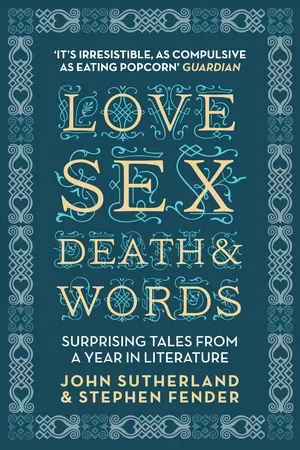
Love, Sex, Death and Words
Surprising Tales From a Year in Literature
- 544 pages
- English
- ePUB (mobile friendly)
- Available on iOS & Android
eBook - ePub
About this book
Love, sex, death, boredom, ecstasy, existential angst, political upheaval - the history of literature offers a rich and varied exploration of the human condition across the centuries. In this absorbing companion to literature's rich past, arranged by days of the year, acclaimed critics and friends Stephen Fender and John Sutherland turn up the most inspiring, enlightening, surprising or curious artefacts that literature has to offer. Find out why 16 June 1904 mattered so much to Joyce, which great literary love affair was brought to a tragic end on 11 February 1963 and why Roy Campbell punched Stephen Spender on the nose on 14 April 1949 in this sumptuous voyage through the highs and lows of literature's bejewelled past.
Information
Subtopic
Literary CollectionsIndex
Literature1 January
Peter Pan: eternal boy, eternal copyright
1988 The copyright history of James Barrie’s most famous creation, Peter Pan, is vexed – and legally unique.
The origin of the character was in stories Barrie told to the children of one of his friends. One of them was called Peter. The image of Pan – thanks to cultish 1890s literary paganism – was current in the Edwardian period (the mischievous goaty-god makes an entry, for example, into another favourite children’s book of the period, The Wind in the Willows).
At the time Barrie was best known as a novelist. His contemporaries would have predicted that his reputation with posterity would rest on such works as Auld Licht Idylls, or The Little Minister. These are out of print nowadays and largely forgotten, while Peter Pan, thanks to the Christmas pantomime, is set to fly on till the crack of doom.
The character was first introduced in Barrie’s 1902 novel for adults, The Little White Bird. The play (aimed at children, principally) Peter Pan, or The Boy Who Wouldn’t Grow Up had its premiere in London on 27 December 1904. The novel Peter Pan in Kensington Gardens was spun off as a follow-up to the play in 1906. Barrie then adapted the play into another novel, Peter and Wendy (usually shortened to Peter Pan), in 1911. In 1929 Barrie, who had no children of his own, donated the work, and all the Peter Pan revenues, to the Great Ormond Street Hospital for Children, in London.
These differing initiation dates, originating conceptions and ownership issues have caused copyright confusion (as has the fact that there is, in Anglo-American law, no copyright in ideas, scenarios or characters – only in the verbal forms in which they are expressed).
Further confusion has arisen in the decades since Barrie’s death, in 1937. The work, popularised by such (copyright licensed) adaptations as Walt Disney’s in 1953, has been a major source of revenue for the hospital. The normal term of copyright in the UK is 50 years post mortem, which meant that Peter Pan entered the public domain at the end of 1987.
It then re-entered copyright protection with the EU ‘harmony’ regulations of 1995, which extended copyright to 70 years post mortem. This was done largely to compensate German literary estates, which had lost out on international copyright revenue during the Second World War. Along with Mein Kampf (whose copyright had expired in 1995) Peter Pan was given a new lease of copyright life until 2007, when – in the normal course of events – it would have popped back into the public domain on the 70th anniversary of Barrie’s death.
This process, however, was forestalled by a measure introduced by the Labour government in 1998 (interested in keeping a healthy income stream into the NHS). This extraordinary amendment to the law affecting intellectual property:
conferred on trustees for the benefit of the Hospital for Sick Children, Great Ormond Street, London, a right to a royalty in respect of the public performance, commercial publication, broadcasting or inclusion in a cable programme service of the play ‘Peter Pan’ by Sir James Matthew Barrie, or of any adaptation of that work, notwithstanding that copyright in the work expired on 31 December 1987.
The situation (particularly in the US) is tangled and has led to serial litigation. But in essence the situation is simple. Peter, the perpetual boy, has – from 1 January 1988 onwards – perpetual copyright. For ever and ever, amen.
2 January
The SS Commodore sinks off the coast of Florida, leaving Stephen Crane adrift in an open boat
1897 Leaving Jacksonville, Florida, for Cuba, the ship struck a sandbar that damaged the hull and started a leak in the boiler room. When the pumps failed she settled in the water and finally sank some sixteen miles offshore. Aboard was Stephen Crane, poet and novelist, renowned author of Maggie, a Girl of the Streets (1893) and The Red Badge of Courage (1895). When the crew took to the lifeboats, Crane found himself in a ten-foot dinghy along with the injured ship’s captain, its cook and an engine-room oiler.
What followed was his best-remembered short story, ‘The Open Boat’, which he would publish in Scribner’s Magazine just four months later. The narrative is freighted with portentous, third-person irony to reflect the seriousness of the men’s situation. Only the oiler Billie is named; the others are just ‘the correspondent’ (Crane’s stand-in), ‘the captain’ and ‘the cook’.
‘None of them knew the color of the sky’, as the famous opening words have it. Crane is good on contrasting points of view. ‘Viewed from a balcony, the whole thing would doubtlessly have been weirdly picturesque’, but what the men see are the huge waves that threaten to swamp them if not kept a close eye on. They know the colour of those all right.
The men support each other, taking turns at the oars without complaint, doing their best to steer in the heaving seas. But set against the fellowship of comrades is the indifference of nature. They catch sight of land but it’s out of reach. ‘If I am going to be drowned – if I am going to be drowned – if I am going to be drowned, why in the name of the seven mad gods who rule the sea, was I allowed to come thus far and contemplate sand and trees?’ Nature’s answer to this question – as to all others – is a ‘high cold star on a winter’s night’. Finally they get ashore, but only after the dinghy has capsized in the surf, forcing the men to swim for it. Billie is drowned. The nameless ones survive.
The truth fell short of this elemental struggle between nature and humanity. In real life the Commodore, not much larger than an inshore trawler, had been loaded to the gunwales with munitions for the Cuban insurrection against Spain. Crane had been sent along as a reporter for the Bacheller-Johnson newspaper syndicate to get the story. The whole adventure took just a day and a night. Just four days after the Commodore went down, Stephen Crane was back in the arms of his new girlfriend, a brothel madam named Cora Taylor whom he had met in Jacksonville before leaving for Cuba.
3 January
Construction begins on the Brooklyn Bridge, long-standing icon of American modernism
1870 It took thirteen years to build, but when it was done it spanned more than a mile over the East River between Manhattan and Brooklyn, then the longest suspension bridge in the world and the first to be held up by filaments of steel wire.
Even before the bridge was started, the idea of crossing that stretch of water had fascinated the poet Walt Whitman as an image of links between work and home, between fellow voyagers, even between the poet and his future readers. This is from ‘Crossing Brooklyn Ferry’ (1860):
I too saw the reflection of the summer night in the water,
Had my eyes dazzled by the shimmering track of beams,
Looked at the fine centrifugal spokes of light round the shape of my head in the water,
Looked on the haze on the hills southward and south westward,
Looked on the vapor as it flew in fleeces tinged with violet.
But it took the bridge to bring technology into the optimistic future vision, in the aesthetics of the machine age. Precisionist painters like Charles Sheeler, Joseph Stella and George Ault rendered factories, skyscrapers and grain elevators almost cubistically – as simplified planes of light and colour. In two paintings by Stella and a film photographed by Sheeler and Paul Stand (Manhatta, 1920) the Bridge is imaged head-on, its suspension cables focusing on the arches of its pillars.
Not just painting but poetry too had to accommodate the commonplace present – and especially modern industrial technology. ‘For unless poetry can absorb the machine,’ Hart Crane wrote in 1929, it will have ‘failed of its full contemporary function.’ Crane’s ambitious sequence The Bridge (1930) both begins and ends with the Brooklyn Bridge, imagining it as the first link westwards and backwards in time to an American past to be recuperated for use in the present.
O sleepless as the river under thee,
Vaulting the sea, the prairies’ dreaming sod,
Unto us lowliest sometime sweep, descend
And of the curveship lend a myth to God.
4 January
The death of T.S. Eliot
1965 No British poet’s death was more momentous (particularly among his fellow poets) than that of T.S. Eliot on this day. It was his stature as a patron, as much as a practitioner, which rendered his death the end of a literary period.
In his private journal, Ted Hughes (all of whose major works had been published by Faber, of which Eliot was senior editor) recorded that the death was
like a crack over the head. I’ve so tangled him in my thoughts, dreamt of him so clearly and unambiguously. At once I feel windswept, unsafe. He was in my mind constantly, like a rather over-watchful, over-powerful father. And now he has gone.
In the genuinely windswept wastes of Siberia, where he was in exile, Josef Brodsky wrote, on 12 January, the elegy ‘Verses on the Death of T.S. Eliot’. It begins (translated from the Russian): ‘He died at start of year, in January’ and clearly evokes Auden’s poem on the death of Yeats.
A continent away, in the Sewanee Review, Allen Tate wrote, with Dantean flourishes:
It was only several days later that I understood that T.S. Eliot was dead. One dies every day one’s own death, but one cannot imagine the death of the man who was il maestro di color che sanno1 – or, since he was an artist and not after his young manhood a philosopher: il maestro di color che scrivonno.2
Those who were not poets were less poetic in their response. Groucho Marx wrote in a letter:
I was saddened by the death of T.S. Eliot. My wife and I had dinner at his home a few months ago and I realized then that he was not long for this world. He was a nice man, the best epitaph any man can have.
The authors of this book were junior lecturers at Edinburgh University in 1965. On hearing the news of Eliot’s death, a less excited colleague remarked: ‘Then I don’t suppose he’ll be turning again.’
1 ‘The master of men who know.’ (Dante, Inferno, Canto IV, describing Aristotle.)
2 ‘The master of men who write.’
5 January
Dumas fights a duel
1825 It’s not an easy statistic to gather but, given the nature of his plots (musketeers and Counts of Monte Cristo), no novelist features more duels in his fiction, nor features them more climactically, than Alexandre Dumas (père).
The twenty-year-old Dumas came to Paris with the restoration of the monarchy in 1822. It would be seven years before he made his name as a writer (of plays, initially), and twenty years before, with the D’Artagnan romances, he would become the most popular writer of fiction in France – specialising in the clash of swords (although the plot of The Three Musketeers hinges, initially, on duels being banned). Initially he worked at the Palais Royal, in the office of the Duc D’Orléans.
In ...
Table of contents
- Cover
- Title Page
- Copyright
- Contents
- About the Authors
- Acknowledgements
- Preface
- 1 January
- 2 January
- 3 January
- 4 January
- 5 January
- 6 January
- 7 January
- 8 January
- 9 January
- 10 January
- 11 January
- 12 January
- 13 January
- 14 January
- 15 January
- 16 January
- 17 January
- 18 January
- 19 January
- 20 January
- 21 January
- 22 January
- 23 January
- 24 January
- 25 January
- 26 January
- 27 January
- 28 January
- 29 January
- 30 January
- 31 January
- 1 February
- 2 February
- 3 February
- 4 February
- 5 February
- 6 February
- 7 February
- 8 February
- 9 February
- 10 February
- 11 February
- 12 February
- 13 February
- 14 February
- 15 February
- 16 February
- 17 February
- 18 February
- 19 February
- 20 February
- 21 February
- 22 February
- 23 February
- 24 February
- 25 February
- 26 February
- 27 February
- 28 February
- 29 February
- 1 March
- 2 March
- 3 March
- 4 March
- 5 March
- 6 March
- 7 March
- 8 March
- 9 March
- 10 March
- 11 March
- 12 March
- 13 March
- 14 March
- 15 March
- 16 March
- 17 March
- 18 March
- 19 March
- 20 March
- 21 March
- 22 March
- 23 March
- 24 March
- 25 March
- 26 March
- 27 March
- 28 March
- 29 March
- 30 March
- 31 March
- 1 April
- 2 April
- 3 April
- 4 April
- 5 April
- 6 April
- 7 April
- 8 April
- 9 April
- 10 April
- 11 April
- 12 April
- 13 April
- 14 April
- 15 April
- 16 April
- 17 April
- 18 April
- 19 April
- 20 April
- 21 April
- 22 April
- 23 April
- 24 April
- 25 April
- 26 April
- 27 April
- 28 April
- 29 April
- 30 April
- 1 May
- 2 May
- 3 May
- 4 May
- 5 May
- 6 May
- 7 May
- 8 May
- 9 May
- 10 May
- 11 May
- 12 May
- 13 May
- 14 May
- 15 May
- 16 May
- 17 May
- 18 May
- 19 May
- 20 May
- 21 May
- 22 May
- 23 May
- 24 May
- 25 May
- 26 May
- 27 May
- 28 May
- 29 May
- 30 May
- 31 May
- 1 June
- 2 June
- 3 June
- 4 June
- 5 June
- 6 June
- 7 June
- 8 June
- 9 June
- 10 June
- 11 June
- 12 June
- 13 June
- 14 June
- 15 June
- 16 June
- 17 June
- 18 June
- 19 June
- 20 June
- 21 June
- 22 June
- 23 June
- 24 June
- 25 June
- 26 June
- 27 June
- 28 June
- 29 June
- 30 June
- 1 July
- 2 July
- 3 July
- 4 July
- 5 July
- 6 July
- 7 July
- 8 July
- 9 July
- 10 July
- 11 July
- 12 July
- 13 July
- 14 July
- 15 July
- 16 July
- 17 July
- 18 July
- 19 July
- 20 July
- 21 July
- 22 July
- 23 July
- 24 July
- 25 July
- 26 July
- 27 July
- 28 July
- 29 July
- 30 July
- 31 July
- 1 August
- 2 August
- 3 August
- 4 August
- 5 August
- 6 August
- 7 August
- 8 August
- 9 August
- 10 August
- 11 August
- 12 August
- 13 August
- 14 August
- 15 August
- 16 August
- 17 August
- 18 August
- 19 August
- 20 August
- 21 August
- 22 August
- 23 August
- 24 August
- 25 August
- 26 August
- 27 August
- 28 August
- 29 August
- 30 August
- 31 August
- 1 September
- 2 September
- 3 September
- 4 September
- 5 September
- 6 September
- 7 September
- 8 September
- 9 September
- 10 September
- 11 September
- 12 September
- 13 September
- 14 September
- 15 September
- 16 September
- 17 September
- 18 September
- 19 September
- 20 September
- 21 September
- 22 September
- 23 September
- 24 September
- 25 September
- 26 September
- 27 September
- 28 September
- 29 September
- 30 September
- 1 October
- 2 October
- 3 October
- 4 October
- 5 October
- 6 October
- 7 October
- 8 October
- 9 October
- 10 October
- 11 October
- 12 October
- 13 October
- 14 October
- 15 October
- 16 October
- 17 October
- 18 October
- 19 October
- 20 October
- 21 October
- 22 October
- 23 October
- 24 October
- 25 October
- 26 October
- 27 October
- 28 October
- 29 October
- 30 October
- 31 October
- 1 November
- 2 November
- 3 November
- 4 November
- 5 November
- 6 November
- 7 November
- 8 November
- 9 November
- 10 November
- 11 November
- 12 November
- 13 November
- 14 November
- 15 November
- 16 November
- 17 November
- 18 November
- 19 November
- 20 November
- 21 November
- 22 November
- 23 November
- 24 November
- 25 November
- 26 November
- 27 November
- 28 November
- 29 November
- 30 November
- 1 December
- 2 December
- 3 December
- 4 December
- 5 December
- 6 December
- 7 December
- 8 December
- 9 December
- 10 December
- 11 December
- 12 December
- 13 December
- 14 December
- 15 December
- 16 December
- 17 December
- 18 December
- 19 December
- 20 December
- 21 December
- 22 December
- 23 December
- 24 December
- 25 December
- 26 December
- 27 December
- 28 December
- 29 December
- 30 December
- 31 December
- Text acknowledgements
- Index
Trusted by 375,005 students
Access to over 1.5 million titles for a fair monthly price.
Study more efficiently using our study tools.
Frequently asked questions
Yes, you can cancel anytime from the Subscription tab in your account settings on the Perlego website. Your subscription will stay active until the end of your current billing period. Learn how to cancel your subscription
No, books cannot be downloaded as external files, such as PDFs, for use outside of Perlego. However, you can download books within the Perlego app for offline reading on mobile or tablet. Learn how to download books offline
Perlego offers two plans: Essential and Complete
- Essential is ideal for learners and professionals who enjoy exploring a wide range of subjects. Access the Essential Library with 800,000+ trusted titles and best-sellers across business, personal growth, and the humanities. Includes unlimited reading time and Standard Read Aloud voice.
- Complete: Perfect for advanced learners and researchers needing full, unrestricted access. Unlock 1.5M+ books across hundreds of subjects, including academic and specialized titles. The Complete Plan also includes advanced features like Premium Read Aloud and Research Assistant.
We are an online textbook subscription service, where you can get access to an entire online library for less than the price of a single book per month. With over 1.5 million books across 990+ topics, we’ve got you covered! Learn about our mission
Look out for the read-aloud symbol on your next book to see if you can listen to it. The read-aloud tool reads text aloud for you, highlighting the text as it is being read. You can pause it, speed it up and slow it down. Learn more about Read Aloud
Yes! You can use the Perlego app on both iOS and Android devices to read anytime, anywhere — even offline. Perfect for commutes or when you’re on the go.
Please note we cannot support devices running on iOS 13 and Android 7 or earlier. Learn more about using the app
Please note we cannot support devices running on iOS 13 and Android 7 or earlier. Learn more about using the app
Yes, you can access Love, Sex, Death and Words by Jon Sutherland,Stephen Fender in PDF and/or ePUB format, as well as other popular books in Literature & Literary Collections. We have over 1.5 million books available in our catalogue for you to explore.