Why is marriage worth £200,000 a year?
Why will having children make you unhappy?
Why does happiness from winning the lottery take two years to arrive?
Why does time heal the pain of divorce or the death of a loved one – but not unemployment?
Everybody wants to be happy. But how much happiness – precisely – will each life choice bring? Should I get married? Am I really going to feel happy about the career that I picked? How can we decide not only which choice is better for us, but how much it's better for us?
The result of new, unique research, The Happiness Equation brings to a general readership for the first time the new science of happiness economics.
It describes how we can measure emotional reactions to different life experiences and present them in ways we can relate to. How, for instance, monetary values can be put on things that can't be bought or sold in the market – such as marriage, friendship, even death – so that we can objectively rank them in order of preference. It also explains why some things matter more to our happiness than others (like why seeing friends is worth more than a Ferrari) while others are worth almost nothing (like sunny weather).
Nick Powdthavee – whose work on happiness has been discussed on both the Undercover Economist and Freakanomics blogs – brings cutting-edge research on how we value our happiness to a general audience, with a style that wears its learning lightly and is a joy to read.
eBook - ePub
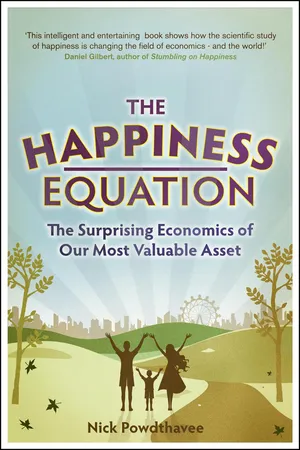
The Happiness Equation
The Surprising Economics of Our Most Valuable Asset
- 256 pages
- English
- ePUB (mobile friendly)
- Available on iOS & Android
eBook - ePub
About this book
Information
Topic
SozialwissenschaftenSubtopic
SoziologieCHAPTER 1
THE PURSUIT
Most of us go through life believing we know exactly what we need to make us happy. For the most part, we believe that all we ever need is to have someone we love loving us back. Or it’s a combination of more money, a good job, a stable marriage and perfect health. Sometimes it’s the little things in life, like a day off work; a clear blue sky on an autumn afternoon; a nice cup of cool mochaccino on a hot day; an hour-long foot rub; a day spent laughing with friends and family; 45 minutes of uninterrupted sex with our partner, and the energy to last for the best part of it.
But unfortunately – in the words of Mick Jagger and Keith Richards – we can’t always get what we want. At least, we can’t always get what we want all the time. A day off work every so often sounds like a good idea until, of course, we realise that we will become a little poorer because of it. And that’s no good because, according to the abstract idea we have in our heads of what makes a good life, money matters a lot. Okay then, in that case, we’ll put in more hours at work. But wait. That will also mean less time to be spent with friends and family, and that doesn’t seem so good either.
So what do we do, then? What do we do when our lives are a series of trade-offs between different combinations of ‘what ifs’? What do we do when there is an endless horizon of time and resource constraints constantly telling us that whatever we do, we can’t possibly have it all? Well, according to economists, who are supposedly experts on decision-making, what usually happens is that we try to do the best we can with our choices. We gather all necessary information about our options. We engage in rationalisation and mental calculations. We quietly argue and debate within ourselves over the potential impacts of each individual decision on our happiness. We cross-refer them to the rule-book of ‘All the things that make me happy’, put each possibility into an order of preference, and then, subject to both time and resource constraints, choose the best combination of bundles that we know would optimise our well-being.
Easy.
Bounded rationality
But of course, if that were true – if we always chose the best possible combination of options according to stable preference functions and the constraints facing them – then the way we led our lives would literally be disappointment-free. Whatever decisions we made, we would know exactly well in advance what we were getting ourselves into. After all, our rationality would have already done the homework for us: we would be getting the greatest reward at the lowest cost.
How could we possibly not be happy with that?
The reality, however, is that our lives are too often filled with disappointing and regrettable decisions, whether big or small. The holiday we went on last summer; that antique car we bought; or even the job or college degrees we picked. The following anecdotal evidence from a chance meeting between two economists and a dentist makes it all too clear.1
Two economics professors and friends, John Bennett and Chuck Blackorby, were attending an economics conference. On the first evening, they met a dentist at the hotel bar who was at an annual conference for dentists just next door to them. After a brief introduction and a couple of drinks, Chuck, who was known for his sometimes brash and direct manner, decided to ask the dentist, by then a little tipsy, a somewhat personal question.
‘So, tell me, are you very happy being a dentist?’
‘Happy? I’m miserable as a dentist’, replied the man.
Chuck smiled to himself. ‘What? If you’re so unhappy, why on earth did you choose to become a dentist in the first place?’
‘I didn’t choose to become a dentist.’ The man took another swig of his drink before delivering the final hammer blow. ‘It’s that stupid kid eighteen years ago that chose to become a dentist. Not me.’
And even when we’re not too disappointed; when we actually think we’re fairly satisfied with the choices we made, sometimes there’s just no way for us to know for certain whether or not we would have been happier if we’d gone with the alternatives. Take having children, for example. For most parents, a natural and genuine response to the question, ‘Would you be happier without children?’ would be a screaming ‘No!’ However, there’s no real way of knowing precisely what life would have been like if these parents had decided not to have their little David or Sarah – simply because the childless alternative didn’t take place for them. The same argument holds true for partners who choose not to become parents.
One of the main reasons why we aren’t always able to choose the best options for ourselves is that our rationality is often bounded by the amount of information it possesses, the cognitive limitations of our brains,2 and the finite amount of time we have to make a decision.3 According to the so-called ‘bounded rationality’ concept, we human beings are only partly rational – and downright irrational in the remaining part of our actions. While economists believe that all human beings are approximately Homo economicus (economic man), rational and broadly self-interested by nature, the reality is that we are just as likely, if not more likely, to let emotions overrule rationality and completely dictate the way we behave.
That we are not wholly rational is shown by studies that have identified two distinct sides to our brains: one that is rational – controlled, slow, deliberative and deductive; and one that is emotional – automatic, rapid, associative and affective.4 The mesh between the two is extremely complex, and one does not always dominate the other. And while economic theories of decision-making have tended to emphasise the operation of the rational side of our brain in guiding choice behaviour, it’s often the case that, when making decisions under pressure or under conditions where information is incomplete or overly complex, we tend to rely on simplifying heuristics or ‘gut feelings’ rather than extensive algorithmic processing.5 These ‘rules of thumb’ are far from perfect, and it’s precisely why we sometimes spend too much money on food when we go grocery shopping with an empty stomach,6 or find it increasingly difficult to walk away from a bus stop the longer we have been waiting for a bus to come – even if it would have been a lot quicker to walk than to wait for that damn bus to arrive.7
The adaptive unconscious and past experiences
But maybe it’s not always such a bad thing to trust our emotions. Research carried out by psychology professor Timothy Wilson suggests that, in situations where we have had a lot of experience, decisions made without thinking (those made on impulses and gut feelings) can often lead to better and happier outcomes than if they had been made under a strict rule of optimisation, simply because this is when the emotional part of our brain works best at detecting that something is out of the ordinary – even if we may not know ourselves what that something is at the time – and alerts us in the form of emotional alarm bells such as sweaty palms and butterflies in our stomach.8 And it’s in these scenarios that practice really makes perfect. It’s also where thinking too much about our past experiences can actually hurt rather than help us.
The question is: Why?
One reason. According to psychologist and Nobel laureate Daniel Kahneman, the cognitive part of our brain tends to suffer from what he called the ‘peak-end’ effect, which is the tendency to judge past experiences – both pleasant and unpleasant – almost entirely on how they were at their peak and how they ended.9
Kahneman and his colleagues illustrated the core concept of the peak-end theory in a series of experiments, most notably that involving hospital patients and the very painful colonoscopy procedure.10 While undergoing a colonoscopy, the patients reported their level of discomfort every 60 seconds throughout the procedure. Afterwards, the patients were asked to remember how unpleasant the procedure was, using several different scales including a ten-point scale, and also about the relative unpleasantness of the colonoscopy compared to other unpleasant experiences such as stubbing a toe, or an average visit to the dentist. What Kahneman and his colleagues found was astonishing. While there was almost zero correlation between the duration of the colonoscopies that different patients experienced and the global rating of the procedure, the relationship between the peak-end average (the average of the peaks and how the patients felt at the end of the procedure) and the global rating of the procedure was simply undeniable. In other words, we are more likely to remember our experience of a colonoscopy as being awful if the peaks of unpleasantness were very high or if it ended awfully for us, than if the entire procedure itself took a long time to finish. What matters is not the duration of an experience; we hardly ever think about it when we try to recall and judge how happy or unhappy we were in the past. It’s how we were feeling at the peaks and at the end of our experience that count the most.
What about frequency? Surely having experienced something often can teach us to repeat only the things that we remember with pleasure and fondness, and avoid those that we remember with embarrassment and regret? The trouble is, according to Harvard psychologist Daniel Gilbert, we are just not very good at remembering them correctly. He illustrates his point by prompting the readers of his book – Stumbling on Happiness – to think about where they were, whom they were with, and what they were doing when they first heard the news about the 9/11 attacks in 2001.11 Okay, that sounds easy enough. Closing my eyes, I can still remember that I was standing at one of the check-in counters at London Heathrow airport, trying to get on the evening flight to Bangkok. Sitting behind the Finnair counter was a man in his late 50s who, as I recall, spoke with a very thick Glaswegian accent.
‘So you’re off to Thailand then, eh? Ah, what a beautiful country! Lovely food, gorgeous beaches, very pretty women!’ His eyes twinkled as he said this.
I smiled politely, acknowledging his appreciation of my country of birth. I knew he was just trying to be friendly in what seemed to be a surprisingly empty airport on a Tuesday afternoon.
‘Okay, sir. Here’s your boarding pass. Have a nice flight … Oh, and have you heard? Two planes hit the World Trade Center not half an hour ago. Probably a terrorist attack. But since you’re flying to Finland first, I’m sure you’ll be just fine.’ He ended with a beam while I stood there, rigid as a board.
Like me, most people will be able to remember in fine detail what they were doing when they first heard the news. But, Gilbert added – would the same people also remember precisely where they were, whom they were with, and what they were doing on the morning of 10 September 2001, one day before the attacks?
I personally couldn’t, of course. And I’m confident enough to bet that not many people could either – a fact that is also true for most Americans.
The main reason why it’s relatively easier for us to recall the exact details of 11 September 2001, but nearly impossible to remember what happened a day earlier, is because momentous events like the 9/11 attacks do not happen frequently in our lifetime. While 11 September 2001 defied our every sense of normality, 10 September, by contrast, was like almost any other day. And unless we religiously keep a diary of everything that ever happened in our lives, any other day is nothing more than a blob in our memory bank.
Daniel Gilbert’s message is clear: it is the infrequent and unusual experiences that are most memorable. These are the ones that stick like glue to the clipboard of our memory cortex. Not the other way round.
Conventional wisdom and imagination
There are two lessons we can draw at this stage. The first is that, in situations where we have had a lot of experience, it’s perhaps better to trust our instincts when it comes to making a decision. And the second lesson, related to the first, is that it seems important not to rely completely on emotions in situations where we have had little or no prior experience. The explanation is simple: in these circumstances, the emotional part of our brain will not have had enough chances to adapt and learn from our past experiences, which will inevitably make it impossible f...
Table of contents
- Cover
- Title
- Copyright
- Contents
- About the author
- Dedication
- Quote
- Chapter 1
- Chapter 2
- Chapter 3
- Chapter 4
- Chapter 5
- Chapter 6
- Chapter 7
- Chapter 8
- Chapter 9
- Chapter 10
- Chapter 11
- Notes
- Bibliography
- Acknowledgements
Trusted by 375,005 students
Access to over 1.5 million titles for a fair monthly price.
Study more efficiently using our study tools.
Frequently asked questions
Yes, you can cancel anytime from the Subscription tab in your account settings on the Perlego website. Your subscription will stay active until the end of your current billing period. Learn how to cancel your subscription
No, books cannot be downloaded as external files, such as PDFs, for use outside of Perlego. However, you can download books within the Perlego app for offline reading on mobile or tablet. Learn how to download books offline
Perlego offers two plans: Essential and Complete
- Essential is ideal for learners and professionals who enjoy exploring a wide range of subjects. Access the Essential Library with 800,000+ trusted titles and best-sellers across business, personal growth, and the humanities. Includes unlimited reading time and Standard Read Aloud voice.
- Complete: Perfect for advanced learners and researchers needing full, unrestricted access. Unlock 1.5M+ books across hundreds of subjects, including academic and specialized titles. The Complete Plan also includes advanced features like Premium Read Aloud and Research Assistant.
We are an online textbook subscription service, where you can get access to an entire online library for less than the price of a single book per month. With over 1.5 million books across 990+ topics, we’ve got you covered! Learn about our mission
Look out for the read-aloud symbol on your next book to see if you can listen to it. The read-aloud tool reads text aloud for you, highlighting the text as it is being read. You can pause it, speed it up and slow it down. Learn more about Read Aloud
Yes! You can use the Perlego app on both iOS and Android devices to read anytime, anywhere — even offline. Perfect for commutes or when you’re on the go.
Please note we cannot support devices running on iOS 13 and Android 7 or earlier. Learn more about using the app
Please note we cannot support devices running on iOS 13 and Android 7 or earlier. Learn more about using the app
Yes, you can access The Happiness Equation by Nick Powdthavee in PDF and/or ePUB format, as well as other popular books in Sozialwissenschaften & Soziologie. We have over 1.5 million books available in our catalogue for you to explore.