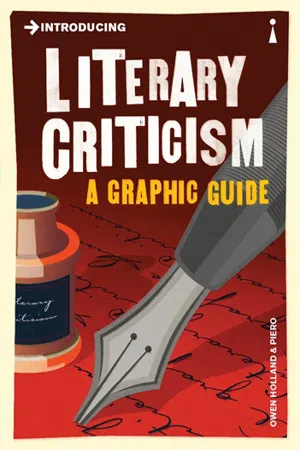
From Plato to Virginia Woolf, Structuralism to Practical Criticism, Introducing Literary Criticism charts the history and development of literary criticism into a rich and complex discipline.
Tackling disputes over the value and meaning of literature, and exploring theoretical and practical approaches, this unique illustrated guide will help readers of all levels to get more out of their reading.
- 176 pages
- English
- ePUB (mobile friendly)
- Available on iOS & Android
eBook - ePub
About this book
Information
Subtopic
Literary CriticismIndex
LiteratureWhat Is Literary Criticism?
This is a (short) introduction to literary criticism. It is a book about literary criticism and so, by necessity, it is not a book of literary criticism. It’s a truism to say that the literary critic’s object of study is literature. A book about literary criticism, then, is only indirectly a book about literature. For this reason, thorny questions as to what constitutes “literature” will have to be left aside at the outset, but it covers: novels, poems and plays, certainly, and much else besides. A literary critic, or a philosopher, might well ask: what is literature?

WHAT IS WRITING? WHY DOES ONE WRITE? FOR WHOM?
The French philosopher, literary critic and communist, Jean-Paul Sartre (1905–80) asked these very questions in 1947.
Our question is somewhat different: “What is literary criticism?” We might start with a broad generalization, and say that it includes any writing that claims to make judgements about the value, or otherwise, of literature in general or particular literary works. Arriving at such judgements is likely to entail interpretation (or close reading), comparison and informed analysis. Judgement might also involve claims about the intrinsic worth of literature, the aesthetic* merits and formal qualities of specific works, or their cultural and historical significance.

THOSE WHO POINT TO THE HISTORICAL CONTINGENCY OF LITERARY VALUE MIGHT NOT NECESSARILY AGREE WITH THOSE WHO ASSERT ITS INTRINSIC WORTH.
We will look at questions like this later on.
* Terms marked with an asterisk are explained in the Glossary on here-here.
For All Time?
Ben Jonson (1572–1637) is best known as a playwright and contemporary of William Shakespeare (1564–1616). When Jonson said this of Shakespeare:

HE WAS NOT OF AN AGE, BUT FOR ALL TIME.
… he made a claim about the universal and “trans-historical” value of Shakespeare’s writing.
So far, Jonson’s claim has been proved correct: Shakespeare’s plays are still performed for audiences that span the globe. Jonathan Bate (b. 1958), on the other hand, in his book The Genius of Shakespeare (1998), suggested that the globalization of Shakespeare might have had as much to do with the extension of the British Empire over large parts of the globe in the years after his death.

HAD THE HISTORY OF THE SPANISH EMPIRE TAKEN A DIFFERENT COURSE, PERHAPS LOPE DE VEGA (1562-1635), THE ACCLAIMED PLAYWRIGHT OF THE SPANISH GOLDEN AGE, MIGHT TODAY ENJOY SHAKESPEARE’S GLOBAL REPUTE.
So, is Shakespeare’s “genius” an innate quality of his being, or a matter of contingent and historical construction?
Aesthetics vs Morality
As such questions might suggest, the literary critic’s object of study is hardly a straightforward matter. For some, such apparently vulgar issues as imperialism and Empire ought not to be wheeled in when considering the specifics of literary value. On this view, questions of aesthetics and questions of morality are best kept separate.

THE SPHERE OF ART AND THE SPHERE OF ETHICS ARE ABSOLUTELY DISTINCT.
But can the “words on the page” of a given poem or novel really be held in splendid isolation from the text’s historical and cultural reception, or its history of publication and translation, or, say, its author’s penchant for producing propagandistic radio-broadcasts on behalf of Benito Mussolini, as did the 20th-century modernist poet Ezra Pound (1885–1972)?
For a literary critic, then, defining one’s object, or area, of study can be a contentious issue. Tracing the significance of references to Shakespeare in the novels of Thomas Hardy (1840–1928) might rank alongside a study of the metrical patterning of Alfred Tennyson’s (1809–92) verse in terms of scholarly rigour, but both of these topics might sit oddly next to a critical re-reading of Theodor Adorno’s (1903–69) Aesthetic Theory (1970) or an essay* on contemporary avant-garde poetry.

Times in which nature confronts man overpoweringly allow no room for natural beauty; as is well known, agricultural occupations, in which nature as it appears is an immediate object of action, allow little appreciation for landscape.
Such is the scope of the field in its contemporary incarnation as an academic discipline that is taught and studied in universities.
If you cherish aspirations of becoming a literary critic, you could do worse than to start by reading widely in the history of literary criticism. This book is, first and foremost, an introduction to some of the major historical practitioners of literary criticism. Literary criticism has a long history.

Even a brief overview, such as this one, will take us from Ancient Greece to Renaissance England and through into more recent departures in 20th-century literary theory.
There are certain limits to this book. It is a concise survey of a tradition of literary criticism formed in Anglo-Saxon universities in the 19th and 20th centuries, oriented around syllabuses that have tended largely to rely upon certain exclusions: because this book is a survey of that tradition, no space will be made for figures such as Abdallah ibn al-Mu’tazz (861–908) or Lu Xun (1881–1936), even though both of these writers were highly respected literary critics in their respective cultures.
Edward Said A postcolonial critic we’ll return to on here

The relatively recent rise of courses in Comparative Literature and Postcolonial Studies has gone some way towards challenging the 20th-century dominance of English Literature, but this topic is large enough to merit a separate introduction in itself.
Learning through Imitation
Literary criticism is a practice perhaps best learned through imitation. The German philosopher Walter Benjamin (1892–1940) reflected on the history of the concept of mimesis* (a word we will encounter again shortly in Aristotle’s Poetics):

Our gift for seeing similarity is nothing but a weak rudiment of the once powerful compulsion to become similar and also to behave mimetically. And the lost faculty of becoming similar extended far beyond the narrow perceptual world in which we are still capable of seeing similarities.
The Critic as Chameleon
The best way of becoming a literary critic, then, is to read widely in the work of other literary critics, while also paying careful attention to the literary critic’s object of study.

One might think of the literary critic as a kind of empathetic chameleon, disinterestedly capable of extending imaginative sympathy to the range of human actors, conditions and motivations that are represented in literary texts.
As...
Table of contents
- Cover
- Title Page
- Copyright
- Contents
- What Is Literary Criticism?
- Glossary
- Further Reading
- About the Authors
- Index
Trusted by 375,005 students
Access to over 1.5 million titles for a fair monthly price.
Study more efficiently using our study tools.
Frequently asked questions
Yes, you can cancel anytime from the Subscription tab in your account settings on the Perlego website. Your subscription will stay active until the end of your current billing period. Learn how to cancel your subscription
No, books cannot be downloaded as external files, such as PDFs, for use outside of Perlego. However, you can download books within the Perlego app for offline reading on mobile or tablet. Learn how to download books offline
Perlego offers two plans: Essential and Complete
- Essential is ideal for learners and professionals who enjoy exploring a wide range of subjects. Access the Essential Library with 800,000+ trusted titles and best-sellers across business, personal growth, and the humanities. Includes unlimited reading time and Standard Read Aloud voice.
- Complete: Perfect for advanced learners and researchers needing full, unrestricted access. Unlock 1.5M+ books across hundreds of subjects, including academic and specialized titles. The Complete Plan also includes advanced features like Premium Read Aloud and Research Assistant.
We are an online textbook subscription service, where you can get access to an entire online library for less than the price of a single book per month. With over 1.5 million books across 990+ topics, we’ve got you covered! Learn about our mission
Look out for the read-aloud symbol on your next book to see if you can listen to it. The read-aloud tool reads text aloud for you, highlighting the text as it is being read. You can pause it, speed it up and slow it down. Learn more about Read Aloud
Yes! You can use the Perlego app on both iOS and Android devices to read anytime, anywhere — even offline. Perfect for commutes or when you’re on the go.
Please note we cannot support devices running on iOS 13 and Android 7 or earlier. Learn more about using the app
Please note we cannot support devices running on iOS 13 and Android 7 or earlier. Learn more about using the app
Yes, you can access Introducing Literary Criticism by Owen Holland,Piero Pierini,Piero in PDF and/or ePUB format, as well as other popular books in Literature & Literary Criticism. We have over 1.5 million books available in our catalogue for you to explore.