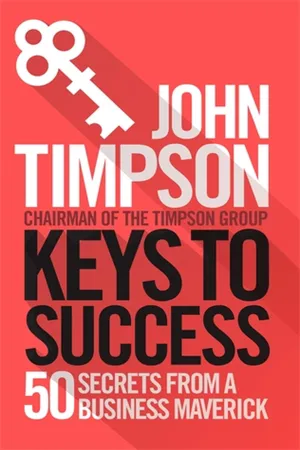
John Timpson, Chairman of the eponymous British high street chain, knows a thing or two about running a successful business. Over many years he revolutionised how his firm worked, developing his philosophy of upside-down management, and has reaped the rewards – the Timpson group (which includes the Snappy Snaps and Max Spielmann chains).
Timpson, whose weekly
Daily Telegraph column and regular media appearances have made him a well-known business commentator, here shares his secrets. Full of actionable advice,
Timpson's Top Business Tips is a step-by- step MBA for business women and men who need results now.
From encouraging flexible working, having a happy index and a great bonus scheme to the importance of checking the cash on hand every day and planning for disaster scenarios; from why you should never make decisions at meetings to the value of a mentor – even when you're at the top – these are essential markers on your roadmap to business success, whatever business you're in.
- 224 pages
- English
- ePUB (mobile friendly)
- Available on iOS & Android
eBook - ePub
About this book
1
Break the rules

If it doesn’t feel right, don’t do it.
Management is an art not a science; break the rules, but stick to your principles.
I am pleased that Nottingham University awarded me a Bachelor of Arts not Bachelor of Science when I completed my degree in Industrial Economics – management is an art not a science. This is much misunderstood throughout business, government and the public services where most managers do their job by following a process and sticking to their rules.
As a result, performance is measured by the ability to follow the process rather than concentrating on the ultimate objective. When recruiting, it doesn’t matter if you pick a poor candidate as long as you follow the proper interview process. Ofsted can withdraw an ‘outstanding’ rating from an amazingly good school simply because a bit of the paperwork is missing. Our well established and highly successful Timpson apprenticeship scheme doesn’t qualify for any government grants because there isn’t an NVQ for cobblers. Young doctors get disillusioned with the NHS because they have invisible bosses who are policing a process that soaks up time that should be spent caring for patients.
As C. Northcote Parkinson predicted, it is getting worse. Organisations become an end in themselves, building a bigger team that spends their time devising rules to tell other people how to do a job they don’t do themselves. Beware any organisation that uses the phrases ‘evidence-based’, ‘joined-up thinking’, ‘working party’ or ‘in-depth study’.
We really don’t have to put up with all the rules that get in the way of doing our day-to-day business. Business leaders only have themselves to blame for allowing lawyers, accountants and so-called ‘professional managers’ to dictate that the only way we can do business is by sticking to the rules and following what they consider to be best practice.
I didn’t realise how bad things have become until we took part in a government procurement process in connection with the proposal to introduce biometric passports.
We were naive, thinking all that mattered was our ability to provide future passport holders with a great service in capturing the new data. But the process was run under strict EU guidelines which eliminated any chance of a company as small as ours competing. It was all done online, no one wanted to see who we are or what we do – the winner was bound to be the team that picked professional advisors, who proved to be the best at following the process. We fell at the first hurdle, but it all came to an end with a change of government. Biometric passports were abandoned, every bidder had to put their hard work down to experience, but the professionals still picked up their fees. What a waste of time, money and talent.
I’ve always been a bit of a maverick, keen to stand my ground when authority flies in the face of common sense. Many times I’ve been told ‘You can’t do that’, a remark that makes me even more determined to do it my way. I got a lot of cautionary advice when we were introducing Upside Down Management. ‘You can’t let each shop charge what they want – you have to have a price list.’ ‘I have a price list’, I replied, ‘and I let each shop charge what they want.’ I have had similar debates over our approach to poor performers who we politely and generously ask to leave without the pedantic production of oral and written warning. ‘You must find yourself in lots of employment tribunals’, I’m told, but we don’t, because we treat our colleagues as human beings rather than part of a process.
I was inspired in this determined quest to ignore perceived best practice and follow my instincts by my wife Alex, whose allergy to process was so acute she never stayed in a meeting for more than an hour. Alex saw way beyond the daily constraints of form-filling (which I had to do on her behalf) and budgeting (she never looked at her bank account). By keeping clear of the conventional ways of business, Alex had a vivid view of the big picture, and a perceptive insight into people’s personality. Alex could never understand why businesses needed to compile long reports or hold meetings that lasted longer than an hour. While most of the world made things more complicated, Alex simply used a bit of intuition and a lot of common sense. Give me inspired instinct rather than measured process every time.
My maverick mood was strengthened by a breakfast meeting with Judith Hackitt CBE, then Chief Executive of the Health and Safety Executive. Our meeting was the result of an article I wrote in my Telegraph column about silly Health and Safety regulations that get companies to spend extra money when they should be making individual colleagues more responsible for their own safety. I found that Judith and I were in total agreement and we went on to talk about PAT testing of electrical equipment. Over breakfast with Judith, I discovered there is no legal requirement: PAT tests are entirely voluntary. I checked with Michelle (the sole member of our Health and Safety department), who confirmed it to be true – no statute talks about PAT testing, it is just the safety consultants who say it is the only way to make sure you are compliant. Michelle went on to tell me that over two years none of our PAT tests (at a cost of £40,000) had revealed a fault – every electrical problem had been discovered and reported by our own colleagues. We now only carry out the tests in shops where the landlord makes it a condition of the lease.
Another, even more bizarre procedure that businesses thought they had to follow, was created in the 1960s when, every fortnight, two women came to our office to clean and disinfect our telephones. They kept coming for years before anyone realised it was a complete waste of money. It’s satisfying to know that we are not the first generation to fall for these snake oil salesmen.
It is particularly frustrating when you come up against silly rules you can’t break, like the security inspection at Fenchurch Street station. Our tiny shop had an open front with a space no more than 3ft × 6ft between the counter and the pavement. Every retailer at the station had to inspect their customer area every hour and sign a form to confirm nothing suspicious had been found. A security guy called every hour to check we had filled in the form. One day our shop colleague had to leave the shop to pick up some shoes from a customer and missed checking the 18 square feet and failed to tick the 10.00am box, so the station manager punished us by shutting the shop for the rest of that day. As the branch didn’t make much money, we solved the problem by shutting the shop for good.
Some of the most stupid rules have been created by employment lawyers who seem to think that there is absolutely no difference between one person and another. Alex was on the interview panel for a new head at our local primary school and came to me with a copy of all the application forms. ‘But they don’t tell me what I want to know’, she said. ‘I don’t know anything about these people – age, sex, home background and everything I would be interested in is missing from their application form and to make it worse they all seem to say exactly the same thing about why they should be given the job.’ To avoid being accused of discrimination we are in danger of discriminating in favour of people who would be no good at the job.
A lot of this modern day ‘best practice’ has been fashioned by accountants, lawyers and consultants, who can be called the rules creation and exploitation sector. Every new bit of legislation brings a new round of breakfast seminars at which professional firms tell us how to keep within the new laws while enhancing their fee income. Don’t you cringe whenever someone stops you in the street to ask ‘Have you had an accident at work?’ By finding a new source of income, lawyers and insurance companies put up the cost of running every other business.
By now you must have guessed that I take a certain pleasure in breaking the rules, but I do so with a purpose. Entrepreneurs make money by using their initiative and being different. If you tread the same path and follow the same process as everyone else you won’t stand out from the crowd and can never create a great business.
We must be the only major retailer that refuses to use EPOS (electronic point of sale), but by denying our central support team the chance of being in total control, we have given our branch colleagues the freedom to give great service. By having the courage to do it in our own way, we have managed to establish a level of customer care that is starting to stand out from other retailers.
The way most companies now do business reminds me of the story of the emperor’s suit of clothes. No one seems to have the courage to blow the whistle on all the process and best practice or see through the plastic world of box-ticking. Be like the little boy who saw the truth – bold business leaders see through convention and follow their convictions. If it doesn’t feel right, don’t do it.
2
Upside Down Management
This is the big idea that made us much more money and established a strong company culture.
Upside Down Management is great for colleagues’ wellbeing.
When I started to read The Nordstrom Way, written about the eponymous American chain of department stores, I didn’t realise that it was going to make such a massive difference to the way we run our business.
The book reveals the secret behind great customer service. Most companies get it wrong. You can’t create great service simply by writing a set of rules, not much is achieved by inventing friendly phrases designed to impress customers, and customer care training courses seldom give the customers the sort of service that will make them go ‘Wow’. The secret is so obvious and so simple, I’m embarrassed to admit that I was running our company for over 21 years before I got the message.
The secret is to trust your colleagues with the freedom to serve each individual customer in the best way they can. Exceptional service, when colleagues sometimes literally go the extra mile, usually occurs when the customer has an unusual request, something that can’t be covered by a set of rules. Nordstrom gave their front-line sales clerks total authority to use their initiative, and they did something else that made a big impression on me. In the middle of the book was a management chart that was upside down. The people who served the customers were up at the top and the chief executive was right at the bottom. The sales clerks are top of the tree because they do the key job that makes the money; everyone else in the company is there to help and support their colleagues on the front line.
Upside Down Management suddenly seemed to me such an obvious thing to do. As a manager who couldn’t repair shoes or cut a key I had, for years, been reliant on colleagues, working in our shops, to do the jobs that made us the money. I was never in a position to tell them what to do, so it seemed far better to abandon the traditional management methods of command and control and concentrate on giving front-line colleagues trust and support.
As soon as I got the message, I was on a mission to turn our management structure upside down, but it took a long time to persuade the rest of my business. Shop colleagues, who I thought would welcome the freedom on offer, were reticent and most of middle management totally disagreed with the whole idea.
The people in our shops were so used to following our rule book that they didn’t believe I was seriously going to give them the freedom to do whatever they wanted. And those that thought it was a good idea were wary of their area managers who had always kept rigid control.
Recognising that people like to have some rules, I just had two: 1) Look the part; 2) Put the money in the till. But to emphasise the degree of trust, I added two guidelines: 1) Anyone, even a new recruit in their first week, can spend up to £500 to settle a complaint, without reference to anyone else; 2) The price list is only a guide – you can charge whatever you think is the appropriate price.
Gradually shop colleagues got the message, but it took me nearly five years to get our area managers to let go. It was difficult to stop them issuing orders. ‘How can I be responsible for the results of my area’, they argued, ‘if I can’t tell anyone what to do?’ Some feared for their job – ‘If I hand over the authority for everything to members of my team, what will be left for me to do?’ I wrote a manual about their new role and we discussed it, section by section, at area manager conferences spread over a period of nearly three years. Gradually some area managers got it and became enthusiastic, while a few uncooperative managers moved on to different roles. It isn’t surprising it took so long to change their attitude; culture change doesn’t happen overnight.
Once our area managers were persuaded, they suddenly realised that their new job was so much better than the old one. Instead of dreaming up all the rules and telling everyone what to do, they now have the time to pick the right people, put them together in strong teams and clear away any obstacles in the way of them doing a great job. With many of those obstacles being problems that occur outside work, our area managers now find that providing a sort of social service is an important part of their job.
Originally I saw Upside Down Management as a way of providing a better service by giving trust and freedom to the front line, but now I know that everyone in the organisation should be trusted to do their job in the way they want. Managers can run their department in their own way as long as they give the same freedom to all the members of their team. The principle even applies to me – I can’t issue orders but I don’t have to follow anyone else’s rules. I might have to comply with the law but there is no need for me to follow ‘best practice’. Like everyone else who works at Timpson I do my job in my own way.
We started Upside Down Management in 1998 and it has worked better with every year that goes by. There are many reasons why it has been so successful. For a start it makes you pick people with a great personality – it soon became clear that dull and pedestrian characters don’t use their initiative. In addition, the business has become bristling with ideas created by colleagues with the freedom to do their own thing. Most of all, our colleagues enjoy coming to work.
Colleagues really like being trusted, they take a pride in running a shop they feel they can call their own. They value the freedom to make decisions and the support they get from a boss who doesn’t issue any orders. When we acquired the Morrisons dry cleaning business in June 2016, the colleagues who transferred to Timpson were amazed that we have such a relaxed approach to business with so few rules and so much freedom.
I wasn’t surprised when a psychologist, who had made a study of the power of delegation, told me that having the freedom to be in control of your working life is very good for employees’ wellbeing. Perhaps that’s why I find it such fun visiting our shops and meeting so many colleagues with a smile on their face. I will never forget the comment from a colleague who joined us when we bought the business where he was working. ‘I was worried at first’, he told me, ‘but after two years I am amazed how much my life has changed. I now look forward to coming to work and I also look forward to going home, where my wife says I’m more relaxed and much better company.’ There is no doubt that a happy workforce will produce better results – another reason why Upside Down Management is so good for business.
But there is another big benefit. When you have established an upside down culture and no longer issue any orders you will find that the business is much easier to run. You no longer have to create a set of standing orders, there is no need to devise a process for everyone to follow. With no rules, your management team don’t have to spend their time checking that everyone is following company policy. By giving every colleague the freedom to do their job in a way that suits them, managers can concentrate on the things that matter – choosing the right strategy, picking people with personality and giving them the support they need to put the strategy into practice.
I promise you it works and it must be the easiest way to run a business.
3
Trust your people
Businesses that are paranoid about theft and security create a negative atmosphere, stifle initiative, prevent proper personal service and undermine company loyalty.
If you can’t trust your colleagues you must be picking the wrong people.
I’ve never un...
Table of contents
- Copyright Page
- Dedication
- About the Author
- Contents
- Introduction
- Chapter 1: Break the rules
- Chapter 2: Upside Down Management
- Chapter 3: Trust your people
- Chapter 4: Only two rules
- Chapter 5: No one issues orders
- Chapter 6: Pick people with personality
- Chapter 7: Encourage flexible working
- Chapter 8: Say goodbye to drongos
- Chapter 9: Promote from within
- Chapter 10: Be wary of outsiders
- Chapter 11: Look after the superstars
- Chapter 12: Rescue over-promoted colleagues
- Chapter 13: Create a great company culture
- Chapter 14: No Head Office
- Chapter 15: Everyone knows the boss
- Chapter 16: Keep walking round the business
- Chapter 17: Town Hall meetings
- Chapter 18: You run PR
- Chapter 19: Weekly newsletter
- Chapter 20: Send handwritten letters
- Chapter 21: Amazing ways to say ‘Well Done!’
- Chapter 22: Have a great bonus scheme
- Chapter 23: Celebrate success
- Chapter 24: Keep looking for new ideas
- Chapter 25: Have a ‘Happy Index’
- Chapter 26: Perfect Day
- Chapter 27: Communicate in pictures
- Chapter 28: The Residential
- Chapter 29: The Annual Report
- Chapter 30: Never make decisions at a meeting
- Chapter 31: Stick to what you know
- Chapter 32: Buy poor performers
- Chapter 33: Keep management accounts off the Board agenda
- Chapter 34: Cash for growth
- Chapter 35: Disaster scenarios
- Chapter 36: Check the cash every day
- Chapter 37: Learn from mistakes
- Chapter 38: Summits
- Chapter 39: Chairman’s Report 2032
- Chapter 40: Agree with your customers
- Chapter 41: Be friends with everyone
- Chapter 42: Trust your intuition
- Chapter 43: Be yourself
- Chapter 44: Have a social conscience
- Chapter 45: Have a company charity
- Chapter 46: Sit down with an A4 pad
- Chapter 47: Recognise stress
- Chapter 48: Have a mentor
- Chapter 49: Spend plenty of time with your family
- Chapter 50: Keep it simple
- Top 25 Phrases
- Back Cover
Trusted by 375,005 students
Access to over 1.5 million titles for a fair monthly price.
Study more efficiently using our study tools.
Information
Publisher
Icon BooksYear
2017Topic
BusinessPrint ISBN
9781785781995
Subtopic
Business SkillseBook ISBN
9781785782008
Index
BusinessFrequently asked questions
Yes, you can cancel anytime from the Subscription tab in your account settings on the Perlego website. Your subscription will stay active until the end of your current billing period. Learn how to cancel your subscription
No, books cannot be downloaded as external files, such as PDFs, for use outside of Perlego. However, you can download books within the Perlego app for offline reading on mobile or tablet. Learn how to download books offline
Perlego offers two plans: Essential and Complete
- Essential is ideal for learners and professionals who enjoy exploring a wide range of subjects. Access the Essential Library with 800,000+ trusted titles and best-sellers across business, personal growth, and the humanities. Includes unlimited reading time and Standard Read Aloud voice.
- Complete: Perfect for advanced learners and researchers needing full, unrestricted access. Unlock 1.5M+ books across hundreds of subjects, including academic and specialized titles. The Complete Plan also includes advanced features like Premium Read Aloud and Research Assistant.
We are an online textbook subscription service, where you can get access to an entire online library for less than the price of a single book per month. With over 1.5 million books across 990+ topics, we’ve got you covered! Learn about our mission
Look out for the read-aloud symbol on your next book to see if you can listen to it. The read-aloud tool reads text aloud for you, highlighting the text as it is being read. You can pause it, speed it up and slow it down. Learn more about Read Aloud
Yes! You can use the Perlego app on both iOS and Android devices to read anytime, anywhere — even offline. Perfect for commutes or when you’re on the go.
Please note we cannot support devices running on iOS 13 and Android 7 or earlier. Learn more about using the app
Yes, you can access Keys to Success by John Timpson in PDF and/or ePUB format, as well as other popular books in Business & Business Skills. We have over 1.5 million books available in our catalogue for you to explore.