FROM THE AUTHOR OF THE SUNDAY TIMES NUMBER ONE BESTSELLER
THE ETYMOLOGICON.
'Reading
The Horologicon in one sitting is very tempting' Roland White,
Sunday Times.
Mark Forsyth presents a delightfully eccentric day in the life of unusual, beautiful and forgotten English words.
From
uhtceare in the hours before dawn through to dream
drumbles at bedtime,
The Horologicon gives you the extraordinary lost words you never knew you needed.
Wake up feeling rough? Then you're
philogrobolized. Pretending to work? That's
fudgelling (which may lead to
rizzling if you feel sleepy after lunch). A Radio 4 Book of the Week,
The Horologicon is an eye-opening, page-turning celebration of the English language at its most endearingly arcane.
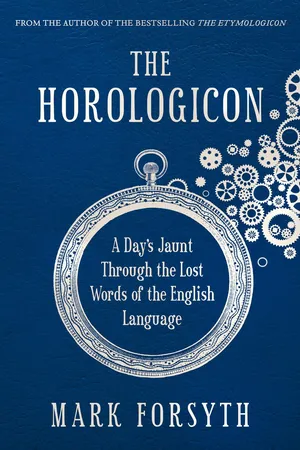
eBook - ePub
The Horologicon
A Day's Jaunt Through the Lost Words of the English Language
- 272 pages
- English
- ePUB (mobile friendly)
- Available on iOS & Android
eBook - ePub
About this book
Information
Chapter 1
6 a.m. – Dawn
Alarm clocks – trying to get back to sleep – feigning illness

There is a single Old English word meaning ‘lying awake before dawn and worrying’. Uhtceare is not a well-known word even by Old English standards, which were pretty damn low. In fact, there is only one recorded instance of it actually being used. But uhtceare is there in the dictionaries nonetheless, still awake and waiting for dawn.
Uht (pronounced oot) is the restless hour before the dawn, when Aurora herself is loitering somewhere below the eastern horizon, rosying up her fingers and getting ready for the day. But for now, it is dark. And in the antelucan hush you should be happily slumbering and dreaming of pretty things.
If you are not, if you are lying there with your eyes wide open glaring at the ceiling, you are probably suffering from a severe case of uhtceare.
There’s an old saying that the darkest hour comes just before the dawn. However, that’s utter tosh. If you get out of bed and peek through the window, you will see a pale glow in the east. But don’t, whatever you do, actually get out of bed. It’s probably chilly and you’ll never get your posture in bed (technically called your decubitus) quite right again. You’ll just have to lie there and try not think about how horrid it all is.
Ceare (pronounced key-are-a) was the Old English word for care and sorrow, emotions that have an annoying habit of striking during the uht. For some reason these early hours are the time when you remember all your sins and unpaid bills and, perhaps, the indelicate thing you did last night, and as each of these creeps into your mind your uhtceare grows more and more severe.
For an affliction so common, uhtceare is a very rare word. It is recorded only once in a poem called The Wife’s Lament, which, surprisingly, isn’t about how awful and messy her husband is, but about how he has been exiled to a far country and left her here with her uhtceare and her vicious in-laws. Old English poetry is almost universally miserable, and Old English poets should really have bucked up a bit, but they did give us uhtceare and for that we should be grateful.
The Old English used to cure their uhtceare by going to listen to the monks singing their uht song. But the monks are long since gone and you have nothing to distract you except for the possible chirruping of an insomniac songbird or the gentle sound of the dustman.
One qualification remains, though, before you self-diagnose with uhtceare. Are you sure you’re awake?
Many is the time that I have lain awake before dawn thinking that I would be able to get back to sleep if only this giant squirrel would stop chasing me round the dentist’s surgery. These strange half-dreamful, half-conscious delusions and illusions have a technical name – they are hypnopompic. Hypno from the Greek for sleep and pompic from the word for sending.
Nor should you be too keenly oneirocritical. Oneirocritical means ‘of or pertaining to the interpretation of dreams’. If your dream has a meaning it is probably obscene, and best forgotten, something that will happen in a couple of minutes anyway.
So best to suffer your uhtceare in silence and wait for the day-raw, which is the first streak of red in the dawn sky. Aside from being terribly pretty and a warning to shepherds, the day-raw will also decide whether today is a high or low dawn. Low dawn is when the sun appears straight over the horizon, high dawn is when it is, at first, obscured by clouds and then pops out suddenly in its glorious nuclear-fusive majesty farther up in the sky.
Whatever happens, this is the dayening, the greking. An eighteenth-century highwayman would have called it the lightmans, for some reason, and would probably have decided that this was the time to go home to bed, making way for the eighteenth-century farmers who would have called it, rather charmingly, the day-peep. Exhausted chorus girls in 1940s New York would have called it early bright. But for you it is simply the end of your usual uhtceare and the cue, one suspects, for your expergefactor.
Alarm clocks
An expergefactor is anything that wakes you up. This may simply be your alarm clock, in which case it is time to hit the snooze button. But it may be a dustman or a milkman or a delivery van, in which case it is time to lean out of your window and shriek: ‘Damn you all, you expergefactors!’ This ought to keep them quiet until one of them has at least found a good dictionary.
You may, though, not have opted for the alarm clock. Many people, for reasons that baffle, make the radio their expergefactor of choice. If this is the case, you will be horribly awoken by news of far-off massacres, earthquakes, plagues, elections etc., or by voices of anxious politicians explaining exactly why they were utterly blameless and how the money or mistress was simply resting in their account or bed.
The technical term for a dishonest politician is a snollygoster. Well, all right, it may not be the technical term, but it is the best one. The OED defines snollygoster as ‘A shrewd, unprincipled person, esp. a politician’, although an American journalist of the 1890s defined it more precisely (if less clearly) as:
… a fellow who wants office, regardless of party, platform or principles, and who, whenever he wins, gets there by the sheer force of monumental talknophical assumnacy.
Unfortunately, the American journalist didn’t stop to explain what talknophical or assumnacy meant. I can’t see why snollygoster has fallen out of use, unless perhaps politicians have all become honest, in which case the rest of us owe them an apology.
If you feel that snollygoster is too ridiculous a way to refer to a dishonest man who holds public office, you may always refer to that voice on the radio by the name throttlebottom.
Either way, you shouldn’t use the radio news as a means to wake you up, as it is liable to irritate or depress or both. Also it may distract you from the correct method of expergefaction: an aubade.
Turn off the radio.
Turn off the alarm clock.
Listen carefully.
Do you hear an aubade?
An aubade is a song sung at dawn by your lover beneath your bedroom window. Providing that your lover can carry a tune, a good aubade is enough to put you in a merry mood until at least breakfast. However, if you cannot, at present, hear an aubade there are only two sad possibilities: I am sorry to have to break this to you so early in the day, but either your lover is a lazy, lollygagging shirker of his/her duties; or you have no lover at all.
In the olden days they had a much better system of waking people up. There was a chap called a knocker-up who would wander around the village tapping on people’s bedroom windows with a special stick. This was actually considered a proper job and was probably a lot safer than its alternative: the weaver’s larum.
A weaver’s larum was an odd device that worked like this. Take a reasonably heavy object like a stone or a small child and tie two pieces of string to it. Both these pieces of string should then be fed through a single hook. One of them should be attached to the wall, so that the string is taut and the stone/baby dangles. The second piece of string, which is loose, should be tied to your finger.
Got that? Heavy object attached by a taut string to the wall and by a loose string to your finger.
Right, now get a tall, thin candle and put its base right next to the taut bit of string. Now light the candle and drift off to sleep. During the night the candle will slowly burn down and down until the flame gets to the piece of string, which is incinerated. The stone/baby falls to the floor and your finger gets a vigorous yank to pull you rudely from your slumbers.
The final possibility is a reveille. This is the drum roll or bugle-blast that’s meant to waken a whole barracks full of soldiers. It’s thus a term that can usefully be applied to the noise of dustmen, children or any of the other inconveniences and natural expergefactors of modern life.
Zwodder
Uhtceare is now officially over; however, that does not mean that you feel great. There is a word for people who are breezy and bright in the morning: matutinal. In fact, there are a bunch of words, but most of them are rude. As Oscar Wilde observed, only dull people are brilliant at breakfast. And, anyway, breakfast is still a long way off.
For the moment, you can lie there in a zwodder cursing the arrival of a new day. The rather racy lexicographical classic Observations on some of the Dialects in the West of England, particularly Somersetshire (1825) defines a zwodder as: ‘A drowsy and stupid state of body or mind.’
This would, in and of itself, make zwodder a useful word. But the really important thing is how it sounds. Say it. Zwodder. It’s the sort of word that can and should be mumbled from the refuge of your bedclothes. Zwodder. It’s the drowsiest word in the English language, but there’s also something warm and comfortable about it.
Alternatively, you could be addled, stupefied and generally speaking philogrobolized, a word that should be said at about an octave beneath your normal speaking voice and reserved for the morning after the carnage before. As responses to ‘How are you this morning?’ go, ‘Philogrobolized’ is almost unbeatable. Nobody will ever have to ask you what you mean as it’s all somehow contained in the syllable grob, which is where the stress should always be laid. It conveys a hangover, without ever having to admit that you’ve been drinking.
Another rather more religious way of doing this is to speak enigmatically of your ale-passion. Passion here is being used in its old sense of suffering, as in the Passion of Christ. (That a word for suffering became a synonym for romantic love tells you all you need to know about romance.) Ale-passion is mentioned in the 1593 book Bacchus Bountie in the following context:
Fourthly, came wallowing in a German, borne in Mentz, his name was Gotfrey Grouthead; with him he brought a wallet full of woodcocks heads; the braines thereof, tempered with other sauce, is a passing preseruatiue against the ale-passion, or paine in the pate.
In fact, you should probably keep a small aviary of woodcocks next to your bed, just in case. If not, you will lie there feeling awful. You will suffer from xerostomia, the proper medical term for dryness of the mouth through lack of saliva. But there will be nothing you can do about it unless you actually get out of bed. You’re also liable to have slumbered in the wrong decubitus and found that your arm has fallen asleep, a condition that the medical world refers to as obdormition. The only way to cure this is to wave the said limb about frantically, like a string-puppet having a fit, until the prinkling starts and your blood slowly, reluctantly resumes its patrol.
Alas that such sufferings should invade your bleary-eyed lippitude. Now is the zwoddery time when you wish that you’d invested in thicker curtains, for the sun is insistent, and you ...
Table of contents
- Title page
- Copyright information
- Contents
- About the author
- Acknowledgements
- The Inky Fool blog
- Epigraph
- Dedication
- Preambulation
- Chapter 1
- Chapter 2
- Chapter 3
- Chapter 4
- Chapter 5
- Chapter 6
- Chapter 7
- Chapter 8
- Chapter 9
- Chapter 10
- Chapter 11
- Chapter 12
- Chapter 13
- Chapter 14
- Chapter 15
- Chapter 16
- Chapter 17
- Chapter 18
- Chapter 19
- Epilogue
- Appendix
- Dictionaries and Idioticons
- Index
- The Etymologicon
- The Etymologicon Audiobook
Trusted by 375,005 students
Access to over 1.5 million titles for a fair monthly price.
Study more efficiently using our study tools.
Frequently asked questions
Yes, you can cancel anytime from the Subscription tab in your account settings on the Perlego website. Your subscription will stay active until the end of your current billing period. Learn how to cancel your subscription
No, books cannot be downloaded as external files, such as PDFs, for use outside of Perlego. However, you can download books within the Perlego app for offline reading on mobile or tablet. Learn how to download books offline
Perlego offers two plans: Essential and Complete
- Essential is ideal for learners and professionals who enjoy exploring a wide range of subjects. Access the Essential Library with 800,000+ trusted titles and best-sellers across business, personal growth, and the humanities. Includes unlimited reading time and Standard Read Aloud voice.
- Complete: Perfect for advanced learners and researchers needing full, unrestricted access. Unlock 1.5M+ books across hundreds of subjects, including academic and specialized titles. The Complete Plan also includes advanced features like Premium Read Aloud and Research Assistant.
We are an online textbook subscription service, where you can get access to an entire online library for less than the price of a single book per month. With over 1.5 million books across 990+ topics, we’ve got you covered! Learn about our mission
Look out for the read-aloud symbol on your next book to see if you can listen to it. The read-aloud tool reads text aloud for you, highlighting the text as it is being read. You can pause it, speed it up and slow it down. Learn more about Read Aloud
Yes! You can use the Perlego app on both iOS and Android devices to read anytime, anywhere — even offline. Perfect for commutes or when you’re on the go.
Please note we cannot support devices running on iOS 13 and Android 7 or earlier. Learn more about using the app
Please note we cannot support devices running on iOS 13 and Android 7 or earlier. Learn more about using the app
Yes, you can access The Horologicon by Mark Forsyth in PDF and/or ePUB format, as well as other popular books in Languages & Linguistics & Historical & Comparative Linguistics. We have over 1.5 million books available in our catalogue for you to explore.