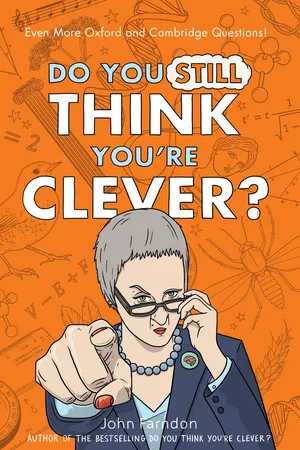
From the ever-curious mind that brought you the bestselling Do You Think You're Clever? comes a brand-new trip to the far reaches of the intellectual universe, courtesy of even more notoriously provocative Oxbridge interview questions.
How would you poison someone without the police finding out? (Medicine, Cambridge)
What makes a strong woman? (Theology, Oxford)
Instead of politicians, why don't we let the managers of IKEA run the country? (Social and Political Sciences, Cambridge)
How do you organise a successful revolution? (History, Oxford)
Whether you're interested in going to Oxbridge or just want to give your brain a workout, join polymath John Farndon on another exhilarating journey through the twists and turns of thought, and explore just what it means to be genuinely clever – rather than just smart.
- 288 pages
- English
- ePUB (mobile friendly)
- Available on iOS & Android
eBook - ePub
About this book
Information
Topic
PhilosophySubtopic
Philosophy History & TheoryWhat is the square root of –1? (Maths, Oxford)
This is perhaps the most elusive number in maths, still not entirely answered after millennia of trying by pretty much all the greatest mathematicians. The problem is not just with 1, but with any negative number. A square root must be the number which, when squared, gives the original number. So the square root of 9 is 3 (3 × 3 = 9), the square root of 4 is 2 (2 × 2 = 4) and the square root of 1 is 1 (1 × 1 = 1). But it doesn’t work with negative numbers, because any two negatives multiplied together is positive, so –2 × –2 = (+)4, and –1 × –1 = (+)1.
So how can you find the square root of a negative number such as –1? The fact is you can’t and so mathematicians call them ‘imaginary’ numbers. They might just as well have called them impossible numbers, or absurd numbers, or downright silly numbers, because they don’t appear to exist. And yet we’d find it hard to live without them nowadays. They’re vital for cutting-edge quantum science, but they’re also vital in the design of aircraft wings and suspension bridges. They’re imaginary because they cannot be tagged to any real number, yet they are ‘real’ because they are part of the real world. So they are paradoxically both imaginary and real, impossible yet possible.
This ambiguity was discovered by the Ancient Egyptians long ago, and one of the great mathematicians of the ancient world, Hero of Alexandria, came across it nearly 2,000 years ago when he tried to calculate the volume of a pyramid sliced off across the top. In his calculations, Hero needed to find the square root of 81 – 144. The answer is, of course, √–63. This is negative so there is no calculable root, so Hero simply switched the sign to a plus and said the answer was √63. It was, of course, a complete fudge, but what else could Hero do? Even negative numbers were regarded warily in his time, so the idea of square roots of negatives was a complete no-no.
Medieval mathematicians came across the problem sometimes when they worked on cubic equations, but they simply dismissed negative roots as ‘impossible’ numbers. It was the (apparently) rather disreputable Italian astrologer Girolamo Cardano who finally began to break the deadlock, and perhaps it needed an outsider to ask the impossible. Cardano ended up as astrologer to the Vatican, but not before he began to explore the root of –1 in his book Ars Magna in 1545. He argued that such a number was possible, though he considered it utterly useless.
In his 1572 book Algebra, Rafael Bombelli was more positive about negatives. What Bombelli proved was that multiplying two of these imaginary numbers always gave a real number. He was doubtful himself at first about what he was saying, ‘The whole matter seemed to rest on sophistry rather than truth,’ he wrote. ‘Yet I sought so long, until I actually proved this [real result] to be the case.’
Over the next two centuries, numerous mathematicians expressed their opinion, some accepting the idea of roots of negatives, others rejecting them out of hand. In the end, it was the genius of the then quite elderly Swiss mathematician Leonhard Euler (1707–1783) to resolve the dilemma. He introduced the ‘imaginary unit’, the symbol i. The symbol i is the imaginary number that when squared gives –1. So i can be written √–1. Euler’s insight meant the square root of any negative number could be included in equations simply as i times the square root of the number. He went on to say that the roots of all negative numbers, √–1, √–2, √–3 and so on, are imaginary numbers, but ‘imaginary’ doesn’t mean they are nonsense; it’s simply a mathematical term for them.
The symbol i was a simple but brilliant solution, which allowed mathematicians to at last use √–1 and the square roots of other negative numbers in equations, with those other roots simply being expressed in terms of the unit i. It meant that mathematicians didn’t need to address the ultimate nature of imaginary numbers; they could simply use them as a practical tool.
Yet the paradox remained. Exactly as Euler’s invention of the symbol i and the concept of imaginary units made imaginary numbers a reality, so he also acknowledged they were impossible, writing, ‘we may assert they are neither nothing, not greater than nothing, nor less than nothing, which necessarily renders them imaginary or impossible.’ Although there were plenty of sceptics, that didn’t bother Euler. If they work mathematically, he saw, imaginary numbers are as real as real numbers.
Euler’s insight was to realise that we don’t have to have all the answers to explore different areas. There may be a mystery at the heart of imaginary numbers, and the square root of –1, but it doesn’t mean we cannot use it. With similar boldness, Newton had presented his theory of gravity purely as a mathematical construct without ever pretending to have any idea how such action-at-a-distance could ever work. We still don’t know how gravity works, but Newton’s theory remains one of the vital cornerstones of science. Similarly, imaginary units have proved hugely valuable in practical terms and are familiar to most advanced mathematicians today, even though they remain essentially a mystery. It’s a proof that imagination and mathematical logic are not contradictions.
Imagine we had no records of the past at all, except everything to do with sport – how much of the past could we find out about? (History, Oxford)
I’m going to assume that this strange circumstance arose because all other records have mysteriously vanished, rather than that these were the only records that were ever made. If they turned out to be the only records ever made, it’d throw a very different light on our understanding of the past to discover our ancestors were so sports-obsessed.
Of course, real records about sport in the past beyond the last 150 years are quite scanty, since it was never something people thought to keep records about. Records were for more serious things, on the whole. So the answer to this question must be speculative – and based on the idea that we have much, much more extensive records about sport than we actually do. The question says ‘everything to do with sport’ but I guess we must limit this to things directly related, since including every record that was even just tenuously connected would cover just about every kind of record and would in some ways be more complete even than the records we already have.
Much of historical research is about building up a picture from very small clues. Historians of the ancient world can figure out trading patterns and international relationships, for instance, from the remnants of amphora (ancient wine storage jars) alone. So it is quite possible that the ingenuity of historians in working out what are useful clues and what are not could reveal a great deal about even the most distant past.
If, for instance, we had an entirely complete record of the identities of athletes competing in the ancient Olympic games, and also of the celebrities and dignitaries present, we could learn a great deal about shifting international relationships at the time. The catering might reveal a great deal about the diet of people at the time, while the origin of the foods involved might tell us about trading patterns.
Similarly, we might learn a great deal about the structure of Roman society from records of the building of the Colosseum and other sports arenas across the empire. We’d learn about Roman building technology. We’d learn the status of different tasks on the project and about the people involved, and their different roles might give us a good insight into the structure of Roman society. We’d learn which cities came to enough prominence to earn themselves a stadium, and about the economic state of different parts of the empire. We’d learn about the administration that commissioned it. We’d learn about Roman engineering practices and we’d learn about the movement of materials through the empire and how they were organised.
These might seem like scratching the surface of our vast knowledge of these times. But if the records of sporting activities were truly complete, we would probably be able to piece together a great deal of this knowledge, about the racial and tribal origins and gender of both participants and spectators. Finding the dates of emperors, for instance, would be, I think, relatively easy, since emperors were patrons of many games, such as gladiator combats and chariot races. And the shifts of locations of events might give us a good indication of the ebb and flow of the empire. The fact that such bloodthirsty sports as gladiatorial combats, throwing Christians to the lions and so on were popular tells us things about Roman society, too.
If we move forward to the Middle Ages, hunting records would reveal a great deal about the royalty and aristocracy of Europe. Hunting was very much the privilege of the elite. From the list of names of each hunting party alone, we’d learn pretty much all the kings (and some queens) and princes, and the makeup of their retinue, since most of their court would be obliged to join them on hunts. We’d learn where they were at different times, and learn when the hunts had to be suspended as wars went on.
Over in Mesoamerica, the Aztec ball game would reveal a great deal about Aztec society. The ball game or ullamaliztli may have first started as long ago as the time of the Olmecs, and was not just entertainment, but a political and religious event, too. Whenever the Aztecs built a new settlement, the first thing they would do was to create a shrine to the god Huitzilopochtli. The very next thing they’d do was to erect a ball game court beside the shrine. In Tenochtitlan, the palace and temple were then built around the ball game court. Since the game played such a key role in the social, political and religious life of the Aztecs, and earlier Mesoamerican civilizations, it is certain that full records of the games would tell us a great deal about these civilizations.
These are just a few examples of how the more prominent official sports might tell us about history. But if the records are complete, they will tell us about the unofficial sports too. Because there is no record now, we have very little knowledge at all of sports among the ordinary people. Yet there is every chance that they played sport. It seems highly unlikely that ordinary people only became sports fans and participants in the late 19th century when records began to be made. Indeed, we know that the second English Civil War actually began on 22 December 1647 when Roundhead armies tried to break up a local street football game between local townspeople in Canterbury.
So sports were clearly played by ordinary people, but at the moment we only get fleeting snapshots of them. The mine of information we’d have at our disposal if we had complete records of village football matches, local archery contests and all the unknown, as yet unrecorded sports people played would be very rich. We’d learn about the way the famous English archers trained for the battle of Agincourt, for instance, with archery competitions in Islington near London – just who these archers were and from which walks of English (and as it happens Welsh) society. These archery competitions are among the few actually known and recorded. But surely there were many, many more unrecorded.
Maybe we’d even learn about things such as when writing began in different parts of the world from the dates of the earliest sports records. Wouldn’t it be fantastic to read the first cuneiform match reports of the cup final in the Sumerian city of Eridu some 6,000 years ago? Maybe we’d learn about the development of paper, or printing, and much more.
Indeed, the possibilities of what we could learn about the past from complete sporting records would excite any historian. We wouldn’t find out about many things we know and take for granted now. We’d certainly lose the myriad personal stories and details that make the study of history so rich and engaging. But we’d learn at least some of the bigger picture, and we’d learn about many, many things we just have no knowledge or certainty of now. So let’s hope one day the Ancient Chinese Wisden and the Viking Looting League archives and many other sports records actually turn up. Come on, you Odinsboys …
How do you see through glass? (Physics, Cambridge)
If you are of a biblical turn of mind, you might answer ‘darkly,’ finishing off the famous passage from Paul’s letter to the Corinthians in which he explains that our view of the divine is somewhat indistinct. Yet a scientific answer to this question is actually every bit as opaque as the theological.
It seems a simple, familiar phenomenon, and on one level, it is. Glass is transparent and lets light rays pass straight through; other solid substances are opaque and block the passage of light. But when you think about it a little more, it becomes more perplexing. When you see through glass, you are seeing the pattern of light beyond the glass transmitted unaltered, as if there was nothing at all in between. Yet glass is a solid. So how is it that light can pass through glass and not other solid substances?
One answer lies in the realm of advanced quantum physics or, to be precise, that devilish realm of quantum physics known as quantum electrodynamics, or QED. QED is the science that describes how light and matter interact, pioneered by Richard Feynman half a century ago.
The crucial thing to remember in QED is that light can sometimes be thought of as streams of unimaginably tiny massless particles called photons, as Einstein first realised. So when light comes towards a window pane – or any other solid surface – you have to think about lots of tiny photons entering a field of atoms, like a horde of fleeing rebel soldiers hurtling into a forest.
Somewhere near the heart of every atom is a nucleus. In relation to the atom, the nucleus is, as the famous physicist Ernest Rutherford so memorably described it, about the size of a gnat in the Albert Hall. So the chances of the hurtling photons actually encountering a nucleus are pretty remote!
But surrounding the nucleus is a whirling fog of tiny electrically charged particles known as electrons. If you think of electrons and photons as like billiard balls, they’d be so ridiculously tiny that the chances of any photons encountering electrons are even less than their chances of interacting with the nucleus – about as slim as the only two gnats in London accidentally colliding – and bricks would be as transparent as glass. But photons are actually electromagnetic energy, just like electrons, and as they get even remotely near atoms, their electric fields interact.
When light strikes matter, the photons rarely go straight through. Instead, they may be drawn in by electrons – as if, in our woody analogy, our fleeing soldiers were caught up in the undergrowth between the trees – and the electrons soak up their energy. In opaque substances, much of this energy turns into heat, which is why walls heat up in the sun. In window glass, however, many of the electrons stay only briefly energised or ‘excited’ before letting the extra energy go as a new photon, usually with identical energy.
So when light shines through a window, the photons don’t go straight through at all. Instead, they get absorbed by the atoms in the glass – and then re-emitted several times before they finally emerge the other side. And it’s only highly probable they’ll emerge, not certain.
But why is that the electrons absorb the photons in most solids, but transmit them in glass? It’s all to do with energy levels. Electrons sit at particular energy levels as they buzz around the nucleus, but if they absorb a photon they are bounced up to a higher level. In opaque solids, photons probably have enough energy to propel electrons up to higher levels. But glass is a special kind of solid, known as an amorphous solid, and it seems that in such solids the gaps between energy levels are much wider – and the energy needed to power the jump is probably beyond that of photons of visible light, which is why many are not absorbed. So visible light is mostly slowed down by glass; a much smaller proportion is scattered, reflected or absorbed. But there is enough energy in photons of ultraviolet light, which is why UV is absorbed by glass.
On the whole, the re-emission of photons happens so quickly that the transmission of light through glass, although slowed to half the speed of light in a vacuum, is all but instantaneous. But science fiction writers have talked, perhaps fancifully, about ‘slow glass’. This could be a window through which light travels so slowly that you could pack it up, take it round the world, and then see the view outside months later. In 2013, researchers from France and China embedded dye molecules in a liquid crystal matrix to slow the group velocity of light down to less than one billionth of its top speed. (With sodium atoms chilled to within a millionth of a degree of absolute zero, in a state called a Bose-Einstein condensate, light can be brought to a complete standstill.) In 2013, too, intriguingly, scientists at the University of Southampton used a laser to rearrange the atoms in the crystals of glass, to create a phenomenal ‘crystal memory’. Three hundred and sixty terabytes of data could be stored in a piece of glass no bigger than a CD with such stability that it would last for centuries.
One of the most extraordinary features of glass, though, is not its transparency but partial reflections. The explanations at a quantum level are so hard to fathom that I won’t even attempt one here.
I’ve chosen to try an admittedly fuzzy quantum explanation of the transparency of glass in responding to the question ‘How do you see through glass?’ but of course there are other avenues that might be explored. One could focus, for instance, on the ‘How do you see’ part of the question and look at the science of human vision, for instance – not just the physical reception of images through the eyes, but the whole remarkable process of registering these images in the brain. That might seem simpler …
Can a thermostat think? (Experimental Psychology, Oxford)
If you were to say thinking is just something brains do, then the simple answer must be ‘no’, since a thermostat does not possess a brain. But what is thinking? Is it possible to think without a brain?
Thinking is something we do every day and every night. Our lives are filled with thoughts. Some are trivial. Some profound. Some funny. Some sad. Some clever. Many more not so clever … Thoughts whirl through our heads non-stop – even more so when we deliberately try to stop thinking.
Sometimes we are conscious of our thoughts. Sometimes they bubble away in the back of our minds without us being aware of them. Try thinking about thinking and you suddenly become aware that your head is spinning with thoughts – but you can only catch a few of them as they flash by. So thinking is connected to consciousness but is not the same thing, and a thermostat would not necessarily need to be conscious to be capable of thinking. (I’ll come back to this later.)
In the past, when they thought about thoughts, thinkers used to think that thought is not connected with the physical world at all. Thought is something the mind does, but it is not material; it is the ‘soul’ or some other immaterial quality that simply uses the body as a conduit. When Descartes famously used thinking as the one irreducible proof of his existence, ‘I think, therefore I am’, he was not talking about any physical process; the mind was for him like the audience watching physical reality pl...
Table of contents
- Copyright Page
- Contents
- Introduction: Do You Still Think You’re Clever?
- How would you poison someone without the police finding out?
- Will this bag ever be empty?
- How would you market a rock band?
- Is Wittgenstein always right?
- How small can you make a computer?
- How do you organise a successful revolution?
- If there were three beautiful, naked women standing in front of you, which one would you pick? And does this have any relevance to economics?
- Do you believe that statues can move, and how might this belief be justified?
- Why do human beings have two eyes?
- Was Shakespeare a rebel?
- Would Ovid’s chat-up line work?
- Instead of politicians, why don’t we let the managers of IKEA run the country?
- Here is a piece of bark, please talk about it
- My little girl says she knows she’s going to get a brother when my wife gives birth in seven months’ time. Is she right?
- If a wife had expressed distaste for it previously, would her husband’s habit of putting marmalade in his egg at breakfast be grounds for divorce?
- Which way is the Earth spinning?
- Should we have laws for the use of light bulbs?
- What do you think of teleport machines?
- How many molecules are there in a glass of water?
- How is it possible that a sailing boat can go faster than the wind?
- Why does a tennis ball spin?
- Would Mussolini have been interested in archaeology?
- Should poetry be difficult to understand?
- What is the square root of –1?
- Imagine we had no records of the past at all, except everything to do with sport – how much of the past could we find out about?
- How do you see through glass?
- Can a thermostat think?
- Why might erosion make mountain ranges higher?
- Should a Walmart store be opened in the middle of Oxford?
- Is the moon made of green cheese?
- What makes a strong woman?
- Why did Henry VII call his son Arthur?
- How would you compare Henry VIII and Stalin?
- Why do you think Charlotte Brontë detested Jane Austen?
- If you are in a boat in a lake and throw a stone out of the boat, what happens to the level of the water?
- Are Fairtrade bananas really fair?
- How does geography relate to
Trusted by 375,005 students
Access to over 1.5 million titles for a fair monthly price.
Study more efficiently using our study tools.
Frequently asked questions
Yes, you can cancel anytime from the Subscription tab in your account settings on the Perlego website. Your subscription will stay active until the end of your current billing period. Learn how to cancel your subscription
No, books cannot be downloaded as external files, such as PDFs, for use outside of Perlego. However, you can download books within the Perlego app for offline reading on mobile or tablet. Learn how to download books offline
Perlego offers two plans: Essential and Complete
- Essential is ideal for learners and professionals who enjoy exploring a wide range of subjects. Access the Essential Library with 800,000+ trusted titles and best-sellers across business, personal growth, and the humanities. Includes unlimited reading time and Standard Read Aloud voice.
- Complete: Perfect for advanced learners and researchers needing full, unrestricted access. Unlock 1.5M+ books across hundreds of subjects, including academic and specialized titles. The Complete Plan also includes advanced features like Premium Read Aloud and Research Assistant.
We are an online textbook subscription service, where you can get access to an entire online library for less than the price of a single book per month. With over 1.5 million books across 990+ topics, we’ve got you covered! Learn about our mission
Look out for the read-aloud symbol on your next book to see if you can listen to it. The read-aloud tool reads text aloud for you, highlighting the text as it is being read. You can pause it, speed it up and slow it down. Learn more about Read Aloud
Yes! You can use the Perlego app on both iOS and Android devices to read anytime, anywhere — even offline. Perfect for commutes or when you’re on the go.
Please note we cannot support devices running on iOS 13 and Android 7 or earlier. Learn more about using the app
Please note we cannot support devices running on iOS 13 and Android 7 or earlier. Learn more about using the app
Yes, you can access Do You Still Think You're Clever? by John Farndon in PDF and/or ePUB format, as well as other popular books in Philosophy & Philosophy History & Theory. We have over 1.5 million books available in our catalogue for you to explore.