- 30 pages
- English
- ePUB (mobile friendly)
- Available on iOS & Android
eBook - ePub
About this book
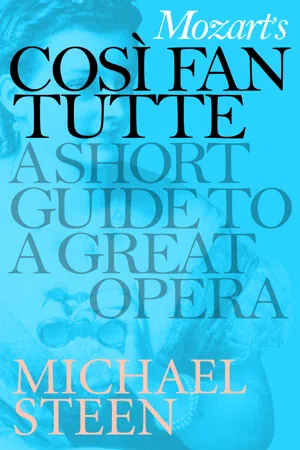
A couple of smooth army officers in metropolitan Naples become increasingly horrified as they find that they are losing their bet with a misogynist philosopher. The wager? That their fiancées will be faithful. Their disguise as Albanians in an attempt to entrap their fiancées, and the complicity of the naughty maid, who feigns as a lawyer organising their 'marriage', provide hilarious moments in an opera full of favourite tunes. Lorenzo da Ponte's libretto was long considered indecent and unsuitable to stage. But today it is regarded as providing one of the greatest illustrations of Mozart's art of musical characterisation, even if the story is somewhat politically incorrect. The ways in which Mozart's music contrasts the two 'provincial' sisters, Fiordiligi and Dorabella, and presents their capitulation, can justify his reputation as possibly the greatest classical composer of all time. Written by Michael Steen, author of the acclaimed The Lives and Times of the Great Composers, 'Short Guides to Great Operas' are concise, entertaining and easy to read books about opera. Each is an opera guide packed with useful information and informed opinion, helping to make you a truly knowledgeable opera-goer, and so maximising your enjoyment of a great musical experience. Other 'Short Guides to Great Operas' that you may enjoy include The Marriage of Figaro and Don Giovanni.
Information
Subtopic
Klassische MusikMOZART’S COSÌ FAN TUTTE
A SHORT GUIDE TO A GREAT OPERA
The opera and its composer
Who’s who and what’s what
The interval: talking points
Act by act
THE OPERA AND ITS COMPOSER
Così fan tutte – they’re all like that! Such generalisations about female behaviour may hardly seem a safe subject for the 21st century. Yet, ironically, Così fan tutte is among the most popular and widely performed operas in the repertoire today, and considered ‘the best of all Lorenzo da Ponte’s librettos and the most exquisite work of art among Mozart’s operas.’
Yet, almost within two years of its première in 1790, the German press attacked Così fan tutte, as absurd, frivolous and immoral. People were disgusted that Mozart could possibly have wasted ‘heavenly melodies on such a worthless libretto.’ And for a long time the standard view was that the libretto was ‘of rather doubtful character’. On the occasions when it was staged, it was often ‘improved’, even by its music being fitted to different words and action.
Da Ponte, then the Poet to the Imperial Theatres, himself rarely mentioned it later in his life, when he was so proud of his earlier association with Mozart which led to The Marriage of Figaro and Don Giovanni. Emperor Joseph II, the eccentric ruler of the Habsburg Empire, who micro-managed (as he did most things)1 the music performed at his court, has been blamed for the misogyny and the immorality in the plot. He found women difficult to handle: he is said to have looked at them in the way that people normally look at statues. He has long been held responsible for encouraging Da Ponte to write the libretto called La scuola degli amanti, ‘The School of Lovers’, which evolved into Mozart’s opera.
The eccentric Emperor may have suggested the story himself. Alternatively, it may have been based on an actual incident that had taken place recently. Whatever, Da Ponte seems to have drawn on the work of two distinguished playwrights, the Venetian Carlo Goldoni (1707–1793), and the Frenchman Pierre de Marivaux (1688–1763), the latter described as a specialist in ‘the coming to awareness of the state of being in love, particularly in young ladies.’
Da Ponte blended two themes which have a long history in literature: one in which the man wagers his lady’s fidelity of which he is (foolishly) convinced; and the other whereby a suspicious husband disguises himself as a stranger and tests his lady’s fidelity by attempting to woo her.
Da Ponte’s plot was unusual in that it was not based specifically on an existing play or story, nor some ancient or classical subject, and it did not involve royal or aristocratic characters in some way. Although obviously absurdly fictional, it was fundamentally about down-to-earth characters (people such as the composer, even), in ordinary surroundings and, importantly, wholly contemporary. The cast would be small: necessarily so, in view of a cost-cutting program that the Emperor was implementing.
Antonio Salieri, the more senior composer in the very hierarchical Viennese structure, and known to many as the villain of the film Amadeus, was offered the first crack at composing the opera, but gave up. Indeed Mozart’s widow later suggested that Salieri’s legendary hatred of her husband arose because Mozart took on this libretto, which Salieri ‘could make nothing of’ and had rejected as being unworthy of musical invention.2
At the time Mozart took on the commission in 1789, he seems to have been in surprisingly bad form. His creativity and rate of composition were dropping off. The public lost interest in his keyboard virtuosity, and his downward trajectory began. His cash flow had deteriorated and he was borrowing from a fellow freemason, most recently against the ‘security’ of his prospective fee. It is perhaps no coincidence that in the second half of the year, his louche wife, whom he adored, was enjoying the high life in Baden, the health resort some twenty miles to the south of Vienna. (Her behaviour, justifying his conclusion ‘così fan tutte’, caused him sufficient concern that he wrote to remonstrate with her about it.)
Mozart himself coined the title. He derived it from a snippet of melody and text from Act 1 of The Marriage of Figaro, the moment when Don Basilio, the reptilian music teacher, discovers the bedroom shenanigans involving the Count, Susanna and Cherubino.
Così fan tutte was premièred in the Vienna court theatre, the Burgtheater, on 26 January 1790. There was a star cast: Guglielmo was played by the ‘best comic singer in Europe’ Francesco Benucci, the original Figaro.
Unfortunately, less than a month later, after there had only been four performances, Mozart’s primary sponsor, Emperor Joseph, died. He went to his grave almost certainly without hearing Così fan tutte. The theatres were closed for court mourning until April. By the end of August, Così fan tutte had been performed ten times. But although it toured – for example in the British Isles – ‘it fell out of the repertoire’. Fifty years later, a distinguished critic in London dismissed it: ‘there is no hope for Così fan tutte on the stage as the work stands.’ It was occasionally staged, however, and some of its numbers featured in collections of Mozart’s popular tunes.
As is normal, the action is moved along by the use of ‘recitatives’, that is, ‘speaking in music’. Recitatives are in themselves an art form. Although they are very clever and witty, they result in the opera being long. A normal performance of Così fan tutte might run for two-and-three-quarter hours, even after the recitatives have been substantially cut (some would say ‘butchered’). The cuts mean that the audience misses music in which (many people feel) Mozart demonstrates his supreme art. They tend to be made especially in Act 2, by which time the story is obvious, and the words are less necessary. That is so, provided the singers’ diction is clear, because, as one great baritone has observed, in this opera ‘it is essential for the words to be clear, whatever the language used.’
To be successful, and to compliment Mozart, Così fan tutte also needs great elegance of style.
The Mozart family was employed in the service of the highly influential Archbishop of Salzburg, the local potentate where Wolfgang Amadeus Mozart was born on 27 January 1756.
From the age of six, he spent much time away on tour. His father Leopold needed to extract, while it lasted, the most value out of his son and daughter Wolfgang and Nannerl, who were both infant prodigies. When Mozart was seven, the family went on a three-and-a-half year European tour to London. Between the ages of thirteen and seventeen, Wolfgang went on three tours to Italy.
As an adult, his father wanted him to get a permanent and secure position, which he never did. He went to Paris in fruitless search of a job, accompanied by his mother, who died there. Later, aged 25, he left Salzburg and fell out with the Archbishop. This did not provide a good basis for his ambition to work as a freelance in the capital of the Habsburg Empire, Vienna. There, the challenge was to distinguish oneself from the many other competing composers. At first, Mozart was successful in this precarious existence.
He married Constanze Weber, whose sister had earlier rejected him. With Constanze, he had two sons. It seems she was a liability: she was often away at a health spa, and Mozart was very worried by her tendency to flirt. He got into debt, fell ill, died and was buried in a common re-usable grave. The cause of his death, on 5 December 1791, is not known, and has been famously attributed to Salieri, not least in a play by Pushkin, an opera by Rimsky-Korsakov and in Peter Shaffer’s drama Amadeus (1984). Mozart had worked himself to death: he spent almost a third of his 36-year life – 3,720 days – away from home. Yet the piled-up volumes of the ‘Mozart Edition’ on display in Salzburg measure over six feet high. BACK
WHO’S WHO AND WHAT’S WHAT
The story below is based on the libretto. Certain directors may amend opera stories to suit their production.
We are in the sensual South. Ferrando and Guglielmo, smooth army officers based in the metropolis of Naples, are betrothed to two sisters from the ‘provincial’ town of Ferrara in northern Italy.
Ferrando is betrothed to the flighty, superficial Dorabella; Guglielmo is betrothed to the high-minded, conscientious, earnest Fiordiligi.3
To the men’s annoyance, Don Alfonso, a crusty old misogynist and a philosopher of reason, has the temerity to question their ladies’ avowed fidelity and constancy. He wagers that, provided the men strictly cooperate with his arrangements, he will demonstrate the superficiality and fragility of these qualities.
Alfonso arranges that the officers will pretend to have been called up to go to war. The disguised Ferrando is then to return and seduce Guglielmo’s Fiordiligi; and the disguised Guglielmo will seduce Ferrando’s Dorabella. Despina, the pert, sexually experienced, insolent ladies’ maid, and the butt of the girls’ fury, encourages their infidelity.
The men reappear disguised as two Albanian nobles who threaten to poison themselves if their ardent love is not reciprocated. To their...
Table of contents
- Title page
- Copyright
- Contents
- PREFACE
- USING THIS EBOOK
- ABOUT THE AUTHOR
- MOZART’S COSÌ FAN TUTTE
- ACKNOWLEDGEMENTS
- NOTES
- Short Guides to Great Operas
Trusted by 375,005 students
Access to over 1.5 million titles for a fair monthly price.
Study more efficiently using our study tools.
Frequently asked questions
Yes, you can cancel anytime from the Subscription tab in your account settings on the Perlego website. Your subscription will stay active until the end of your current billing period. Learn how to cancel your subscription
No, books cannot be downloaded as external files, such as PDFs, for use outside of Perlego. However, you can download books within the Perlego app for offline reading on mobile or tablet. Learn how to download books offline
Perlego offers two plans: Essential and Complete
- Essential is ideal for learners and professionals who enjoy exploring a wide range of subjects. Access the Essential Library with 800,000+ trusted titles and best-sellers across business, personal growth, and the humanities. Includes unlimited reading time and Standard Read Aloud voice.
- Complete: Perfect for advanced learners and researchers needing full, unrestricted access. Unlock 1.5M+ books across hundreds of subjects, including academic and specialized titles. The Complete Plan also includes advanced features like Premium Read Aloud and Research Assistant.
We are an online textbook subscription service, where you can get access to an entire online library for less than the price of a single book per month. With over 1.5 million books across 990+ topics, we’ve got you covered! Learn about our mission
Look out for the read-aloud symbol on your next book to see if you can listen to it. The read-aloud tool reads text aloud for you, highlighting the text as it is being read. You can pause it, speed it up and slow it down. Learn more about Read Aloud
Yes! You can use the Perlego app on both iOS and Android devices to read anytime, anywhere — even offline. Perfect for commutes or when you’re on the go.
Please note we cannot support devices running on iOS 13 and Android 7 or earlier. Learn more about using the app
Please note we cannot support devices running on iOS 13 and Android 7 or earlier. Learn more about using the app
Yes, you can access Mozart's Così Fan Tutte by Michael Steen in PDF and/or ePUB format, as well as other popular books in Medien & darstellende Kunst & Klassische Musik. We have over 1.5 million books available in our catalogue for you to explore.