- 30 pages
- English
- ePUB (mobile friendly)
- Available on iOS & Android
eBook - ePub
About this book
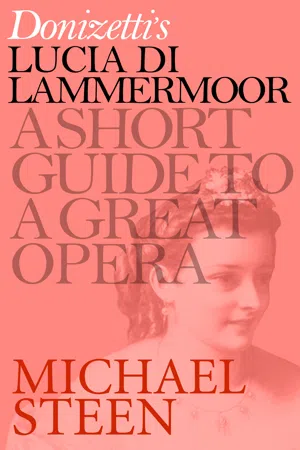
Sir Walter Scott's story of a Scottish girl forced by her family into an arranged marriage still resonates today, two centuries after it was published. Donizetti's opera, which premièred in Naples in 1835, is famous particularly for the Mad Scene when Lucia, after leaving for her nuptials, reappears having murdered the man she has just married, the unfortunate Arturo. She truly loves Edgardo, sworn enemy of her family, who turned up moments too late to stop the wedding.The story unfolds in diverse and sensational locations – a fountain haunted by a murdered woman, a ruined tower called The Wolf's Crag, and a graveyard where Edgardo – a part played by both Domingo and Pavarotti – hears of Lucia's death and stabs himself. Immortalised by such stars as Joan Sutherland, the role of Lucia herself provides an immense challenge for even the best of sopranos. Written by Michael Steen, author of the acclaimed The Lives and Times of the Great Composers, 'Short Guides to Great Operas' are concise, entertaining and easy to read books about opera. Each is an opera guide packed with useful information and informed opinion, helping to make you a truly knowledgeable opera-goer, and so maximising your enjoyment of a great musical experience. Other 'Short Guides to Great Operas' that you may enjoy include L'Elisir d'Amore, La Bohème and La Traviata.
Information
Subtopic
Classical MusicDONIZETTI’S LUCIA DI LAMMERMOOR
A SHORT GUIDE TO A GREAT OPERA
The opera and its composer
Who’s who and what’s what
The interval: talking points
Act by act
THE OPERA AND ITS COMPOSER
Donizetti composed his operas at a frantic pace, at the rate of five a year, and around 70 in all. His L’Elisir d’Amore had been composed in a couple of weeks. He is said to have composed Don Pasquale in eight days, or at any rate in less than a month. It took rather longer to bring Lucia di Lammermoor to the stage – about four months – but that was mainly because the theatre in Naples, the San Carlo, was virtually bankrupt. The Lucia, the ‘incomparable’ Fanny Persiani, one of the greatest sopranos, refused to rehearse until paid; and Donizetti himself almost went on strike.
The première of Lucia di Lammermoor was on 26 September 1835. Donizetti had composed the music as fast as his librettist, Salvatore Cammarano,1 the official ‘poet’ at the San Carlo, could write the words. Donizetti had begun work during the previous June. The score was finished on 6 July, but it was not until 20 August that it was finally accepted by the management.
Lucia di Lammermoor is the ‘archetype of Italian Romantic opera’, and it might almost be regarded as an absurd parody, if it were not for the extraordinarily effective and dramatic ‘Mad Scene’, in particular.
The Bride of Lammermoor by Sir Walter Scott, who had very recently died and whose novels were still the rage at the time, was used as a basis, although not in much more than outline. This was not the first time Scott’s story had been used: around six years earlier Paris had first seen a version of the story in an opera by a composer in the second division, Michele Carafa. Even before that, there had been a version in Denmark, in which the fairytale writer Hans Christian Andersen was involved.
As in the story of Romeo and Juliet, the lovers come from different sides of warring factions. Scott based his tale on an incident in the life of a top lawyer in Scotland, Lord Stair, from the Dalrymple family. His daughter had pledged herself to marry someone other than the person her family forced her to marry. She stabbed her bridegroom and was discovered, as Scott wrote, ‘dabbled in gore’.
Lucia was a great success. In Paris, one commentator reported that ‘it is a miracle; Donizetti has succeeded in electrifying the dead.’ It became one of the most universally popular operas of the nineteenth century. Great novelists have used it to colour dramatic moments in their works. It arises in Flaubert’s Madame Bovary when she is at the opera with her dull husband, and her former lover returns into her life. It features in Tolstoy’s Anna Karenina when the heroine, a fallen woman, caused a sensation and was snubbed in the opera house.
In England it was also a sensation and, although expensive to stage, it became a great standby. It was beloved of audiences but less acclaimed by critics. Indeed, it became sufficiently hackneyed that the playwright and critic Bernard Shaw became utterly fed up with it. He suggested that it needed some element of comic relief, such as a ‘highlander with a fling and a burlesque chorus to liven the precepts of Raimondo.’ Earlier a leading critic in London had taken a dim view: ‘Never was a story so full of suggestion for music tamed into such insipid nothingness, even by an Italian librettist, as this.’
The title role has attracted an unending succession of high sopranos. In the twentieth century, Joan Sutherland was perhaps the most famous exponent: her ability to sing her Mad Scene while running among the wedding guests greatly enhanced the effectiveness.
And he who sings Edgardo knows that he has the final scene, ‘the darling of tenor singers’, almost entirely to himself. Pavarotti, aged twelve, was inspired by Gigli singing Edgardo.2 And later, with Sutherland’s help, he himself made his American début in 1965 in the role, filling in for another tenor who had cancelled at the last minute. Three years earlier, Domingo had made his US début in the role of the unfortunate Arturo, and later went on to sing Edgardo opposite Lily Pons (who had sung opposite Gigli thirty years before that) and, of course, opposite Sutherland.
Whatever view one takes about the quality of the music, there is no doubting that Lucia can be great entertainment, a truly great show. It requires a star ‘coloratura’ performance from the soprano, and an excellent production. Lucia’s nuptial nightie needs to be suitably ‘dabbled in gore’, and the baronial hall, the fountain and the Wolf’s Crag suitably ‘gothick’. Oh, and the kilts need to be of suitable tartan.
Gaetano Donizetti was born into a poor family in Bergamo in the north of Italy in 1797. After an uncertain début, he settled in Naples. He had composed 30 operas by the time Anna Bolena made his name internationally in 1830. This was followed by L’Elisir d’Amore, Lucia di Lammermoor, La Fille du Régiment, La Favorite, Don Pasquale and many others no longer remembered.
He never really recovered from the death in July 1837 of his wife Virginia and their young children. He moved to Paris and later took a post in Vienna. He began to show symptoms of syphilis and acute sexual depravity. He was incarcerated in an asylum near Paris before being allowed to return, in an appalling state, to Bergamo for the nine months before his death in April 1848.
One of the greatest tenors of the era, Rubini, visited him at the end, and sang from Lucia. Donizetti indicated just a slight sign of recognition, and thus gave the onlookers grounds for some optimism that he might be recovering. But it was hopeless. BACK
WHO’S WHO AND WHAT’S WHAT
The story below is based on the libretto. Certain directors may amend opera stories to suit their production.
It is around 1700, a time when the Scottish Puritan Presbyterians have successfully opposed the Jacobite supporters of the exiled Roman Catholic King James.
Edgardo Ravenswood, a Jacobite, has been dispossessed by the Puritan family of Lucia Ashton, the girl he loves. Her family is headed by her brother Enrico. Because the wheel of fortune has moved, the family reputation and standing can only be salvaged if Lucia marries Arturo, Lord Bucklaw, a local grandee.
In Ravenswood park, Normanno, the evil captain of the guard, searches for an intruder who often has an assignation with Lucia. Enrico, who is accompanied by the chaplain Raimondo, is appalled to hear that this intruder might be Edgardo, his deadly and sworn enemy.
Lucia and Alisa, her lady-in-waiting, walk near a fountain haunted by the ghost of a woman who was murdered by her lover, a jealous Ravenswood. In the past, the ghost has appeared to Lucia and beckoned her towards the fountain, which was covered in blood. Lucia has come to warn Edgardo that her brother has returned to Ravenswood.
Edgardo tells Lucia he is leaving for France. She is concerned by his wish to make peace with Enrico, their bond sealed with her hand in marriage: she believes that this is fanciful and unsustainable. They pledge themselves to each other eternally, with rings.
In the castle, Normanno is confident that the wedding between Lucia and Arturo will go ahead. He has interfered with Lucia’s post and has interposed a forged letter indicating that Edgardo has fallen for another woman. This letter is produced to persuade the reluctant Lucia to marry Arturo. Raimondo, who has been on her side, also concedes that she must marry him. They tell the bridegroom that the bride may seem unenthusiastic because she is mourning her mother’s death.
At the moment the marriage contract is signed, Edgardo reappears. The emotions of the lead characters are depicted in the well-known sextet. Raimondo then intervenes to stop a fight developing. When Edgardo is shown the contract, he curses Lucia for breaking her pledge, and flings the ring at her. H...
Table of contents
- Title page
- Copyright
- Contents
- PREFACE
- USING THIS EBOOK
- ABOUT THE AUTHOR
- DONIZETTI’S LUCIA DI LAMMERMOOR
- NOTES
- Short Guides to Great Operas
Trusted by 375,005 students
Access to over 1.5 million titles for a fair monthly price.
Study more efficiently using our study tools.
Frequently asked questions
Yes, you can cancel anytime from the Subscription tab in your account settings on the Perlego website. Your subscription will stay active until the end of your current billing period. Learn how to cancel your subscription
No, books cannot be downloaded as external files, such as PDFs, for use outside of Perlego. However, you can download books within the Perlego app for offline reading on mobile or tablet. Learn how to download books offline
We are an online textbook subscription service, where you can get access to an entire online library for less than the price of a single book per month. With over 1.5 million books across 990+ topics, we’ve got you covered! Learn about our mission
Look out for the read-aloud symbol on your next book to see if you can listen to it. The read-aloud tool reads text aloud for you, highlighting the text as it is being read. You can pause it, speed it up and slow it down. Learn more about Read Aloud
Yes! You can use the Perlego app on both iOS and Android devices to read anytime, anywhere — even offline. Perfect for commutes or when you’re on the go.
Please note we cannot support devices running on iOS 13 and Android 7 or earlier. Learn more about using the app
Please note we cannot support devices running on iOS 13 and Android 7 or earlier. Learn more about using the app
Yes, you can access Donizetti's Lucia di Lammermoor by Michael Steen in PDF and/or ePUB format, as well as other popular books in Media & Performing Arts & Classical Music. We have over 1.5 million books available in our catalogue for you to explore.