What do Philip Pullman and J.K. Rowling have in common that has made both of their stories so successful? What does Pullman listen to while he writes – and who, or what, is Dust?
Pullman's award-winning trilogy
His Dark Materials has been appreciated by readers of all ages. It is now set to welcome new fans as it is adapted for television by the BBC, and his new trilogy at last sees publication.
Nicholas Tucker, a leading authority on children's literature, writes about the man he knows as a friend. Unpacking and examining Pullman's life and the sources he drew on for his masterpiece, he explores the world of science, theology, imagination and adventure that Pullman has created.
Including a personal interview with Pullman himself,
Darkness Visible offers a unique exploration of the author's work – and its controversies.
"Enigmas from
His Dark Materials are unraveled… Unmissable for all Pullman readers"
Sussex Express
- English
- ePUB (mobile friendly)
- Available on iOS & Android
eBook - ePub
About this book
Information
Subtopic
European Literary CriticismIndex
LiteratureHis Dark Materials
The Stories
Pullman’s great trilogy was written over a period of seven years and is around 1,300 pages long. Its cast ranges from scholarly Oxford dons to armoured bears, witches, angels, murderous Spectres and hideous harpies. It can be read at many different levels, from an adventure story to a parable about the essence of human nature and how this has been betrayed. As he puts it himself, it is also a story about what it means ‘to be human, to grow up, to suffer, and to learn’. It draws on a wide range of sources, from Ancient Greek myths, the Bible, Dante, John Milton and William Blake to Hollywood films, a Finnish telephone directory and the superstring theory developed from the study of quantum physics.
Partly arising from a suggestion by Pullman over lunch with his editor David Fickling that his next project might involve a re-writing of Milton’s Paradise Lost, the trilogy also draws on and develops themes and ideas found in his previous novels. Although it brings numbers of philosophical and scientific ideas into play, it is at base a work of imagination and should always be read as such. For Pullman, the story comes first before everything else, and he strongly believes that it is through stories that humans can best hope to understand both themselves and others. As a writer who has never gone in for too much forward planning, he also believes that as the story itself emerges, it always knows best, even when it may occasionally seem to be going in an unexpected direction. Sometimes the extra meaning implicit in what he has written, in terms of how it then goes on to inform what happens in the rest of the trilogy, has only become clear to him well after the event.
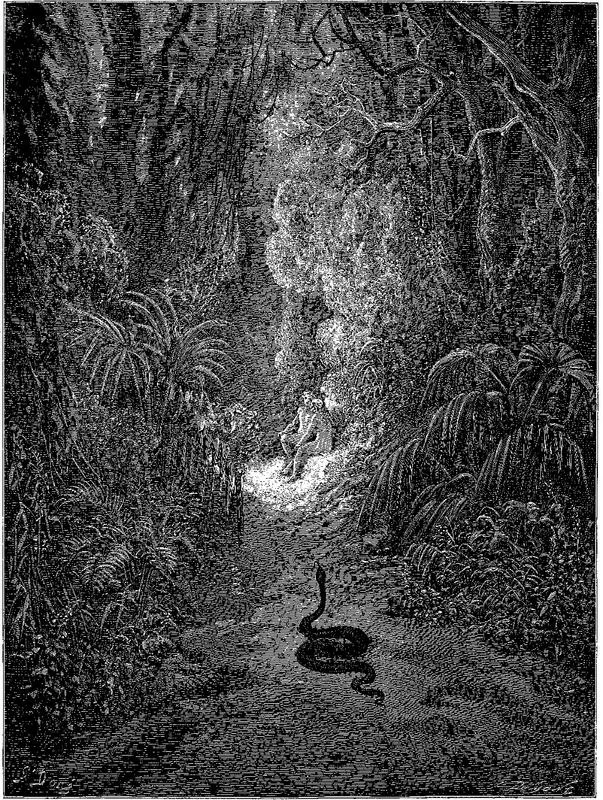
13. ‘Nearer he drew, and many a walk traversed / Of stateliest covert, cedar, pine or palm’. (IX 434–435) (Source: Doré’s Illustrations for ‘Paradise Lost’, Gustave Doré. Copyright © 1993 by Dover Publications, Inc.)
The basic plot of the trilogy describes how two children, Lyra and Will, manage to overcome forces of oppression to establish a new order based on truth, honesty and love. In so doing, they repeat the original decision of Adam and Eve to seek full understanding and consciousness by eating from the tree of knowledge. But this time the two children, in their own symbolic re-enactment of this original act of defiance, manage to defeat a Church establishment which is still intent on condemning their determined search for freedom as a wicked rebellion. Involving a whole universe of different human, animal and supernatural players inhabiting a number of parallel worlds, Will and Lyra also have to sort out some personal difficulties with their own parents. They must, too, make a final decision about their growing feelings for each other, when it becomes clear that it will not be possible for them to live together in the same world now made fresh and new by their joint victory.
Northern Lights
This story opens with eleven-year-old Lyra Belacqua, accompanied as always by her dæmon Pantalaimon. This is the inseparable, visible spirit that is part of every child in her particular world and can change into any sort of animal. Only later, when an individual turns adult, does the dæmon finally stay in a fixed form for the rest of their life. Lyra and her dæmon are creeping through the darkened main hall of Jordan College, Oxford.
As there is no such college, this is in a world which, as the author says, is ‘like ours, but different in many ways’. Overhearing a plot by the Master of the College to poison Lord Asriel, the man she believes to be her uncle but who is in fact her father, Lyra prevents him from drinking a fatal draught. After that, she hears Lord Asriel tell colleagues about his discovery of another world running parallel with this one and his determination to explore it. He also talks about Dust, the normally invisible particles that cluster around living beings. During the rest of the evening, the Master of the College is forced to give up his plans to stop Lord Asriel’s supposedly dangerous enquiries from going any further.
In the coming weeks, Lyra becomes aware that some local children have been mysteriously disappearing, including her particular friend Roger, a kitchen boy and the son of a college servant. She also makes the acquaintance of the glamorous Mrs Coulter, without knowing that Mrs Coulter is her mother. Mrs Coulter then plans to take Lyra with her on an exciting journey to the North. But before this happens, the Master of the College, in conditions of the greatest secrecy, presents Lyra with an alethiometer, which he hopes will help protect her from the terrible dangers Lord Asriel seems intent on drawing both himself and his daughter into. Once she has learned to read it, this device will provide her with honest and accurate answers to all the questions she puts to it.
Things soon turn sour with Mrs Coulter, when Lyra learns that she plays an important role in the Church’s General Oblation Board. This organisation has been supervising the kidnapping of children from Oxford and elsewhere. The children are then taken far North to Bolvangar, where Lord Asriel is being held captive as well. Lyra runs away to try to free him. She makes contact with John Faa, the leader of the Oxford Gyptians, some tough water gypsies with whom Lyra has had numbers of high-spirited disputes in the past. But everyone is united now in the determination to find the missing children, and Lyra joins an expedition setting out to rescue them. While she is with the Gyptians, she finally learns the truth about who her parents are after talking to John Faa and his aged companion, Farder Coram.
Once the group reaches Lapland, Lyra meets Iorek Byrnison, a talking, armoured bear. He tells them where the lost children are being kept, and how they are being cut away from their dæmons in a hideous operation known as intercision. The Gyptians also meet the American aviator Lee Scoresby. He is named by Pullman after the actor Lee Van Cleef, who appeared in a number of films with Clint Eastwood, and William Scoresby, a real-life Arctic explorer. They hire him and his balloon for extra back-up. Lyra becomes friends with Serafina Pekkala too, a witch queen who reveals Lyra’s own particular destiny, which is to bring an end to destiny itself. The witch’s surname was drawn by Pullman at random from a Finnish phone directory.
As they near their destination, Lyra is kidnapped by a band of Tartars who take her to the special camp which houses the lost children. Scientists hired by the Church Oblation Board are removing the dæmons from the children who have been rounded up before they can reach adolescence. The Church believes that dæmons help attract Dust to the individual concerned, and that this Dust is synonymous with original sin. But Pullman describes Dust instead as the essence of all accumulated human consciousness. It is attracted to adults rather than to children since older people are less innocent and more experienced. If a dæmon is cut away before a child enters puberty, then Dust would no longer be drawn towards the same child once turned adult. And without dæmons everyone becomes much tamer and more manageable, so providing the Church with no trouble when it comes to maintaining and extending what in this world still remained its traditional near-total control.
Hiding under an assumed name after she hears that her mother has arrived at the camp, Lyra meets up again with Roger. Mrs Coulter then rescues her daughter when Lyra is about to be forced to undergo the operation herself. But her mother also wants to get her hands on Lyra’s alethiometer. With the help of Iorek the bear plus an army of friendly witches headed by Serafina Pekkala, Lyra escapes with Roger in Lee Scoresby’s balloon. This is then attacked by hordes of cliff-ghasts: large, venomous creatures with leather wings and hooked claws. Crashing to earth, Lyra is captured by another tribe of bears who turn out to be hostile. Tricking them into allowing Iorek into their midst, Lyra sees her great friend beat his rival Iofur in single combat. He can now once again take up his rightful leadership of this particular kingdom of the bears.
Lyra then finds Lord Asriel in order to give him the alethiometer she thought he needed, though he can now do without it. In return, he tells her of the great battle that led to the Church condemning Dust as a manifestation of the original sin committed when Eve ate the apple from the tree of knowledge in the Garden of Eden. He now wants to travel to other worlds in order to trace the origin of all Dust. But when Lyra wakes up after a night’s rest, she finds that her father has departed, taking Roger with him. For in order to travel to another world, her father needs that flash of extra energy generated when a child is separated from his or her dæmon. Roger has been chosen to pay this heavy price. Too late to intervene, Lyra follows him and her father into another world, determined now to find out for herself what Dust is all about.
With an attempted murder in the first chapter, along with rumours of an imminent global war, Northern Lights gets off to a running start and maintains a fierce narrative pace to the end. Familiar conventions of children’s adventure stories abound, such as vital eavesdropping, kidnapping, rescues, last-minute escapes and hiding away to avoid capture. There are also some graphic fights involving victory over villainous-looking adversaries. Events on the emotional front are equally gripping, with a wicked mother pretending to be nice and a sulky father intent on getting his own way whatever the outcome. The main character, Lyra, who has to cope with all these situations is an immediately attractive presence, mischievous but brave, and at home within a wide social spectrum. Shrugging off any adult who tries to control her, she relishes the sort of independence denied to most children, who have always enjoyed reading about wild adventures within the consoling safety of their own homes.
If this were all, Pullman would have written a serviceable but unexceptional adventure story using well-grounded but familiar plot devices. But by introducing the concept of Dust early on he brings in a new and highly charged dimension, full of meaning but ambiguous at the same time. Lyra is understandably puzzled by this phenomenon but is determined to find out more about it. More ominously for her, it seems as if she has also been chosen by the fates, whatever they are, to bring about the end of destiny itself. The universe, as cranky Professor Jotham Santelia explains to her towards the end, ‘is full of intentions’. Never quite sure what these intentions might be, Lyra and her readers advance towards the second volume knowing there is still all to play for.
The Subtle Knife
The narrative starts with Will Parry, a twelve-year-old boy living in modern-day England. Following the disappearance of his explorer-father John on an expedition to the North, Will now has to look after his mentally ill mother. He is taking her to a place of safety after their house has been raided by two sinister men intent on stealing a case of letters and documents belonging to his father. Will foils them, but rightly fears he may have unintentionally killed one of the men.
Running away after leaving his mother in the care of a kind, older friend, he comes across an almost invisible window in the air while walking through the Northern suburbs of Oxford. Passing through it, he finds he is in Cittàgazze, literally the city of the magpies, which acts as a type of crossroads between millions of different worlds. It is an eerie, empty, Italian type of town, only inhabited by children because of the existence of ghost-like Spectres that have fed on all the adults there, leaving them as zombies. There he meets Lyra, also lost in this alien world.
Returning together to Will’s Oxford, Lyra meets Dr Mary Malone, a scientist working in the university’s Dark Matter Research Unit. Dark matter here is defined as the so-far undetected stuff that exists between stars and makes gravity work, and which makes up at least 90 per cent of the universe. Lyra tells her about Dust, and together the two are able to bring up on a computer screen some elementary particles that seem to have consciousness. Dark matter and Dust turn out to be one and the same thing, or as the angel Balthamos puts it later: ‘Dust is only a name for what happens when matter begins to understand itself.’
Lyra loses her alethiometer to Lord Boreal, a smoothtongued, dishonest collector. He will only give it back if she and Will bring him the very special knife that exists in the other, Italian, world. Returning to Cittàgazze, they finally capture the knife during a fight in the Torre degli Angeli, the Tower of the Angels, formerly occupied by the local Guild of Philosophers.
Will is wounded in the process, losing two fingers and then bleeding dangerously. Like many other traditional heroes, he has to pay a harsh price in acquiring the magical powers he needs. He soon manages to learn how to operate the knife, which is capable of cutting a window into another world at a moment’s notice. By now Will has read the letters his father sent home during his final expedition, where he too wrote about the windows that exist between worlds. Will decides that his father may still be alive, and resolves to find him. Back in Oxford, the two children use the knife to cut their way from one world to another, so allowing them access to Lord Boreal’s house, where they steal back the alethiometer. Lord Boreal is entertaining Mrs Coulter at the time, who is still anxious to find Lyra.
Meanwhile Lee Scoresby, the aviator, has met up with Stanislaus Grumman, who turns out to be John Parry, Will’s father and now a self-taught shaman. Grumman too has been investigating Dust, which was why the two hired men, acting on instructions from the Church, were trying to confiscate his papers at the start of the story. He also knows about the knife, though not that it is his own son who currently holds it. Grumman desperately wants to find whoever does have it, in order to tell him or her about the vital role it has to play in the future fate of the entire universe.
The soldiers of the Church surround Lee and shoot him dead after a prolonged gun battle. Will at last meets his father, who tells him that the knife is the only weapon capable of killing God himself. But just as they finally both recognise each other, John Parry is slain by the witch he once dared to scorn. Will is then told by two angels to find Lord Asriel, in order to help him in his great fight against the Church authorities. But Lyra meanwhile has disappeared, and Will wonders if he is ever going to see her again.
Evil in its blackest form again walks the land here, with ghastly Spectres not unlike the Dementors that haunt J.K. Rowling’s Harry Potter stories. In each case, they have the power to invade and destroy a person, rendering them into a zombie state. Evil is shown to exist in children too, with Lyra declaring to Will that she will never trust kids again, after seeing the young people of Cittàgazze torturing and killing a pet cat. In return, Will tells her about the time when his mentally ill mother was tormented by boys from his school.
For Will, this could be evidence that: ‘Maybe we do have the Spectres in my world, only we can’t see them and we haven’t got a name for them.’ Other explanations for the existence of evil in humans go back as far as the Bible and beyond. Pullman rejects theological theories as to why this should be, and is happy to describe various communities, such as the Gyptians, where harmony always prevails. He is also a lifelong admirer of Erich Kästner’s pre-war classic children’s tale Emil and the Detectives, where a group of street-wise Berlin children set about helping the more innocent country-born Emil track down the crook who has stolen his money. For Pullman, the main point in this junior self-help story is ‘that the children find the solution themselves, out of the everyday qualities they share: resourcefulness, quick wits, deter...
Table of contents
- Cover
- Title Page
- Dedication
- About the Author
- Acknowledgements
- Contents
- Illustrations
- Philip Pullman
- His Dark Materials
- Conclusion
- Bibliography
- Appendix
- On the Marionette Theatre
- Lyra ’s Oxford
- Once Upon a Time in the North
- Interview with Philip Pullman
- Copyright
Trusted by 375,005 students
Access to over 1.5 million titles for a fair monthly price.
Study more efficiently using our study tools.
Frequently asked questions
Yes, you can cancel anytime from the Subscription tab in your account settings on the Perlego website. Your subscription will stay active until the end of your current billing period. Learn how to cancel your subscription
No, books cannot be downloaded as external files, such as PDFs, for use outside of Perlego. However, you can download books within the Perlego app for offline reading on mobile or tablet. Learn how to download books offline
Perlego offers two plans: Essential and Complete
- Essential is ideal for learners and professionals who enjoy exploring a wide range of subjects. Access the Essential Library with 800,000+ trusted titles and best-sellers across business, personal growth, and the humanities. Includes unlimited reading time and Standard Read Aloud voice.
- Complete: Perfect for advanced learners and researchers needing full, unrestricted access. Unlock 1.5M+ books across hundreds of subjects, including academic and specialized titles. The Complete Plan also includes advanced features like Premium Read Aloud and Research Assistant.
We are an online textbook subscription service, where you can get access to an entire online library for less than the price of a single book per month. With over 1.5 million books across 990+ topics, we’ve got you covered! Learn about our mission
Look out for the read-aloud symbol on your next book to see if you can listen to it. The read-aloud tool reads text aloud for you, highlighting the text as it is being read. You can pause it, speed it up and slow it down. Learn more about Read Aloud
Yes! You can use the Perlego app on both iOS and Android devices to read anytime, anywhere — even offline. Perfect for commutes or when you’re on the go.
Please note we cannot support devices running on iOS 13 and Android 7 or earlier. Learn more about using the app
Please note we cannot support devices running on iOS 13 and Android 7 or earlier. Learn more about using the app
Yes, you can access Darkness Visible by Nicholas Tucker in PDF and/or ePUB format, as well as other popular books in Literature & European Literary Criticism. We have over 1.5 million books available in our catalogue for you to explore.